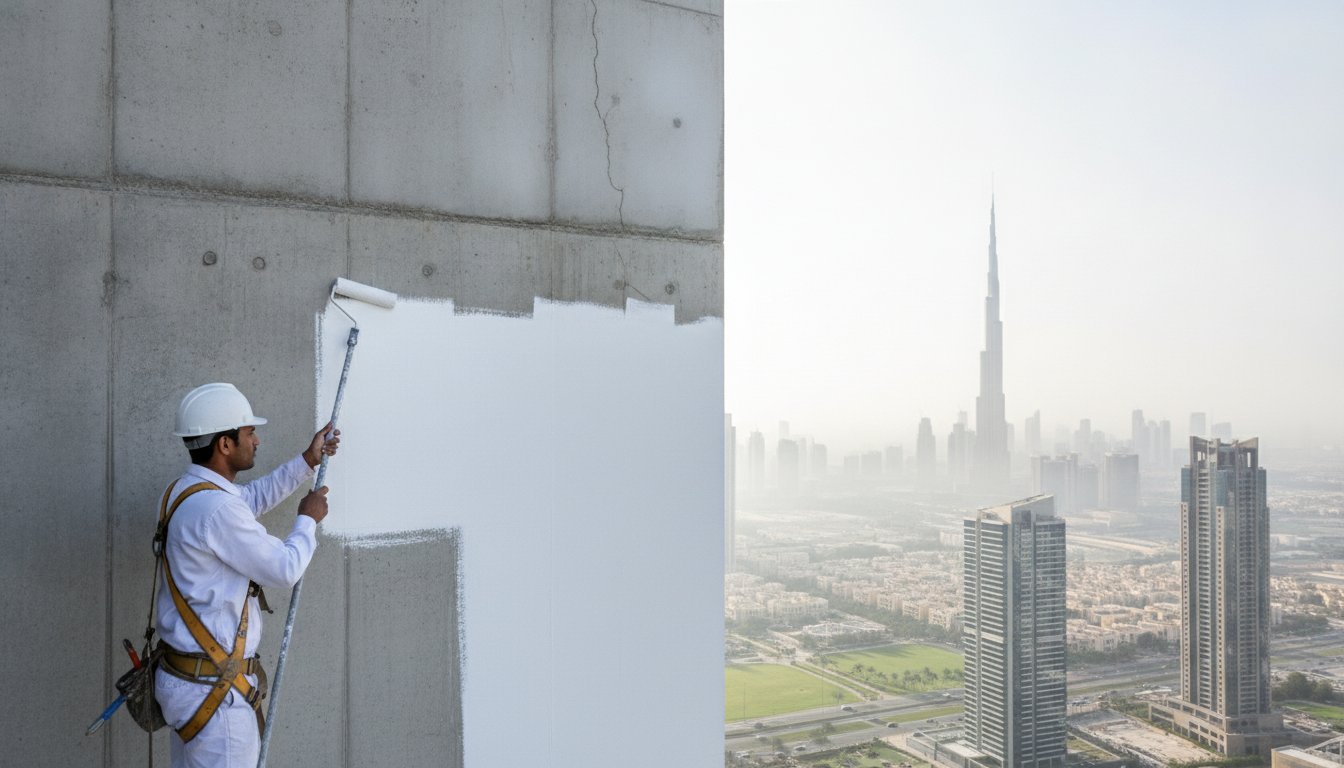
A building facade in Dubai is no longer just an aesthetic asset; under Law No. (3) of 2026, it’s a regulated structural component where neglect can lead to penalties reaching Dh1 million. We recognize the immense pressure property owners face when visible cracks and steel reinforcement corrosion begin to compromise high-rise integrity under the UAE’s punishing humidity and high carbon dioxide levels. The solution isn’t merely cosmetic. By utilizing specialized anti-carbonation paint for concrete, we can effectively block CO2 ingress and prevent the chemical shifts that lead to devastating structural decay.
In this article, you’ll learn how these advanced protective coatings safeguard reinforced concrete from the Middle East’s unique environmental stressors while ensuring full compliance with the latest Dubai Municipality safety standards. We’ll outline the technical advantages of elastomeric barriers, the necessity of professional application for long-term asset preservation, and the specific steps required to secure your building’s Quality and Safety Certificate for the coming decade. Our goal is to provide the technical clarity you need to transform maintenance challenges into a strategy for integrated excellence and extended building life.
Key Takeaways
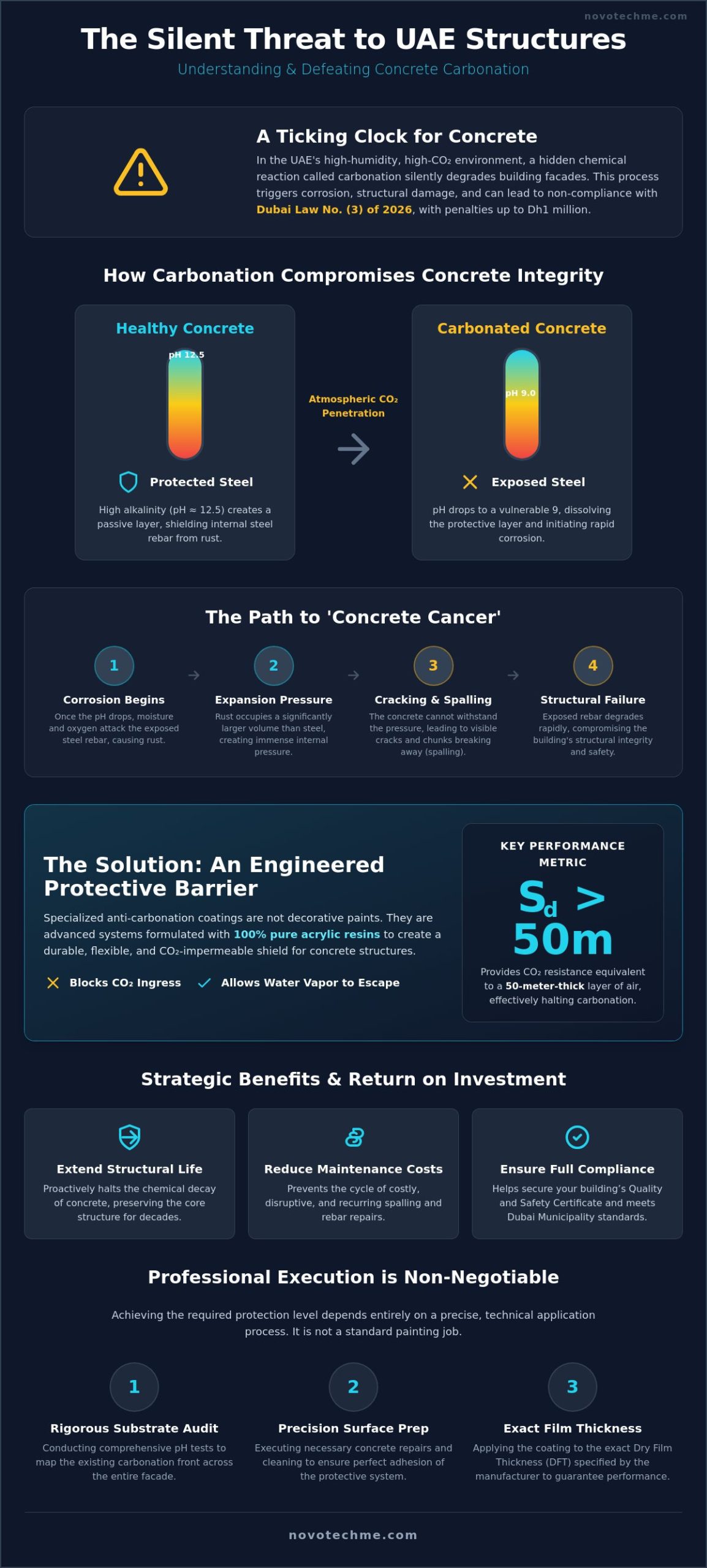
- Understand the chemical transition where carbonation lowers concrete pH from a protective 12.5 to a vulnerable 9, initiating rapid steel reinforcement corrosion.
- Discover how specialized anti-carbonation paint for concrete creates a CO2-impermeable membrane while maintaining breathability to prevent internal moisture entrapment.
- Recognize the strategic ROI of high-performance coatings in extending the structural service life of UAE high-rises and reducing recurring maintenance expenditure.
- Learn the technical requirements for a successful application, from conducting rigorous pH substrate audits to executing precision surface preparation.
- Identify why professional execution is vital to achieving the exact dry film thickness required to halt the silent threat of atmospheric carbonation.
Understanding Concrete Carbonation: The Silent Threat to UAE Structures
Concrete is often perceived as a permanent, inert material. It’s actually a porous substance that remains chemically active throughout its lifecycle. In the UAE’s rapidly expanding urban centers, atmospheric carbon dioxide gradually diffuses into these pores, triggering the process of carbonation in concrete. This reaction specifically targets the calcium hydroxide in the cement paste, converting it into calcium carbonate. While high-quality concrete begins its life with a highly alkaline pH of approximately 12.5, this chemical shift forces the alkalinity down to a vulnerable level of 9. This drop is a catastrophic turning point for reinforced structures.
Strategic asset management requires understanding that once this alkalinity is lost, the concrete can no longer protect its internal steel. Specifying a high-performance anti-carbonation paint for concrete acts as a critical shield, preventing the ingress of acidic gases. Without this barrier, the structural lifespan of a high-rise or villa is significantly shortened by the silent, invisible march of the carbonation front. Our technical approach focuses on arresting this decline before the structural core is compromised.
How Carbonation Causes ‘Concrete Cancer’
The primary defense mechanism for steel rebar is the ‘passivation layer’, which is a microscopic film of iron oxide that only exists in high-pH environments. When carbonation lowers the pH, this layer dissolves, leaving the steel exposed to moisture and oxygen. The resulting oxidation is a transformative process; rust occupies a significantly larger volume than the original steel. This expansion generates intense internal pressure that the concrete’s tensile strength cannot withstand. The carbonation front is the depth of CO2 penetration over time. Once this front reaches the reinforcement, the resulting ‘concrete cancer’ manifests as visible spalling, where large chunks of the facade break away, exposing the corroded metal beneath.
Environmental Stressors in Dubai and Sharjah
Infrastructure in Dubai and Sharjah faces some of the most aggressive atmospheric conditions in the world. Dense traffic corridors and industrial activity create localized zones of high CO2 concentration, which drastically increases the diffusion rate into exposed concrete facades. The UAE’s extreme thermal cycling also plays a destructive role. Daily temperature fluctuations cause the building’s skin to expand and contract; this movement eventually opens micro-cracks that provide a direct path for carbon dioxide to bypass the surface. Coastal buildings face an even more complex threat. They must withstand a dual assault of carbonation and chloride attack from saline humidity. For these structures, anti-carbonation paint for concrete isn’t an optional finish; it’s a fundamental engineering requirement for long-term stability.
What is Anti-Carbonation Paint? Engineering a Protective Barrier
Anti-carbonation paint for concrete is not a mere decorative finish; it is a sophisticated engineering solution designed to mitigate the chemical degradation of reinforced structures. While standard exterior paints focus on color retention and basic weatherproofing, these specialized coatings are formulated to provide a high degree of carbon dioxide diffusion resistance. The primary indicator of a coating’s performance is its Sd value. This coefficient measures the equivalent air layer thickness that would offer the same level of resistance to CO2 as the applied film. For a coating to be considered effective in the UAE’s high-CO2 urban environments, it must achieve an Sd value exceeding 50 meters, creating a formidable barrier against the Corrosion of reinforcement.
The chemical foundation of these systems typically relies on 100% pure acrylic resins. These binders offer superior UV stability and chemical resistance compared to the vinyl or styrene-acrylic blends found in retail-grade paints. This technical depth is why we emphasize protective painting systems that are specifically tailored to the harsh climatic demands of the region. By utilizing high-density resins, the coating forms a tight molecular matrix that blocks gas molecules while maintaining the flexibility required for long-term adhesion.
The Balance of Breathability and Impermeability
The engineering challenge of these coatings is the requirement for selective permeability. A high-quality system must be impermeable to CO2 molecules while remaining permeable to water vapor. This ‘breathability’ is essential to prevent the buildup of hydrostatic pressure behind the paint film. If moisture cannot escape from the concrete substrate, it leads to blistering, delamination, and eventually, the failure of the protective barrier itself. Technical standards for these coatings ensure that while the carbonation front is halted, the building’s natural moisture equilibrium remains undisturbed.
Crack-Bridging Properties for Structural Longevity
Elastomeric properties are another defining feature that separates these coatings from standard finishes. Structural concrete in the UAE is subject to significant thermal expansion and contraction due to the extreme temperature delta between day and night. Anti-carbonation paints are graded by their crack-bridging ability, ranging from Class A1 to A5. A higher classification indicates the coating’s capacity to remain intact even as micro-cracks open and close in the substrate. This elasticity ensures that the protective membrane remains continuous, preventing the carbonation front from finding an easy entry point through structural movement. This capability is vital for maintaining the integrity of buildings subject to the intense heat and thermal stresses found throughout Dubai and Sharjah.
Strategic Benefits and ROI of Anti-Carbonation Systems
The financial logic for applying anti-carbonation paint for concrete is rooted in asset lifecycle management. Rather than viewing facade maintenance as a recurring cost, forward-thinking property managers treat it as a capital preservation strategy. Scientific literature assessing anti-carbonation coatings confirms that these systems provide a multi-decade buffer against structural decay. By maintaining the alkaline environment around steel rebar, we eliminate the risk of catastrophic failure and ensure the building remains a viable long-term asset.
Compliance with Dubai Law No. (3) of 2026 has transformed protective coatings from an option into a requirement. The mandate for a Quality and Safety Certificate requires owners to provide evidence of structural integrity to Dubai Municipality. Documented use of anti-carbonation paint for concrete serves as tangible proof of a proactive maintenance regime. This level of preservation doesn’t just satisfy regulators; it significantly enhances property valuation by reassuring investors of the structure’s long-term health and safety.
Preventing Costly Structural Repairs
The ROI becomes clear when comparing the expense of a protective coating to the astronomical costs of concrete patch repair. Once carbonation reaches the rebar, the remediation process involves breaking out large sections of concrete, treating the steel, and applying structural mortars. These repairs are invasive and often exceed the cost of a protective system by a factor of ten. Early intervention through specialized exterior building painting dubai prevents this cycle of decay. It’s a strategic move that shifts the focus from reactive damage control to planned asset longevity.
UV Resistance and Color Retention
The UAE’s high UV index is notoriously aggressive on standard decorative finishes. Most retail paints chalk and peel within a few seasons because their binders degrade under solar radiation. Our systems utilize UV-stable acrylic resins that resist sun fading while maintaining their protective properties over time. Beyond aesthetics, high-reflectivity coatings can also reduce facade surface temperatures. This thermal management contributes to building energy efficiency, potentially lowering cooling loads during peak summer months and providing a secondary layer of operational savings.
Technical Selection and Application Standards
The success of any protective coating project rests on the precision of the initial substrate audit. Before applying anti-carbonation paint for concrete, we must assess the current state of the structure through carbonation depth testing and pH analysis. This typically involves using a phenolphthalein indicator solution on a fresh concrete core; a clear result indicates that carbonation has already occurred, whereas a pink hue confirms the presence of healthy alkalinity. If the carbonation front has already reached the reinforcement, the project must shift from simple protection to structural remediation before any coating is applied.
Quality control during the application phase is equally critical. To ensure compliance with the Sd values required for structural safety, applicators must consistently measure the Wet Film Thickness (WFT) using a comb gauge. This ensures the final Dry Film Thickness (DFT) meets the manufacturer’s specification for CO2 diffusion resistance. Airless spray application is generally preferred for large-scale infrastructure to achieve a uniform, pinhole-free membrane, whereas rollers may be utilized for detailed areas or where overspray is a concern. Achieving a consistent, specified thickness is the only way to guarantee the coating functions as a true engineering barrier.
Surface Preparation: The Foundation of Success
Applying a high-performance coating over a compromised surface leads to premature failure. Our technical protocol begins with high-pressure washing to remove laitance, dust, and any incompatible previous coatings. Any existing ‘concrete cancer’ must be mechanically removed and repaired with polymer-modified mortars. Finally, we conduct moisture content checks. Applying a barrier coating to a saturated substrate will trap water, leading to the osmotic blistering that compromises the entire system’s integrity. Proper surface preparation accounts for roughly 70 percent of the total coating performance.
Selecting the Right System: High-Rise vs. Villas
Engineering requirements vary significantly based on the structure’s profile. High-rise buildings in the UAE are subject to intense wind loads and structural swaying, necessitating coatings with superior elasticity and adhesion ratings. Conversely, for residential projects like our villa painting services sharjah, the focus shifts toward a balance of high-performance protection and refined aesthetic finishes. Environmental factors also dictate the schedule. During peak summer months, application must be timed to avoid direct sunlight on the wet film, which can cause flash drying and surface cracking.
For technical guidance on selecting the optimal protective system for your asset, contact our team to discuss our comprehensive protective painting systems.
Professional Execution: Why Specialized Application Matters
The chemical efficacy of anti-carbonation paint for concrete is only as reliable as the precision of its application. It’s a common industry failure to treat these high-performance systems like standard decorative coatings. When applied in layers that are too thin, the coating fails to establish the necessary CO2 diffusion resistance, allowing atmospheric gases to bypass the barrier entirely. We position ourselves as a strategic extension of your asset management team, ensuring that every micron of the protective membrane is verified to meet engineering specifications. Our technical competence transforms a simple painting project into a rigorous structural preservation exercise.
Integrating these advanced coatings into a broader property maintenance checklist uae is now a regulatory necessity under Dubai Law No. (3) of 2026. Leveraging 30 years of UAE experience, we understand how to navigate the specific environmental challenges that can compromise application, such as high-salinity humidity and extreme surface temperatures. We don’t just apply paint; we deploy a protective shield that has been calibrated for the Middle East’s most aggressive conditions.
Authorized Terraco Application Specialists
As authorized Terraco application specialists, we provide our clients with a level of certainty that retail contractors cannot match. This authorization ensures that every project utilizes Terraco’s climate-specific formulations, which are engineered to remain stable under the intense UV radiation of the UAE. Furthermore, using an authorized applicator is often a prerequisite for product warranty validity. Our partnership with Terraco gives us direct access to advanced technical support and site-specific system specifications, ensuring that the anti-carbonation paint for concrete performs exactly as the laboratory data suggests.
Comprehensive Project Ownership
Contact NovoTech for a professional concrete protection audit to ensure your asset remains compliant and structurally sound.
Future-Proofing UAE Infrastructure for the Next Decade
Securing the structural integrity of your property requires a transition from reactive repairs to a strategy of integrated excellence. We’ve explored how atmospheric carbon dioxide compromises the alkalinity of reinforced concrete, leading to the dissolution of the steel passivation layer. Implementing a high-specification anti-carbonation paint for concrete is the only scientifically proven method to halt this chemical decay and align with the stringent requirements of Dubai Law No. (3) of 2026. By treating your facade as a critical engineering component, you ensure both regulatory compliance and long-term asset appreciation.
As an Authorized Terraco Application Specialist with 30+ years of UAE engineering expertise, we provide the technical depth necessary to navigate the region’s aggressive environmental stressors. Our comprehensive high-rise maintenance solutions ensure that your asset remains a safe, compliant, and high-value investment. We take total ownership of the preservation process, from the initial substrate audit to the final quality inspection. Don’t wait for visible spalling to address structural vulnerabilities; proactive protection is always more cost-effective than structural remediation.
Request a Technical Consultation for Your Building’s Protection to secure your infrastructure today. We’re ready to serve as your dependable strategic partner in building safety.
Frequently Asked Questions
What is the difference between anti-carbonation paint and normal exterior paint?
Anti-carbonation paint for concrete is engineered specifically to block carbon dioxide molecules, whereas normal paint only provides color and basic moisture resistance. These specialized coatings possess a high diffusion resistance coefficient, known as the Sd value, which prevents the chemical shift that leads to steel corrosion. Standard decorative paints lack the molecular density and specific resins required to halt the carbonation front effectively.
How long does a professional anti-carbonation coating last in the UAE?
A professional coating typically lasts between 10 to 15 years in the UAE, provided the application follows strict technical standards. Factors like extreme UV exposure, proximity to the coast, and the quality of initial surface preparation influence this lifecycle. Regular inspections help identify any localized failures before they compromise the entire structural shield, ensuring the building remains compliant with safety regulations.
Can anti-carbonation paint be applied to old buildings with existing cracks?
Yes, it’s highly effective for older structures, but any existing structural damage must be remediated before application. We use elastomeric anti-carbonation paints with high crack-bridging capabilities to accommodate the building’s natural thermal movement. This prevents new micro-cracks from compromising the protective membrane as the structure expands and contracts during the intense heat of the day.
How much does anti-carbonation coating cost per square meter in Dubai?
Costs for protective coatings are determined by several technical factors, including the structure’s height, the current depth of carbonation, and the required surface preparation. Since every project has unique engineering demands, we provide customized quotes based on a detailed site audit rather than a flat rate. Factors like accessibility and substrate condition play a significant role in the final project valuation.
Is anti-carbonation paint breathable?
These coatings are specifically designed to be breathable, allowing internal water vapor to escape while simultaneously blocking external CO2 ingress. This selective permeability prevents moisture from being trapped behind the paint film, which would otherwise cause blistering and delamination. It’s a critical feature for maintaining the substrate’s moisture equilibrium and preventing internal structural rot.
Does anti-carbonation paint protect against chloride and salt attack?
High-performance anti-carbonation paint for concrete provides excellent protection against chloride and salt attack, especially for coastal infrastructure. The dense acrylic resin matrix acts as a physical barrier that prevents salt-laden moisture from reaching the steel reinforcement. This dual protection is essential for structures in the UAE that are exposed to both urban pollution and saline humidity.
How do I know if my building needs an anti-carbonation treatment?
Visible indicators include fine hairline cracks, rust staining, or concrete spalling on the facade. However, the only definitive way to assess the need is through a technical audit involving a phenolphthalein test to measure the carbonation depth. We recommend professional testing for any reinforced concrete structure older than ten years to ensure the passivation layer remains intact.
Is a primer necessary before applying anti-carbonation paint?
A primer is absolutely necessary to ensure maximum adhesion between the concrete substrate and the protective topcoat. The primer seals the porous surface, stabilizes the substrate, and creates a uniform foundation for the subsequent protective layers. Skipping this step often leads to poor film build and premature failure of the entire engineering system, leaving the concrete vulnerable.