Did you know that every د.إ1 deferred in building maintenance today typically escalates into د.إ4 of capital renewal costs tomorrow? In the harsh climate of the UAE, where humidity and extreme heat accelerate structural deterioration, the gap between a minor repair and a total overhaul closes faster than most realize. We understand that justifying a renovation budget to a board of directors is often the most difficult stage of any project. You’re likely facing skepticism from stakeholders who see a high price tag without seeing the invisible corrosion or salt-air damage behind the facade.
It’s frustrating when your technical assessment of a building’s health is met with demands for cost-cutting. You know that doing nothing is actually the most expensive option, yet quantifying that risk for non-technical stakeholders is a complex task. This 2026 strategic guide changes that dynamic. We’ll show you how to master the art of securing board approval by transforming renovation costs into strategic asset preservation and ROI-driven investments. By leveraging new Dubai building safety laws and predictive maintenance data, you’ll gain a clear framework for financial justification that ensures your full budget request is approved.
Key Takeaways
- Reframe maintenance as a hedge against capital depreciation to align with the board’s fiduciary focus on risk mitigation.
- Master a data-driven framework for justifying a renovation budget to a board of directors by leading with financial “whys” instead of technical “whats.”
- Quantify the “cost of doing nothing” by calculating the impact of UAE-specific environmental factors on structural integrity and long-term liability.
- Utilize a multi-option proposal approach to empower stakeholders with choices between immediate aesthetic updates and long-term asset preservation.
- Understand how specialized protective systems and authorized applicators provide a measurable ROI through reduced energy consumption and extended building lifecycles.
Understanding the Board Perspective: Fiduciary Duty and ROI
Boards operate on a different frequency than facility managers. Their primary mandate is fiduciary responsibility, which means protecting shareholder value and mitigating risk. When you’re justifying a renovation budget to a board of directors, you aren’t just asking for money to apply a fresh coat of paint. You’re presenting a strategy for capital preservation. Sophisticated investors understand that deferred maintenance isn’t a cost-saving measure; it’s a growing liability on the balance sheet. In the UAE, where sand and high salinity can compromise structural integrity, neglecting the exterior is a direct threat to the building’s Return on Investment (ROI) and long-term valuation.
Shifting the narrative from a “repair expense” to “Capital Improvement” (CapEx) is essential for approval. Expenses drain the budget, while CapEx investments improve the asset’s book value and extend its operational life. A high-quality renovation, such as applying protective painting systems or anti-corrosive solutions, serves as a financial hedge against the rapid depreciation common in Dubai’s climate. We’ve seen that boards are far more likely to approve budgets when they see the project as a move to stabilize the property’s market position rather than a simple aesthetic fix.
The Language of the Boardroom
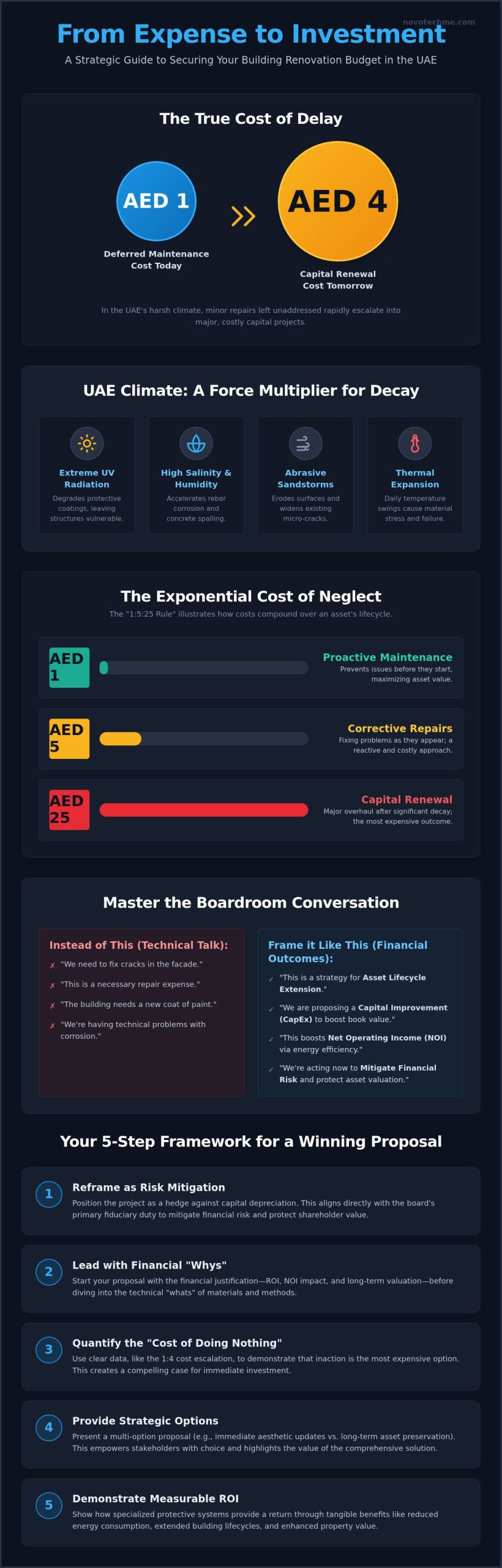
Success in the boardroom requires a shift in vocabulary. Don’t talk about “fixing cracks”; talk about “Asset Lifecycle Extension.” Frame the project in terms of its impact on Net Operating Income (NOI). For example, energy-efficient exterior finishes can lower cooling costs, which directly boosts NOI. By aligning your proposal with the organization’s strategic goals, such as sustainability or market leadership, you transform the renovation from an optional upgrade into a business necessity. We provide the technical data required to bridge this gap between engineering needs and financial outcomes.
Identifying Key Decision Makers
Each board member views the budget through a different lens. The CFO focuses on cash flow, depreciation schedules, and how the investment impacts the bottom line over five to ten years. Meanwhile, the COO prioritizes operational efficiency and wants to ensure that building maintenance doesn’t disrupt tenants or daily workflows. Finally, the Owner or Chairperson is often driven by brand prestige and market positioning. They want the property to remain a “Class A” asset that attracts high-value occupants. Addressing these specific concerns is the most effective way of justifying a renovation budget to a board of directors while securing the necessary د.إ allocation for the full scope of work.
The Financial Risk of Deferred Maintenance in the UAE
In the UAE, the environment is a constant adversary to structural longevity. Extreme UV radiation, high salinity near the coast, and abrasive sandstorms create a unique set of challenges that standard building materials aren’t designed to withstand indefinitely. The financial risk of deferred maintenance is compounded by these local conditions, where a small crack can lead to significant water ingress or salt-air damage within a single season.
We often cite the “1:5:25 Rule” to illustrate the compounding nature of building decay. This principle suggests that د.إ1 spent on proactive maintenance today prevents د.إ5 in corrective repairs later, which eventually escalates into a د.إ25 capital renewal cost if left unaddressed. When justifying a renovation budget to a board of directors, this exponential cost curve serves as a powerful argument for immediate action. It transforms the discussion from an optional spend into a critical move to prevent asset value erosion.
For high-rise structures, the danger is often invisible until it becomes critical. Concrete carbonation allows moisture and chlorides to reach the steel reinforcement, triggering rebar corrosion and structural spalling. A strategic repaint at the 5-year mark might cost a fraction of the price of the major structural overhaul required at year 10 once the building’s core is compromised. Demonstrating these long-term savings is vital when justifying a renovation budget to a board of directors.
Climate-Driven Asset Depreciation
Thermal expansion and contraction act as a silent killer for UAE facades. Surface temperatures can swing 40 degrees Celsius in a single day, causing micro-cracks that sand abrasion then widens. This cycle compromises protective coatings and leads to substrate failure far faster than in temperate climates. Utilizing anti-corrosive paint uae acts as a financial insurance policy, sealing the building envelope against these aggressive environmental factors and extending the asset’s lifecycle.
Regulatory and Safety Liabilities
Board members must also consider the legal landscape. Dubai’s Law No. (3) of 2026 mandates regular structural integrity checks for all buildings to ensure safety and quality standards. Neglecting these requirements doesn’t just invite government fines; it can lead to increased insurance premiums and reduced liability coverage. Proactive exterior building painting dubai ensures full compliance with civil defense standards while protecting the board from the massive emergency repair costs that follow a failure in building safety. Partnering with a specialist in regional coatings ensures your technical data is robust enough to withstand board scrutiny.
Quantifying the ROI of a Renovation Project
Securing approval requires moving beyond the “it looks better” argument. When justifying a renovation budget to a board of directors, you must present a multi-dimensional ROI model that encompasses both direct financial gains and indirect strategic advantages. Direct ROI is often found in increased rental yields and higher occupancy rates. In Dubai’s high-growth rental market, which saw a 17% increase in contract values during 2025, buildings that fail to modernize quickly lose their competitive edge to newer giga-projects. A renovated facade doesn’t just attract tenants; it justifies premium rates that directly impact the building’s valuation.
Energy efficiency is perhaps the most measurable component of modern ROI. Heat-reflective coatings are no longer a luxury in the UAE; they are a technical necessity. These systems can reduce energy expenses by up to 30% by significantly lowering the thermal load on HVAC systems. For a commercial tower, this translates to hundreds of thousands of د.إ saved annually in operational costs. We focus on these data-backed justifications because they speak the language of the board: net operating income and capital appreciation.
Property Value and Market Positioning
The perceived quality of a management team is often judged by the physical state of the asset. In prime districts like Downtown Dubai or Dubai Marina, the valuation gap between renovated and unrenovated properties continues to widen. High-quality finishes signal to the market that the asset is being managed with a long-term vision. This principle extends to the luxury residential sector as well. For instance, the demand for premium villa painting services sharjah is driven by owners who recognize that a superior exterior finish is essential for maintaining luxury market premiums and protecting the substrate from salt-air crystallization.
Operational Savings and Efficiency
High-quality initial renovations are the most effective way to reduce the annual maintenance budget over a 10-year period. This “Maintenance Avoidance” value is a critical metric for any CFO. Consider the impact of industrial-grade floor systems; installing a high-performance epoxy floor coating uae significantly reduces long-term cleaning costs and facility downtime while improving safety. Similarly, modernizing interior spaces with advanced gypsum work does more than update the aesthetics. It improves acoustic performance and thermal insulation, which has been shown to enhance employee productivity and tenant satisfaction. By presenting these granular efficiencies, you provide the board with the technical confidence they need to approve the full requested budget.
Building a Persuasive Board Proposal: A Step-by-Step Framework
The proposal is the bridge between technical necessity and financial approval. When justifying a renovation budget to a board of directors, your Executive Summary must lead with the financial “Why.” Boards don’t need to know the chemical composition of the paint; they need to know how the project protects the asset’s valuation and reduces future liabilities. We recommend a Multi-Option Approach, providing “Good, Better, and Best” scenarios. This strategy empowers the board to choose the level of investment that aligns with their current capital reserves while clearly seeing the trade-offs in long-term durability and ROI.
Visual proof is non-negotiable for securing high-value approvals. We use thermal imaging and comprehensive site audits to reveal invisible deterioration, such as moisture entrapment behind facades or heat leakage through degraded coatings. This data makes the “cost of doing nothing” tangible. When justifying a renovation budget to a board of directors, you must also address the project timeline. A phased plan demonstrates how we’ll maintain building access and minimize operational disruption, ensuring that tenant comfort isn’t sacrificed for structural integrity.
The Financial Modeling Section
A successful proposal includes a Total Cost of Ownership (TCO) analysis rather than just an initial quote comparison. You should present a break-even analysis showing when the renovation pays for itself through reduced energy bills and avoided emergency repairs. For instance, integrating data from specialist waterproofing companies in dubai can prove how a roof renovation prevents catastrophic structural damage to the upper floors. This protects the building envelope for a decade or more, turning a د.إ spend today into a massive saving over the next five years.
Risk Mitigation and Vendor Selection
Boards are naturally risk-averse. You can lower their perceived liability by selecting a certified Terraco applicator with a proven track record in the Middle East. Choosing a partner with 30 years of regional expertise ensures that the project follows stringent safety and quality assurance plans, which is vital for compliance with new Dubai building safety laws. We provide the technical documentation and historical performance data needed to make this vendor selection a secure choice for your stakeholders. If you’re ready to build a data-backed case for your property, contact us for a professional site audit and a comprehensive renovation proposal tailored to your board’s specific requirements.
Leveraging Specialized Expertise for Board Approval
Experienced board directors recognize that the lowest bid is often a significant red flag in the UAE’s high-stakes real estate market. In a region where humidity and salinity can destroy standard finishes in under 24 months, a “budget” quote usually signals inferior surface preparation or the use of non-specialized coatings. When you’re justifying a renovation budget to a board of directors, you must frame the selection of a premium contractor as a move to eliminate hidden liabilities. A lower initial price often masks the looming cost of a total substrate failure, which would require a second, much more expensive intervention within three years.
The trust factor is paramount in the boardroom. We’ve spent 30 years building a reputation as a dependable strategic partner for high-rise and villa renovations across the Emirates. This history provides the technical depth and operational reliability that boards require to feel secure in their decision-making. By presenting a case study of a successful Dubai high-rise renovation where specialized anti-corrosive systems prevented structural spalling, you demonstrate that the requested د.إ allocation is a calculated investment in asset longevity. Our role as authorized Terraco applicators further reinforces this, as it guarantees that the materials and application methods meet international standards for extreme climates.
Technical Justification through Quality Materials
Protective painting systems aren’t just about color; they’re about engineering a building’s envelope. High-performance materials, such as Terraco’s specialized coatings, create a breathable yet impermeable barrier against moisture and UV radiation. These systems can extend the “time to next renovation” by 50% compared to standard commercial paints. This technical superiority also applies to interior spaces. A professional office renovation dubai does more than modernize a floor plan; it utilizes high-value business descriptors and premium finishes to align a company’s physical environment with its brand prestige and market positioning.
The NovoTech Strategic Partnership
We don’t just provide a service; we act as an extension of your management team. Our technical audits and thermal imaging reports are designed to be integrated directly into your board presentation materials, providing the data-backed evidence needed for justifying a renovation budget to a board of directors. We take end-to-end responsibility for the project lifecycle, from complex gypsum ceiling work to high-rise external finishes. This holistic approach ensures long-term asset health with a partner who understands the granular details of the UAE landscape. By choosing a partner with three decades of regional experience, you provide the board with the peace of mind that their complex technical needs are in expert hands.
Securing Long-Term Asset Value in the UAE
Mastering the art of justifying a renovation budget to a board of directors requires a fundamental shift from discussing aesthetic costs to presenting a strategic investment in capital preservation. This guide has detailed how quantifying the ROI through energy efficiency and market positioning transforms a proposal into a business necessity. Focusing on the compounding financial risks of deferred maintenance in the UAE’s aggressive climate provides the board with the clarity needed to act before structural liabilities escalate.
Success depends on data-backed precision and the trust factor that only specialized expertise provides. With 30+ years of UAE renovation excellence and our status as authorized Terraco and anti-corrosive specialists, we possess a proven track record with Dubai high-rise boards. We don’t just apply coatings; we provide the technical depth required to ensure your building remains a Class A asset. It’s time to transition from reactive maintenance to strategic asset management.
Request a Technical Audit and Proposal Support from NovoTech to secure the professional backing your board demands. We’re ready to help you protect your property’s future with confidence and technical excellence.
Frequently Asked Questions
What are the most convincing ROI metrics for a renovation board proposal?
The most convincing metrics focus on Net Operating Income (NOI) and capital appreciation. Boards prioritize data showing how a renovation increases property valuation or reduces annual energy consumption by up to 30%. You should also present the “CapEx to Value” ratio, demonstrating how a specific investment in facade restoration correlates to higher rental yields and lower vacancy rates in competitive Dubai districts.
How do I handle a board that wants to defer maintenance to next year?
When a board suggests deferring maintenance, highlight the immediate legal and safety liabilities under Dubai’s Law No. (3) of 2026. Explain that delaying a project doesn’t just postpone costs; it exponentially increases them through structural decay. Presenting a risk matrix that shows how a د.إ1 repair today evolves into a د.إ4 capital renewal cost next year usually shifts the conversation from “if” to “how soon.”
Should I present multiple quotes or a single preferred vendor to the board?
Presenting three distinct options, Good, Better, and Best, within a single preferred vendor’s framework is often more effective than a raw comparison of unrelated quotes. This approach allows you to maintain control over quality standards while giving the board a sense of fiduciary choice. It’s essential to justify why a specific specialist was chosen based on their 30-year regional track record and authorized applicator status.
How does the UAE climate specifically affect my renovation budget requirements?
The UAE climate necessitates a higher allocation for specialized protective layers that standard budgets often overlook. High UV indices and salinity require anti-corrosive systems that prevent rebar oxidation and concrete spalling. When justifying a renovation budget to a board of directors, you must account for these environmental factors as non-negotiable technical requirements rather than aesthetic upgrades. This ensures the building envelope remains sealed against extreme thermal expansion.
What is the difference between CapEx and OpEx in building renovation?
Capital Expenditure (CapEx) refers to major investments that extend the life of the asset or improve its value, such as a full exterior protective painting system. Operating Expense (OpEx) covers day-to-day repairs and maintenance. Framing a renovation as CapEx is crucial because it allows the board to capitalize the cost on the balance sheet, spreading the financial impact over several years while immediately enhancing the building’s book value.
How can I prove that a higher initial renovation cost saves money long-term?
Proving long-term savings requires a Total Cost of Ownership (TCO) analysis. Contrast a low-cost solution that requires repainting every three years with a premium system that lasts a decade. When the board sees that the premium option reduces the frequency of mobilization costs, scaffolding rentals, and tenant disruption, the higher initial د.إ investment clearly emerges as the most fiscally responsible path for the organization’s long-term health.
What visual aids are most effective when presenting to a board of directors?
Thermal imaging reports and high-resolution site audit photos are the most persuasive tools for non-technical stakeholders. These visuals reveal invisible problems like heat leakage or moisture entrapment that data sheets cannot convey. Side-by-side comparisons of current deterioration against a rendered vision of the completed project help the board visualize the transformation, making the financial request feel like a tangible improvement to their asset portfolio.
How do I justify the use of premium coatings like Terraco over cheaper alternatives?
Justify premium coatings like Terraco by highlighting their performance specifications tailored for Middle Eastern heat and sand abrasion. Cheaper alternatives often lack the elasticity required to survive Dubai’s thermal swings, leading to premature cracking. Emphasize that using an authorized applicator provides a manufacturer-backed warranty, which significantly reduces the board’s liability and ensures the facade remains pristine for a significantly longer lifecycle while justifying a renovation budget to a board of directors.