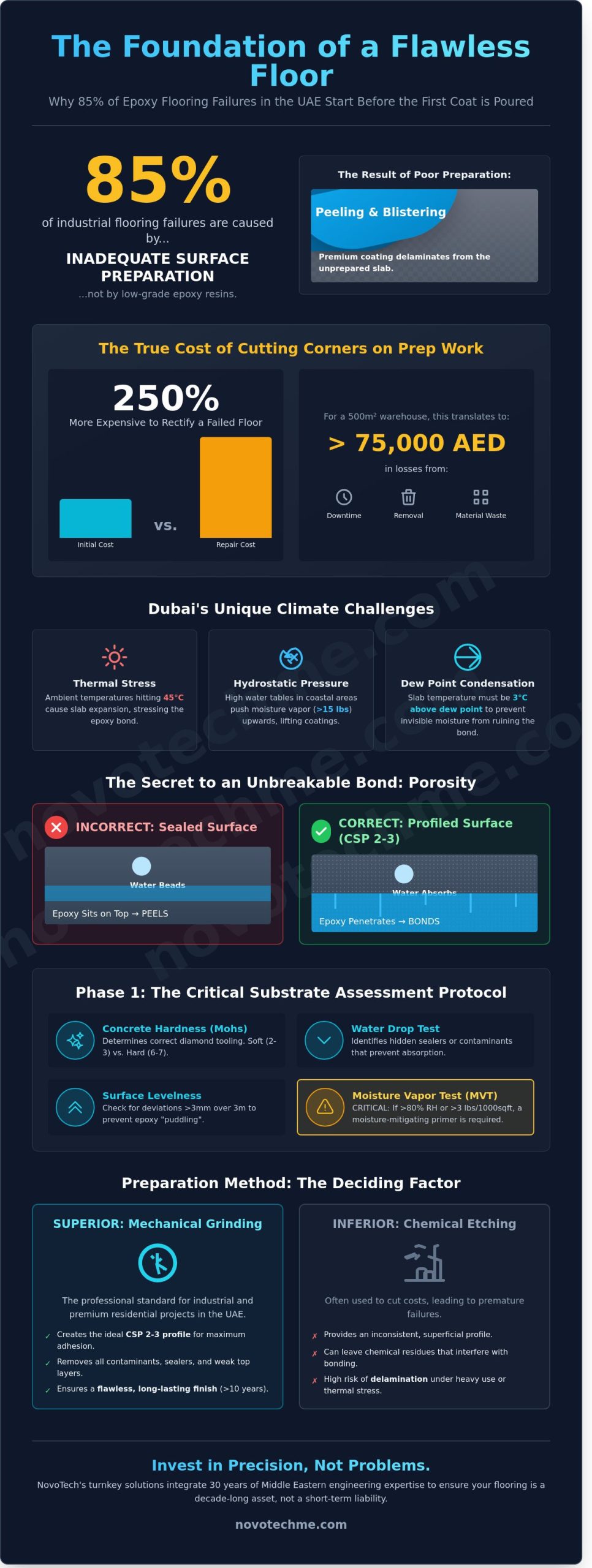
An estimated 85% of industrial flooring failures across the UAE aren’t caused by low-grade resins; they’re the direct result of inadequate mechanical profiling. You’ve likely seen the frustration of a premium coating that begins to bubble or peel because the concrete floor preparation for epoxy wasn’t executed to international standards. In Dubai’s specific climate, where ambient temperatures regularly hit 45°C, the bond between your slab and the coating is under constant stress.
By mastering the technical steps of professional substrate treatment, you’ll ensure your investment results in a flawless, showroom-quality finish that remains intact for over a decade. This guide details the mechanical grinding standards required for a CSP 3 profile, advanced dust management systems for residential renovations, and the exact moisture testing protocols needed to protect your 25,000 AED flooring project. We’ll provide the clarity you need to select a turnkey partner who prioritizes structural integrity and technical precision over quick aesthetics.
Key Takeaways
- Understand how Dubai’s extreme thermal cycles and high humidity impact epoxy adhesion and how to mitigate the risk of delamination.
- Identify the critical technical assessments, including the Mohs scale and Water Drop Test, required to evaluate substrate integrity before application.
- Learn why professional mechanical diamond grinding is superior to chemical etching for achieving a high-performance profile in UAE industrial projects.
- Master the essential stages of professional concrete floor preparation for epoxy to ensure a durable, seamless finish that withstands heavy use.
- Discover how NovoTech’s turnkey approach integrates 30 years of Middle Eastern engineering expertise into every bespoke flooring solution.
Why Concrete Floor Preparation for Epoxy is Critical in Dubai
Achieving a high-performance, durable finish starts long before the first gallon of resin is mixed. In Dubai’s demanding industrial and residential sectors, concrete floor preparation for epoxy represents the technical difference between a decade-long asset and a six-month failure. Adhesion relies on a mechanical bond where the resin penetrates the concrete substrate. Understanding what is epoxy? involves recognizing it as a thermosetting polymer that requires a specific Concrete Surface Profile (CSP) to anchor correctly. Without mechanical grinding or shot blasting to reach an International Concrete Repair Institute (ICRI) standard of CSP 2 or 3, the coating merely sits on the surface. This leads to immediate delamination under the weight of heavy machinery or vehicle traffic.
The cost of neglecting these steps is substantial. Rectifying a failed floor in the UAE often costs 250% more than a correct initial installation. You’re forced to pay for the mechanical removal of the failed coating, disposal fees, and the original application cost. For a standard 500-square-meter warehouse in Al Quoz, this financial oversight can result in losses exceeding 75,000 AED when factoring in operational downtime and material waste. Understanding the complete epoxy flooring cost in Dubai helps you budget appropriately for both the initial installation and potential remediation expenses.
The Role of Porosity in Epoxy Bonding
Smooth, power-troweled concrete is the primary enemy of resinous coatings. It lacks the “tooth” or open pore structure necessary for the primer to bite into the slab. We identify sealed concrete by performing a water drop test; if water beads on the surface, a curing compound or densifier is present. These barriers require aggressive mechanical removal. Opening the pores allows the resin to flow into the capillary structure of the slab, creating an unbreakable root system. If the concrete is “tight,” the epoxy can’t penetrate, leaving it vulnerable to peeling.
Environmental Factors in the UAE
Dubai’s climate introduces variables that don’t exist in temperate regions. In coastal zones like Dubai Marina and Jumeirah, high water tables lead to significant hydrostatic pressure. This moisture vapor can exceed 15 lbs per 1,000 square feet, forcing the epoxy to lift if a moisture barrier isn’t integrated. In the industrial corridors of Al Quoz, warehouse floors experience thermal expansion as internal temperatures fluctuate between 25°C and 48°C during summer cycles. We mandate strict climate control to maintain a substrate temperature at least 3°C above the dew point. This prevents invisible condensation from forming on the prepared surface, which would otherwise compromise the concrete floor preparation for epoxy and ruin the chemical bond.
Phase 1: Testing and Assessing the Concrete Substrate
Successful concrete floor preparation for epoxy begins with a rigorous audit of the existing slab. We start with the water drop test to detect invisible barriers. By placing beads of water across various zones, we observe absorption rates; if the water beads up rather than soaking in, a hidden sealer or heavy oil saturation is present. This indicates that mechanical grinding must be more aggressive to reach the porous concrete beneath. For high-gloss or metallic finishes common in premium UAE interiors, we also use a 3-meter straightedge to check surface levelness. Any deviation exceeding 3mm over a 3-meter span requires self-leveling underlayments to prevent “puddling” of the epoxy resin.
Selecting the correct abrasive tooling depends entirely on concrete hardness. We utilize the Mohs scale to determine if the slab is “soft” (rating 2 to 3) or “hard” (rating 6 to 7). Using the wrong diamond grit leads to glazed tools or excessive dust. Before grinding begins, we categorize every fissure. Hairline cracks are typically superficial, yet structural cracks wider than 3mm require deep-fill epoxy injections to ensure the slab moves as a single monolithic unit. Understanding these variables allows us to deploy proven concrete prep methods that match the specific mechanical needs of your facility.
The Crucial Moisture Vapor Transmission (MVT) Test
In Dubai villas and coastal commercial sites, moisture is the primary catalyst for osmotic blistering and coating delamination. We strictly adhere to the 3 lbs per 1,000 sq ft moisture vapor emission rate (MVER) limit for standard epoxies. To verify this, we perform Calcium Chloride tests (ASTM F1869) or utilize In-Situ RH probes (ASTM F2170) to measure internal slab humidity. If levels exceed 80% relative humidity, we must specify a specialized moisture-mitigating primer to prevent future failure. You can request a comprehensive flooring evaluation from our team to determine your slab’s specific moisture profile.
Identifying and Removing Contaminants
Residential garages and industrial workshops often harbor deep-seated oil and chemical stains that act as bond-breakers. Simple degreasing isn’t enough; we often employ centrifugal shot blasting to strip away the top layer of contaminated concrete. This process also removes laitance, which is the weak, milky layer of cement paste that rises to the surface during the curing of new concrete. We also look for curing compounds on new construction floors. These chemicals are designed to retain water during the drying phase but will prevent epoxy from penetrating the pores if they aren’t completely mechanically removed. Neglecting this step accounts for 75% of premature coating failures in new builds across the Emirates.
Mechanical vs. Chemical Preparation: Which is Right for You?
Selecting the correct methodology for concrete floor preparation for epoxy determines the long-term durability of the installation. While acid etching was once a standard practice, 95% of professional contractors in Dubai now favor mechanical preparation for indoor projects. Chemical etching often fails to achieve the necessary Concrete Surface Profile (CSP) and can leave residual moisture or salts that cause osmotic blistering. Mechanical methods provide a predictable, dry surface that adheres to the American Concrete Institute guidelines for high-performance coatings.
The International Concrete Repair Institute (ICRI) defines CSP levels ranging from 1, which is nearly smooth, to 9, which is very rough. For standard 2mm epoxy systems, a CSP 2 or 3 is required. Heavy-duty industrial screeds usually demand a CSP 5 or higher to ensure a mechanical bond. Achieving these profiles requires specialized machinery equipped with HEPA filtration to maintain air quality during residential renovations. This technology ensures 99.97% of silica dust is captured at the source. Using high-end vacuum systems ensures the concrete floor preparation for epoxy meets the strict health and safety standards required for occupied buildings in the UAE.
Diamond Grinding: The Gold Standard for Villas
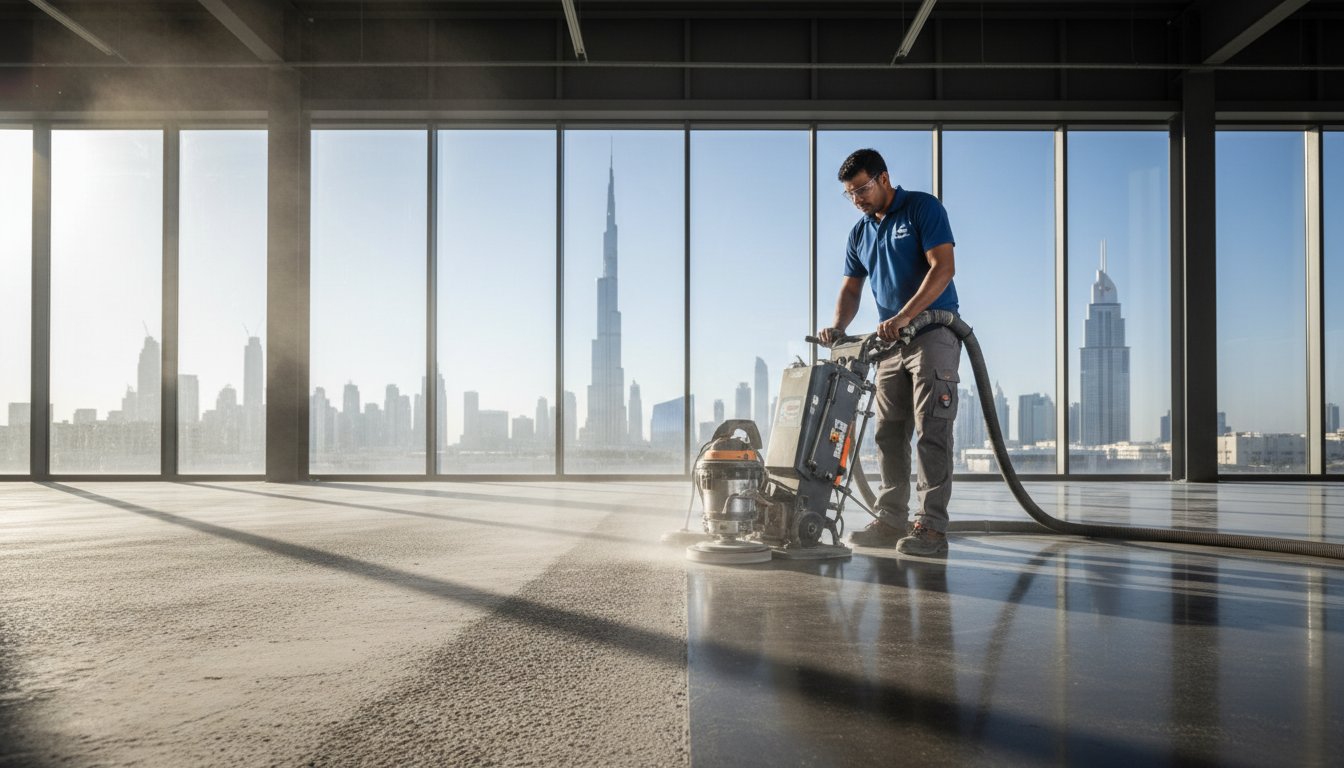
Planetary grinders utilize rotating heads to create a uniform, level surface ideal for residential villas and showrooms. These machines use diamond-segmented discs to remove laitance and open the concrete’s pores effectively. Technicians typically start with a 16 or 30-grit metal bond diamond for initial leveling, followed by finer grits depending on the primer’s viscosity. Edge grinding is a critical part of the process; 80% of coating failures occur at the perimeter where large machines can’t reach. Handheld grinders ensure these vulnerable points are sufficiently profiled to prevent future peeling.
Shot Blasting for Industrial Applications
In high-traffic Dubai warehouses exceeding 1,000 square meters, shot blasting is the most efficient choice for surface readiness. This process involves propelling steel shot at the floor to “profile” the surface by removing the top layer of weak concrete. It’s capable of reaching CSP 3 to 7 in a single pass, making it faster for large-scale logistics hubs. Shot blasting leaves distinct lap lines that can telegraph through thin-film coatings, so it’s best reserved for thick-build industrial systems. Small-scale residential settings rarely accommodate these large units because of their high power requirements and aggressive impact on the slab.
Step-by-Step Execution: The NovoTech Preparation Protocol
Achieving a seamless, industrial-grade finish requires a rigorous five-step workflow. We don’t settle for surface-level aesthetics; our protocol focuses on the structural integrity of the bond between the resin and the substrate. This systematic concrete floor preparation for epoxy ensures that the final surface can withstand the heavy load requirements of UAE logistics hubs and manufacturing plants.
- Step 1: Deep Cleaning: We utilize industrial degreasers to remove 99% of hydrocarbons and chemical residues. This is vital for slabs in older facilities where oil saturation is common.
- Step 2: Mechanical Profiling: Our teams use planetary diamond grinders to achieve a Concrete Surface Profile (CSP) of 2 or 3. This mechanical “tooth” is essential for resin adhesion.
- Step 3: Specialized Repair: We address every fissure using high-modulus epoxy fillers that match the slab’s compressive strength.
- Step 4: Technical Decontamination: We deploy industrial HEPA-filtered extractors to eliminate particles as small as 0.3 microns.
- Step 5: Moisture-Mitigating Primer: Given the high water tables in coastal areas like Dubai Marina or JAFZA, we apply a specialized primer to prevent osmotic blistering.
Repairing Cracks and Imperfections
Precision repair prevents future floor failure. We use V-groove diamond blades to cut into existing cracks, which creates a wider surface area for the resin to bond. In the UAE’s climate, thermal expansion is a constant factor. We select between rigid structural fillers for static cracks and flexible polyurea joints for expansion gaps. Every repair is sanded to a tolerance of less than 0.5mm. This prevents any “telegraphing,” where imperfections show through the glossy topcoat after curing.
Final Surface Decontamination
Dust is the primary enemy of a successful concrete floor preparation for epoxy project. Sweeping alone leaves micro-dust in the concrete pores. We execute a “tape test” by applying a 50mm strip of industrial adhesive to the floor; if any grey residue appears on the tape, the vacuuming cycle repeats. For sensitive environments like pharmaceutical labs, we perform a final solvent wipe using denatured alcohol. This ensures the surface is chemically receptive to the first coat of the primer system.
Ready to upgrade your facility with a high-performance surface? Request a technical site survey from our turnkey flooring specialists.
Turnkey Epoxy Solutions with NovoTech in Dubai
NovoTech maintains a 30-year legacy as a premier applicator across the Middle East. We deliver bespoke flooring solutions that cater to the specific demands of both luxury residential villas and heavy-duty industrial facilities. Our role as an authorized Terraco applicator means we utilize advanced materials engineered specifically for the UAE’s unique climate, where temperatures often exceed 40°C. We manage every phase of the project; we ensure the transition from initial preparation to the final high-gloss finish is seamless and technically sound.
Our methodology treats concrete floor preparation for epoxy as the most critical phase of the installation. We don’t settle for surface-level cleaning. Instead, we focus on the structural integrity of the substrate to ensure long-term bonding. By choosing a turnkey provider, you consolidate responsibility under one expert team. This approach ensures that the technical specifications of the primer, base coat, and topcoat align perfectly with the mechanical profile of your concrete slab.
Our Specialized Equipment Advantage
Precision requires industrial-grade tools. We utilize high-capacity planetary grinders to achieve rapid, 98% dust-free execution even on large-scale warehouse floors. These machines create the specific International Concrete Repair Institute (ICRI) surface profile needed for maximum resin adhesion. Our teams also deploy advanced moisture detection systems to verify that slab humidity levels are below the 4% threshold. This technical rigor, combined with professional training that meets Dubai Municipality safety standards, guarantees a durable result that resists delamination and osmotic blistering.
Get Started on Your Flooring Transformation
Successful projects begin with accurate data. We conduct a professional site survey to assess your floor’s compressive strength and identify underlying issues like deep oil contamination. This allows us to provide transparent, fixed-price project quotes in AED, so you won’t deal with unexpected costs mid-project. Our team delivers a comprehensive timeline that respects your operational requirements. Contact NovoTech for a Professional Epoxy Floor Consultation to secure a flooring system built on three decades of regional expertise and engineering excellence.
Secure Your Asset with Technical Floor Excellence
Success in Dubai’s demanding industrial landscape relies on the structural integrity of your facility’s surfaces. High-performance coatings fail without rigorous substrate testing and mechanical profiling. By identifying moisture levels and surface contaminants early, you eliminate the risk of delamination; you protect your capital investment from premature degradation. Our team integrates technical expertise with local environmental knowledge to deliver results that last.
Professional concrete floor preparation for epoxy isn’t just a preliminary step; it’s the foundation of your facility’s operational integrity. NovoTech brings 30+ years of UAE experience to every site. We function as your strategic partner rather than a standard vendor. As an authorized Terraco applicator, we provide turnkey industrial and residential solutions that meet the highest engineering standards. We’ve built our reputation on precision, ensuring every square meter of your floor is ready for heavy-duty operational use. For facilities requiring specialized coating systems, our comprehensive epoxy floor paint in Dubai guide provides detailed specifications for achieving optimal thermal shock resistance and chemical durability in extreme UAE conditions.
Book Your Professional Concrete Floor Assessment in Dubai
We’re ready to help you build a foundation that supports your long-term business goals with confidence.
Frequently Asked Questions
Can I just acid etch my garage floor instead of grinding it?
No, mechanical diamond grinding is the mandatory standard for professional-grade adhesion in the UAE. Acid etching often fails to achieve the required Concrete Surface Profile (CSP) of 2 or 3, especially on power-troweled slabs common in Dubai villas. Roughly 90% of epoxy failures result from inadequate surface prep that acid alone cannot fix. Grinding ensures the removal of laitance and deep-seated contaminants that chemical washes miss.
How long does the concrete preparation process take for a standard villa?
Preparation for a standard 400-square-meter villa typically requires 48 to 72 hours of active site work. This schedule includes 1 full day for heavy-duty diamond grinding and another 24 hours for meticulous crack injection and substrate patching. We follow a methodical sequence to ensure the foundation is structurally sound before any resin touches the surface. Rushing this phase compromises the entire project’s lifecycle.
Is it necessary to wait 28 days for new concrete to cure before epoxy?
Yes, you must wait a minimum of 28 days to allow the slab to reach its full compressive strength and release internal moisture. Applying coatings prematurely leads to osmotic blistering as moisture vapor tries to escape the sealed surface. We verify the slab’s readiness using calcium chloride tests to ensure the moisture vapor emission rate is below 3 lbs per 1,000 square feet. This patience prevents costly delamination later.
How do you manage dust during the grinding process in an occupied home?
We utilize industrial HEPA-filtered vacuum systems connected directly to our planetary grinders to capture 99.97% of airborne particulates. This closed-loop extraction system prevents dust from migrating into your living spaces or HVAC systems. Our team also installs 6-mil polyethylene barriers at all entry points to maintain a clean environment. You won’t need to worry about fine silica dust settling on your furniture or electronics.
Will epoxy cover up cracks and unevenness in my concrete?
Epoxy is a thin-film coating that mirrors the substrate, so it won’t hide structural defects without proper intervention. Comprehensive concrete floor preparation for epoxy involves filling every visible crack with high-modulus epoxy or polyurea fillers. We then grind these repairs flush with the surrounding floor. If your slab has deviations exceeding 3mm over a 3-meter span, we apply a specialized self-leveling compound to ensure a flat, mirror-like finish.
What is the best temperature for applying epoxy in Dubai?
The optimal temperature for resin application ranges between 21°C and 30°C. In the UAE’s extreme climate, we often perform work in climate-controlled environments or during early morning hours to prevent the epoxy from “flashing” or curing too rapidly. High humidity levels above 85% can also interfere with the chemical bond. We monitor ambient conditions and slab temperatures constantly to ensure the chemical reaction proceeds exactly as engineered.
How do I know if my concrete has a moisture problem?
We perform quantitative moisture testing using Tramex meters or ASTM D4263 plastic sheet tests to identify hidden dampness. If moisture levels exceed 4% by weight, the floor requires a specialized moisture vapor barrier to prevent future failure. Ignoring these readings is a risk that leads to repairs costing an average of 150 AED per square meter. Our technical team identifies these issues during the initial site survey to provide a turnkey solution.
Do you provide warranty for epoxy floors in high-traffic areas?
We provide a 5-year performance warranty on delamination and material defects for all high-traffic installations. This guarantee is directly linked to our rigorous concrete floor preparation for epoxy, which ensures a bond strength exceeding 250 psi. By acting as your technology partner rather than just a vendor, we take full ownership of the project’s durability. Our solutions are designed to withstand the heavy mechanical loads of commercial garages and industrial facilities.