In the demanding industrial landscape of the United Arab Emirates, the integrity of your critical assets is non-negotiable. Yet, the relentless combination of aggressive chemical exposure and extreme ambient temperatures means that substandard chemical resistant coatings uae frequently fail, triggering costly operational downtime, significant safety risks, and escalating maintenance budgets. This cycle of repair and replacement is an unsustainable drain on resources, threatening both profitability and regulatory compliance for facilities across the region.
This definitive 2026 guide is engineered to break that cycle. We deliver a comprehensive framework for industrial leaders and facility managers to confidently select, specify, and apply the optimal coating systems tailored to the unique environmental challenges of the UAE. Prepare to enhance asset longevity, ensure rigorous compliance with local standards, and secure a significant reduction in future maintenance costs, empowering your operations with a solution built for long-term resilience and excellence.
Key Takeaways
- Discover a systematic framework for specifying the complete coating system-primer, body coat, and topcoat-to ensure long-term asset protection.
- Gain a technical understanding of primary resin technologies, enabling you to select a solution based on performance characteristics rather than just features.
- Learn why meticulous surface preparation is critical to the success of chemical resistant coatings uae, especially in the region’s demanding industrial environments.
- Identify the primary chemical threats unique to the UAE’s industrial landscape and learn how to specify coatings that provide targeted resistance.
Understanding Chemical Resistant Coatings in the UAE’s Industrial Landscape
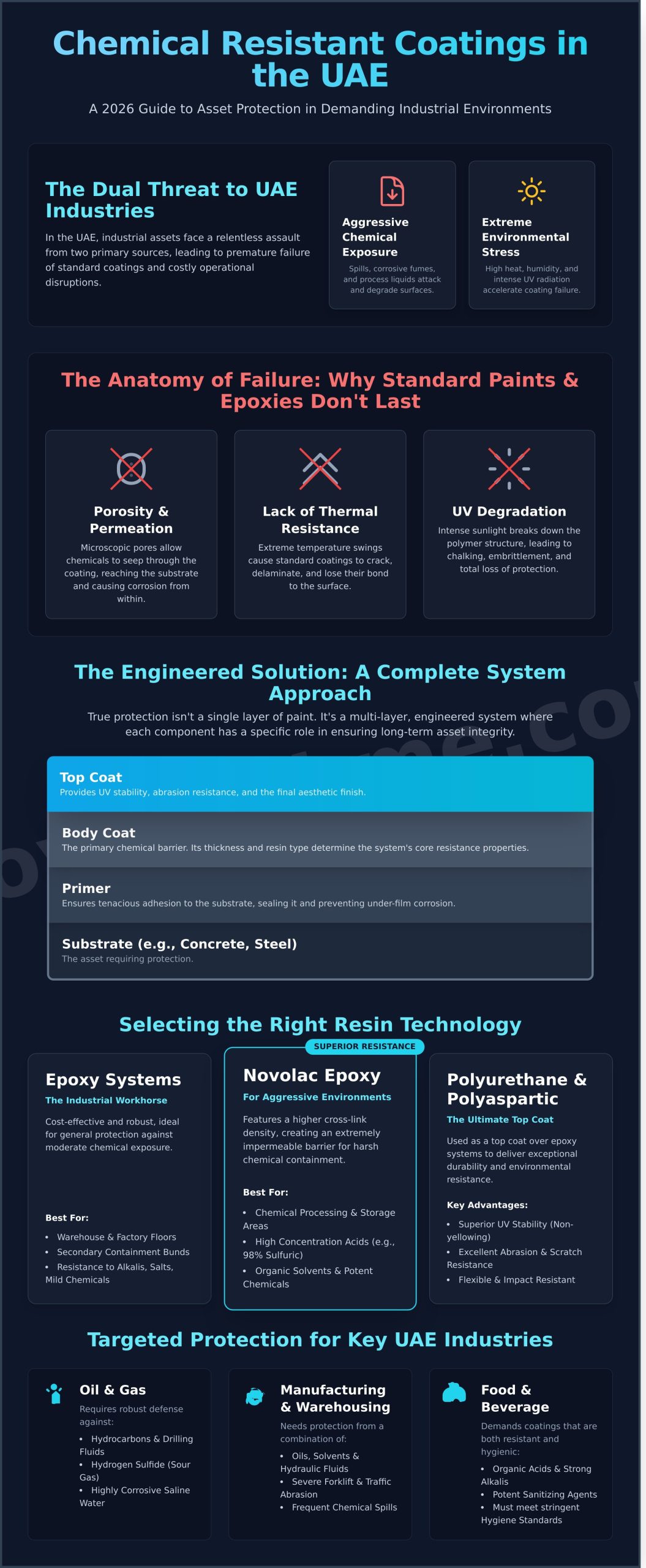
In the demanding industrial environments of the UAE, protecting critical infrastructure is paramount to maintaining operational integrity and safety. It is a common misconception to view chemical resistant coatings as a mere layer of paint. In reality, they are sophisticated, engineered protection systems designed to form an impermeable barrier between a substrate and a hostile chemical environment. Unlike standard decorative finishes, which primarily offer aesthetic value, these high-performance systems are formulated to withstand specific chemical attacks. For a foundational overview of their purpose, it is helpful to understand what is a coating in a broader industrial context.
The primary threats within the UAE’s industrial sectors-from Jebel Ali to Khalifa Industrial Zone-are multifaceted. They include direct chemical spills, exposure to corrosive fumes, and constant contact with aggressive process liquids. This chemical assault is significantly accelerated by the region’s unique and harsh climate. Extreme ambient heat, high humidity, and relentless UV radiation work in concert to weaken and degrade standard surface protection, leading to premature failure and costly asset damage. Selecting the right chemical resistant coatings in UAE facilities is not just a maintenance decision; it is a strategic investment in long-term operational resilience.
Why Standard Epoxy or Paint Fails
Conventional paints and standard-grade epoxies are fundamentally ill-equipped for the challenges of Dubai’s industrial zones. Their failure is typically rooted in three key vulnerabilities:
- Porosity and Permeation: These coatings possess a microscopic porous structure that allows aggressive chemicals to permeate through to the substrate, causing corrosion from within.
- Lack of Thermal Resistance: The extreme temperature fluctuations between daytime heat and cooled indoor facilities can cause standard coatings to crack and delaminate due to thermal shock.
- UV Degradation: Constant exposure to intense sunlight causes chalking, embrittlement, and rapid loss of protective properties, rendering the coating ineffective.
Key Industries in Dubai Requiring Specialized Protection
The need for bespoke chemical resistant coatings in UAE is critical across several core sectors, each with unique operational demands:
- Oil & Gas: Facilities require robust protection against hydrocarbons, hydrogen sulfide (sour gas), drilling fluids, and highly corrosive saline environments.
- Manufacturing & Warehousing: Floors and containment areas must withstand frequent spills of oils, solvents, and hydraulic fluids, combined with the severe abrasion from forklift traffic.
- Food & Beverage: Processing plants demand coatings that resist organic acids, strong alkalis, and potent sanitizing agents while meeting stringent hygiene standards.
Types of Chemical Resistant Coatings: A Technical Breakdown
Selecting the appropriate chemical resistant coating is a technical decision rooted in polymer science. The efficacy of a protective system is directly determined by its core resin technology, as each formulation offers a distinct performance profile against specific chemical agents, environmental stressors, and mechanical wear. Understanding these differences is paramount for ensuring long-term asset integrity. When specifying chemical resistant coatings in the UAE, it is crucial to move beyond surface-level features and analyze the fundamental capabilities of each system. Leading industry bodies, such as the American Coatings Association, provide comprehensive standards that underscore the importance of matching polymer chemistry to operational demands.
Epoxy and Novolac Epoxy Systems
Epoxy coatings are the established workhorse for industrial floor and wall protection. Standard bisphenol A epoxies deliver robust performance against alkalis, salts, and mild chemicals, making them an ideal and cost-effective solution for general-purpose applications like warehouse floors, manufacturing facilities, and secondary containment bunds. For more aggressive environments, Novolac epoxies provide a significant performance upgrade. Their higher cross-link density creates a far more impermeable barrier, offering superior resistance to concentrated sulfuric acid, organic solvents, and other potent chemicals often found in chemical processing and storage areas.
Polyurethane & Polyaspartic Coatings
While epoxies provide the chemical backbone, polyurethane (PU) and polyaspartic coatings deliver exceptional surface endurance. Their primary advantages are outstanding abrasion resistance and UV stability. This makes them the preferred choice for topcoats in a multi-layer system, protecting the underlying epoxy from mechanical damage and discoloration-a critical factor in the high UV-index environment of the UAE. Though their resistance to strong acids is moderate, they excel against oils, fuels, and hydraulic fluids, making them indispensable for high-traffic zones, automotive workshops, and aircraft hangars.
Vinyl Ester & Other High-Performance Linings
For the most severe service conditions, vinyl ester linings represent the pinnacle of chemical protection. These systems are engineered to withstand constant immersion in aggressive acids, caustics, and solvents, often at elevated temperatures. Their primary application is in the lining of chemical storage tanks, process vessels, wastewater treatment plants, and sumps where failure is not an option. The application of vinyl ester systems is a specialist task, often requiring fiberglass reinforcement and precise environmental controls to achieve a fully cured, seamless protective barrier.
| Coating Technology | Chemical Resistance | UV Stability | Abrasion Resistance | Relative Cost (AED) |
|---|---|---|---|---|
| Standard Epoxy | Good (Alkalis, Mild Acids) | Poor (Ambers) | Good | Moderate (د.إ) |
| Novolac Epoxy | Excellent (Concentrated Acids, Solvents) | Poor (Ambers) | Very Good | High (د.إد.إ) |
| Polyurethane / Polyaspartic | Moderate (Excellent for Fuels/Oils) | Excellent | Excellent | High (د.إد.إ) |
| Vinyl Ester Lining | Superior (Aggressive Chemicals, High Temp) | Good | Very Good | Very High (د.إد.إد.إ) |
Ultimately, the optimal choice is not about selecting the most expensive or robust system, but about deploying the precise technology engineered to counter the specific chemical threats present in your facility. A comprehensive chemical exposure analysis is the foundational first step in designing a durable and reliable protective coating solution.
How to Select the Right Coating System for Your UAE Facility
Selecting the correct chemical resistant coating is not a matter of choosing a single product, but of specifying an integrated, multi-layer system. A successful outcome depends on a methodical approach that aligns the primer, body coat, and topcoat with your facility’s unique chemical, operational, and environmental demands. The most durable chemical resistant coatings uae facilities depend on are those specified with precision from the substrate up.
Step 1: Identify the Chemical Exposure
The foundation of any coating specification is a precise inventory of the chemical agents present. A granular understanding is essential, as even minor variations can lead to premature system failure. We analyse:
- Chemicals and Concentration: Identify every chemical, its exact concentration (e.g., 98% Sulfuric Acid vs. 30%), and operating temperatures.
- Type of Exposure: Differentiate between full immersion (e.g., in a tank), frequent splash and spill (e.g., loading bays), or atmospheric fumes.
- Operational Context: A food processing plant in Dubai requires coatings resistant to citric acids and sanitising agents, whereas a petrochemical facility in Abu Dhabi needs protection against aggressive solvents and hydrocarbons.
Step 2: Assess the Operational Environment
Beyond chemical threats, the physical environment dictates system durability. The substrate and mechanical stresses must be factored into the specification to ensure long-term performance and compliance with local regulations, such as those set by Dubai Municipality. Key considerations include the substrate material (concrete or steel), expected mechanical stress from impact and abrasion, and the presence of heavy forklift traffic. The performance of the coating system is fundamentally linked to its application, which is why projects must be handled by certified coating applicators trained to meet international standards for surface preparation and installation.
Step 3: Match the System to the Need
With a comprehensive understanding of the exposure and environment, we can engineer the optimal coating system. We consult detailed Chemical Resistance Charts to cross-reference specific chemicals against polymer technologies. For complex chemical mixtures or unique operating conditions, direct consultation with a technical specialist is non-negotiable.
- Example – Dubai Warehouse Floor: A high-build epoxy base coat provides excellent adhesion and durability, while a polyurethane topcoat delivers superior abrasion resistance and UV stability for areas near loading doors.
- Example – Sharjah Chemical Plant Bund: For secondary containment areas exposed to aggressive chemicals, a high-performance Novolac Epoxy or Vinyl Ester system is specified for its exceptional resistance to a broad range of acids and solvents.
These examples illustrate the bespoke nature of system specification. To determine the optimal solution for your unique operational demands, request a complimentary site assessment to specify your coating system.
The Critical Role of Surface Preparation and Application
Selecting a high-performance chemical resistant coating is only the first step. The most advanced formulation will inevitably fail if the substrate is not meticulously prepared and the application is not executed with technical precision. Industry data consistently shows that up to 80% of all coating failures are a direct result of inadequate surface preparation, a factor that is magnified in the demanding environmental conditions of the UAE, where dust and ambient contaminants are a constant challenge.
A successful application is a systematic process built on three foundational pillars: thorough decontamination to remove oils and salts, mechanical abrasion to create a physical anchor for the coating, and strategic priming to seal the substrate and ensure optimal adhesion. Neglecting any of these stages compromises the integrity and lifespan of the entire protective system.
Best Practices for Concrete Surface Preparation
For concrete substrates, modern mechanical methods such as diamond grinding and shot blasting are vastly superior to outdated techniques like acid etching. These processes create a uniform and predictable Concrete Surface Profile (CSP), which is essential for strong mechanical bonding. Furthermore, given the region’s high humidity, comprehensive moisture testing is non-negotiable. The application of specialized moisture-tolerant primers is often a critical requirement to mitigate the risk of blistering and delamination caused by hydrostatic pressure.
Ensuring Quality Control During Application
Vigilant quality control during the application phase is paramount for achieving the specified performance. Our technical teams adhere to a stringent protocol that includes continuous monitoring and documentation of key parameters. This ensures the long-term success of chemical resistant coatings uae projects.
- Ambient Condition Monitoring: Continuously tracking air temperature, relative humidity, and dew point to ensure they remain within the manufacturer’s specified range.
- Material Verification: Ensuring correct mixing ratios as per the technical data sheet (TDS) to guarantee proper chemical cross-linking and curing.
- Thickness Measurement: Systematically checking Wet Film Thickness (WFT) during application and later verifying Dry Film Thickness (DFT) to confirm the protective barrier meets design specifications.
- Adherence to Curing Schedules: Respecting specified curing times before exposing the coating to service conditions, a critical step often accelerated by the high ambient temperatures in the UAE.
This disciplined, data-driven approach moves beyond simple application to engineered implementation, guaranteeing that your assets receive the robust, long-term protection they require. To discuss the technical specifications for your project, contact a NovoTech specialist.
Partnering with NovoTech: Your Expert Applicator in the UAE
Selecting the right coating is critical, but expert application is what guarantees performance and longevity. With over three decades of specialized experience in the UAE’s most demanding industrial environments, NovoTech transcends the role of a simple contractor. We are your strategic asset protection partner, ensuring that your investment in high-performance coatings delivers maximum durability and return on investment. Our established partnerships with leading global manufacturers, such as Terraco, provide access to proven, cutting-edge material science, specified and applied with unparalleled precision.
We understand that the integrity of your infrastructure is non-negotiable. That is why we deliver solutions, not just services, positioning ourselves as an extension of your team dedicated to safeguarding your most critical assets from chemical corrosion and environmental degradation.
Our Turnkey Project Management Approach
We deliver a comprehensive, end-to-end service designed for operational continuity. Our process begins with a meticulous site survey and technical assessment, leading to a bespoke specification tailored to your unique chemical exposure and operational conditions. From surface preparation to final application and handover, our project management ensures:
- Minimal Disruption: We schedule and execute projects to integrate seamlessly with your operational timelines.
- Uncompromising Safety: Strict adherence to world-class safety standards to protect your personnel and property.
- Regulatory Compliance: Full compliance with all local UAE environmental and construction regulations.
Proven Expertise in Demanding Sectors
NovoTech’s portfolio includes successful projects across the UAE’s key industrial sectors, from manufacturing and processing plants to logistics hubs and water treatment facilities. This deep, practical experience provides us with an intrinsic understanding of the specific challenges inherent to each industry. Our expertise in applying robust chemical resistant coatings UAE-wide ensures that your floors, tanks, and structural steel are shielded against corrosion, delivering durable, long-term value and operational reliability.
Protect your critical infrastructure with a partner dedicated to integrated excellence. Contact NovoTech today to discuss how our expert application services can fortify your assets.
Future-Proofing Your UAE Operations with Advanced Coating Systems
As this guide has detailed, the long-term integrity of your industrial assets hinges on a strategic approach to protection. Selecting the appropriate coating system requires a deep understanding of your facility’s specific chemical exposures and operational demands, while recognizing that flawless surface preparation and expert application are non-negotiable for achieving optimal performance and longevity.
Navigating the complexities of chemical resistant coatings uae demands a partner with proven regional expertise. At NovoTech, we leverage over 30 years of specialized experience within the Emirates to deliver turnkey solutions. As an Authorized Terraco Applicator and specialists in industrial epoxy and protective systems, we provide not just a product, but a comprehensive asset protection strategy tailored to your exact requirements.
We invite you to take the decisive step in safeguarding your critical infrastructure. Contact our specialists for a comprehensive asset protection plan. Let us partner with you to build a resilient, compliant, and highly productive operational future.
Frequently Asked Questions
What is the lifespan of a chemical resistant floor coating in Dubai?
The operational lifespan of a high-performance chemical resistant floor coating is engineered to last between 7 to 15 years, contingent upon several critical factors. These include the specific system selected (e.g., epoxy, polyurethane, or novolac), the intensity of chemical exposure, mechanical traffic, and the rigor of the maintenance protocol. In Dubai’s demanding industrial climate, a correctly specified and professionally installed system ensures maximum durability and return on investment, mitigating the need for premature replacement.
How long does my facility need to shut down for a coating application?
Facility downtime is meticulously managed to minimize operational disruption. A standard application typically requires a shutdown of 48 to 72 hours. This period accounts for surface preparation, primer and coating application, and initial curing to allow for light foot traffic. For projects requiring rapid return-to-service, we deploy specialized fast-curing polyaspartic systems that can reduce this timeframe significantly, enabling operations to resume in as little as 24 hours post-application.
Can you apply coatings to new concrete? What is the required curing time?
Yes, our coating systems are engineered for application on new concrete substrates. However, adherence to industry best practices is paramount for long-term performance. We require new concrete to cure for a minimum of 28 days to ensure it reaches sufficient compressive strength and allows excess moisture to evaporate. This curing period is critical to prevent delamination and blistering, guaranteeing a seamless and durable bond between the substrate and the protective coating.
Are chemical resistant coatings slippery? What anti-slip options are available?
The final surface texture is a key safety consideration. While high-gloss coatings can be slippery when wet, we offer a comprehensive range of anti-slip solutions tailored to your facility’s specific operational requirements. These include broadcasting aggregates like quartz or aluminum oxide into the wet coating or incorporating specialized texturizing additives. This creates a bespoke, slip-resistant profile that meets stringent HSE standards without compromising the floor’s chemical resistance or cleanability.
How much does a chemical resistant coating system cost per square meter in the UAE?
The investment for a chemical resistant coating system in the UAE typically ranges from 120 د.إ to 350 د.إ per square meter. The final cost is determined by a comprehensive assessment of factors including substrate condition, the required level of surface preparation, the specific coating chemistry (e.g., epoxy vs. novolac epoxy), and the desired thickness. We provide a detailed, transparent quotation following a thorough site evaluation to ensure a bespoke solution that aligns with your budget and technical needs.
What is the difference between chemical resistance and anti-corrosive paint?
While both serve protective functions, their core purposes differ significantly. Chemical resistant coatings are formulated to protect substrates, primarily concrete floors, from degradation caused by spills and exposure to specific acids, alkalis, and solvents. In contrast, anti-corrosive paints are engineered specifically to inhibit the oxidation process (rust) on metallic surfaces. While some systems offer dual properties, selecting the correct solution is critical and depends entirely on the substrate and the specific environmental threat.
How do I clean and maintain my new chemical resistant floor?
Maintaining your new floor is straightforward and essential for maximizing its lifespan. We recommend a routine cleaning schedule using a pH-neutral cleaner and mechanical scrubbers or mops. It is critical to clean chemical spills immediately according to your facility’s safety protocols to prevent prolonged exposure. We provide a detailed maintenance guide upon project completion, ensuring your team has the information needed to preserve the integrity of your investment in chemical resistant coatings uae.