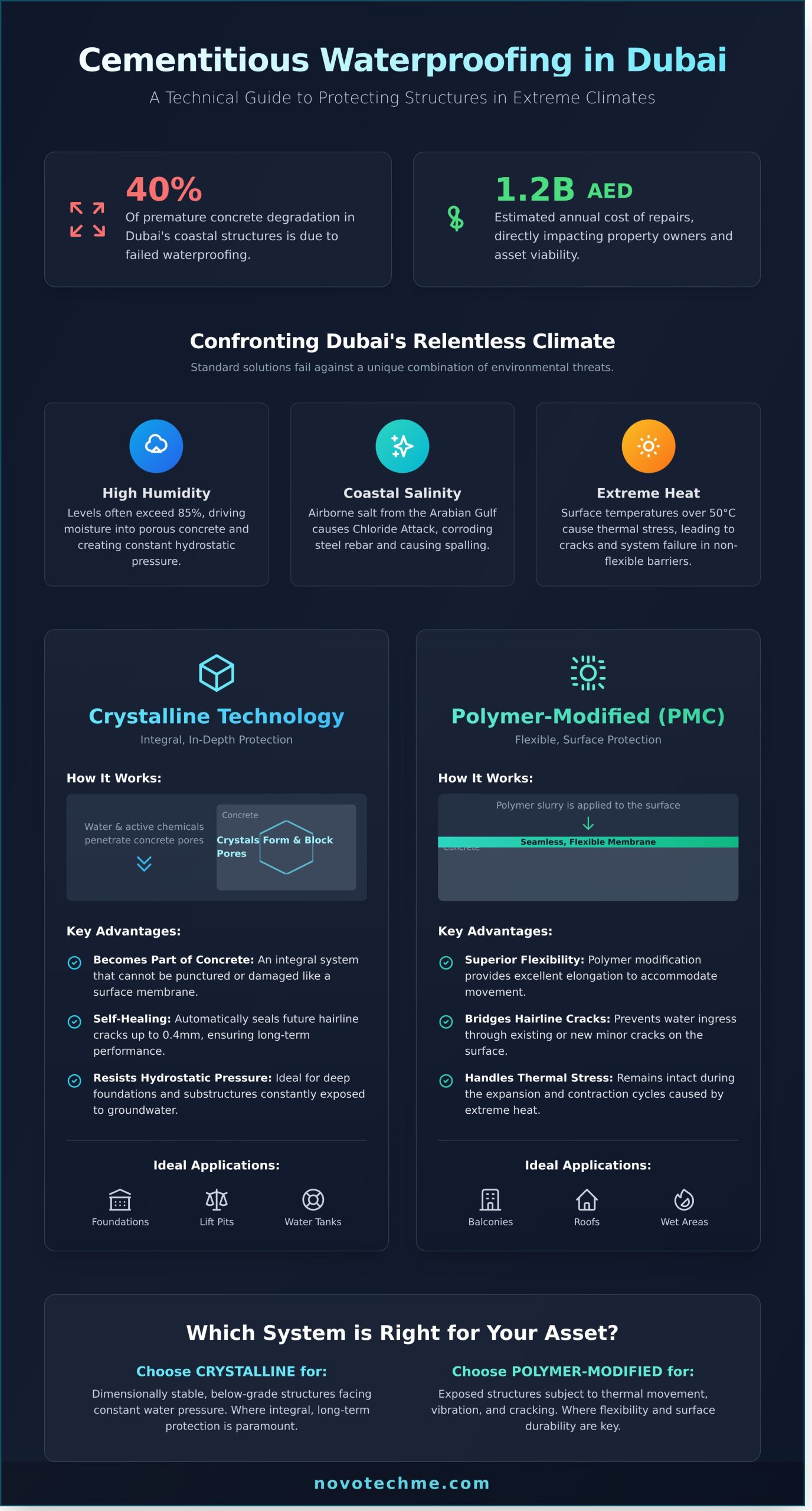
A 2024 analysis by the UAE Society of Engineers revealed that nearly 40% of premature concrete degradation in Dubai’s coastal structures is directly attributable to failed waterproofing systems, costing property owners an estimated 1.2 billion AED annually in repairs. You’ve likely seen the consequences firsthand: concrete spalling on balconies, persistent water ingress in basements, and the costly cycle of replacing failed membranes under the relentless UAE sun. These aren’t minor issues; they are direct threats to your asset’s structural and financial viability.
This definitive guide for 2026 moves beyond temporary fixes. We will demonstrate precisely how professional-grade cementitious waterproofing provides a seamless, monolithic barrier that delivers long-term structural integrity against extreme heat, salinity, and chloride attack. We’ll explore the technical specifications, application methods, and compliance standards necessary to protect your assets and ensure your project meets Dubai Municipality requirements for decades to come.
Key Takeaways
- Learn why Dubai’s unique climate-including high humidity and coastal salinity-demands specialized protection for concrete structures.
- Differentiate between crystalline and polymer-modified systems to select the optimal cementitious waterproofing solution for your specific application.
- Discover why precise substrate preparation, meeting the “Saturated Surface Dry” (SSD) standard, is non-negotiable for system longevity in the UAE.
- Evaluate the long-term ROI of professional application versus the high cost of future structural repairs from water ingress and chloride attack.
Understanding Cementitious Waterproofing in Dubai’s Extreme Climate
In the demanding environment of the United Arab Emirates, protecting a structure’s concrete foundation isn’t just a recommendation; it’s a critical engineering requirement. Cementitious waterproofing provides a robust solution, functioning as a breathable, cement-based coating that cures to form a seamless and monolithic moisture barrier. Unlike simple paints or surface sealers, this system becomes an integral part of the concrete itself, delivering durable protection against the region’s unique environmental threats.
Dubai’s structures face a relentless combination of challenges. Summer humidity levels frequently exceed 85%, rising groundwater tables exert constant hydrostatic pressure on substructures, and the coastal salt spray in districts like Jumeirah and Dubai Marina accelerates material degradation. A comprehensive waterproofing strategy is essential for asset longevity. The technology behind these systems involves polymer-modified slurries that chemically bond with the concrete substrate at a molecular level. This deep integration seals capillaries and micro-cracks, effectively preventing water ingress while maintaining structural integrity. For a general waterproofing overview, it’s clear that integral systems offer superior performance over simple membranes in these conditions.
A critical attribute of high-performance cementitious coatings is their breathability. In the UAE, concrete surfaces can reach temperatures exceeding 50°C, causing trapped moisture within the slab to turn into vapor. A completely impermeable barrier would trap this vapor, leading to blistering, delamination, and eventual system failure. Cementitious systems are engineered to be microporous. They possess a pore structure fine enough to block liquid water molecules yet large enough to allow water vapor to escape. This balance is fundamental to preventing long-term damage and ensuring the longevity of concrete in an extreme climate.
The Threat of Chloride Attack and Carbonation
Airborne salt from the Arabian Gulf carries aggressive chloride ions that readily penetrate porous concrete. Once these ions reach the steel reinforcement within the slab, they initiate a corrosive reaction. Chloride Attack is the primary cause of structural spalling in the UAE. A professionally applied cementitious barrier creates a low-permeability shield, significantly reducing chloride ion ingress and preventing the catastrophic rebar corrosion that compromises a building’s structural framework.
Rigid vs. Flexible Cementitious Systems
Choosing the correct system is paramount. Rigid cementitious coatings are highly effective for dimensionally stable structures with no risk of movement, such as internal water tanks, reservoirs, and elevator pits. However, for most applications in Dubai, flexible systems are a necessity. These advanced, polymer-modified coatings possess superior elongation properties, allowing them to bridge hairline cracks and accommodate the thermal expansion and contraction cycles driven by Dubai’s 50°C summer heat, ensuring the waterproof barrier remains intact.
Technical Composition: Crystalline vs. Polymer-Modified Slurries
Understanding the technical composition of a waterproofing system is fundamental to its successful application. While both Crystalline and Polymer-Modified systems fall under the umbrella of cementitious waterproofing, they operate on entirely different principles. The selection process isn’t about which is better, but which is precisely engineered for the specific structural and environmental challenge at hand. Polymer-Modified Cementitious (PMC) coatings are typically two-component systems, combining a liquid polymer resin with a specialized blend of cements, graded aggregates, and proprietary additives. This combination creates a robust, flexible membrane. Crystalline technology, conversely, works from within the concrete itself.
The Science of Crystalline Waterproofing
Crystalline waterproofing technology offers a unique, integral solution. Instead of forming a surface barrier, it leverages the inherent moisture within concrete to trigger a chemical reaction. Active chemicals in the product penetrate deep into the concrete’s capillary tracts and pores. In the presence of water, these chemicals react to form a non-soluble, needle-like crystalline structure. This growth effectively plugs the voids, rendering the concrete itself impervious to water penetration. A key advantage is its self-healing capability; if new hairline cracks form (typically up to 0.4mm), any subsequent moisture will trigger new crystal growth to reseal the gap. This makes it ideal for below-grade structures facing constant hydrostatic pressure, such as deep-ground foundations and lift pits in Dubai’s high-rise developments.
Polymer-Modified Cementitious (PMC) Advantages
Polymer-Modified Cementitious slurries deliver enhanced performance through advanced formulation. The inclusion of acrylic or SBR-based polymers significantly improves the system’s adhesion, flexibility, and durability compared to standard cement renders. This enhanced adhesion is critical on UAE construction sites, where substrates are often damp. The flexible membrane created by a PMC system can accommodate minor structural movements and thermal expansion without cracking. It provides formidable resistance to both positive and negative hydrostatic pressure, making it a versatile choice for everything from basement retaining walls to rooftop water tanks. Furthermore, leading PMC systems feature low Volatile Organic Compound (VOC) profiles, aligning with sustainable building practices and helping projects meet the stringent Dubai Municipality building requirements necessary for green building certifications like Estidama and LEED.
For applications in the UAE, specific performance characteristics are non-negotiable. Exposed rooftops and parapet walls demand systems with proven UV resistance to withstand the intense solar radiation, often requiring a compatible protective topcoat. For potable water storage in Dubai villas, it’s mandatory to use products with certification from bodies like the Water Regulations Advisory Scheme (WRAS), ensuring the material is non-toxic and safe for human consumption. Choosing between these advanced systems requires a detailed analysis of the structure’s end-use and environment; our specialists can help specify the optimal waterproofing solution for your project’s unique demands.
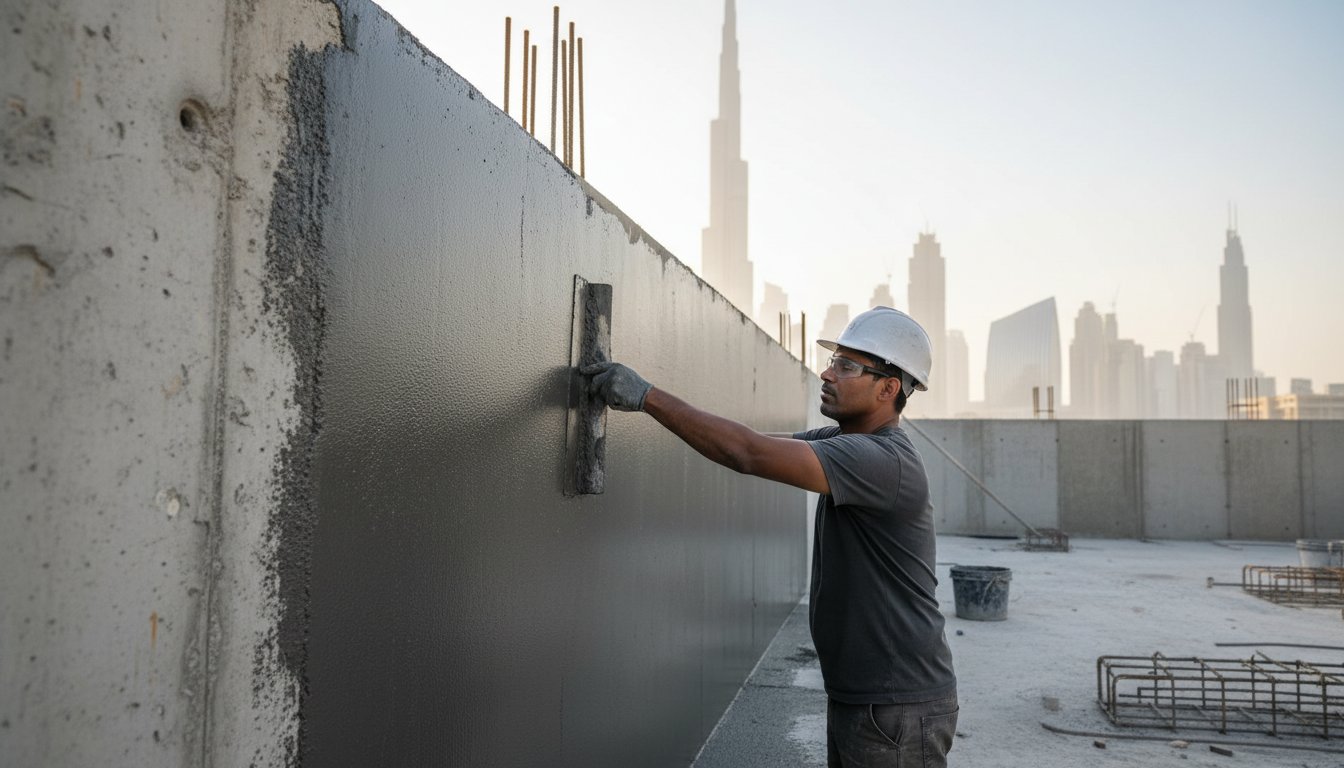
Precision Application: Meeting Dubai Municipality Standards
Executing a successful waterproofing project in the UAE isn’t merely about product selection; it’s a discipline of precise application governed by stringent local standards and extreme environmental factors. The Dubai Municipality’s 2021 Building Regulations and the DM-DBC-REQ-2021 code mandate specific performance criteria for waterproofing systems. Achieving this compliance hinges on a methodical approach that accounts for ambient temperatures often exceeding 45°C, which can compromise material integrity if not expertly managed. Success is a direct result of technical mastery, from substrate conditioning to final curing protocols.
Substrate Preparation and Priming
The foundation of any durable waterproofing system is an immaculately prepared substrate. We mandate mechanical cleaning to create a profile that ensures maximum adhesion. This typically involves high-pressure water jetting (at pressures over 2,500 PSI) or abrasive sandblasting to remove all contaminants. A common point of failure is “laitance,” a weak, chalky layer of cement and fine aggregates that forms on the surface of new concrete. If not completely removed, it will cause the waterproofing layer to delaminate within the first 18 months. Any existing defects, such as spalls or cracks wider than 1.5mm, are meticulously repaired with high-strength, polymer-modified repair mortars before any coating is applied.
The Multi-Coat Application Process
The application of the cementitious waterproofing coating itself demands precision. The initial step is to achieve a “Saturated Surface Dry” (SSD) condition. The concrete must be damp to prevent it from drawing moisture from the coating too quickly, but it cannot have any standing water. In Dubai’s heat, this window is brief and requires constant monitoring by trained technicians.
Mixing ratios are non-negotiable. The temptation to add excess water for better workability in high heat is a critical error that drastically reduces the coating’s final strength and impermeability. Our protocols strictly adhere to manufacturer specifications, using a two-coat system as a minimum standard.
- Application Method: For large, open areas like podium decks or rooftops, spray application delivers the most consistent film thickness. For detailed work in wet areas or around pipe penetrations, brushes and rollers are used.
- The Cross-Hatch Technique: We apply the second coat perpendicular to the first. This “cross-hatch” method is essential for eliminating pinholes and ensuring a monolithic, seamless barrier across the entire surface.
- Joint Reinforcement: Critical stress points like wall-to-floor corners, construction joints, and pipe protrusions are reinforced. We embed a compatible fiber mesh or specialized AquaProof reinforcement tape into the first wet coat of the waterproofing slurry to provide enhanced tensile strength and prevent cracking.
Finally, curing is paramount. A freshly applied coating exposed to direct sun and low humidity can suffer from rapid dehydration, leading to shrinkage cracks and a compromised barrier. We protect the system for a minimum of 48-72 hours using methods like covering with damp hessian cloths or applying an approved, water-based curing compound to ensure the material achieves its full design strength and long-term durability.
Selecting the Right System for Your UAE Property
In the UAE’s demanding construction environment, selecting the correct waterproofing system isn’t a simple procurement decision; it’s a critical engineering choice that directly impacts a building’s longevity and value. The region’s high humidity, saline groundwater, and extreme temperature cycles mean a one-size-fits-all approach is destined for failure. A successful strategy requires a precise match between the waterproofing technology and the specific structural element it’s designed to protect.
A rigorous cost-benefit analysis reveals the true value of a premium system. Consider a 500-square-meter basement: a standard application might cost approximately AED 45,000. A superior crystalline cementitious waterproofing system could increase the initial investment by 20%, to around AED 54,000. However, over a 20-year lifecycle, the cheaper system is far more likely to fail, leading to concrete spalling and water ingress repairs that can easily exceed AED 70,000, excluding the significant costs of operational downtime. The initial AED 9,000 premium becomes a strategic investment that prevents substantial long-term financial loss.
Furthermore, regulatory compliance is non-negotiable. All waterproofing materials used in Dubai must meet stringent codes set by the Dubai Municipality and the Dubai Civil Defense. These regulations ensure that products are tested to withstand the local environment’s specific challenges, including high soil salinity and thermal fluctuations that can range from 10°C to 50°C. Using non-compliant materials not only voids warranties but also poses a significant risk to the structural integrity of the asset.
Application Zones: From Roofs to Foundations
Different areas of a structure are exposed to unique forms of moisture and pressure, demanding specialized solutions:
- Wet Areas: In high-rise apartments across Dubai Marina and Business Bay, bathrooms and kitchens require flexible, polymer-modified cementitious membranes beneath the tiling. These systems are engineered to accommodate minor structural deflections without cracking, preventing leaks to floors below.
- Retaining Walls and Foundations: For below-grade structures, especially in coastal developments like Palm Jumeirah, the primary threat is aggressive groundwater with high chloride and sulfate levels. Crystalline waterproofing is the optimal solution here, as it penetrates the concrete’s capillary tracts to form an insoluble crystalline structure, providing integral and permanent protection against water and chemical attack.
- Swimming Pools and Water Features: These structures must withstand constant, positive-side hydrostatic pressure. A robust, two-component cementitious coating is required to provide a seamless, impermeable barrier that is also flexible enough to handle the dynamic pressure and temperature shifts of the contained water.
Positive vs. Negative Side Waterproofing
Understanding the application side is fundamental to system selection. “Positive side” waterproofing is applied to the exterior surface of a structure-the side in direct contact with water. It is the primary line of defense, specified in over 95% of new construction projects in the UAE because it protects the concrete structure itself from moisture saturation.
Conversely, “negative side” waterproofing is applied to the interior, or “dry,” face. This method is a strategic choice for remedial work where excavation is impossible, such as repairing a leaking basement wall in a completed Downtown Dubai tower. These specialized systems are designed to counteract hydrostatic pressure, effectively blocking water ingress from within. While highly effective for repairs, they leave the structural concrete saturated. In the UAE, a properly installed positive side system has a design life exceeding 25 years, whereas a negative side solution is a targeted repair with a typical lifespan of 10-15 years before re-evaluation is advised.
Ensuring your property is protected with the correct system requires specialist knowledge of materials science and local conditions. Consult with our waterproofing experts to design a solution that meets UAE codes and your long-term asset goals.
NovoTech: Authorized Terraco Application Specialists in Dubai
Selecting the right material is only half the battle; expert application is what guarantees long-term performance. With a 30-year operational history in the UAE, NovoTech delivers unparalleled project execution founded on a deep understanding of the region’s unique environmental and structural challenges. Our status as authorized applicators for Terraco is a deliberate choice, aligning our technical expertise with a manufacturer renowned for advanced protective systems engineered specifically for the Middle East’s demanding climate.
Terraco’s product formulations are designed to withstand extreme UV radiation, high humidity, and the corrosive effects of a high-salinity environment. This makes their systems exceptionally durable for local conditions. At NovoTech, we leverage these advanced materials within a framework of total project ownership. We provide comprehensive, turnkey solutions that ensure the integrity of your structure from the ground up.
Our methodical process guarantees a seamless and effective application every time. It includes:
- Structural Assessment: A thorough evaluation of the substrate to identify vulnerabilities and determine the precise technical requirements.
- System Specification: Selecting the optimal Terraco products to create a bespoke waterproofing system tailored to your asset.
- Surface Preparation: Meticulous cleaning, repairing, and priming of surfaces to ensure maximum adhesion and system longevity.
- Expert Application: Precise installation of the cementitious waterproofing membrane by certified technicians, followed by protective topcoats.
- Quality Assurance: Rigorous post-application testing and inspection to verify complete and compliant coverage.
This end-to-end management is backed by robust warranties and long-term maintenance support, providing both commercial and residential clients with complete confidence in their investment. We protect your assets for the future.
The NovoTech Standard of Integrated Excellence
We operate as a technology partner, not merely a contractor. Our commitment extends beyond application to encompass rigorous quality control and on-site supervision, which is critical for complex high-rise projects and large-scale commercial facilities. This integrated approach ensures that our waterproofing solutions contribute to the overall structural health and longevity of your building, forming a key component of our comprehensive Building Maintenance Services.
Bespoke Solutions for Dubai’s Architecture
Dubai’s diverse architecture demands customized solutions. We engineer and apply bespoke cementitious systems for everything from luxury villas requiring seamless aesthetic integration to industrial plants needing high chemical and abrasion resistance. Our portfolio includes the successful waterproofing of high-load structural foundations for commercial towers, protecting critical substructures from aggressive groundwater. Let our experts design a system for your specific needs.
Consult with NovoTech for your waterproofing requirements.
Partner with NovoTech for End-to-End Waterproofing Excellence
Protecting a high-value asset in the UAE requires more than a standard solution. The decision between crystalline and polymer-modified systems, coupled with the stringent requirements of Dubai Municipality, dictates the long-term resilience of your structure. It’s a technical decision with significant financial implications.
Navigating these complexities is where a strategic partner becomes essential. As an authorized Terraco Applicator, NovoTech delivers precision-engineered cementitious waterproofing solutions backed by over 30 years of specialized UAE engineering experience. Our deep expertise in Dubai Municipality compliance ensures your project doesn’t just meet standards; it sets a benchmark for durability. We provide a comprehensive, turnkey service from initial specification to final sign-off.
Don’t leave your asset’s structural integrity to chance. Request a Professional Waterproofing Consultation from NovoTech and engage a partner committed to protecting your investment for decades to come.
Frequently Asked Questions About Cementitious Waterproofing
Is cementitious waterproofing better than bitumen for Dubai buildings?
Yes, for many applications in Dubai, cementitious waterproofing provides superior performance over traditional bitumen. Its seamless, rigid barrier excels in high-temperature environments, resisting the UV degradation common in the UAE climate. While bitumen is effective for below-grade structures, it can soften under direct sun. For concrete roofs, water tanks, and wet areas, the inorganic nature of cementitious systems ensures greater durability and a longer asset lifecycle, aligning with modern construction standards.
Can cementitious waterproofing be applied to old, wet concrete?
Yes, certain crystalline cementitious waterproofing systems are engineered specifically for application on damp or old concrete. These advanced systems use existing moisture to trigger a chemical reaction, forming non-soluble crystals within the concrete’s capillary tracts. This process seals pores and micro-cracks from within, creating an integral waterproof barrier. Proper surface preparation, including removing all loose material, remains a critical first step for ensuring optimal adhesion and long-term performance.
How long does a cementitious waterproofing system last in the UAE?
A professionally installed cementitious waterproofing system can last for more than 10 to 15 years in the UAE’s demanding climate. The system’s lifespan is directly linked to the quality of the product, the precision of the application, and the structure’s exposure to mechanical stress. For example, systems protected by a screed in high-traffic areas will outperform exposed applications. Adherence to manufacturer specifications and Dubai Municipality guidelines is essential for achieving maximum longevity.
Is it safe to use cementitious coatings in drinking water tanks?
Yes, it is safe, provided the specific cementitious coating is certified for use with potable water. Products for this purpose must comply with international standards like NSF/ANSI 61 or local regulations set by authorities such as DEWA. These certified coatings are non-toxic and won’t leach harmful chemicals into the water supply. It’s imperative to verify the product’s technical data sheet for potable water approval before commencing any project involving drinking water infrastructure.
Does cementitious waterproofing require a protective screed?
A protective screed is highly recommended for applications exposed to foot traffic, vehicle movement, or potential mechanical impact. While the waterproofing layer is durable, it’s not designed as a final wearing surface. A cementitious screed, typically 40-50mm thick, shields the membrane from abrasion and distributes loads, preventing punctures. For non-traffic areas like foundation walls, a screed isn’t necessary, but for rooftops and balconies, it’s a critical component for long-term protection.
Can I apply paint directly over a cementitious waterproofing layer?
Yes, you can apply paint over most cementitious waterproofing membranes after they have fully cured, which typically takes a minimum of 7 days. For optimal results, select a compatible, high-quality acrylic or elastomeric paint that can accommodate minor substrate movements. Before painting, ensure the surface is clean and dry. Some systems may require a specific primer to guarantee proper paint adhesion, so always consult the manufacturer’s technical datasheet for precise recommendations.
What is the curing time for waterproofing in the Dubai summer?
During the Dubai summer, with ambient temperatures often exceeding 40°C, the initial curing time for a cementitious membrane is reduced to approximately 24-48 hours. However, achieving a full cure and maximum waterproofing properties can still take up to 7 days. The intense heat accelerates water evaporation, so professional installers often use damp curing techniques, like misting the surface, to ensure a gradual and complete hydration process for optimal strength and impermeability.
How much does professional cementitious waterproofing cost in Dubai?
The cost for a professional application of cementitious waterproofing in Dubai typically ranges from 45 د.إ to 75 د.إ per square meter. This price bracket generally includes standard surface preparation and the application of a two-component system. Final costs can vary based on project scale, the condition of the existing substrate, and the specific system required (e.g., flexible vs. rigid). For a precise, turnkey project quotation, a professional site assessment is recommended.