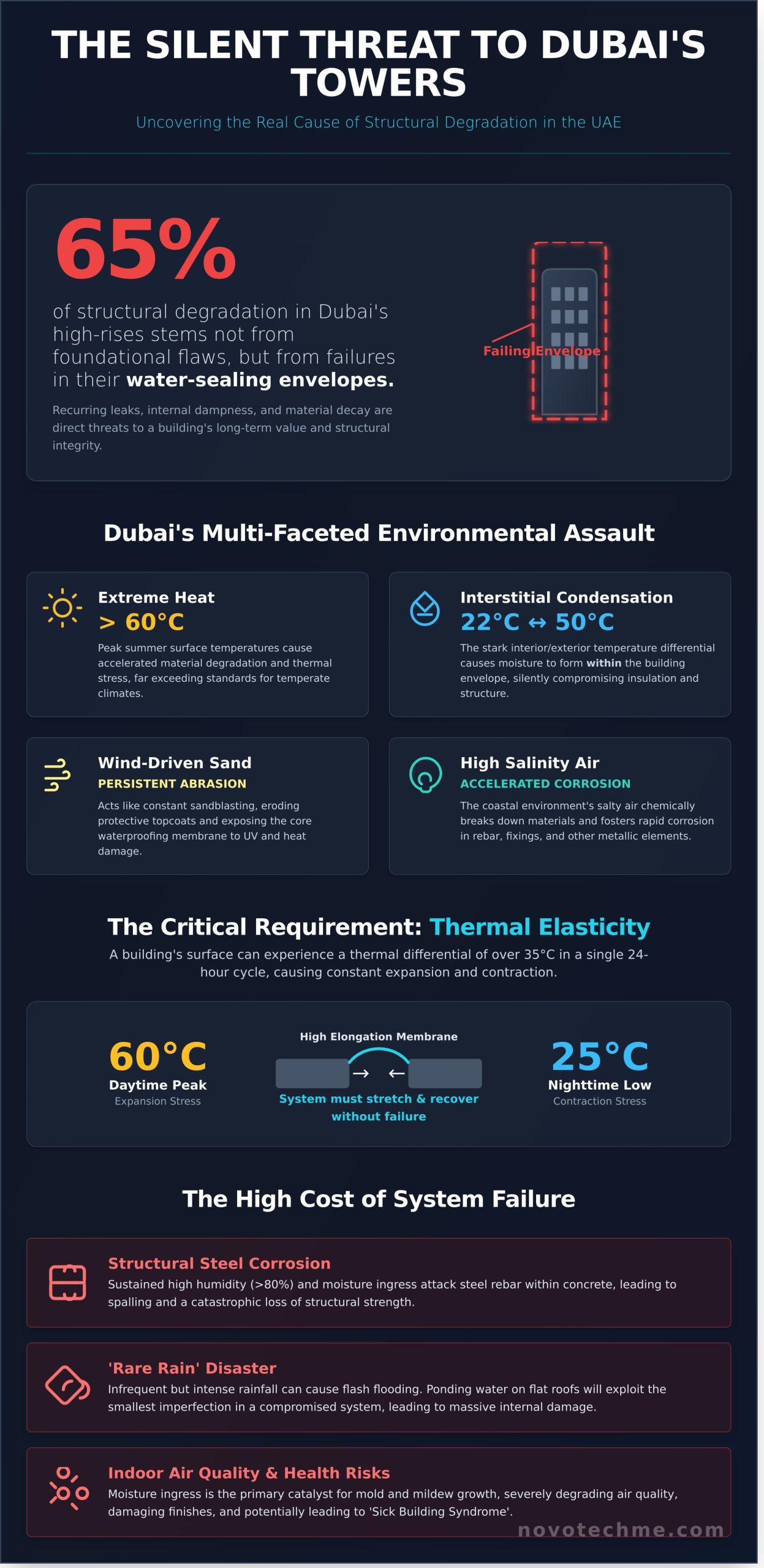
Industry analysis reveals that nearly 65% of structural degradation issues in Dubai’s high-rise buildings stem not from foundational flaws, but from failures in their water-sealing envelopes. It’s a frustrating reality for asset managers and developers. You invest millions of Dirhams in cutting-edge architecture, only to face recurring leaks, internal dampness from constant AC condensation, and material decay under the relentless UAE sun. These aren’t minor inconveniences; they are direct threats to a building’s long-term value and structural integrity.
This comprehensive 2026 guide moves beyond generic advice to deliver a technical framework for selecting the ideal waterproofing membrane. We will empower you to specify a system engineered for the region’s unique climatic demands, ensuring a leak-free structure and significantly reducing lifecycle maintenance costs for the next decade and beyond. We’ll dissect the performance of liquid-applied versus sheet membranes, evaluate UV and thermal resistance criteria, and outline the critical application standards that differentiate a successful installation from a costly failure.
Key Takeaways
- Learn why standard waterproofing solutions often fail in the UAE’s extreme climate and identify the performance metrics essential for Dubai.
- Distinguish between liquid-applied and sheet-based systems to make an informed decision for complex roofs versus foundational structures.
- Select the optimal waterproofing membrane by matching the technology to specific architectural demands, from luxury villa roofs to high-rise building envelopes.
- Understand how meticulous surface preparation and correct primer application are critical first steps that determine the long-term success of any waterproofing project.
Understanding Waterproofing Membranes in Dubai’s Extreme Climate
A waterproofing membrane is a thin layer of water-tight material engineered to prevent fluid ingress into a structure. While this definition is universal, its practical application in Dubai demands a far more robust approach than what is considered standard in European or Asian markets. For a comprehensive overview of waterproofing fundamentals, one can find ample resources, but these often fail to account for the punishing operational environment of the UAE. Here, systems must perform flawlessly not just against water, but against a constant assault from extreme heat, UV radiation, and atmospheric salinity.
Standard materials, often rated for temperate climates, experience accelerated degradation when exposed to Dubai’s peak summer surface temperatures, which can exceed 60°C. This extreme heat creates a significant challenge beyond simple water resistance. In the city’s iconic high-rise towers, a ‘hidden’ enemy emerges: AC-induced interstitial condensation. The stark temperature differential between a 22°C cooled interior and a 50°C exterior can cause moisture to form within the building envelope itself, silently compromising insulation and structural components if the vapor barrier is inadequate.
Adding to this thermal stress, the coastal environment of Dubai introduces two more aggressive factors. Wind-driven sand acts as a persistent abrasive, eroding protective topcoats and exposing the core membrane. Simultaneously, the high salinity of the air accelerates the chemical breakdown of certain materials and fosters corrosion in any adjacent metallic elements, from fixings to structural rebar. A successful waterproofing membrane in this region must be a high-performance composite engineered to combat this multi-faceted environmental assault.
Why Waterproofing is Critical in a Desert Climate
The imperative for advanced waterproofing in Dubai extends beyond preventing leaks. It is a critical component for ensuring long-term structural integrity and occupant safety. The consequences of system failure are severe, impacting everything from asset value to public health.
- Protecting Structural Steel: Sustained high humidity, often exceeding 80% in summer months, creates a highly corrosive environment. Any moisture that bypasses a failed membrane will attack the steel rebar within concrete, leading to spalling and a catastrophic loss of structural strength.
- Preventing the ‘Rare Rain’ Disaster: Though infrequent, rainfall in the UAE is often intense. These flash-flood events can deposit a massive volume of water in a short period. Flat roofs, common in local architecture, are exceptionally vulnerable to ponding water, which will exploit the smallest imperfection in a compromised roof system.
- Maintaining Indoor Air Quality: Moisture ingress is the primary catalyst for the growth of mold and mildew. This not only damages interior finishes but severely degrades indoor air quality, posing health risks and potentially leading to ‘Sick Building Syndrome’ in commercial properties.
Thermal Expansion and Membrane Elasticity
Dubai’s buildings are in a constant state of flux, ‘breathing’ with the dramatic day-night temperature shifts. A building’s surface can experience a thermal differential of over 35°C within a single 24-hour cycle, causing significant expansion and contraction. This movement places immense stress on the building’s outer skin, including the waterproofing system.
For this reason, high elongation properties are non-negotiable for any waterproofing system specified in the UAE. The material must be able to stretch and recover without failing. A rigid or brittle membrane will inevitably crack under this cyclical strain, creating pathways for water intrusion. Thermal elasticity in membranes is the ability to expand without fracturing under 60°C surface heat. Choosing a system without certified performance in this area is a direct invitation to premature failure and costly, complex remediation projects.
Comparing Core Waterproofing Technologies: Liquid vs. Sheet Membranes
Selecting the correct waterproofing technology is a critical engineering decision, directly impacting a structure’s longevity and operational integrity. The choice fundamentally pivots between two core methodologies: pre-formed sheet membranes and fluid, liquid-applied systems. Each presents a distinct set of performance characteristics tailored to specific applications, from subterranean foundations enduring saline groundwater to expansive roofs under the intense UAE sun.
While traditional bituminous sheets have long been the standard for below-grade structures, modern liquid-applied membranes (LAMs) offer unparalleled flexibility for complex architectural forms. Concurrently, specialized systems like thermoplastic and cementitious membranes address niche requirements, from Dubai’s ‘Cool Roof’ initiatives to the high-pressure environments of water containment structures.
Sheet Membranes: Pros, Cons, and UAE Use-Cases
Sheet-based systems offer a factory-controlled thickness, providing a reliable physical barrier. For the UAE’s demanding climate, Atactic Polypropylene (APP) modified bitumen is often specified over Styrene-Butadiene-Styrene (SBS) for its higher softening point, which provides superior thermal stability against summer temperatures that can push roof surface heat above 80°C. However, their effectiveness hinges entirely on application quality. Over 70% of sheet membrane failures originate at the seams, making the precision of torch-on application a non-negotiable factor. For substructures in Dubai’s coastal areas, like Jumeirah or Palm Jumeirah, the high-density, multi-layer composition of a bituminous sheet provides a robust defense against the aggressive chloride and sulfate content found in the region’s saline soil.
The Rise of Liquid-Applied Systems in Modern Dubai
The architectural ambition of modern Dubai necessitates advanced material science. The extreme climatic conditions of the Arabian Gulf, characterized by high temperatures and humidity, demand high-performance waterproofing solutions that can withstand thermal shock and UV degradation. For exposed roofs, aliphatic polyurethane (PU) coatings outperform acrylics, offering superior UV resistance and greater tensile strength, which is critical for accommodating thermal expansion and contraction. The primary advantage of a liquid-applied waterproofing membrane is its monolithic, seamless finish. This completely eliminates the risk of joint failure, a crucial benefit for structures with intricate geometries, such as the undulating roof of the Dubai Opera. Furthermore, fast-cure polyaspartic and PMMA technologies can reduce application and curing times to under two hours, a significant advantage for time-sensitive commercial renovations in bustling hubs like Downtown Dubai.
Beyond these two primary categories, other technologies serve vital roles:
- Thermoplastic Membranes (TPO/PVC): These are central to Dubai’s sustainability goals. A white TPO roof membrane can achieve a Solar Reflectance Index (SRI) value greater than 78, reflecting over 80% of solar radiation and significantly reducing cooling costs in alignment with Dubai Municipality’s Al Sa’fat green building regulations.
- Cementitious Systems: These rigid coatings are ideal for positive and negative side waterproofing in concrete structures. Their ability to withstand constant hydrostatic pressure makes them the definitive choice for internal swimming pools, concrete water tanks, and wet areas.
Choosing between these advanced systems requires a detailed analysis of the substrate, environmental exposure, and long-term performance objectives. Our team provides bespoke waterproofing consultations to engineer solutions that ensure total asset protection.
Selecting the Right Membrane for Dubai’s Architectural Diversity
Dubai’s architectural landscape is a testament to ambition, from the sprawling luxury villas of Emirates Hills to the vertical cities that define its skyline. This diversity demands a highly specialized approach to asset protection. A generic waterproofing solution is not merely inadequate; it’s a direct risk to structural integrity and operational efficiency. Selecting the correct waterproofing membrane requires a granular analysis of the building’s function, design, and micro-environmental challenges, including intense UV radiation, high humidity, and thermal shock.
Residential Villa Waterproofing Strategies
Luxury residential properties present unique waterproofing complexities. Rooftop gardens, terraces, and the now-ubiquitous infinity pools on villas in Palm Jumeirah create constant hydrostatic pressure, demanding systems with zero tolerance for failure. The challenge is twofold: ensuring absolute water tightness while providing a stable, compatible substrate for high-end decorative finishes like Italian marble or natural stone. Elastomeric, liquid-applied membranes are often specified for these applications due to their seamless finish and ability to accommodate complex detailing around drains and planters. This foundational protective layer is critical before considering the final aesthetic, which is perfected through expert Villa Painting & Exterior Finishes.
Commercial and High-Rise Requirements
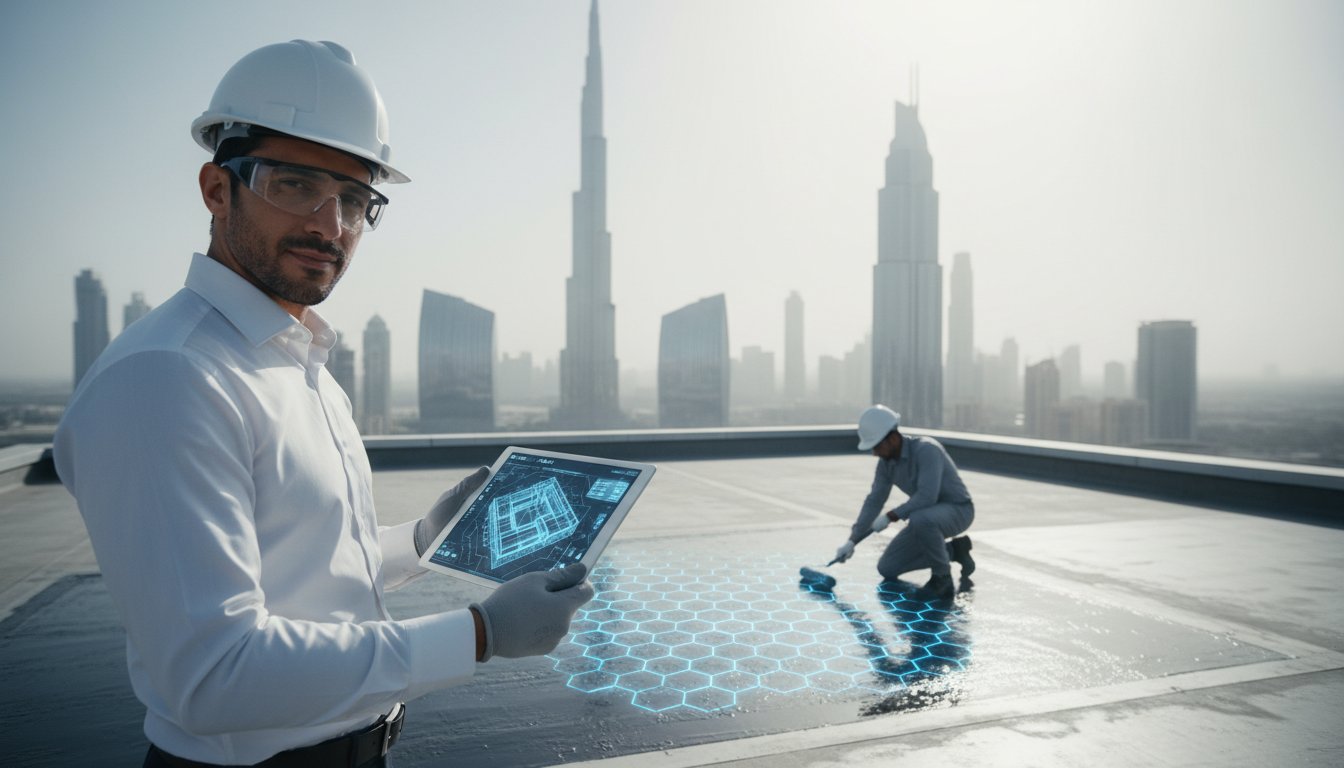
For commercial towers exceeding 50 stories, the building envelope is exposed to extreme environmental forces. Wind loads at these altitudes can generate negative pressures exceeding 3.0 kPa, which can delaminate improperly secured membranes. Therefore, mechanically-fastened systems like TPO or PVC are often engineered to withstand significant wind uplift. Crucially, the waterproofing system must integrate flawlessly with complex curtain wall systems and structural glazing to prevent water ingress at critical junctions. Application and maintenance at height also demand strict adherence to safety protocols, utilizing IRATA-certified rope access technicians for precision installation and inspection.
The logistical and industrial hubs in areas like Jebel Ali Free Zone present a different set of requirements. Here, the primary concerns are durability, rapid application over vast surface areas-often exceeding 100,000 square meters-and long-term cost-effectiveness. High-performance, spray-applied polyurethane or polyurea systems deliver a seamless, durable, and trafficable surface ideal for large-scale warehouse roofs and industrial facilities. Their rapid curing times minimize operational downtime, a critical factor for 24/7 logistics operations.
A pivotal factor in modern specifications is the ‘cool roof’ concept, a direct response to the UAE’s climate. White or light-colored membranes with a high Solar Reflectance Index (SRI) can reduce a roof’s surface temperature by as much as 30°C compared to traditional black bitumen. This thermal efficiency significantly lowers the building’s heat gain, directly reducing the load on HVAC systems and cutting cooling energy consumption by up to 20%. This practice isn’t just an economic advantage; it’s a core component of sustainable construction, aligning with the performance mandates detailed in the Dubai Green Building Regulations. Choosing a high-SRI waterproofing membrane is a strategic decision that delivers both environmental compliance and tangible operational savings.
Professional Application Standards and UAE Building Codes
A high-performance waterproofing membrane is only as effective as its application. In the demanding climate of the UAE, where extreme heat and UV radiation are constant operational factors, precision isn’t a luxury; it is a fundamental requirement for structural integrity and long-term asset protection. The success of any waterproofing system is determined by a meticulous, multi-stage process that adheres to both international standards and local building codes. Cutting corners at any stage compromises the entire system.
The application process follows a disciplined sequence, where each step builds upon the last. Our operational methodology confirms that over 90% of waterproofing success is directly attributable to correct substrate preparation. The complete professional workflow includes:
- Surface Preparation: The critical first step involves cleaning the concrete substrate to remove all dust, laitance, oil, and loose debris. The surface must be sound, smooth, and dry to ensure a flawless bond. Any imperfections or cracks are repaired with appropriate materials before proceeding.
- Primer Application: A compatible primer is applied to the prepared substrate. This crucial step seals the porous concrete and creates a powerful chemical bond, ensuring the waterproofing membrane adheres uniformly and permanently.
- Layering and Detailing: The membrane is applied according to manufacturer specifications. Meticulous attention is given to critical failure points like corners, pipe penetrations, and drainage outlets, which often require reinforcement with additional layers or specialized detailing to create a seamless, monolithic barrier.
- Flood Testing: This is a non-negotiable verification stage in Dubai construction. Once the membrane has fully cured, the area is flooded to test for any leaks or imperfections, providing tangible proof of a successful application.
- Final Inspection: Upon successful completion of the flood test, a final inspection is conducted. Comprehensive documentation, including application records and test results, is compiled and provided to the property owner along with the system warranty.
The Dangers of Substandard Installation
Common installation mistakes, such as applying membranes over damp concrete or during high-wind sandstorms, can lead to catastrophic failure. In the UAE’s intense sun, trapped moisture or air vaporizes, creating blisters and ‘bubbles’ under the membrane. These bubbles expand and contract with daily temperature fluctuations, eventually causing the membrane to delaminate and rupture. The cost of rework, which involves stripping the failed system and starting over, can easily reach 200-300% of the initial application price in AED, not including damages from water ingress.
Dubai Municipality and International Standards
Compliance is mandatory, not optional. For building permits in Dubai, waterproofing systems must adhere to internationally recognized standards, most commonly ASTM (American Society for Testing and Materials) and BS (British Standards). Furthermore, all applications must align with the Dubai Green Building Regulations and Specifications, which promote sustainable and durable construction practices. As a baseline for quality assurance, professional flood testing must involve maintaining a minimum water depth of 50mm over the entire tested area for at least 24 hours to be considered valid.
Ensuring your project’s waterproofing system meets these exacting technical and regulatory requirements is essential for securing your investment. Contact NovoTech’s certified waterproofing experts to guarantee compliance and long-term performance for your facility.
NovoTech’s Integrated Waterproofing and Protective Solutions
Selecting the right materials is only one part of a successful waterproofing strategy. True, long-term asset protection in the United Arab Emirates requires a partner with deep regional expertise. For over 30 years, NovoTech has engineered and implemented solutions specifically designed to combat the relentless ‘heat-humidity-sand’ triad that defines our climate. We don’t just apply a product; we deliver a comprehensive system that addresses the root causes of water ingress and structural degradation, ensuring your building’s integrity for decades.
Our status as an Authorized Terraco Applicator grants us access to a portfolio of premium, climate-engineered protective systems. This partnership allows us to provide turnkey project management, from initial structural repairs and substrate preparation to the final application of a high-performance waterproofing membrane and protective topcoat. Every project is backed by the NovoTech Warranty, a guarantee of quality and performance that provides unparalleled peace of mind for Dubai’s most discerning property owners.
The Terraco Advantage for UAE Structures
Terraco systems represent the gold standard for anti-corrosive and waterproof protection because they are scientifically formulated for the Gulf’s harsh conditions. These solutions are tested to withstand ambient temperatures exceeding 50°C and provide exceptional resistance to chloride ion penetration from coastal air, a primary cause of steel reinforcement corrosion. Their advanced elastomeric properties allow them to bridge hairline cracks that develop from thermal expansion and contraction, maintaining a seamless, monolithic barrier against moisture.
This technical excellence creates a powerful synergy with our Exterior Building Painting Services. A protective coating is only as effective as the waterproofing system beneath it. Our integrated approach ensures that the waterproofing and aesthetic layers are chemically compatible, preventing delamination and forming a unified building envelope that both protects and beautifies. We develop bespoke solutions tailored to the unique demands of each structure, whether it’s protecting the intricate rooftop terraces of a luxury Jumeirah villa or the vast podium decks of a commercial tower in Downtown Dubai.
Partnering with NovoTech for Your Next Project
Engaging with NovoTech means partnering with a team committed to precision and long-term results. Our process begins with a methodical site assessment, where our technical specialists use diagnostic tools to identify vulnerabilities and moisture sources. This data informs a detailed technical specification that outlines the precise preparation methods, product selection, and application protocol required for your property. This meticulous planning eliminates guesswork and ensures predictable, high-quality outcomes.
Our commitment extends beyond project completion. We view our solutions as a critical component of your long-term building maintenance strategy, designed to reduce future operational costs and preserve the capital value of your asset. Protect your investment with a proven, integrated system built on three decades of regional expertise. Request a professional waterproofing assessment for your Dubai property today.
Secure Your Dubai Asset with a Bespoke Waterproofing Strategy
Protecting your building in Dubai isn’t just about choosing a product; it’s about executing a precise engineering strategy. The critical takeaways are clear: the emirate’s extreme climate demands high-performance materials, and the choice between liquid or sheet applications must align perfectly with your structure’s unique architectural demands. Selecting the correct waterproofing membrane is a foundational decision that directly impacts your asset’s longevity and its compliance with mandatory UAE building codes.
Don’t leave this critical layer of protection to chance. At NovoTech, we leverage over 30 years of UAE engineering excellence to deliver turnkey solutions for the region’s most demanding projects, from iconic high-rises to luxury villas. As an Authorized Terraco Applicator, our expertise is certified and our commitment to quality is absolute. Let our team design a comprehensive protection system tailored to your project’s specific requirements.
Partner with a leader in building envelope protection. Contact NovoTech for a Bespoke Waterproofing & Protective Coating Consultation and secure your investment for decades to come.
Frequently Asked Questions About Waterproofing Membranes
How long does a waterproofing membrane last in Dubai?
A professionally installed waterproofing membrane in Dubai typically lasts between 15 and 25 years. The precise lifespan depends on the material quality and its exposure to the UAE’s intense UV radiation and thermal cycling. For instance, high-grade Polyurethane (PU) liquid membranes can exceed 20 years, while standard APP-modified bitumen sheets may offer a service life closer to 15 years. We recommend biennial inspections to ensure maximum longevity and prevent premature failure.
Can I apply a waterproofing membrane over existing tiles?
Yes, a liquid-applied waterproofing system can be applied directly over existing tiles if the substrate is properly prepared. This process involves meticulous deep cleaning, mechanical abrasion of the tile surface, and applying a specialized primer to guarantee optimal adhesion. It’s a highly efficient solution for balconies and terraces, avoiding the cost and disruption of tile removal. A thorough substrate inspection is mandatory to rule out underlying damage before proceeding.
What is the best waterproofing membrane for a concrete roof in the UAE?
Polyurethane (PU) liquid-applied membranes are widely recognized as the superior solution for concrete roofs in the UAE’s climate. Their seamless, monolithic application eliminates joints, which are the most common failure points in sheet-based systems. High-performance PU membranes also offer excellent solar reflectance to reduce surface temperatures and exhibit elongation properties of over 300%, accommodating the thermal movement of concrete structures without cracking.
How much does professional waterproofing cost per square meter in Dubai?
The cost for professional waterproofing services in Dubai generally ranges from 45 د.إ to 95 د.إ per square meter. This price is contingent on the system specified, the complexity of the roof or structure, and the extent of surface preparation required. A straightforward liquid application on a new, clean surface will be at the lower end of this range. A project requiring the removal of old materials and installation of a high-performance system will approach the upper limit.
Is liquid waterproofing better than torch-on sheet membranes?
Liquid waterproofing systems offer superior performance for roofs with complex geometries, while torch-on membranes provide excellent, uniform thickness. Liquid-applied systems create a seamless layer that perfectly adapts to details like pipes and vents, eliminating potential weak points. In contrast, torch-on bitumen sheets offer a guaranteed factory thickness of 3mm or 4mm, delivering robust puncture resistance. The optimal choice is dictated by specific project requirements.
Does the Dubai Municipality require specific waterproofing certifications?
Yes, the Dubai Municipality (DM) mandates that all waterproofing materials used in the emirate must hold a valid DM approval certificate from the Dubai Central Laboratory (DCL). Contractors performing the application must also be approved by both the DM and the material manufacturer. This regulatory framework ensures all products and installation methods meet stringent local standards for durability and performance, which is critical for compliance and long-term asset protection.
How do I know if my building’s current waterproofing is failing?
The most definitive signs of waterproofing failure include visible water stains on interior ceilings, peeling paint or plaster, and a persistent musty odor. Externally, you should inspect for blistering, cracking, or visible separation of seams on the roof’s membrane surface. On tiled balconies, look for loose tiles or efflorescence, which is a white, powdery residue. An infrared thermal inspection can also detect trapped moisture before it becomes visible internally.
Can waterproofing help reduce my AC electricity bill?
Yes, specific waterproofing systems with high solar reflectivity can substantially reduce your AC electricity consumption. A “cool roof” system, typically a white or light-colored liquid-applied membrane, can reflect over 80% of solar radiation. This technology lowers the roof surface temperature by up to 30°C, which reduces heat transfer into the building. This directly lessens the load on your HVAC system, leading to documented energy savings of 10-15% on cooling costs.