What if the painting contractor you hired last month has already put your entire project at legal risk before a single brush touched the facade? For facility managers and property developers overseeing high-altitude building maintenance in the UAE, this isn’t a hypothetical. High rise painting safety regulations in the UAE operate across multiple, overlapping frameworks: federal labor law, Dubai Municipality codes, and internationally recognised certification standards like IRATA. Miss one layer, and you’re exposed to project shutdowns, insurance voidance, and serious liability.
You already know that working at height carries real stakes. The anxiety of a workplace incident and the confusion of reconciling federal requirements with emirate-specific bylaws are entirely legitimate concerns. Compliance here isn’t a single checkbox; it’s a structured shield built from several distinct requirements working in concert.
This guide cuts through that complexity. You’ll come away with a clear understanding of which certifications to verify before signing a contractor, how IRATA rope-access standards compare to Building Maintenance Unit requirements, and exactly what your compliance posture needs to look like to keep your project insured and legally sound through 2026.
Key Takeaways
- High rise painting safety regulations in the UAE span multiple overlapping frameworks — federal labor law, emirate-level municipality codes, and international standards — and full compliance requires satisfying all layers simultaneously.
- IRATA certification is not optional on high-rise projects in the UAE; every site must have a qualified Level 3 supervisor present, and verifying this credential before contract signing is a non-negotiable due diligence step.
- Building Maintenance Units and rope access systems carry distinct regulatory requirements and risk profiles — understanding the difference directly affects your insurance validity and project approval status.
- A contractor’s trade license must include explicit approval for “Building Painting” as a listed activity; a general construction license alone does not satisfy UAE regulatory requirements for facade work.
- Partnering with a contractor that holds authorized applicator status for specified protective coating systems adds a critical layer of material compliance that most property managers overlook during procurement.
The Regulatory Landscape for High-Rise Building Maintenance in the UAE
Compliance with high rise painting safety regulations in the UAE isn’t governed by a single authority. It’s the product of several distinct legal layers operating simultaneously, and understanding which body holds jurisdiction over which requirement is the first step toward building a defensible compliance posture.
At the federal level, UAE Labor Law establishes the foundational duty of care that all employers owe to workers engaged in hazardous activities. The Ministry of Human Resources and Emiratisation (MOHRE) enforces these obligations and holds contractors accountable for maintaining safe working conditions at elevation. Critically, Ministerial Decree No. 32 of 1982 on preventive measures for workers codifies the specific obligations relevant to high-altitude operations, including the provision of personal protective equipment, fall arrest systems, and documented safety protocols. While the decree predates modern facade systems, its requirements remain legally active and are regularly cited during incident investigations.
Dubai Law No. (3) of 2026 introduces a more contemporary dimension. It mandates defined maintenance intervals for skyscrapers, effectively creating a legal obligation for building owners to schedule facade interventions on a structured cycle rather than reactively. This shifts liability in a meaningful way: a building owner who defers maintenance beyond the mandated interval is no longer simply making a business decision; they’re accumulating legal exposure.
Federal vs. Local Safety Mandates
MOHRE rules set the floor. Local municipality codes often raise it considerably. Dubai Municipality enforces its own technical guidelines for facade access, requiring contractors to submit permit-to-work (PTW) documentation before any high-rise facade intervention begins. Sharjah Municipality operates a parallel framework with its own inspection protocols. Both require mandatory reporting of high-risk activities prior to commencement, and neither accepts a federal-level approval as a substitute for local sign-off. These aren’t redundant systems; they’re complementary layers that must each be satisfied independently.
The Impact of Al Sa’fat 2.0 on Safety Standards
Dubai’s Green Building Evaluation System, Al Sa’fat 2.0, has extended its reach into the materials used during facade maintenance. For high-density residential towers, the framework specifies requirements for low-VOC and non-toxic coating systems, directly affecting which products can be applied legally. Waste management protocols for painting materials used at height are also addressed, requiring contractors to demonstrate disposal compliance as part of project documentation. For property managers specifying protective coating systems, this means material selection isn’t purely a performance decision; it carries regulatory weight that affects project approval status.
Taken together, these frameworks define the full scope of what compliance with high rise painting safety regulations in the UAE actually requires: federal labor obligations, emirate-level PTW systems, maintenance cycle mandates, and material standards that now reach into the coating specification itself.
Mandatory Safety Standards: IRATA Certification and Height Access
Personnel certification and equipment safety are two distinct compliance categories, yet they’re routinely conflated during contractor vetting. This distinction matters enormously under high rise painting safety regulations in the UAE: a team can carry perfectly maintained ropes and still be operating illegally if its supervision structure doesn’t meet IRATA requirements. Equally, an IRATA-certified crew working with uninspected or non-standard equipment creates a liability gap that neither federal nor municipal frameworks will excuse.
IRATA, the Industrial Rope Access Trade Association, sets the internationally recognised benchmark for rope-access operations. In the UAE, it’s not treated as an optional credential; it’s the standard against which regulatory bodies, insurers, and project approvals are assessed. Any contractor performing facade work at elevation without documented IRATA certification is exposing your project to immediate legal and insurance risk.
IRATA Levels and Team Composition
IRATA operates across three technician levels, each carrying defined responsibilities on site:
- Level 1 technicians perform rope access tasks under direct supervision. They may not make independent decisions about rigging or anchor configurations.
- Level 2 technicians can work with reduced supervision and are qualified to assist in setting up systems, but they cannot supervise a team independently.
- Level 3 supervisors hold full site authority over rope access operations. UAE projects require at least one Level 3 supervisor present on site whenever work at height is active. This isn’t a recommendation; it’s a compliance threshold.
A crew without this tiered structure, regardless of how experienced the individual workers appear, constitutes what the industry calls a “bucket and brush” operation. These crews carry no verifiable accountability chain, no documented rescue capability, and no defensible compliance posture. Every rescue plan submitted for a high-rise facade project must include a self-rescue protocol signed off by the Level 3 supervisor. Without it, the permit-to-work documentation is incomplete by definition.
Equipment Integrity and Certification
Equipment compliance is a separate layer entirely. Every rope, karabiner, and fall arrester used on a UAE high-rise project must conform to EN-standardised specifications, and all height access gear must be logged in a formal equipment register subject to inspection every six months. Third-party inspectors verify this documentation in Dubai; self-certification by the contractor alone doesn’t satisfy the requirement.
One technical consideration that’s frequently overlooked: the application of anti-corrosive and protective coating systems at height introduces chemical exposure to anchor points and safety lines. Where aggressive coating products are being applied, anchor integrity must be independently assessed as part of the pre-work inspection cycle. This is particularly relevant when specifying protective painting systems for coastal towers, where the combination of salt air and coating chemistry creates compounding corrosion risk.
For property managers evaluating contractors against these requirements, working with an experienced high-rise painting specialist who maintains current IRATA documentation and structured equipment logs removes a significant layer of compliance burden from your procurement process.
Evaluating Access Methods: Cradles, BMUs, and Rope Access
Choosing the wrong access method doesn’t just create operational inefficiency; it can invalidate your permit-to-work documentation before the first worker leaves the ground. Under high rise painting safety regulations in the UAE, the access system selected for a facade project carries its own distinct regulatory obligations, and each method’s compliance requirements are non-negotiable.
Building Maintenance Units are permanently installed systems engineered into a tower’s structure at the design stage. Their primary advantage is load stability and predictable operational parameters. However, BMUs require annual third-party structural certification, and any modification to the original manufacturer’s configuration must be re-approved before operational use. Rope access, by contrast, offers deployment flexibility on structures where BMU infrastructure is absent or inaccessible, but it places the full burden of rigging integrity and supervision compliance directly on the contractor’s IRATA-certified team.
Wind speed thresholds are where many projects encounter unexpected shutdowns. Suspended Access Equipment operations in the UAE are subject to mandatory work-stop thresholds: cradle and BMU operations must cease when sustained wind speeds exceed 12.5 metres per second (approximately 45 km/h), while rope access operations carry a lower threshold due to the increased exposure of individual technicians. Contractors who don’t have real-time anemometer readings logged on site are operating outside documented compliance, regardless of conditions on the day.
Dropped object risk is a separate and frequently underestimated hazard category. Dubai Municipality requires defined exclusion zones at ground level beneath any elevated work activity, with physical barrier systems, not just signage, demarcating the controlled area. Netting systems must be rated for the specific load risk presented by the tools and materials in use at height. For facade painting operations, this includes paint containers, applicator equipment, and coating system components.
Cradles and Suspended Platforms
Temporary cradles require a pre-use inspection checklist completed and signed before each operational shift, covering wire rope condition, suspension points, platform load ratings, and emergency lowering systems. Operators of powered suspended platforms must hold a recognised operator certification specific to that equipment class; a general working-at-height qualification doesn’t satisfy this requirement. For projects where facade painting intersects with structural waterproofing, expert waterproofing companies in Dubai that coordinate integrated facade safety planning can significantly reduce the compliance overhead of managing multiple access systems simultaneously.
Mobile Elevated Work Platforms (MEWPs)
Boom lifts and scissor lifts are appropriate for mid-rise structures where ground conditions permit their deployment, but they’re not a universal substitute for rope access on super-tall towers. Ground condition assessments in dense urban Dubai environments must account for subsurface utility infrastructure, load-bearing capacity, and outrigger spread requirements before any MEWP is positioned. Machine operators must hold current IPAF certification specific to the equipment category being used; this credential is separate from any general construction safety qualification and is verified independently during site inspections.
The practical distinction between access methods ultimately comes down to structure height, available infrastructure, and the specific regulatory obligations each method triggers. Selecting the right system from the outset, with full awareness of those obligations, is what separates a compliant project from an exposed one under high rise painting safety regulations in the UAE.
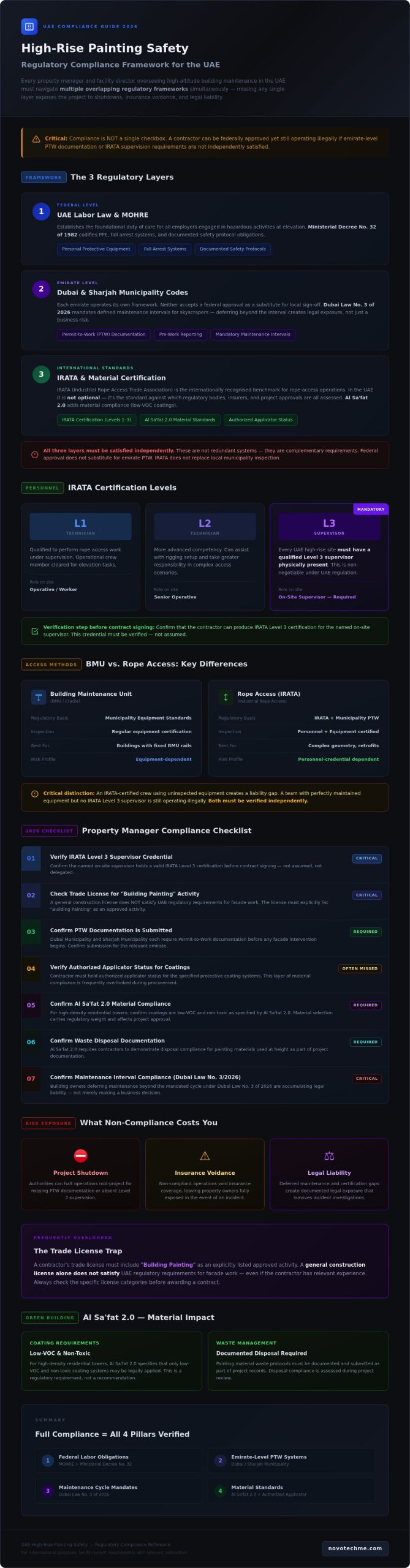
The 2026 Compliance Checklist for Property Managers
Contractor vetting under high rise painting safety regulations in the UAE isn’t a single conversation; it’s a structured due diligence sequence. Each step in the process closes a specific liability gap, and skipping any one of them leaves your project exposed in ways that won’t become visible until an incident, an inspection, or an insurance claim surfaces the gap. Work through this checklist before a contract is signed, not after mobilisation begins.
- Step 1: Verify the Trade License activity listing. A contractor’s trade license must explicitly list “Building Painting” as an approved activity. A general construction or maintenance license does not satisfy this requirement under UAE regulatory frameworks. Request the physical license document and cross-reference the listed activities before any commercial discussion proceeds.
- Step 2: Confirm IRATA certification and insurance documentation. Verify that the contractor holds current IRATA credentials for all personnel, with a Level 3 supervisor confirmed for your specific project. Request the insurance certificates separately and review them against the criteria outlined below.
- Step 3: Request a project-specific RAMS document. A Method Statement and Risk Assessment produced for a different project is not acceptable. The document must reference your building, your access method, and your coating system. Generic templates are a red flag.
- Step 4: Audit the proposed coating system for UAE climate compliance. Al Sa’fat 2.0 requirements for low-VOC materials apply to high-density residential towers, and the coating specification must be verified against those standards before procurement. Material selection is a regulatory decision, not just a performance one.
- Step 5: Confirm waste disposal and environmental compliance permits. Contractors must demonstrate documented disposal protocols for painting materials used at height, including solvent-based products and application waste. This documentation forms part of the project file that municipality inspectors may request.
Reviewing Insurance and Liability
Standard contractor insurance policies routinely exclude or limit coverage for work conducted above specified heights. Reviewing a certificate of insurance without reading the policy schedule is insufficient. You’re looking for two specific instruments: Public Liability coverage with an explicit “work at height” clause, and Workman’s Compensation coverage that remains valid for rope-access and suspended platform operations. If either policy contains altitude exclusions or requires separate endorsements for elevated work, those endorsements must be active before your project commences.
Material specification connects directly to long-term liability here. Coating systems that aren’t engineered for the UAE’s combination of UV intensity, humidity cycling, and coastal salt exposure will degrade ahead of schedule, creating both structural risk and a maintenance liability that falls back on the property owner. Selecting anti-corrosive paint formulated for UAE climate conditions isn’t a premium specification; it’s the baseline for a coating system that will perform within its warranted lifespan.
Vetting Technical Competence
A Method Statement reveals far more than operational sequence. The emergency response section is where technical competence either demonstrates itself or collapses. A credible RAMS document will specify the rescue protocol, name the Level 3 supervisor responsible for executing it, and confirm that the rescue plan has been submitted as part of the permit-to-work application. Vague language about “following standard procedures” is not an acceptable substitute for a documented, site-specific rescue capability.
Authorized Applicator status for specialist coating systems is a separate credential that most property managers don’t think to verify. For projects specifying Terraco products, the contractor must hold current authorization from Terraco directly; applying these systems without that status voids the product warranty and creates a compliance gap in your material documentation. Checking references for completed exterior building painting projects in Dubai should include specific questions about permit-to-work compliance and whether the project completed without regulatory intervention.
A contractor that manages the full compliance burden across all five checklist steps, from license verification through coating system authorization, removes significant procurement risk from your project. Speak with NovoTech’s high-rise painting specialists to review your specific project requirements against current regulatory standards.
NovoTech: 30 Years of Safe, Compliant Vertical Excellence
Since 1993, NovoTech has operated at the intersection of technical precision and regulatory accountability. Three decades of high-rise facade work in the UAE means our team has navigated every iteration of the compliance landscape described in this guide, from the foundational obligations of Ministerial Decree No. 32 through to the material specifications introduced by Al Sa’fat 2.0. That operational history isn’t incidental. It’s the foundation on which every project we undertake is structured.
Our authorized Terraco applicator status is one of the more consequential credentials we hold. As covered earlier in this guide, applying specialist coating systems without direct manufacturer authorization voids the product warranty and creates a material compliance gap in your project documentation. Our authorization closes that gap entirely, ensuring that every Terraco system we specify and apply carries its full warranted performance and the manufacturer-backed documentation your project file requires.
Protective system selection is also where we distinguish between a coating that looks correct at handover and one that performs across its full design lifespan. The UAE’s combination of UV intensity, humidity cycling, and coastal salt exposure degrades underspecified coatings ahead of schedule, returning maintenance liability to the property owner. We engineer against that outcome from the specification stage, not after the first signs of failure appear.
End-to-End Responsibility
NovoTech manages the full project lifecycle: initial facade condition audit, access method selection, RAMS preparation, municipality permit acquisition, and final coating application. We don’t hand clients a method statement template and expect them to navigate the permit-to-work process independently. The regulatory burden of high rise painting safety regulations in the UAE sits with us, not with your facilities team.
Integrated maintenance planning consistently outperforms piecemeal repair cycles on both cost and risk grounds. Isolated interventions that address visible defects without assessing the underlying facade condition routinely miss substrate issues that accelerate between maintenance cycles. Our audit-led approach identifies those conditions before mobilisation, reducing unplanned scope and the liability exposure that comes with deferred structural risk.
For clients undertaking broader facility renovation programmes, our epoxy floor coating services in the UAE extend the same specification rigour and compliance discipline to interior surfaces, providing a single accountable partner across the full renovation scope.
Contact NovoTech for a Safety-First Consultation
Every compliant high-rise project starts with an accurate picture of the facade’s current condition and a clear understanding of the regulatory obligations that apply to it. NovoTech offers comprehensive facade health and safety audits for high-rise residential and commercial towers, producing site-specific findings that inform both the access strategy and the coating specification.
If your project has compliance questions that this guide hasn’t fully resolved, or if you’re approaching a maintenance cycle deadline under Dubai Law No. (3) of 2026, now is the right time to act. Partner with NovoTech for compliant high-rise solutions and put three decades of verified UAE expertise behind your next facade project.
Your Next Facade Project Starts with the Right Compliance Foundation
High rise painting safety regulations in the UAE don’t reward reactive compliance. The frameworks covered in this guide, from MOHRE’s federal obligations through Dubai Municipality’s permit-to-work requirements and Al Sa’fat 2.0’s material standards, operate simultaneously and must each be satisfied independently. Treating any single layer as sufficient leaves the others exposed.
Three decisions determine whether your project stays protected: choosing a contractor whose trade license explicitly covers building painting, confirming IRATA Level 3 supervision is in place before mobilisation, and specifying coating systems that are both climate-engineered and materially compliant. Get those right, and the rest of the compliance structure follows logically.
NovoTech brings 30+ years of UAE expertise, authorized Terraco applicator status, and comprehensive public liability insurance to every project, carrying the full regulatory burden so your facilities team doesn’t have to. Secure your high-rise asset with NovoTech’s compliant painting services and approach your next maintenance cycle with confidence.
Frequently Asked Questions About High-Rise Painting Safety Regulations in the UAE
What is the maximum wind speed allowed for high-rise painting in Dubai?
Suspended Access Equipment operations, including cradles and Building Maintenance Units, must cease when sustained wind speeds exceed 12.5 metres per second, which is approximately 45 km/h. Rope access operations carry a lower operational threshold due to the greater exposure individual technicians face. Contractors are required to have real-time anemometer readings logged on site; estimating conditions by observation alone doesn’t satisfy documented compliance requirements.
Is IRATA certification mandatory for all high-rise painting contractors in the UAE?
Yes. IRATA certification is the recognised standard against which regulatory bodies, insurers, and project approvals are assessed for rope access operations on high-rise facades. Every active site requires at least one Level 3 supervisor present whenever work at height is underway. A contractor without this supervision structure has no defensible compliance posture under high rise painting safety regulations in the UAE, regardless of individual worker experience.
Do I need a permit from Dubai Municipality for exterior building painting?
Yes, a permit-to-work document must be submitted to Dubai Municipality before any high-rise facade intervention begins. Federal-level approvals don’t substitute for this local sign-off; both layers must be satisfied independently. The PTW documentation must include a site-specific risk assessment, the proposed access method, and a rescue plan signed off by the project’s Level 3 IRATA supervisor before the permit is considered complete.
What insurance coverage should a high-rise painting company have?
Two specific instruments are non-negotiable: Public Liability coverage with an explicit “work at height” clause, and Workman’s Compensation coverage that remains valid for rope access and suspended platform operations. Standard policies routinely contain altitude exclusions or require separate endorsements for elevated work. Reviewing a certificate of insurance without reading the full policy schedule is insufficient; those endorsements must be confirmed as active before your project commences.
How often does UAE law require high-rise buildings to be repainted?
Dubai Law No. (3) of 2026 mandates defined maintenance intervals for skyscrapers, creating a legal obligation for building owners to schedule facade interventions on a structured cycle rather than reactively. Deferring maintenance beyond the mandated interval is no longer simply a business decision; it creates accumulating legal exposure for the property owner. Confirming your specific building’s applicable interval against current regulatory requirements is a necessary step before any maintenance planning begins.
What is the difference between a BMU and rope access for safety?
Building Maintenance Units are permanently installed systems engineered into a tower’s structure, offering load stability and predictable operational parameters, but they require annual third-party structural certification and any configuration changes must be re-approved before use. Rope access is contractor-deployed and works on structures without BMU infrastructure, but it places the full burden of rigging integrity and supervision compliance on the contractor’s IRATA-certified team. Each method triggers distinct regulatory obligations that must be managed separately.
Can a painting contractor use standard scaffolding for a 20-story building?
Standard tube-and-fitting scaffolding becomes increasingly impractical and subject to additional engineering requirements at significant heights. For a 20-story structure, the more relevant compliance question is whether the chosen access method, whether scaffolding, a suspended cradle, or rope access, is supported by the appropriate operator certifications and a site-specific risk assessment. Scaffolding at that height typically requires a structural engineer’s sign-off and a separate permit process; it’s not a straightforward substitute for purpose-built height access systems.
What are the penalties for non-compliant high-rise maintenance in the UAE?
Penalties operate across several levels simultaneously. At the regulatory level, Dubai Municipality can issue project shutdown orders and financial penalties for work proceeding without a valid permit-to-work. MOHRE holds authority to sanction contractors operating without documented safety protocols under federal labor law. Beyond regulatory penalties, non-compliance typically voids contractor insurance coverage, transferring liability directly to the property owner in the event of an incident or third-party claim.