Could a single hairline crack in your floor’s grout be the reason you fail your next FoodWatch Digital Audit? In 2026, the commercial kitchen epoxy flooring requirements Dubai enforces have evolved into a sophisticated technical standard where compliance is non-negotiable. We recognize that the fear of heavy fines or forced closures is a constant pressure for facility managers, especially when aging tiles and unhygienic junctions begin to fail under the rigors of a high-volume kitchen.
It’s understandable to feel overwhelmed by the transition from traditional surfaces to high-performance systems. This guide simplifies the complex landscape of Dubai Municipality and HACCP regulations to help you secure a seamless, durable environment. We’ll examine the mandatory R-10 slip resistance ratings, the critical 2% drainage gradients, and the latest coving specifications required for a successful inspection. You’ll learn how to implement these advanced flooring solutions with minimal operational disruption, ensuring your facility remains a benchmark of hygiene and safety in the regional market.
Key Takeaways
- Understand how the 2026 FoodWatch Digital Audit integrates with physical infrastructure to determine your facility’s health and safety rating.
- Identify the specific commercial kitchen epoxy flooring requirements Dubai mandates, including R-10 slip resistance and precise 2% drainage gradients.
- Evaluate the lifecycle cost advantages of seamless epoxy systems over traditional tiling, specifically focusing on the elimination of porous grout lines.
- Learn the technical necessity of thermal shock and chemical resistance to ensure your flooring substrate withstands extreme kitchen temperatures and industrial cleaning agents.
- Recognize the importance of mechanical substrate preparation and specialized moisture barriers in achieving a compliant, durable finish that passes every inspection.
Dubai Municipality Standards for Commercial Kitchen Flooring
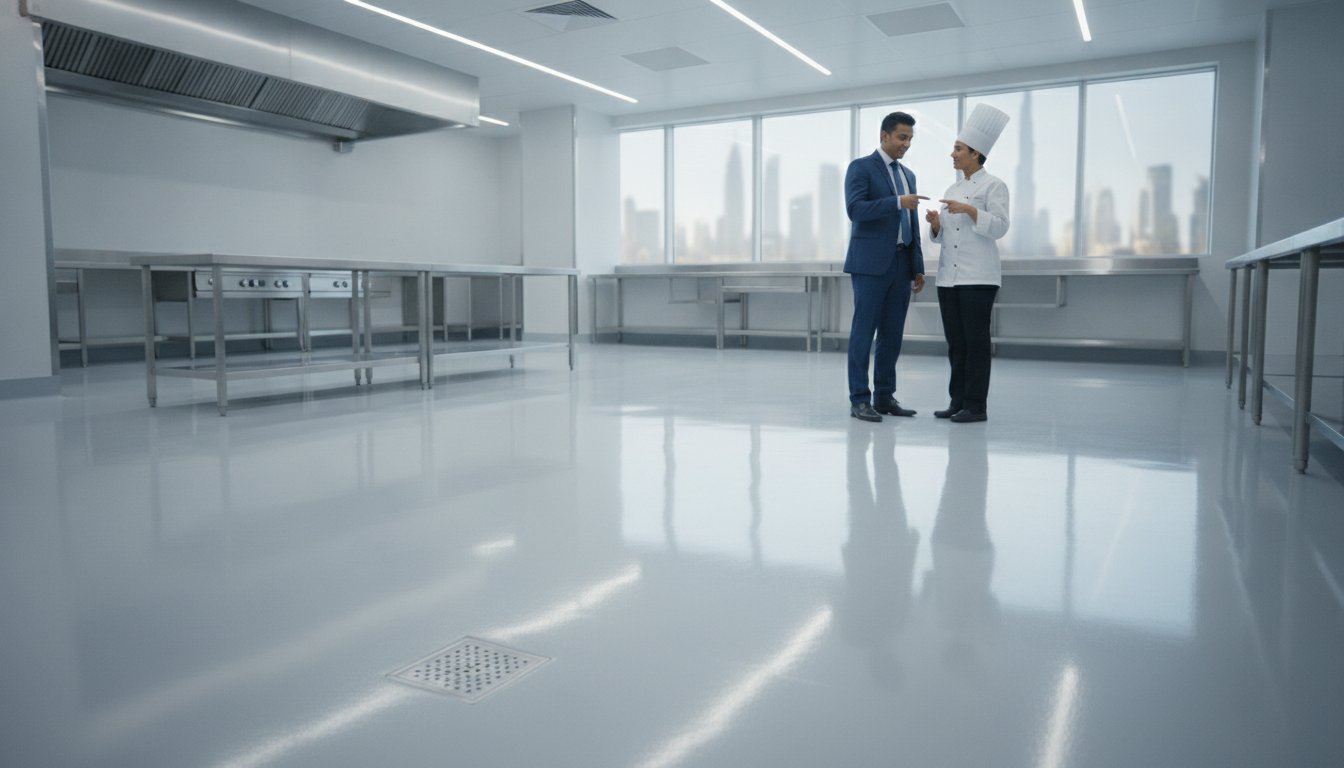
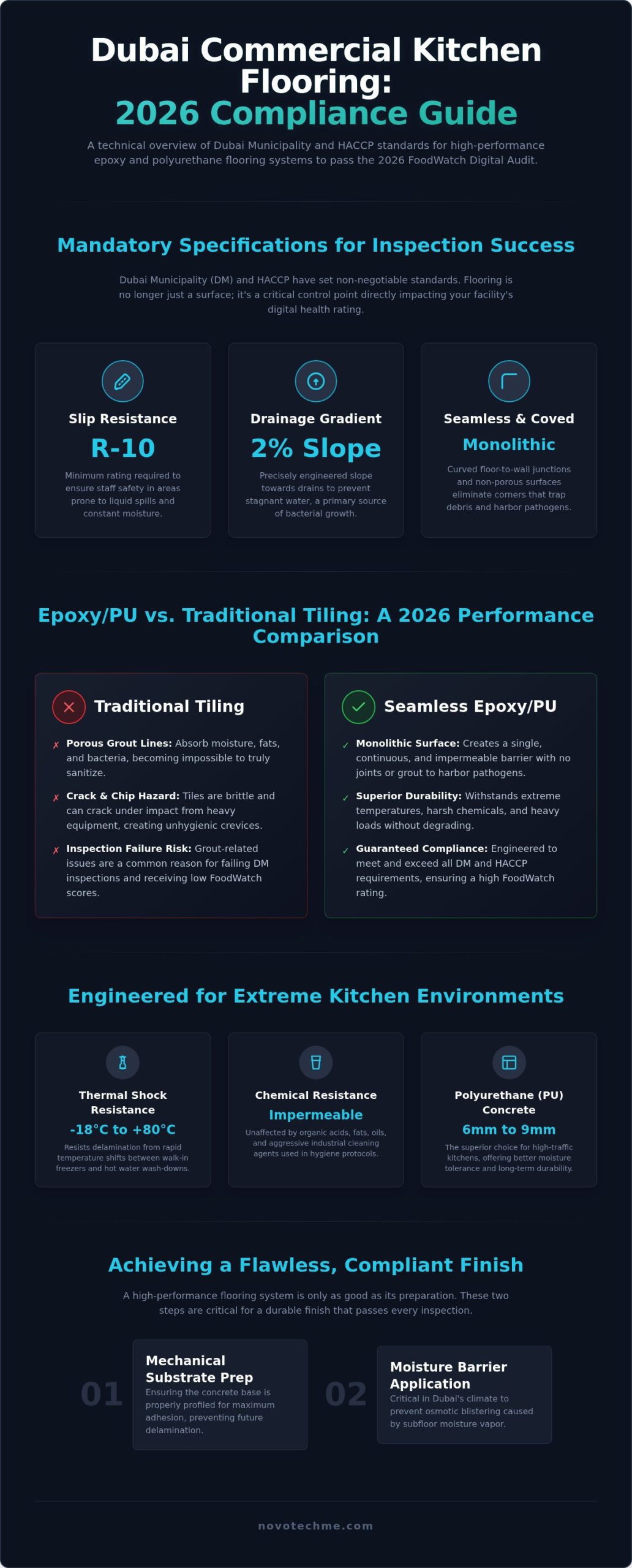
Dubai Municipality (DM) maintains rigorous health and safety codes for food preparation facilities. To achieve compliance, a floor must be light-colored, non-absorbent, and offer a slip resistance rating of R-10. Meeting the commercial kitchen epoxy flooring requirements Dubai enforces is essential for any operator looking to pass inspections without costly rework. DM inspectors specifically look for a 2% slope towards drainage points to prevent stagnant water.
Traditional flooring often fails because of porous surfaces that harbor pathogens. Modern facilities now utilize seamless polymer flooring to eliminate these vulnerabilities. Beyond the surface itself, DM mandates coved junctions; these are curved transitions between the floor and the wall. This design prevents the accumulation of organic matter in sharp corners, making mechanical cleaning more effective.
HACCP Compliance and International Standards
Adhering to Hazard Analysis and Critical Control Points (HACCP) principles is a global benchmark that Dubai’s food industry strictly follows. High-performance epoxy systems facilitate this certification by providing a monolithic surface that resists bacterial colonization. Many modern resin systems include antimicrobial additives that actively inhibit the growth of mold and fungi. Inspectors prioritize these seamless surfaces because they remove the “grout problem” found in ceramic tiles, where moisture and bacteria often penetrate the substrate.
The 2026 FoodWatch Digital Audit Impact
The introduction of the FoodWatch digital platform has transformed how health and safety data is recorded and analyzed. Your facility’s physical infrastructure, including the floor’s integrity, now directly influences your digital health score. Understanding the commercial kitchen epoxy flooring requirements Dubai has established for 2026 is critical for maintaining your status. A cracked or peeling surface isn’t just a maintenance issue; it’s a data point that can trigger an immediate downgrade in your FoodWatch rating.
Compliance now requires documented proof of “cleanability” and regular maintenance schedules. If a surface shows signs of delamination or deep staining, it suggests a failure in the facility’s hygiene protocol. A high-quality epoxy system ensures that your kitchen maintains a professional appearance while meeting the technical demands of high-volume production. Seamless flooring creates a continuous barrier that prevents liquid ingress and significantly reduces the risk of cross-contamination during high-volume shifts.
Essential Technical Specifications for Kitchen-Grade Epoxy
Achieving full compliance goes beyond aesthetics; it requires a deep understanding of the mechanical and chemical stresses specific to high-volume food production. The commercial kitchen epoxy flooring requirements Dubai mandates are designed to ensure that the substrate remains intact under extreme conditions. Thermal shock resistance is a primary consideration. In a typical Dubai facility, floors often experience rapid temperature fluctuations, such as when a walk-in freezer at -18°C is adjacent to a wash-down area using water at +80°C. Without specific thermal properties, standard coatings will delaminate from the concrete slab.
Chemical resistance is equally vital. Kitchen floors are constantly exposed to organic acids, fats, and oils that can penetrate and degrade unprotected concrete. Modern resin systems must also withstand the aggressive caustic cleaning agents used to satisfy FoodWatch hygiene protocols. High compressive strength is another non-negotiable factor. Industrial-scale ovens and heavy refrigeration units exert significant point loads, necessitating a system that won’t crack or indent over time. To maintain staff safety, surfaces must achieve an R-10 to R-12 slip resistance rating, especially in areas prone to liquid spills.
Polyurethane Concrete vs. Standard Epoxy
While standard epoxy is suitable for many commercial areas, heavy-duty polyurethane (PU) concrete is often the superior choice for high-traffic kitchens. PU systems offer better moisture vapor tolerance, which is critical in Dubai’s humid environment where subfloor moisture can cause osmotic blistering. For most intensive restaurant environments, an application thickness of 6mm to 9mm ensures long-term durability. If you’re planning a facility upgrade, consulting with expert epoxy floor painting specialists can help determine the optimal system for your specific load requirements.
Seamless Coving and Drainage Integration
The integration of the floor with the drainage system is where many installations fail during a Dubai Municipality inspection. A 100mm cove base is the industry standard for Dubai Municipality approval because it creates a radius that is easy to sanitize and prevents liquid from seeping behind wall finishes. This coving must be applied as a continuous, seamless extension of the floor itself. Integrating these coatings with stainless steel drains requires precision to ensure a watertight seal that prevents sub-surface leaks and structural damage. Regular digital logging of these junction points in the FoodWatch system ensures that your maintenance remains transparent and compliant with 2026 standards.
Epoxy vs. Traditional Tiling: A 2026 Performance Comparison
In the context of the 2026 Dubai food sector, selecting a floor surface is a strategic business decision rather than a simple aesthetic choice. While ceramic tiles were once the default for back-of-house areas, they often fail to meet the rigorous commercial kitchen epoxy flooring requirements Dubai inspectors now demand during digital audits. The fundamental issue remains the “Grout Problem.” Grout is a naturally porous material that inevitably absorbs fats, organic proteins, and moisture. Over time, these lines become permanent breeding grounds for bacteria, leading to failed digital audits and substantial administrative fines.
The lifecycle cost of an epoxy floor coating uae facility managers choose is significantly lower when considering long-term maintenance and compliance stability. Tiles frequently crack under the impact of dropped industrial cookware or the vibration of heavy equipment. Replacing a single broken tile requires mechanical removal, which generates hazardous dust, and a multi-day curing period for new adhesive and grout. In contrast, high-performance epoxy systems offer superior impact resistance. If a surface is damaged, it can be patched with localized resin injections, maintaining the integrity of the seamless barrier without a full facility shutdown.
Hygiene and Bacterial Proliferation
Microscopic analysis reveals that even the most well-maintained grout lines possess a surface area that traps pathogens beyond the reach of standard mops. Epoxy resins create a monolithic, non-porous finish that prevents liquid ingress entirely. This structural difference directly impacts sterilization efficiency. Technical assessments of kitchen sanitation reveal that seamless surfaces can be deep-cleaned significantly faster than tiled floors, reducing labor costs and ensuring consistent compliance with FoodWatch standards. The lack of joints means there’s no place for moisture to settle and degrade the subfloor over time.
Installation Speed and Operational Downtime
Operational downtime is a primary concern for 24/7 kitchen environments in Dubai. Traditional tile installation is a labor-intensive process involving setting times that can stretch over several days. Modern fast-cure epoxy resins allow for rapid deployment, often enabling overnight installations that are ready for foot traffic by the next morning shift. We utilize phased installation strategies for larger facilities to ensure that production never stops. This methodical approach allows for the systematic upgrade of a facility while strictly adhering to the commercial kitchen epoxy flooring requirements Dubai mandates for 2026.
Preparing for Installation: Ensuring a Flawless Result
The integrity of a resin system depends entirely on the quality of the concrete substrate. Meeting the commercial kitchen epoxy flooring requirements Dubai inspectors expect starts long before the first layer of resin is applied. We utilize mechanical preparation techniques, such as diamond grinding or shot blasting, to open the pores of the concrete. This process creates a specific surface profile that allows the epoxy to achieve a permanent mechanical bond. Without this step, even the highest-grade materials will eventually peel or delaminate under the pressure of industrial kitchen operations.
Dubai’s unique climate introduces significant challenges regarding subfloor moisture. High humidity levels can lead to high moisture vapor emission rates (MVER), which often cause osmotic blistering in non-breathable coatings. We perform rigorous moisture testing and, where necessary, install specialized vapor barriers to isolate the resin from rising dampness. During the application, managing the kitchen environment is critical. While mobile equipment must be removed, fixed assets should be protected or elevated. Dubai Municipality requires a minimum of 150mm floor clearance for equipment on legs to ensure thorough cleaning and inspection access.
The NovoTech 5-Step Preparation Protocol
Our methodology ensures that every installation meets the highest technical standards. We begin with deep degreasing to extract subsurface oils that have penetrated the slab over years of operation. Following this, we perform mechanical profiling to establish a receptive surface. The third step involves precise MVER testing to determine the need for moisture-mitigating primers. For the fourth stage, we address structural integrity by performing crack injections and joint treatments using specialized anti-corrosive paint uae systems or high-build primers to prevent future substrate movement. The final step is the application of the base coat under controlled ventilation to manage odors and ensure a bubble-free finish.
Post-Installation Care and Maintenance
Maintaining compliance with the 2026 FoodWatch Digital Audit requires more than just a successful installation. You must implement specific cleaning protocols that preserve the R-10 slip resistance and the antimicrobial integrity of the topcoat. Avoid using abrasive metal scrapers or harsh solvent-based cleaners that can degrade the resin’s surface over time. Instead, use soft-bristled brushes and pH-neutral detergents designed specifically for industrial coatings. We recommend an annual inspection checklist to identify minor wear and tear before it evolves into a regulatory compliance issue. If you’re ready to upgrade your facility to the highest standards, consult with our technical team today to ensure your project adheres to the latest regional standards.
NovoTech: Expert Kitchen Epoxy Solutions in Dubai
NovoTech has spent three decades refining its operational history in the UAE, establishing a reputation for technical precision and reliability. We function as a strategic partner for the region’s leading hospitality groups, addressing the specific commercial kitchen epoxy flooring requirements Dubai enforces. Our status as an authorized Terraco applicator ensures that our clients receive high-performance resin systems engineered for extreme durability. We don’t just provide a surface; we deliver a technical safety system that integrates with your facility’s digital health audit infrastructure.
Our project management model is designed to handle the complexities of large-scale commercial environments. We provide comprehensive oversight from the initial Dubai Municipality consultation through to the final handover. This methodical approach ensures that every customized resin formulation is tailored to your kitchen’s specific volume and temperature requirements. By maintaining total project ownership, we eliminate the risks associated with multi-vendor installations, ensuring a seamless transition from preparation to completion.
Integrated Excellence in Commercial Renovation
Success in the Dubai market requires a deep understanding of regional standards, including the evolving codes from the Dubai Municipality and Sharjah Health Authority. We coordinate closely with your internal maintenance teams to schedule applications during off-peak hours, significantly reducing business interruption. Our expertise extends beyond simple application; we take end-to-end responsibility for both the mechanical substrate preparation and the final antimicrobial coating to ensure a unified, compliant system. This commitment to integrated excellence is why we remain the preferred choice for facilities navigating the evolving commercial kitchen epoxy flooring requirements Dubai has established for 2026.
Schedule Your Professional Site Assessment
A technical walkthrough is the first step in securing a compliant, high-performance facility. During our assessment, we evaluate the substrate integrity, moisture levels, and existing drainage configurations to identify potential compliance gaps. Whether you require a detailed quote for exterior building painting dubai or a specialized kitchen flooring system, our team provides clear, data-driven recommendations. We prioritize transparency and technical competence over sales hyperbole, ensuring you have the information needed to make an informed investment. Contact NovoTech today to schedule your assessment and ensure your kitchen floor is ready for the next FoodWatch audit.
Securing Your Facility’s Future with Technical Compliance
Navigating the evolving regulatory landscape in the UAE requires more than just a surface-level upgrade. We’ve examined how adhering to the commercial kitchen epoxy flooring requirements Dubai mandates involves a precise integration of slip resistance, thermal shock durability, and seamless coving. By transitioning from problematic tiled surfaces to high-performance resin systems, you eliminate the hygiene risks associated with porous grout while ensuring your facility is fully prepared for the 2026 FoodWatch Digital Audit.
NovoTech brings over 30 years of UAE experience to every project. As an authorized Terraco applicator, we provide the technical depth necessary to manage complex substrate preparation and final coating with total project ownership. Our commitment to HACCP and Dubai Municipality standards ensures your kitchen remains a benchmark for safety and efficiency. It’s time to protect your investment with a floor that stands up to industrial rigors.
Take the first step toward a compliant, durable facility today. Request a Professional Site Assessment for Your Dubai Kitchen and partner with a team that values precision and long-term reliability. We’re ready to help you achieve integrated excellence in your next commercial renovation.
Frequently Asked Questions
Is epoxy flooring mandatory for commercial kitchens in Dubai?
Epoxy flooring isn’t strictly named as the only legal option, but Dubai Municipality mandates surfaces that are non-absorbent, light-colored, and impervious to moisture. High-performance epoxy is the most efficient way to satisfy these commercial kitchen epoxy flooring requirements Dubai inspectors look for. It eliminates the porous grout lines that lead to hygiene failures and administrative fines in modern restaurant facilities.
How long does it take to install epoxy flooring in a restaurant kitchen?
A standard installation typically requires 48 to 72 hours for a medium-sized kitchen. This timeline includes mechanical substrate preparation, primer application, the main resin body, and the final antimicrobial topcoat. We utilize fast-cure technologies that allow for phased work during off-peak hours. This methodical approach ensures your facility returns to full operational capacity with minimal disruption to your production schedule.
What is the R-rating requirement for kitchen floors in the UAE?
The mandatory slip resistance standard for commercial kitchens in the UAE is an R-10 rating. This ensures staff safety in environments where water, fats, and oils are frequently present on the floor surface. In high-risk zones, such as heavy wash-down areas or industrial pot-washing stations, an R-12 rating might be recommended to provide superior traction and prevent workplace accidents during peak shifts.
Can epoxy be installed over existing kitchen tiles?
You can install epoxy over existing ceramic or porcelain tiles if they’re still firmly bonded to the subfloor. Our team performs a technical assessment to check for hollow spots or loose grout. If the tiles are stable, we use industrial diamond grinding to remove the top glaze and create a receptive profile for the resin. This avoids the noise and dust associated with full tile removal.
How do I clean an epoxy floor to maintain its HACCP compliance?
Maintaining HACCP compliance requires a daily cleaning protocol using pH-neutral detergents and warm water. You should avoid using metal scrapers or highly abrasive pads that can scratch the protective topcoat. Because the surface is seamless, standard mechanical scrubbers are highly effective at removing organic matter. Regular sanitation of the coved junctions ensures that your facility passes the rigorous FoodWatch digital audit inspections.
Does Dubai Municipality require coving for all kitchen-to-wall junctions?
Dubai Municipality requires coved junctions for all floor-to-wall transitions in food handling areas. These curved radius finishes must be at least 100mm high to prevent the accumulation of dirt and bacteria in sharp 90-degree corners. This technical requirement is a critical part of the commercial kitchen epoxy flooring requirements Dubai health inspectors verify. It ensures that the entire kitchen perimeter is as easy to clean as the main floor.
What is the average lifespan of a professional-grade kitchen epoxy floor?
A professionally installed kitchen epoxy floor has a functional lifespan of 7 to 15 years. This longevity depends on the system’s thickness, the volume of foot traffic, and the consistency of the maintenance schedule. High-build industrial systems are engineered to withstand the heavy point loads of refrigeration units and the thermal shock of industrial ovens. Annual inspections help identify minor wear before it impacts your facility’s compliance status.
How does epoxy flooring help with the FoodWatch digital audit?
Epoxy flooring supports the FoodWatch digital audit by providing a high-visibility, easy-to-clean surface that reduces the risk of cross-contamination. The digital audit tracks facility hygiene scores, and a monolithic resin surface is much easier to document as “sanitary” compared to cracked tiles. Its durability ensures that your infrastructure remains compliant over multiple audit cycles, preventing the negative data points that lead to facility downgrades.