A contractor’s name on a trade licence isn’t the whole verification. To learn how to verify a contractor’s Dubai Municipality registration, search the public Dubai Contractor Register, managed by Dubai Municipality and integrated with the Invest in Dubai platform. Match the listing to the contractor’s company details, activity domain and classification, then check the classification expiry date.
Confirm that the registration fits the work you’re planning rather than relying on the company name alone. This guide explains how to check the register listing, understand the classification and review relevant SIRA, DEWA and business compliance details.
You’ll also learn how to spot details that need closer attention before work proceeds. These checks give you a clearer, more structured way to assess a contractor’s credentials for a project in Dubai.
Key Takeaways
- Use the Dubai Contractor Register on Invest in Dubai to match the company’s identity, activity and classification to the work you’re planning.
- Check the classification expiry date and confirm the contractor’s category is appropriate for the project scope.
- Review SIRA and DEWA compliance only where the project’s security or utility work makes those regulator checks relevant.
- Use a short, structured verification sequence to compare register details with the contractor’s trade licence and supporting business information.
Trade-specific regulator checks for Dubai Municipality, SIRA and DEWA
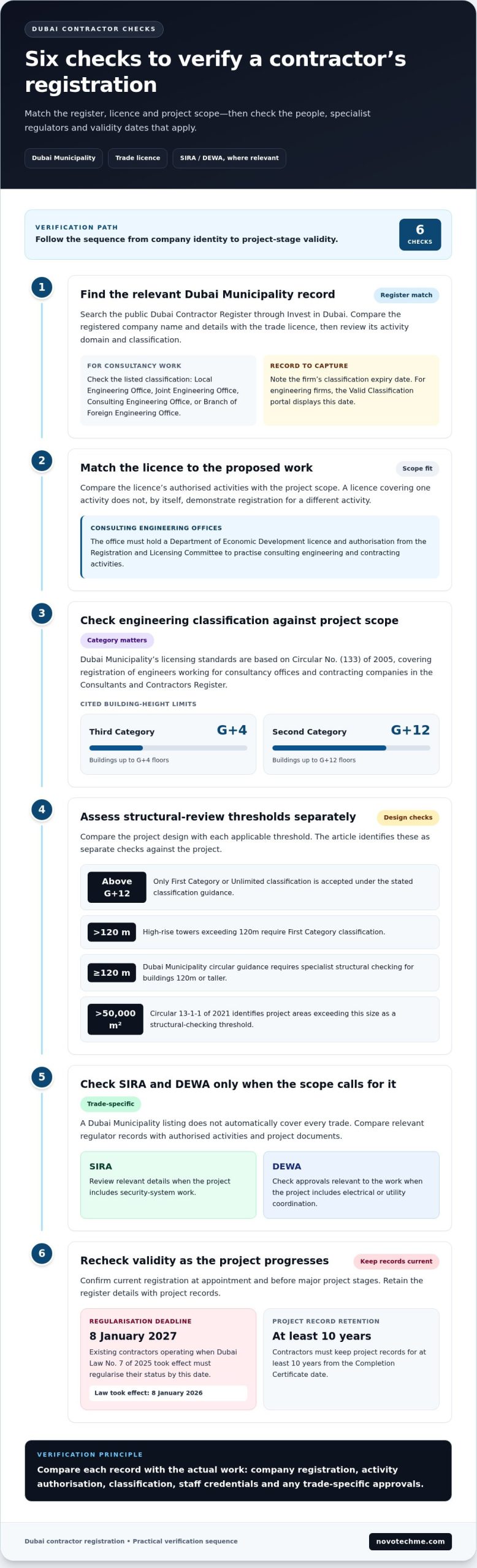
To verify a contractor’s Dubai Municipality registration and expiry date, search the Dubai Contractor Register through Invest in Dubai and compare the listing with the company’s trade licence. For engineering firms, Dubai Municipality’s Engineering Firms with Valid Classification portal displays the classification expiry date.
- Search the relevant Dubai Municipality register. Compare the contractor’s registered name and company details with its trade licence, then review its activity domain and classification. For consultancy work, Dubai Municipality recognises Local Engineering Office, Joint Engineering Office, Consulting Engineering Office and Branch of Foreign Engineering Office classifications. Record the expiry date shown for the firm’s classification.
- Match the trade licence to the work. In Dubai, consulting engineering offices must hold a Department of Economic Development licence and authorisation from the Registration and Licensing Committee to practise consulting engineering and contracting activities. Compare the licence’s authorised activities with the proposed scope. A licence for one activity does not, by itself, demonstrate registration for a different activity.
- Check engineering credentials and standards. Dubai Municipality’s licensing standards are based on Circular No. (133) of 2005, covering the registration of engineers working for consultancy offices and contracting companies in the Consultants and Contractors Register. For an engineering consultancy, compare its classification with the project’s height and scope. The cited classification allows Third Category firms to cover buildings up to G+4 floors, and Second Category firms up to G+12 floors.
- Assess structural review thresholds. For projects above G+12, the stated classification guidance accepts only First Category or Unlimited classification. High-rise towers exceeding 120m require First Category classification. Dubai Municipality circular guidance requires specialist structural checking for buildings 120m or taller; Circular 13-1-1 of 2021 identifies project areas exceeding 50,000 m² as a structural-checking threshold. Treat these as separate checks against the project design.
- Check SIRA and DEWA against the actual scope. If the project includes security-system work, review the relevant SIRA details for that activity. If it includes electrical or utility coordination, check the DEWA-related approvals relevant to the work. Compare each regulator record with the contractor’s authorised activities and project documents, rather than assuming a Dubai Municipality listing covers every trade.
- Recheck validity during the project. Dubai Law No. 7 of 2025 took effect on 8 January 2026. Existing contractors operating when it took effect must regularise their status by 8 January 2027. Confirm current registration at appointment and before major project stages; retain the register details with project records, which contractors must keep for at least 10 years from the Completion Certificate date.
What Is the Dubai Contractor Register?
Dubai Municipality manages the public Dubai Contractor Register, which is integrated with Invest in Dubai. The register forms part of a regulatory framework covering company licensing, activity classification, staff accreditation and professional practice. Review it alongside the trade licence and project documents, since each record answers a different compliance question.
- Match the public listing to the trade licence. Search the contractor’s legal name and compare it with the name on the trade licence. Check the licence holder, authorised activities and current validity details. For consulting engineering offices, the Department of Economic Development issues the licence, while the Registration and Licensing Committee authorises consulting engineering and contracting activities. A trade licence alone does not establish every professional approval.
- Identify the relevant Dubai Municipality classification. Dubai Municipality classifies consulting engineering offices as Local Engineering Office, Joint Engineering Office, Consulting Engineering Office, or Branch of Foreign Engineering Office. Compare the listed category with the firm’s proposed role. A contractor carrying out construction work and a consultancy providing engineering services may require different records, so match the classification to the actual scope.
- Review engineer accreditation and staff certificates. Dubai Municipality’s regulatory framework covers registering engineers working for consultancy offices and contracting companies in the Consultants and Contractors Register. It also covers accrediting staff and renewing Professional Competency Certificates. Request the names and roles of technical staff assigned to the project, then compare their credentials with the services they will perform. This connects company registration to the people responsible for technical work.
- Check Professional Competency Certificates individually. Confirm that technical staff have valid PCCs relevant to their roles, and record expiry dates with the project compliance documents. Employing technical staff without valid PCCs can result in a first-offence fine of AED 1,000-100,000. Repeat offences can result in fines of up to AED 200,000. These penalties make staff accreditation a separate check, not a substitute for company registration.
- Review insurance certificates against the project. Ask for the contractor’s insurance certificate and compare the insured company name, policy period, covered activities and stated project scope with the contract. Check whether the certificate’s dates cover the planned work period, and retain the document with the contract file. An insurance document supports a distinct risk review; it does not prove Dubai Municipality registration or engineer certification.
- Keep the documents together and current. Save the trade licence, register details, classification record, engineer credentials, PCC information and insurance certificate in one project compliance file. Reconcile company names and activity descriptions across the documents. If the contractor’s scope changes, review the activity and staff records against the revised work before relying on the original document set.
A 10-minute contractor verification sequence
A focused first-pass review can take about 10 minutes. Use the government portal and company documents together, since each verifies a different part of the contractor’s status.
- Gather the company details. Start with the contractor’s exact legal name and trade licence. Keep the proposed project activity beside you. Matching these details before searching helps distinguish companies with similar names and gives you a clear reference for the portal checks.
- Search the Dubai Contractor Register. Use the Invest in Dubai platform, where the publicly accessible register is integrated. Search using the company name, then compare the result with the trade licence. Check that the record refers to the same legal entity, not a similarly named business.
- Compare the registered activities. Read the activity domain shown in the register and compare it with the proposed scope. For example, a listing should make sense for the type of contracting work being considered. Treat a mismatch as a reason to clarify which entity will perform the work.
- Review the classification record. Note the contractor’s classification and, for an engineering firm, its displayed expiry date in Dubai Municipality’s Engineering Firms with Valid Classification portal. Compare the category with the project role and scope. Keep the result as a dated record, rather than relying on a search viewed earlier.
- Check the trade licence details. Compare the licence’s company name and authorised activities with the register entry. For consulting engineering offices, Dubai requires a Department of Economic Development licence and authorisation to practise from the Registration and Licensing Committee. The licence and professional authorisation are distinct checks.
- Match technical personnel to the scope. Review the project team’s names and roles against the relevant Professional Competency Certificates. Dubai’s professional practice framework includes staff accreditation and certificate renewal. Record which technical staff are associated with the work, so the company record is not the only credential considered.
- Flag trade-specific approvals. If the scope includes security systems or utility-related work, identify the relevant SIRA or DEWA checks separately. Compare any supporting documents with the contractor’s proposed activities. A Dubai Municipality listing addresses its own registration context; it does not replace trade-specific regulatory checks.
- Save a concise verification file. Keep the search result, trade licence, classification details and relevant staff documents together. Add the date of your review and the project activity assessed. This creates a practical record for procurement and project teams, and makes later comparisons more efficient.
These checks provide a useful screening step within Dubai’s wider regulatory framework. For a complex project, conflicting company details or a change in scope, review the relevant records more closely before making a contracting decision.
Business compliance and credibility
Hiring an unregistered contractor in Dubai can expose the business to regulatory penalties. Operating without Dubai Municipality registration can result in a first-offence fine of up to AED 100,000, while repeat offences in the same year can result in fines of up to AED 200,000. An incorrect classification also creates a practical risk: the register may not show that the contractor’s category fits the proposed project.
- Confirm the company’s registration position. Compare the Dubai Municipality listing with the legal entity named in the contract and trade licence. Check that the listed activities align with the actual work, not just a broad company description. Keep a dated copy of the search result with procurement records. This gives the project team a clear basis for resolving company-name or activity mismatches before appointing the contractor.
- Assess classification against project scope. Review the contractor’s category alongside the work it will undertake. A valid listing does not, by itself, show that every project falls within that classification. For example, an engineering consultancy’s category should correspond with the building scope it is assigned. Record the project requirements and compare them with the classification shown in the register, especially when the scope changes.
- Track transition requirements and dates. Dubai Law No. 7 of 2025 came into effect on 8 January 2026. Existing contractors operating in Dubai when it took effect must regularise their status by 8 January 2027. Dubai Municipality may extend that deadline by another year if necessary. For procurement planning, note the relevant deadline and revisit registration status during the project rather than relying only on an earlier review.
- Use the correct application channel. Dubai Municipality contractor registration, classification applications and Professional Competency Certificate requests are submitted through the Invest in Dubai platform. When an application or classification change affects a project, record what the contractor must submit and which department or activity it concerns. Keep application records separate from approved register details; an application document is not the same as an approved listing.
- Preserve project records and subcontract controls. Contractors in Dubai must retain project documents for at least 10 years from the Completion Certificate date under Law No. 7. Keep contracts, approvals, register records and completion documents organized around that requirement. Also document any proposed subcontracting: unapproved subcontracting can result in a first-offence fine of AED 1,000-100,000. Link each subcontractor’s role to the approved project scope.
- Build a repeatable compliance review. Assign a procurement or project control owner to record the company name, register status, classification, review date and supporting documents. Recheck when the project scope or contracting entity changes. This process helps distinguish a current registration record from older paperwork and gives the project team traceable information for governance reviews.
Confirming a contractor’s register listing
Use the public Dubai Contractor Register to compare a contractor’s listing with its trade licence and project records. The checks below can help distinguish a matching entry from a similar company name or an unrelated permit.
-
Search Dubai Municipality Records Online
Open the Dubai Contractor Register through the Invest in Dubai platform and search using the contractor’s legal company name. Compare the result with the trade licence, including the company identity, activity domain and classification. To confirm registration status, use the listing and check its details against the licence; for engineering firms, consult Dubai Municipality’s Engineering Firms with Valid Classification portal for the classification expiry date.
Have the exact legal name and trade licence details ready, along with any registration number shown on company documents. Check the spelling and legal form before treating an empty search as conclusive. A trading name may differ from the registered company name, so compare the listing with the entity named in the proposed contract.
-
Use a Permit or Project Number
Use the Dubai Municipality permit or project number to identify the project’s approval documents. Compare the company named in those documents with the company in the Dubai Contractor Register. A permit or project number helps locate project paperwork, while the register listing provides the contractor’s registration details.
Check that project documents identify the same legal entity and align with the contractor’s registered activity and the project scope. A permit number alone does not prove registration. If the documents name a different company, establish its role in the project and contract before relying on the permit as evidence of the contractor’s status.
-
Respond to a Missing Register Listing
If your search returns no listing, try the exact legal name on the trade licence and check for spelling or name variations. Compare the licence details with any registration number in the contractor’s documents. Then review the project paperwork, including a permit or project number, to identify the entity named for the work.
A permit, trade licence or application record is not a substitute for an approved register listing. Keep a record of your search terms and the documents reviewed, and resolve any mismatch before relying on the contractor’s status. If company names, activities or classifications differ across records, identify the discrepancy and seek clarification through the appropriate Dubai Municipality process.
NovoTech: Exterior Building Painting Services
NovoTech can support your Dubai project with building painting and related finishes. After completing the contractor checks, match the project scope to the work required, such as Exterior Building Painting Services for building exteriors or Interior Painting Solutions for internal spaces.
For residential projects, Villa Painting & Exterior Finishes cover villa surfaces, while Epoxy Floor Painting & Coatings are suited to flooring projects. Define the scope clearly to match the work required with the appropriate service and project plan.
To discuss a painting or coating project, contact NovoTech through its website.
Move from verification to project planning
Knowing how to verify a contractor’s Dubai Municipality registration gives you a sound starting point for procurement. Next, define the work clearly: identify the surfaces, finish requirements, access conditions and project boundaries that shape the scope. A clear brief helps align the contractor’s approved activities with the work you intend to commission.
For painting projects in Dubai, NovoTech offers Exterior Building Painting Services, Interior Painting Solutions and Villa Painting & Exterior Finishes. Each service suits different property needs, so specify the building type and areas to be painted when planning your project. Clear scope information helps focus the discussion on the work involved.
When your project is ready to move forward, contact NovoTech for help. A considered plan can turn your compliance checks into a more confident project decision.
Frequently Asked Questions
Which Dubai regulator covers your trade?
The relevant regulator depends on the work and the company’s role. Dubai Municipality covers contractor registration and the professional practice of consulting engineering offices and contracting companies. SIRA and DEWA checks apply when a project includes work within their respective regulatory areas. For a mixed-scope project, match each activity to its relevant approval rather than assuming one registration covers every trade.
Who Is Required to Register?
Contracting companies and consulting engineering offices undertaking regulated professional work in Dubai must follow the applicable registration requirements. Law No. 7 of 2025 took effect on 8 January 2026, and existing contractors operating when it took effect must regularise their status by 8 January 2027. Engineering consultancies must register within one year under the transitional provisions of Law No. 14 of 2025. Check which requirement applies to the company’s role.
What is Dubai Municipality’s official contractor or engineering consultancy directory?
Dubai Municipality’s public Dubai Contractor Register is integrated with Invest in Dubai. Use it to find contractor registration details. Engineering firms can also use Dubai Municipality’s Engineering Firms with Valid Classification portal, which displays a firm’s classification expiry date. These resources support separate checks: use the contractor register for the listing and the engineering portal for consultancy classification validity.
How to check a Dubai contractor’s classification, grade, and approved construction activities?
Search the contractor’s listing and compare its classification and activity domain with the proposed project scope. Dubai Municipality’s grade guidance describes Grade 4 as suitable for projects up to AED 5 million and Grade 5 for projects up to AED 2 million. Treat these thresholds as project-fit indicators, then confirm the registered activities align with the work being contracted.
How to confirm a contractor is approved for a specific project type or building height?
Compare the project’s height and scope with the consultancy classification shown in the relevant Dubai Municipality record. The stated guidance allows Third Category consultancies to cover buildings up to G+4 floors, and Second Category consultancies up to G+12 floors. Projects above G+12 require First Category or Unlimited classification; towers exceeding 120m require First Category classification.
How can you confirm a contractor’s registration directly with Dubai Municipality?
Search the Dubai Contractor Register through Invest in Dubai and compare the result with the company’s legal name and trade licence. For an engineering consultancy, check the Engineering Firms with Valid Classification portal for its classification expiry date. If available, use the contractor’s registration number, but also verify that the company identity and activities match the project documents.