A floor can look clean while grease, moisture, and small coating defects are already making it harder to maintain. Epoxy floor maintenance for commercial kitchens works best as a consistent, zone-aware routine, not a one-size-fits-all cleaning task.
Kitchen teams manage food residue, frequent washing, and heavy foot traffic while choosing cleaning methods that suit the installed epoxy system. The wrong products can dull or damage some surfaces over time, while overlooked chips or worn areas may become harder to clean. A clear routine helps staff respond consistently without treating every spill or floor zone the same way.
This guide explains how to structure regular cleaning, manage spills promptly, and inspect the floor for early signs of wear or damage. It also covers what to document and when routine care may no longer be enough to keep the floor serviceable. The goal is a practical process that supports hygiene, protects the flooring system, and helps your team spot problems before they disrupt kitchen operations.
Key Takeaways
- Remove debris and spills before washing, and follow the installed epoxy system’s guidance for products, tools, and dilution.
- Tailor epoxy floor maintenance for commercial kitchens to each zone’s residue, moisture exposure, and traffic rather than applying one routine everywhere.
- Assign clear staff responsibilities for cleaning, spill response, visual checks, and recording recurring issues.
- Track coating changes and cleaning difficulties to distinguish removable residue from signs that need further attention.
- Recognize when persistent damage or recurring maintenance problems may call for a professional review or a new epoxy flooring project.
Why commercial kitchen epoxy floor maintenance matters
In a commercial kitchen, floor care means more than removing visible dirt. It combines routine cleaning, visual inspection, and a timely response when the surface changes. Grease can leave a film, food residue can collect around equipment, and moisture can spread through busy work areas. Without a consistent process, these conditions may make the floor harder to clean and hide early signs of wear.
Consistent cleaning helps keep a kitchen floor serviceable by removing residue before it builds up and making changes easier to spot. Staff should notice whether a spill leaves a persistent mark, water behaves differently in a familiar area, or a coating defect interferes with cleaning.
Epoxy flooring is a system, and its composition and care requirements can vary. The general background on Epoxy helps explain the material, but it doesn’t replace the installed system’s maintenance instructions. Follow the specified guidance for cleaning agents, tools, dilution, and any topcoat. Effective epoxy floor maintenance for commercial kitchens depends on caring for the floor that is actually installed, rather than making assumptions about epoxy as a category.
What puts an epoxy floor under pressure in a commercial kitchen?
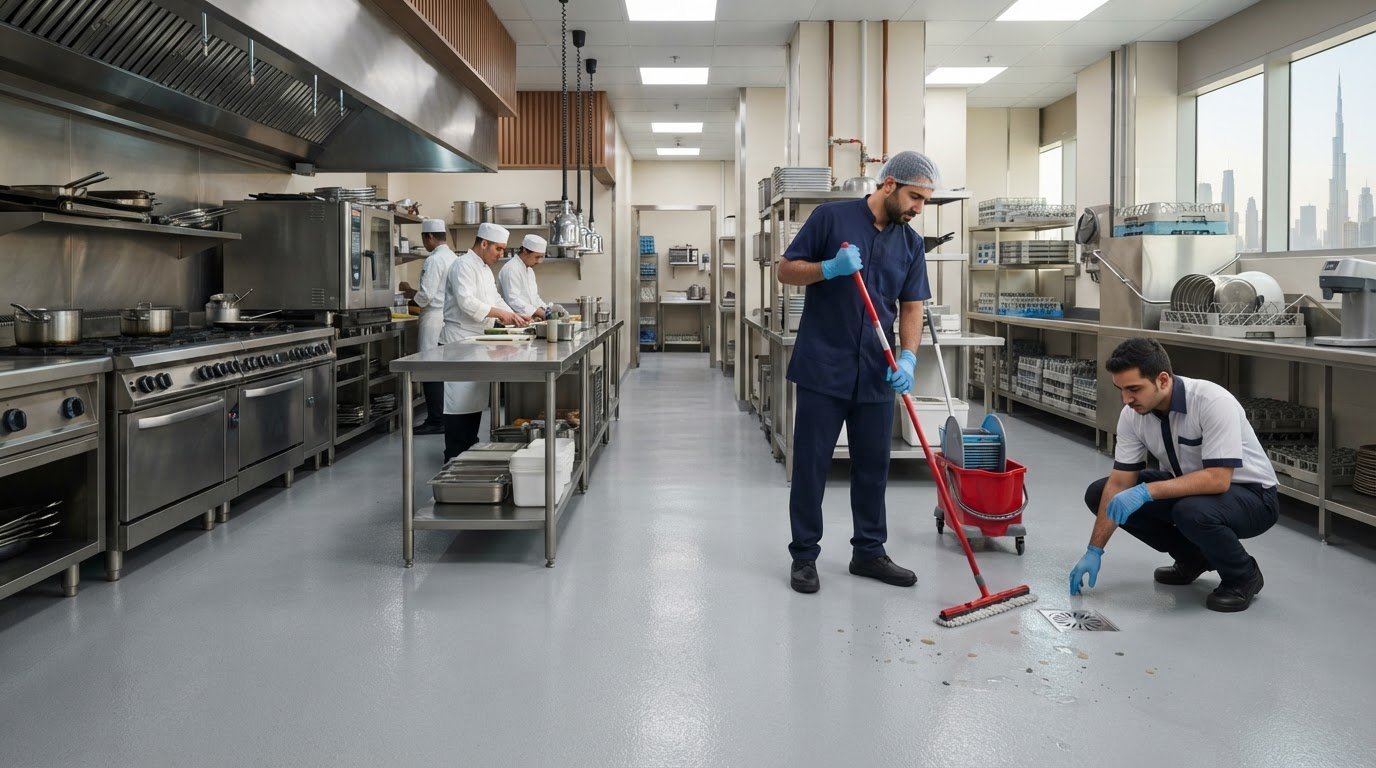
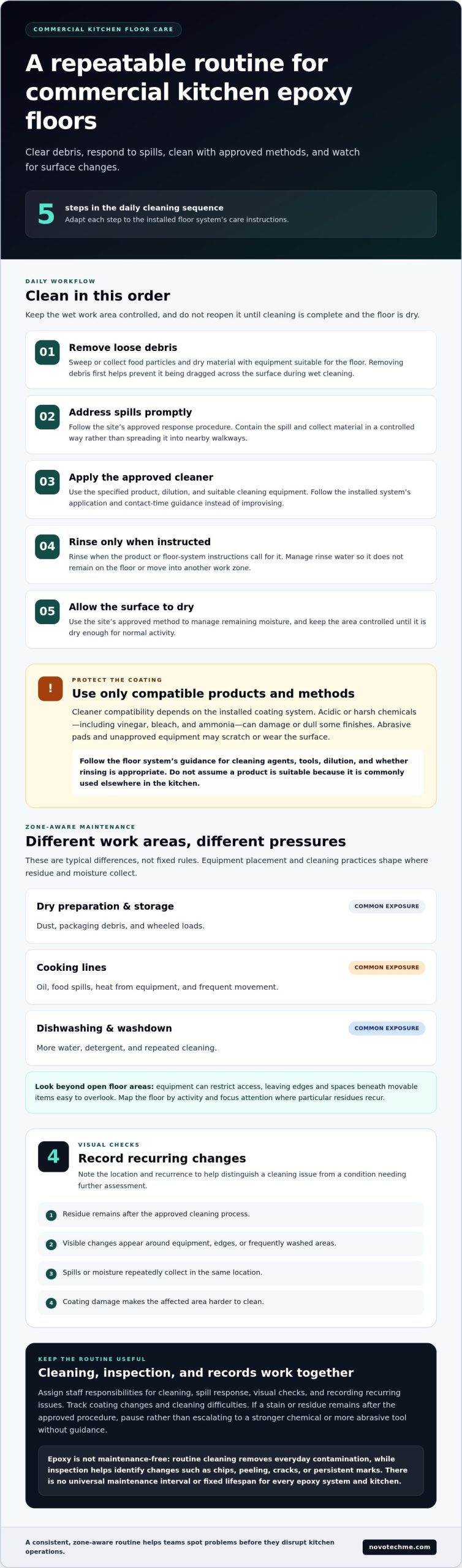
Daily exposure depends on the layout and work pattern. Dry preparation and storage areas may see more dust, packaging debris, and wheeled loads. Cooking lines are more likely to encounter oil, food spills, heat from equipment, and frequent movement. Dishwashing and washdown areas face more water, detergent, and repeated cleaning. These are typical differences, not fixed rules: equipment placement and cleaning practices shape where residue and moisture collect.
Equipment can restrict access, leaving edges and spaces beneath movable items easy to overlook. Mapping the floor by activity helps staff focus on places where particular residues recur.
Is epoxy flooring maintenance-free?
No. A durable coating still needs routine care and observation. Cleaning removes everyday contamination; inspection helps identify changes such as chips, peeling, cracks, or persistent marks. Repair or renewal is a separate response when cleaning no longer resolves the issue or visible damage affects the surface. There’s no universal maintenance interval or fixed lifespan that applies to every epoxy system and kitchen.
During routine checks, staff can record observations such as:
- Residue that remains after the approved cleaning process.
- Visible changes around equipment, edges, or frequently washed areas.
- Spills or moisture that repeatedly collect in the same location.
- Coating damage that makes the affected area harder to clean.
These notes provide a useful baseline for the rest of the maintenance routine. If a concern persists, recording its location and recurrence can help distinguish a cleaning issue from a floor condition that needs further assessment.
How to clean a commercial kitchen epoxy floor without damaging it
A repeatable cleaning sequence helps remove contamination without introducing methods that could affect the coating. Before staff begin, they should follow the site’s safety and hygiene procedures and the installed floor system’s care instructions. Those instructions should guide the choice of cleaner, equipment, dilution, and whether rinsing is appropriate.
Cleaner compatibility depends on the installed coating system, so use only products and methods approved for that floor. Acidic or harsh chemicals, including vinegar, bleach, and ammonia, can damage or dull some finishes. Abrasive pads and unapproved cleaning equipment may also scratch or wear the surface. Don’t assume a product is suitable just because it’s commonly used elsewhere in the kitchen.
A repeatable daily cleaning sequence
Use the steps below as a workflow, adapting them to the installed system’s product guidance and the kitchen’s procedures. Keep staff aware of the wet work area, and don’t reopen it until cleaning is complete and the floor is dry.
- Remove loose debris. Sweep or collect food particles and other dry material with equipment suitable for the floor. Removing debris first helps prevent it from being dragged across the surface during wet cleaning.
- Address spills. Follow the site’s approved response procedure promptly. Contain the spill and collect the material in a controlled way rather than spreading it into nearby walkways.
- Apply the approved cleaner. Use the specified product, dilution, and suitable cleaning equipment. Follow the system guidance for application and contact time instead of improvising.
- Rinse if appropriate. Rinse only when the product or installed-system instructions call for it. Manage rinse water so it doesn’t remain on the floor or move into another work zone.
- Allow the surface to dry. Use the site’s approved method to remove or manage remaining moisture, and keep the area controlled until it’s dry enough for normal activity.
This sequence makes epoxy floor maintenance for commercial kitchens easier to carry out consistently across shifts. It also gives teams a clear point to pause if a stain or residue remains after the approved procedure, rather than escalating to a stronger chemical or more abrasive tool without guidance.
How should staff handle grease and spills?
Grease is easy to spread. Work from the spill’s outer edge towards its centre, using clean materials and the approved procedure, then dispose of contaminated material according to site practice. Keep the affected area controlled while staff clean and dry it. If similar spills or residue keep appearing, record where and when they occur. The pattern may point to a process or equipment issue that needs review.
Food hygiene guidance can help explain why cleanable surfaces and disciplined procedures matter. The FDA Food Safety Regulations are a US reference, not a substitute for UAE requirements or the floor system’s care instructions. If cleaning no longer addresses the floor’s condition, epoxy floor painting services may be relevant as part of a flooring project.
Match epoxy floor maintenance to kitchen zones and cleaning demands
A single floor-care plan can provide consistency, but applying it identically in every area may miss the different residues and moisture patterns created by kitchen work. Zone-aware epoxy floor maintenance for commercial kitchens keeps the core cleaning process consistent while directing staff attention to the conditions that recur in each space. The table is a starting point: actual exposure depends on equipment placement, kitchen layout, and daily operations.
| Kitchen zone | Likely residue | Moisture exposure | Traffic | Cleaning and inspection attention |
|---|---|---|---|---|
| Cooking lines | Grease, oil, and food spills | Spills and cleaning water | Staff movement and equipment access | Remove contamination promptly; check recurring traffic paths for residue or visible surface changes. |
| Dishwashing and washdown areas | Food particles and cleaning residue | Frequent water exposure from work and cleaning | Staff movement around washing tasks | Manage water during cleaning; note recurring pooling and areas that are difficult to dry. |
| Dry preparation | Food debris, powders, and tracked-in grease | Generally less routine water exposure, though spills can occur | Movement between preparation and adjacent work areas | Remove dry debris and watch for contamination tracked in from cooking or washing zones. |
| Storage | Dust, packaging debris, or occasional product spills | Depends on storage activity and cleaning practices | Staff and stored-item movement | Keep access paths clear for cleaning and look for residue or marks around equipment and stored goods. |
Cooking lines and grease-prone work areas
Cooking lines need prompt attention to grease and food residue, especially along routes used repeatedly by staff. If the same patch remains greasy after the approved cleaning process, record its location and check whether equipment, preparation steps, or movement patterns may be contributing. During visual checks, note persistent residue and visible wear or other changes. Recurring contamination may call for a workflow review as well as a review of cleaning practice.
Dishwashing, washdown, and dry-preparation areas
In washdown areas, focus on how water is managed during cleaning and whether the area dries as expected. Record repeated pooling or difficulty clearing rinse water for facilities review. Dry-preparation zones need a different emphasis: remove food debris and prevent grease from being tracked in from nearby cooking areas. Storage areas also benefit from clear access so staff can clean and observe the floor beneath and around routine activity.
Uniformity has a place: staff should follow one controlled process for approved products and equipment. But attention should vary by zone. A cooking-line spill and recurring moisture near dishwashing don’t present the same cleaning challenge. Adjusting where staff focus, what they observe, and what they record makes the routine more useful without improvising a different chemical or method for each area. Use recurring residue, moisture, or surface changes to guide facilities review and refine the zone plan as kitchen operations change.
Build a practical inspection and staff maintenance routine
A workable floor-care routine depends on clear ownership. Cleaning staff can complete assigned cleaning and note visible changes; kitchen staff can contain spills and report repeat incidents; a supervisor or facilities lead can review records and route concerns through the established maintenance process. Define who receives reports and what information they need. This keeps observations from disappearing between shifts and helps distinguish an isolated spill from a recurring condition.
Set inspection points around the kitchen’s actual operating pattern, such as after cleaning, during a scheduled facilities check, or when staff report a change. These are examples, not a universal interval. Choose a cadence that fits site procedures and the floor system’s care guidance, then reassess it if equipment, workflow, or cleaning demands change. Consistent epoxy floor maintenance for commercial kitchens depends on staff knowing what to look for and where to report it.
What should staff check during routine floor inspections?
Use a visual check to spot cracks, peeling, chips, discolouration, or changes in surface texture. Note standing water, recurring residue, and areas that remain difficult to clean after the approved process. Staff shouldn’t attempt an improvised repair or change the cleaning method to hide a defect. Record the location and report the observation through the facility’s established maintenance process, especially if it affects routine cleaning.
How can a kitchen team keep useful maintenance records?
Keep the record simple enough to complete consistently. A paper log or site-approved digital record can capture the area, what staff observed, the cleaning action taken, and any follow-up required. Entries should describe what was seen rather than guess at the cause. For example, “residue returns beside the cooking line after cleaning” is more useful than an unverified diagnosis.
- Area: Identify the kitchen zone and precise location.
- Observation: Record visible changes, recurring residue, standing water, or cleaning difficulties.
- Action: Note the cleaning procedure used and whether the issue remained.
- Follow-up: State who was notified and what review is pending under site procedures.
Review entries for patterns. Repeated pooling in one area, residue that returns along the same route, or a coating change that appears in successive observations may warrant facilities review. A record helps staff communicate the pattern without assuming whether it stems from operations, cleaning, or floor condition.
Keep the installed floor-system details and product-care instructions accessible to the staff responsible for cleaning and facilities decisions. This makes it easier to align routine practice with the specified system and share relevant context if concerns need further assessment. For broader context on flooring systems, see NovoTech’s epoxy floor coating guide. If the log points to a floor condition that routine care isn’t resolving, NovoTech’s epoxy flooring services may be a suitable project option.
When maintenance is not enough: plan the next epoxy flooring step
Routine cleaning can remove grease, food residue, and other surface contamination. It won’t correct persistent peeling, cracks, chips, or surface changes that continue to make an area difficult to clean. The distinction matters: repeating an approved cleaning process may be appropriate for removable residue, but stronger chemicals or abrasive tools can risk further damage without addressing the underlying concern.
Use inspection notes to determine when a concern needs a closer look. Record where the issue appears, what it looks like, whether it returns after cleaning, and how it affects upkeep. Share that information through the facility’s maintenance process and arrange a professional review when the problem persists or spreads. A useful record gives the next decision a basis beyond memory or guesswork.
Signs that routine cleaning may not resolve the issue
Pay attention to coating that continues to peel, visible cracks or chips, discolouration, or patches that remain difficult to clean after the approved procedure. A single observation may not explain the cause, so avoid diagnosing it or attempting an improvised repair. If the same change recurs, document it and escalate it for assessment instead of applying increasingly aggressive cleaning methods.
A review can help distinguish a cleaning challenge from a floor condition that may require a flooring project. Keep the installed system’s care instructions and the maintenance log available, and note any operational changes in the affected area. That context supports a more informed discussion about next steps. Routine epoxy floor maintenance for commercial kitchens remains useful, but it should not be treated as a substitute for addressing persistent visible damage.
How NovoTech supports epoxy floor projects in the UAE
NovoTech provides Epoxy Floor Painting in Dubai, Sharjah, and the UAE. With 30+ years of experience and over 250 projects delivered, the company brings relevant project experience to epoxy flooring work. A Dubai Studio City project included epoxy work within a G+4 package covering internal, exterior, and Terraco work.
When maintenance no longer addresses the floor’s condition, an epoxy flooring project may be the right next step. Discuss your epoxy flooring project with NovoTech.
Make the next flooring decision with confidence
A useful maintenance record can do more than document problems. Over time, it gives your team a clearer basis for deciding whether a cleaning adjustment is enough or whether the floor’s condition calls for a project review. Keep observations connected to the area, operating conditions, and steps already taken. That context helps frame a practical next decision instead of relying on a one-off impression.
Use your epoxy floor maintenance for commercial kitchens routine to understand how the installed floor responds to real kitchen activity. If persistent defects or cleaning challenges continue, bring the recorded observations into a discussion about the flooring scope and suitable next steps.
NovoTech provides Epoxy Floor Painting in Dubai, Sharjah, and the UAE, supported by an in-house team of 30 experts and tradespeople. Discuss your commercial epoxy flooring project with NovoTech.
A well-informed plan starts with what your team sees every day. Use those insights to move forward with confidence.
Frequently Asked Questions
Can I use bleach to clean a commercial kitchen epoxy floor?
Use bleach only if the installed floor system’s care instructions identify it as suitable. Bleach formulations and coating systems differ, so don’t rely on general kitchen-cleaning habits. Follow the facility’s sanitation procedures and documented floor-care guidance. If compatibility isn’t addressed, choose a documented alternative approved for the system. For epoxy floor maintenance for commercial kitchens, record repeated stains or cleaning difficulties and share them with facilities staff rather than increasing the cleaner’s concentration.
Can a commercial kitchen epoxy floor be pressure-washed?
Don’t assume pressure washing is suitable for every epoxy floor. The system, current surface condition, nearby joints, and drains can all affect whether this method is appropriate. Follow the installed system’s instructions and the facility’s cleaning protocol. If pressure washing isn’t addressed in the guidance, use an approved method instead. For example, note whether water collects near a joint or drain during routine cleaning and raise the observation with facilities staff.
Can staff use abrasive pads on an epoxy kitchen floor?
Staff should use abrasive pads only if the installed system’s care instructions approve them. A pad that removes a stubborn mark could also change the surface, so match tools to both the coating guidance and the residue. If a mark remains after the approved method, staff should record its location and report it rather than switching to a harsher pad. This keeps the response consistent and gives facilities staff a clear issue to assess.
What should kitchen staff do if they notice a chip or peeling?
Staff should follow the kitchen’s established safety process, record the location and visible condition, and notify the responsible facilities contact. Don’t treat cleaning as a repair or apply an improvised patch. If the area is close to a workstation or a route used during service, include that context in the report so the facility can decide how to manage the area. A review can assess whether the issue is isolated or recurring without assuming its cause.
Does a commercial kitchen need to close while its epoxy floor is being repaired?
Not necessarily. The operational impact depends on the affected area, planned work, and requirements for returning the surface to use. Before scheduling, map the work zone against staff routes, equipment access, and food-preparation activity. NovoTech provides epoxy floor painting projects suited to the site scope. Coordinate operational arrangements with the facility team and follow the system-specific instructions for the planned work.
How should we handle water that keeps pooling on an epoxy kitchen floor?
Record the location, when pooling appears, and whether it returns after the area is cleaned. Follow the site’s wet-floor procedures while facilities staff review the observation. Note whether pooling occurs during a particular task or after a cleaning operation, without assuming that either is the cause. Repeated pooling shouldn’t be treated as a cleaning issue alone; share the pattern with facilities staff and avoid making unverified changes to drains or the floor.