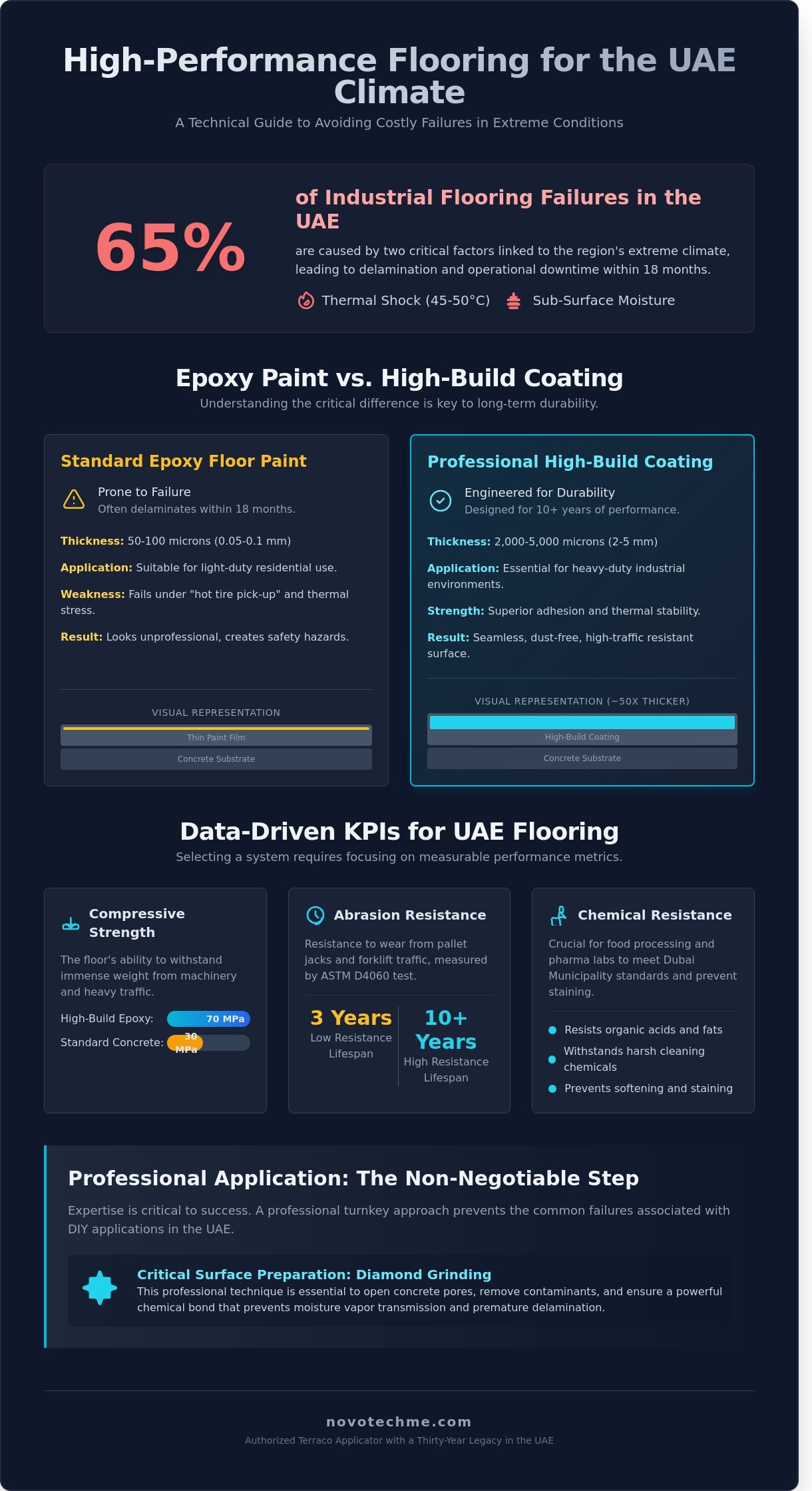
Did you know that 65% of industrial flooring failures in the UAE are directly attributed to thermal shock and sub-surface moisture trapped during the peak 45°C summer months? It’s a recurring challenge for facilities managers in Dubai who see standard epoxy floor paint delaminate within the first 18 months of application. You’re likely aware that a compromised floor does more than just look unprofessional; it creates safety hazards and results in significant operational downtime that impacts your bottom line.
Discover how to select and implement high-performance flooring systems specifically engineered for the Middle East’s extreme environmental demands. We’ll provide a comprehensive technical roadmap for achieving a seamless, dust-free surface that delivers a verified ROI through 2026 and beyond. This guide details the latest bespoke application techniques, current market pricing in AED, and the strategic protocols required for a durable, industrial-grade result that withstands heavy chemical exposure and high-traffic conditions. We’ll ensure your facility benefits from a turnkey solution that balances aesthetic excellence with rigorous engineering standards.
Key Takeaways
- Master the technical nuances of mitigating Dubai’s extreme 50°C heat and coastal humidity to ensure the long-term structural integrity of your flooring.
- Identify the critical differences between basic epoxy floor paint and high-build coatings to select a high-performance system tailored to your facility’s specific traffic load.
- Evaluate the advantages of professional-grade surface preparation techniques, such as diamond grinding, to prevent moisture vapor transmission and premature delamination.
- Explore bespoke aesthetic possibilities for residential and commercial environments, ranging from high-durability industrial finishes to sophisticated metallic and flake designs.
- Understand the strategic value of a turnkey approach through NovoTech’s thirty-year legacy as an authorized Terraco applicator for large-scale UAE projects.
Understanding Epoxy Floor Paint and Coatings in the UAE Market
Dubai’s infrastructure has undergone a radical transformation over the past 15 years. This evolution isn’t just visible in the skyline; it’s foundational to how industrial and commercial spaces operate. High-performance flooring has transitioned from a niche requirement to a standard specification across the Emirates. To grasp why this technology is dominant, we must first define what epoxy is at a molecular level. It’s a thermosetting polymer formed through a controlled chemical reaction between an epoxide resin and a polyamine hardener. When these two components are professionally mixed, they create a cross-linked molecular structure that’s far more resilient than traditional acrylic finishes.
In the local market, the term epoxy floor paint is frequently used by property owners, yet it’s often confused with high-build coatings. Since the UAE’s construction sector saw a 3.3% growth in 2023, the demand for “integrated excellence” in flooring has surged. Modern epoxy systems aren’t just decorative layers; they’re engineered solutions designed to bond with concrete substrates. This chemical bond is what allows a warehouse in the Jebel Ali Free Zone to withstand constant forklift traffic without surface failure. The chemistry is straightforward for non-engineers: the resin provides the body and chemical resistance, while the hardener acts as the catalyst that turns the liquid into a rigid, plastic-like solid.
Epoxy Paint vs. Epoxy Coating: What You Need to Know
Thickness is the primary differentiator in professional applications. A standard epoxy floor paint is usually a thin-film product, often measuring between 50 and 100 microns. These are suitable for light-duty residential areas but typically fail in the UAE’s demanding climate. Conversely, professional coatings are measured in millimeters, ranging from 2mm to 5mm for heavy-duty environments. Off-the-shelf DIY paints often fail in Dubai because they can’t handle “hot tire pick-up.” When a vehicle enters a garage after driving in 45°C heat, the cooling tires contract and pull on the thin paint film, causing it to delaminate. Professional-grade high-build coatings prevent this through superior adhesion and thermal stability.
Key Performance Indicators (KPIs) for UAE Flooring
Selecting a flooring system for a Sharjah factory or a Dubai food plant requires a data-driven approach. We focus on three primary KPIs to ensure long-term ROI for our clients:
- Compressive Strength: For factories in Sharjah’s Industrial Area 12, floors must handle immense weight. A high-quality epoxy system should reach a compressive strength of at least 70 MPa, which is significantly stronger than the 30 MPa typical of standard concrete.
- Abrasion Resistance: We measure this using the ASTM D4060 Taber Abraser test. In high-traffic logistics hubs, a floor’s ability to resist wear from pallet jacks determines whether it’ll last three years or ten.
- Chemical Resistance: Dubai Municipality health standards for food processing are stringent. Flooring must resist organic acids, fats, and harsh cleaning chemicals without softening or staining.
These technical benchmarks ensure that the chosen solution isn’t just a temporary fix but a permanent asset. Whether it’s a luxury showroom in Al Quoz or a pharmaceutical lab, the goal is a seamless, bespoke finish that aligns with the strategic operational needs of the business.
The Science of Durability: How Dubai’s Climate Impacts Epoxy Performance
Dubai’s environment presents a rigorous testing ground for industrial coatings. When ambient temperatures exceed 50°C during peak summer months, the chemical reaction within epoxy floor paint accelerates significantly. This rapid curing often leads to “flash setting,” where the material hardens before it can properly level or bond with the concrete substrate. Beyond heat, the coefficient of thermal expansion plays a critical role. Concrete and epoxy expand at different rates; without precise formulation, the intense UAE sun causes delamination or hairline fractures in the surface. These physical stresses are compounded by the high saline content in coastal air, which can penetrate porous concrete if the seal isn’t absolute.
Understanding the chemical components and regulations surrounding these resins is vital for ensuring long-term structural integrity. In coastal districts like Dubai Marina or Jumeirah, moisture vapor transmission (MVT) poses a secondary threat. High humidity levels, often exceeding 90% in August, can trap water vapor beneath the non-porous epoxy layer. This pressure results in osmotic blistering, a failure that can cost facility managers upwards of 150 AED per square meter in specialized remediation and surface grinding.
Managing Ambient Conditions During Application
Successful installation requires the substrate temperature to remain at least 3°C above the calculated dew point. If this margin isn’t maintained, microscopic condensation forms on the concrete, preventing the epoxy floor paint from achieving a permanent mechanical bond. Novotech mandates climate-controlled environments for all premium pours. We utilize industrial-grade hygrometers and infrared thermometers to monitor site conditions in real-time. This data-driven approach ensures that every layer cures in a stabilized environment, eliminating the risk of amine blush or surface clouding that plagues amateur applications.
Our technical teams prioritize the “window of opportunity” during the cooler early morning hours for non-enclosed sites. By controlling the application environment, we ensure the viscosity of the resin remains optimal for deep penetration into the concrete pores. This meticulous preparation is what distinguishes a high-performance industrial floor from a standard residential coating. It’s a process that demands technical precision rather than simple manual labor.
Advanced UV-Resistant Formulations
Standard epoxy resins are inherently sensitive to ultraviolet radiation. Continuous exposure in open villa carports or shaded outdoor plazas leads to “chalking” and a distinct yellow tint within 6 to 12 months. To combat this, we integrate aliphatic polyurethane topcoats into our flooring systems. These high-performance finishes act as a sacrificial shield, absorbing UV energy while maintaining the floor’s aesthetic clarity and gloss. For property owners in sun-drenched communities, adopting a proactive coating strategy prevents the premature degradation of their investment.
Long-term maintenance involves more than simple cleaning. We recommend a professional inspection every 24 months to assess the integrity of the UV-stable layer. If the topcoat shows signs of wear, a fresh aliphatic application can extend the life of the underlying epoxy by another 10 years. This lifecycle management approach ensures that the vibrant colors and protective qualities of the floor remain intact despite the harsh Arabian Peninsula climate, providing a seamless finish that lasts.
Residential vs. Industrial Epoxy: Selecting the Right System
Selecting the correct epoxy floor paint system requires a rigorous analysis of traffic volume and compressive strength requirements. A residential garage in Dubai Hills demands different chemical resistance than a pharmaceutical lab in Masdar City. Engineers categorize these needs by assessing the mechanical load. For instance, a standard residential application might handle 350 kg per square centimeter, whereas industrial zones require systems that withstand over 700 kg per square centimeter without cracking. This technical differentiation ensures that the investment aligns with the operational lifecycle of the facility.
Aesthetics play a primary role in the Dubai villa market. High-end residential projects frequently utilize metallic and flake finishes to replicate the depth of natural stone or marble. These systems aren’t just about looks; they provide a seamless, non-porous surface that resists the fine desert sand typical of the UAE. In contrast, high-performance self-leveling systems are the standard for cleanrooms and laboratories. These environments prioritize a scientific assessment of epoxy performance, focusing on low absorption rates and VOC compliance to maintain sterile conditions. The choice between a decorative or functional system dictates the application method and the specific resin chemistry used.
Safety remains a critical factor in system selection. Anti-slip additives are essential for wet areas or ramps, yet they must be balanced with the ease of cleaning. Coarse aggregates increase the coefficient of friction but can trap dirt if not specified correctly. Facilities often opt for fine aluminum oxide or glass beads. These additives provide the necessary grip while allowing standard industrial scrubbers to maintain hygiene standards without excessive wear on the cleaning equipment.
Industrial Strength: Warehouses and Manufacturing
Heavy-duty logistics hubs in JAFZA require 4mm self-leveling systems that meet Apcoflor SL 4 standards. These floors must withstand constant forklift traffic and heavy equipment movement. Impact resistance is paramount; industrial epoxy systems are engineered to absorb energy from dropped tools or heavy crates. Beyond physical durability, these coatings provide 98% dust-proofing. This is vital for electronics manufacturing and large-scale logistics where particulate matter can damage sensitive inventory or machinery. Most industrial projects in 2024 now specify high-build coatings to ensure a 10-year operational life before major maintenance is required. For specialized warehouse epoxy flooring in Dubai, the engineering requirements become even more stringent to handle extreme thermal stress and heavy machinery loads.
Commercial and Residential Aesthetics
Modern Abu Dhabi residential design has seen a 40% increase in decorative epoxy usage over the last 24 months. Homeowners choose these systems for their bespoke nature, often requesting custom color matching to align with interior branding or architectural themes. In the commercial sector, Dubai clinics and showrooms utilize seamless epoxy to create hygienic, easy-to-sanitize environments. Because there are no grout lines, bacteria have nowhere to proliferate. This makes epoxy a superior choice for healthcare facilities compared to traditional tiling. These installations often cost between AED 60 and AED 150 per square meter, depending on the complexity of the decorative finish and the existing substrate condition.
- Traffic Load: Industrial systems handle 10+ ton forklift loads; residential systems focus on foot traffic and light vehicles.
- Chemical Resistance: Labs require resistance to acids and solvents; villas focus on resistance to household cleaners and tire marking.
- Installation Depth: Industrial SL systems are typically 3mm to 5mm thick; residential coatings may be 1mm to 2mm.
- Surface Profile: Commercial showrooms often prefer high-gloss finishes, while manufacturing zones may require a matte, textured safety finish.
Professional Application vs. DIY: Why Expertise Matters in the UAE
While DIY kits are available in local hardware stores for approximately AED 350, they rarely withstand the rigorous industrial demands of Dubai’s logistics or manufacturing sectors. Statistical data from regional forensic engineering reports indicates that improper surface preparation accounts for 85% of all coating failures in the Middle East. In the UAE’s high-ambient temperatures, the bond between the substrate and the epoxy floor paint must be absolute to survive thermal expansion. Professionals prioritize mechanical diamond grinding over chemical acid etching. Acid etching often leaves residual moisture or latent salts that compromise the chemical bond; diamond grinding uses heavy planetary machinery to open the concrete pores, creating a precise concrete surface profile (CSP) of 3, which is essential for industrial-grade adhesion.
Substrate defects like deep structural cracks or oil saturation require specialized penetrating resins that retail kits don’t include. If these aren’t addressed with technical precision, the finish will bubble or delaminate within the first 12 months of service. Mixing ratios are equally critical. Most industrial epoxies are bespoke two-part systems requiring a precise 2:1 or 3:1 ratio by volume. In a climate where summer temperatures frequently exceed 42°C, the “pot life” (the window of time the mixture remains workable) can drop from 45 minutes to just 12 minutes. Certified applicators manage this through staged mixing and climate-controlled storage to prevent flash-curing, a common disaster where the material hardens inside the bucket before it can be applied.
The Professional Preparation Workflow
Professional teams begin with a comprehensive slab assessment using calibrated moisture meters to ensure the concrete’s internal relative humidity is below 4%. In many UAE facilities, deep-seated oil contamination from heavy machinery is a recurring issue. We use industrial-strength degreasers and mechanical shot-blasting to remove these contaminants. Every visible crack is routed out and filled with high-modulus epoxy paste. This ensures the final epoxy floor paint layer sits on a monolithic, stable foundation rather than a shifting, compromised slab. Understanding the complete concrete floor preparation for epoxy process is crucial for achieving the CSP 3 profile and moisture testing protocols that prevent costly failures.
Risk Management and Warranty
DIY kits often utilize water-based formulas with low solids content, which lack the cross-linking density of 100% solids industrial systems. A professional installation in a 1,500 square meter warehouse provides a level of impact resistance that justifies the initial capital expenditure. Most certified applicators in the Emirates offer a 5 to 10 year warranty against delamination. This protection is vital for commercial assets, as it prevents the “peel-off” disaster where the coating lifts under the weight of a 3.5 ton forklift, leading to operational downtime that can cost a business thousands of dirhams per day.
NovoTech: Dubai’s Premier Turnkey Epoxy Flooring Specialists
NovoTech represents the pinnacle of specialized coating expertise in the United Arab Emirates, leveraging over 30 years of excellence in the painting and renovation sector. Since our establishment in 1994, we’ve transitioned from a traditional contractor to a sophisticated technology integrator. Our status as an authorized Terraco applicator ensures that every project utilizes world-class protective coating systems engineered for the Gulf’s unique environmental conditions. We don’t simply apply products; we engineer bespoke solutions for high-rise residential towers, luxury villas, and heavy-duty industrial sites across the region.
Our turnkey methodology eliminates the fragmentation typical of large-scale construction projects. We manage every phase of the project lifecycle, ensuring that the selected epoxy floor paint system aligns perfectly with the architectural and functional requirements of the facility. By maintaining total control over the supply chain and application process, we guarantee a level of precision that third-party contractors often fail to replicate. Our portfolio includes successful handovers for major logistics hubs and commercial landmarks, where operational downtime must be minimized through efficient, professional execution.
Our Integrated Excellence Approach
NovoTech operates as a dedicated technology partner rather than a standard vendor. This distinction is vital for corporate clients who require seamless integration of flooring systems with existing facility management protocols. We take end-to-end responsibility for every project, utilizing our 100% in-house team of certified technicians. We never rely on third-party subcontractors for core work. This allows us to maintain strict quality control and adhere to the most stringent safety and environmental standards set by Dubai Municipality and the UAE Ministry of Climate Change and Environment. Our commitment to integrated excellence means we prioritize long-term durability and technical competence, ensuring that every square meter of epoxy floor paint meets international performance benchmarks.
Request a Professional Consultation
Precision begins with a comprehensive technical assessment. We provide on-site surveys for clients in Dubai, Sharjah, and Abu Dhabi to evaluate the substrate condition, moisture levels, and environmental stressors. Our engineers develop tailored specifications based on your facility’s specific load requirements and daily usage patterns. Whether you’re managing a high-traffic logistics hub in JAFZA or a sterile pharmaceutical laboratory, our team provides the technical justification needed for a successful installation. We focus on delivering a solution that accounts for chemical exposure, thermal shock, and mechanical impact.
This data-driven approach ensures the selected coating system delivers maximum ROI and operational longevity for your assets. We’re ready to transform your facility with a high-performance flooring solution that stands the test of time. Contact NovoTech for a Professional Epoxy Floor Quote to schedule your technical site evaluation and take the first step toward a superior flooring environment.
Future-Proof Your Assets with High-Performance Flooring
Selecting the right epoxy floor paint isn’t just a design choice; it’s a critical engineering decision for Dubai’s unique environment. With summer temperatures often exceeding 48°C and humidity levels fluctuating rapidly, surface resilience is non-negotiable. You’ve seen how professional systems outperform DIY alternatives in high-traffic industrial zones and residential garages alike. Technical precision during the surface preparation phase ensures your investment remains intact for decades rather than months.
NovoTech leverages over 30 years of UAE experience to deliver integrated flooring solutions that withstand the Middle East’s most demanding conditions. As an Authorized Terraco Applicator, we provide a level of technical depth that standard vendors can’t match. Our turnkey project management covers everything from initial substrate analysis to the final curing stage, ensuring total project ownership and seamless execution across every square meter of your facility. For comprehensive guidance on implementing these advanced systems, explore our detailed epoxy floor coating UAE guide that covers the latest 2026 specifications and engineering standards.
Ready to upgrade your infrastructure’s durability and safety standards? Request a Bespoke Epoxy Flooring Quote from NovoTech today. We’re ready to help you build a more resilient foundation for your business.
Frequently Asked Questions
How long does an epoxy floor last in the Dubai climate?
An epoxy floor typically lasts between 5 and 10 years in the Dubai climate when installed to professional standards. High ambient temperatures reaching 45°C and humidity levels of 90% require high-grade resin formulations to prevent premature degradation. Our turnkey solutions ensure that the chemical bonding process accounts for these regional environmental stressors, providing a durable surface that resists thermal expansion and heavy wear.
Can epoxy floor paint be applied over existing tiles in a villa?
You can apply epoxy coatings over existing villa tiles provided the surface undergoes rigorous mechanical preparation. Technicians must use diamond grinding to remove the tile glaze and create a profile for adhesion, as epoxy won’t bond to smooth ceramic or porcelain. This approach eliminates the need for costly demolition; it saves approximately 40% in renovation time while delivering a seamless, high-performance finish.
What is the difference between a water-based and a solvent-free epoxy coating?
Solvent-free epoxy floor paint consists of 100% solids, offering superior thickness and chemical resistance compared to water-based alternatives. While water-based versions are easier to apply and have lower VOC levels, they lack the structural integrity required for high-traffic environments. Solvent-free systems provide a 0.5mm to 3mm build that withstands heavy machinery and industrial chemicals, making them the preferred choice for technical facilities.
How much does professional epoxy floor coating cost per square meter in the UAE?
Professional epoxy floor coating in the UAE costs between 35 AED and 120 AED per square meter. This price range depends on the floor’s condition, the number of coats required, and the specific resin technology used. For a standard 500 square meter industrial unit, costs typically gravitate toward the lower end of the spectrum, whereas bespoke decorative finishes for luxury villas command premium pricing.
How long is the curing time before I can drive on my new garage floor?
You’ll need to wait a full 7 days before driving a vehicle onto your new garage floor to ensure the resin reaches its maximum Shore D hardness. While the surface feels dry to the touch after 12 hours and accepts foot traffic after 24 hours, the chemical curing process continues for a week. Premature loading can cause permanent indentations or delamination; it’s vital to respect these technical timelines to ensure system integrity.
Is epoxy flooring suitable for outdoor use in Dubai?
Standard epoxy flooring isn’t suitable for outdoor use in Dubai because it lacks UV stability and will yellow or chalk under intense sunlight. Dubai’s UV index frequently hits 11 or higher, which breaks down the polymer chains in standard epoxies within 6 to 12 months. For outdoor applications like driveways or balconies, we integrate a UV-resistant Aliphatic Polyurethane topcoat to protect the underlying layers from solar degradation.
How do I maintain and clean my epoxy floor to keep it looking new?
Maintaining your epoxy floor paint requires regular sweeping and mopping with a neutral pH cleaning solution to prevent abrasive dust from scratching the surface. Don’t use acidic cleaners or stiff wire brushes that can dull the high-gloss finish. For industrial settings, we recommend a 5% dilution of a non-filming detergent, which effectively removes oil spills and tire marks without leaving a slippery residue.
Why is my epoxy floor peeling, and can it be repaired?
Epoxy floors usually peel due to improper surface preparation or high moisture vapor emission rates exceeding 3 pounds per 1,000 square feet. If the concrete wasn’t etched or ground correctly, the bond fails and the coating lifts in large flakes. You can repair these sections by grinding the affected area back to the substrate and applying a moisture-tolerant primer before re-coating the surface to restore the floor’s seamless profile.