With the implementation of Law No. (3) of 2026, building owners now face potential fines of up to AED 1,000,000 for failing to meet Dubai’s updated structural and technical safety standards. Maintaining an asset in an environment where summer temperatures frequently exceed 50°C requires more than a simple aesthetic refresh; it demands high-performance protective coatings for buildings in Dubai. We recognize the frustration of seeing premium facades succumb to rapid chalking, salt-induced corrosion, and concrete carbonation within just a few years. Standard decorative paints simply cannot withstand the unique atmospheric pressures of the UAE’s coastal and desert landscapes.
This technical guide demonstrates how advanced coating systems safeguard your architecture against extreme UV radiation and humidity. By integrating high-SRI thermal-reflective technologies, we help you achieve the mandatory 20% energy reduction required for Al Sa’fat Silver ratings while extending maintenance cycles to over ten years. We’ll provide a comprehensive look at the latest anti-corrosive solutions and low-VOC materials that preserve structural integrity, lower operational costs, and ensure your property remains fully compliant with the latest municipal regulations.
Key Takeaways
- Understand why specialized protective coatings for buildings in Dubai are essential to counteract the accelerated polymer degradation caused by the UAE’s extreme UV radiation and high salinity.
- Identify the specific performance advantages of acrylic elastomeric and polyurethane systems for long-term facade and horizontal surface protection.
- Learn how thermal-reflective coating technologies facilitate compliance with Al Sa’fat Silver ratings by achieving mandatory energy reduction targets.
- Evaluate the lifecycle ROI of engineered coating systems that extend maintenance intervals to 15 years, significantly lowering recurring operational costs compared to standard paints.
- Recognize the critical role of rigorous surface preparation and environmental monitoring in ensuring the technical integrity and long-term adhesion of advanced coating systems.
The Science of Asset Protection: Why Dubai Buildings Require Specialized Coatings
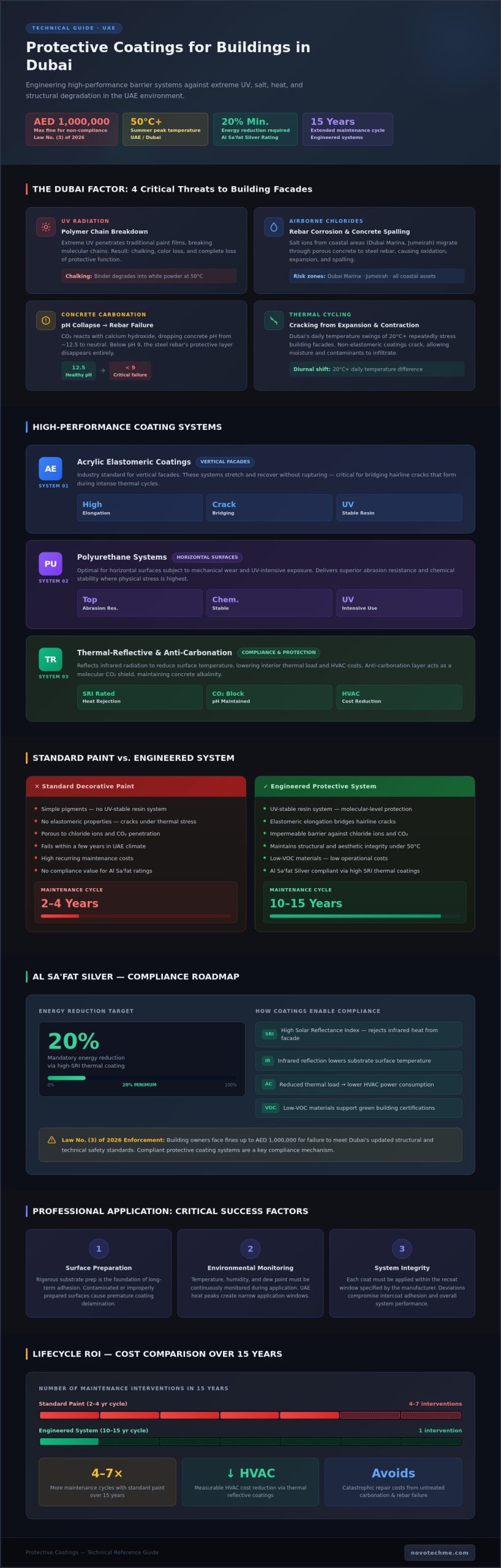
Protective coatings are not merely aesthetic finishes. They are engineered, high-performance layers designed to provide a barrier against chemical and physical degradation. Understanding The Science of Protective Coatings is vital for asset managers who need to justify the transition from standard decorative paints to specialized systems. In the context of the UAE, standard polymers often fail because they weren’t formulated for the “Dubai Factor.” This refers to the extreme levels of UV radiation that penetrate traditional paint films, causing the molecular chains to break down. When these polymers degrade, the coating loses its ability to protect the underlying substrate, leading to premature failure and increased maintenance costs.
The geographical location of assets adds another layer of complexity. For buildings in coastal areas like Dubai Marina or Jumeirah, airborne chlorides present a constant threat. These salt ions migrate through porous concrete, eventually reaching the internal steel reinforcement. Once the chloride threshold is exceeded, the rebar begins to oxidize and expand, causing the concrete to spall. High-performance protective coatings for buildings in Dubai must act as an impermeable shield against these ions. Additionally, these coatings must manage intense thermal expansion cycles. Dubai experiences diurnal temperature shifts of 20 degrees or more. If a coating isn’t sufficiently elastomeric, it will crack as the building structure expands and contracts, allowing moisture and contaminants to enter.
Combatting Concrete Carbonation and Rebar Corrosion
Concrete carbonation is a subtle but destructive process where atmospheric carbon dioxide reacts with calcium hydroxide in the concrete. This reaction lowers the pH level of the material from an alkaline state (around 12.5) to a more neutral state. When the pH drops below 9, the natural protective layer around the steel rebar vanishes. Anti-carbonation coatings serve as a molecular shield, preventing CO2 penetration and maintaining the concrete’s alkalinity. Ignoring this structural protection often results in catastrophic repair costs for high-rise assets that could’ve been avoided with a technically superior coating system.
UV Resistance and Color Retention in 50°C Heat
The intense heat of a 50°C summer accelerates “chalking,” a phenomenon where the binder on the surface of the paint degrades into a fine white powder. While decorative paints rely on simple pigments, specialized protective coatings for buildings in Dubai utilize UV-stable resin systems that maintain their chemical bond under extreme exposure. This ensures long-term color retention and surface integrity. The Solar Reflectance Index (SRI) is a composite value that measures a surface’s ability to reject solar heat, which is critical for reducing the heat island effect and lowering the thermal load on Dubai facades.
High-Performance Coating Systems for Commercial and Residential Structures
Selecting the correct chemical composition is the foundation of long-term asset preservation. We categorize protective coatings for buildings in Dubai based on their specific polymer structures and target applications. Acrylic-based elastomeric coatings are the industry standard for vertical facades due to their exceptional elongation properties. These systems can stretch and recover without rupturing; this is vital for bridging hairline cracks that develop during intense thermal cycles. For horizontal surfaces subject to mechanical wear or UV-intensive exposure, polyurethane systems offer superior abrasion resistance and chemical stability. Choosing the right system isn’t just about color; it’s about engineering a barrier that lasts.
Modern protective coatings for buildings in Dubai go beyond physical protection by incorporating thermal-reflective properties. These coatings act as a heat shield, reflecting infrared radiation away from the building envelope. By reducing the surface temperature of the substrate, these high-performance systems decrease the thermal load on the building interior. This leads to a measurable reduction in HVAC power consumption, directly supporting the energy reduction mandates of Dubai’s 2026 building regulations. This thermal shielding effect is a critical component for any asset manager looking to optimize operational efficiency.
Silicone-enhanced coatings provide a hydrophobic surface that repels water and prevents the accumulation of wind-borne sand and dust. This self-cleaning effect maintains the building’s aesthetic appeal while reducing cleaning frequency and associated costs. For below-ground protection, cementitious waterproofing systems are essential. They create a rigid or semi-flexible barrier on foundations and sub-grade structures, preventing groundwater ingress and protecting the structural concrete from sulfate attack. These systems ensure that the building’s foundation remains as secure as its facade.
Exterior Facade Systems: Aesthetics Meets Engineering
Engineering a facade requires a balance between architectural vision and technical performance. A critical factor is vapor permeability; the coating must allow the building to “breathe” by letting moisture vapor escape while preventing liquid water from entering. In the sandy environments of the UAE, choosing between textured and smooth finishes is a strategic decision. Textured finishes can hide substrate imperfections, but smooth finishes are often preferred for their ease of cleaning and lower dust retention. Our expertise in exterior building painting dubai ensures that every project meets these rigorous engineering standards.
Specialized Anti-Corrosive Solutions for Metal Elements
The technical requirements for protecting metal in coastal regions often mirror marine engineering standards. For example, just as maritime experts help vessel owners explore Antifouling to prevent hull corrosion, building managers must utilize high-performance primers to shield architectural steel from salt-induced oxidation.
Architectural metalwork, including HVAC units and steel railings, requires specialized protection against coastal salinity. We utilize a range of anti-corrosive paint uae solutions, selecting between epoxy primers for general durability and zinc-rich coatings for cathodic protection in high-salinity zones. These systems prevent the rapid oxidation that compromises both safety and structural aesthetics. If you are managing a large-scale facility, our team can provide a detailed assessment of your Protective Painting Systems to ensure long-term stability and compliance.
The ROI of Protective Coatings: Beyond the Initial Investment
Investing in premium protective coatings for buildings in Dubai represents a strategic shift from short-term cosmetic maintenance to long-term asset lifecycle management. While standard decorative paints typically require re-application every three to five years due to the aggressive local climate, engineered protective systems offer a documented service life of 10 to 15 years. This longevity significantly reduces the frequency of major maintenance cycles, allowing property managers to allocate capital more efficiently. Beyond surface durability, these systems provide a critical defense against structural decay. By preventing the concrete carbonation and rebar corrosion discussed earlier, we eliminate the need for high-cost emergency repairs associated with spalling and structural instability.
The financial impact extends to monthly operational expenses. High-performance thermal-reflective coatings lower the surface temperature of the building envelope, which directly reduces the heat transferred into the interior. This thermal barrier eases the load on HVAC systems, resulting in lower DEWA utility bills. Maintaining the structural health and aesthetic “curb appeal” of a property also preserves its market valuation. A well-protected building commands higher rental yields and resale prices, as savvy investors increasingly prioritize assets with lower projected maintenance liabilities and verified structural integrity.
Lifecycle Cost Analysis for Dubai Property Managers
We advocate for a Total Cost of Ownership (TCO) approach when evaluating facade treatments over a 20-year horizon. Choosing cheaper materials often results in triple the labor costs over time because the expense of scaffolding, permits, and manpower must be paid four times instead of once. We provide comprehensive warranties through our status as authorized applicators, giving stakeholders financial predictability. This long-term perspective proves that the initial premium for high-quality protective coatings for buildings in Dubai is recovered through avoided labor and material costs within the first two maintenance cycles.
Sustainability and Green Building Regulations
Compliance with the latest environmental mandates is no longer optional. Our low-VOC protective coatings align with the Dubai Green Building Regulations (DGBR), ensuring that projects meet stringent air quality and sustainability standards. In high-density areas like Downtown Dubai, the adoption of cool-roof technology is essential for mitigating the Urban Heat Island effect. The Al Sa’fat Silver rating now mandates a 20% energy reduction above the ASHRAE 90.1 baseline for new constructions, a target that’s significantly easier to reach with high-performance coatings. High-SRI coatings directly contribute to LEED certification points by mitigating the heat island effect and reducing the overall energy demand of the building’s climate control systems.
Professional Application Standards: Ensuring System Integrity
Even the most advanced protective coatings for buildings in Dubai will fail prematurely if the execution phase is flawed. We prioritize a rigorous, multi-stage application process that accounts for local atmospheric conditions. This begins with precise environmental monitoring. Surface temperature and relative humidity must be tracked continuously to ensure the substrate is at least 3°C above the dew point. Failing to observe these parameters leads to condensation at the interface, which compromises adhesion and doesn’t allow for a secure chemical bond, causing catastrophic coating detachment within months.
A robust specification follows a multi-layer system architecture. This typically involves a penetrating primer to stabilize the substrate, followed by high-build intermediate layers that provide the bulk of the chemical resistance. The system concludes with a UV-stable topcoat to maintain the SRI values and color integrity required for the UAE’s high-exposure environments. Each layer serves a specific engineering purpose, and skipping any step compromises the entire asset protection strategy.
Surface Preparation: The Foundation of Longevity
Preparation is the most labor-intensive phase, yet it’s the most critical for system integrity. In coastal districts, we utilize high-pressure washing to remove deep-seated salt contamination that standard cleaning doesn’t reach. For severely degraded substrates, grit blasting provides the necessary mechanical profile for superior bonding. We also address structural vulnerabilities through crack injection and the application of specialized repair mortars. This integrated approach is why we are recognized among the leading waterproofing companies in dubai, as we treat the building envelope as a single, cohesive unit.
Application Techniques for High-Rise and Large-Scale Projects
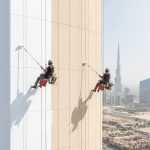
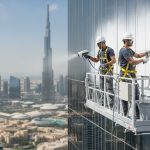
Scaling protective coatings for buildings in Dubai across high-rise towers requires specialized equipment and safety protocols. We utilize airless spray systems to achieve a uniform, pinhole-free finish that roller methods often struggle to replicate on large surface areas. For vertical access, our teams are trained in both cradle-based and IRATA-certified rope access techniques. We strictly adhere to manufacturer-specified overcoating windows; applying subsequent layers too early or too late prevents proper inter-layer chemical bonding and reduces the system’s overall lifespan.
Our Quality Control protocols provide the final layer of assurance. We conduct Dry Film Thickness (DFT) measurements using calibrated gauges to verify the coating meets the engineering specification. Pull-off adhesion testing is performed on representative sections to confirm the bond strength exceeds the required megapascals (MPa). If you require a technical audit of your asset’s current condition, our team provides comprehensive Protective Painting Systems assessments to ensure your building remains compliant and protected.
NovoTech: Authorized Terraco Applicators for Integrated Excellence
NovoTech’s 30-year history in the UAE construction sector has been built on a foundation of technical precision and strategic partnerships. As authorized Terraco Application Specialists, we bridge the gap between advanced chemical engineering and field-level execution. Terraco formulations are specifically engineered for the Middle Eastern climate, addressing the high-salinity and extreme UV challenges previously discussed. Our role as an integrator ensures that these high-performance protective coatings for buildings in Dubai are applied according to strict manufacturer protocols. This guarantees the system performs as intended over its full lifecycle.
Our service model is all-encompassing. It extends beyond facade protection to include comprehensive structural renovations and epoxy floor coating uae. We take end-to-end responsibility for every project, starting with a granular technical site audit and concluding with the issuance of long-term warranties. This level of project ownership provides property owners with a single point of accountability. It streamlines communication and ensures that complex technical requirements are met without compromise.
Why Partner with an Authorized Terraco Applicator?
Choosing an authorized partner provides access to manufacturer-backed technical support that general contractors simply don’t have. We ensure that every protective coatings for buildings in Dubai project adheres to international standards regarding mixing ratios and dry film thickness. Using genuine Terraco systems prevents the compatibility issues that arise when mixing components from different suppliers. Our technicians receive direct training from the manufacturer, ensuring that the latest application technologies and safety protocols are implemented on every site. It’s a level of precision that protects the manufacturer’s warranty and your investment.
A Strategic Partnership for Your Property Portfolio
We view our clients as long-term partners rather than temporary service providers. We develop customized maintenance schedules designed to maximize the lifespan of your coating systems and preserve your asset’s structural health. Our project management team coordinates every phase of the work to ensure minimal disruption to building occupants. This is a critical factor for operational commercial and residential towers. To secure the future of your asset, you can request a technical consultation for your building here.
Securing the Future of Dubai’s Urban Infrastructure
Transitioning from standard maintenance to advanced protective coatings for buildings in Dubai is a strategic imperative for long-term asset preservation. By prioritizing high-SRI thermal-reflective systems and anti-carbonation barriers, you’re doing more than complying with the 2026 safety and green building mandates. You’re fundamentally extending the service life of your structure and optimizing its energy performance. This technical approach ensures that your property withstands the UAE’s extreme environmental stressors while significantly reducing the frequency of costly maintenance cycles and preserving the building’s structural health.
Achieving these results requires the technical precision of a specialized partner. With over 30 years of UAE experience and ISO-certified quality management, we provide the engineering depth required for complex high-rise and villa projects. As an authorized Terraco applicator, we deliver integrated excellence from the initial technical site audit to the final warranty issuance. We’re ready to help you safeguard your investment with solutions that balance architectural vision and structural integrity. Consult with our technical experts for a customized building protection plan to ensure your asset remains a high-value, high-performance landmark for decades to come.
Frequently Asked Questions
What is the difference between standard exterior paint and a protective coating?
Standard paint is primarily decorative and thin-film, offering minimal resistance to environmental stressors. In contrast, protective coatings for buildings in Dubai are high-performance systems engineered for physical and chemical resistance. They feature higher solids content and specific resins that provide a thicker, more durable barrier against structural threats like concrete carbonation, chloride ingress, and extreme thermal expansion cycles common in the UAE.
How long do protective coatings typically last in Dubai’s climate?
Properly specified and applied protective coatings for buildings in Dubai typically provide a service life of 10 to 15 years. This longevity is significantly higher than standard decorative finishes, which often fail within three years due to polymer degradation from intense UV exposure. The actual lifespan depends on the system architecture and adherence to professional application standards, including rigorous surface preparation and thickness monitoring.
Can protective coatings really help reduce my building’s electricity bill?
High-performance coatings with a high Solar Reflectance Index (SRI) reflect a significant portion of solar radiation away from the building. This reduction in heat absorption lowers the surface temperature of the facade, which decreases the thermal transfer into the building’s interior. Consequently, HVAC systems operate with a reduced load, leading to a measurable reduction in DEWA utility expenses and supporting regional energy efficiency mandates.
Are protective coatings suitable for both old renovations and new builds?
These systems are essential for both new construction and major refurbishment projects. New builds utilize specialized coatings to meet Al Sa’fat Silver rating requirements for energy efficiency and environmental compliance. For older structures, these coatings are vital during renovations to halt the progress of concrete carbonation and seal existing hairline cracks, effectively rejuvenating and extending the structural life of the asset.
How does coastal salt air affect the choice of building coatings in Dubai?
Coastal environments require coatings with exceptional resistance to chloride ion penetration to prevent internal rebar corrosion. Salt-laden air in areas like Dubai Marina accelerates the degradation of porous concrete substrates. We specify impermeable, elastomeric systems that act as a molecular shield, ensuring that airborne salts don’t reach the internal steel reinforcement and cause the structural spalling common in seaside properties.
What certifications should I look for in a protective coating contractor in the UAE?
You should prioritize contractors holding ISO 9001 Quality Management and ISO 14001 Environmental Management certifications. It’s equally critical to verify that the firm is an authorized applicator for global manufacturers like Terraco. This status ensures the technical team has the specialized training, equipment, and manufacturer-backed support required to execute complex projects and issue valid, long-term performance warranties.
Is it possible to match custom architectural colors with high-performance coatings?
High-performance systems can be matched to almost any custom architectural color palette while maintaining their technical properties. Unlike standard paints that use organic pigments prone to rapid UV degradation, these systems utilize UV-stable resins and inorganic pigments. This technology ensures that custom colors remain vibrant for over a decade and don’t experience the surface powdering or “chalking” associated with standard paints.
What is the typical curing time for exterior coatings in the UAE summer?
Surface drying occurs rapidly in the UAE summer, often within two hours, but achieving a full chemical cure requires specific environmental conditions. We monitor overcoating windows to ensure proper inter-layer bonding. Technical teams typically schedule applications during early morning hours to avoid “flash drying,” a condition where the coating cures too quickly, leading to poor leveling and compromised film integrity.