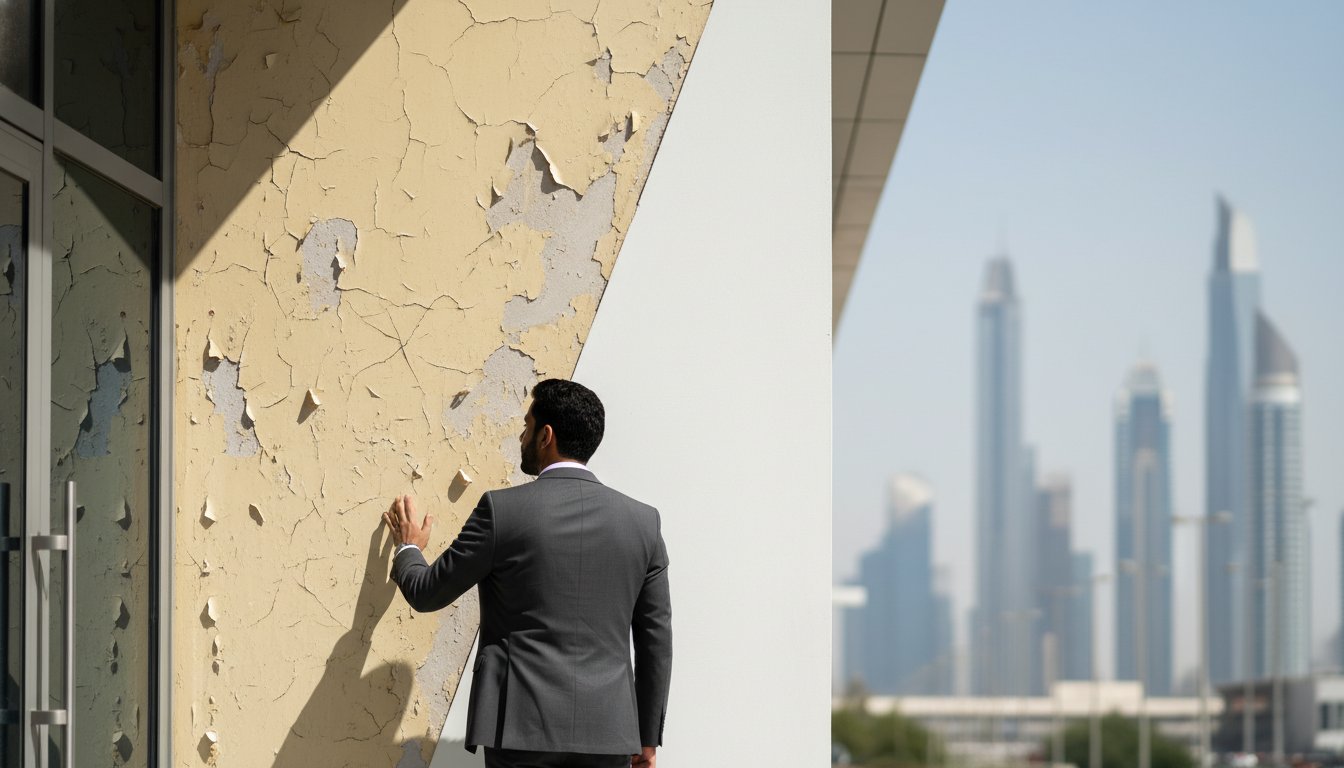
A building’s exterior is its primary layer of defense, yet many owners mistake structural coating failure for simple desert dust. In the harsh climate of the UAE, a fading facade is rarely just a cosmetic issue; it’s often the first warning of a failing technical barrier against extreme thermal stress. Identifying the specific signs your commercial building needs repainting is critical for asset managers who want to avoid the high costs of structural remediation caused by neglected maintenance.
Key Takeaways
- Identify technical markers of coating failure, such as binder chalking and alligatoring, to prevent irreversible substrate damage.
- Recognize the specific signs your commercial building needs repainting to distinguish between routine sand accumulation and deep structural risk.
- Evaluate the financial benefits of high-performance reflective systems in reducing thermal load and improving overall energy efficiency.
- Understand the impact of facade maintenance on tenant perception and the long-term appreciation of your commercial property.
- Learn how to manage complex high-rise logistics while ensuring compliance with Dubai Municipality permits and specialized application standards.
Beyond Aesthetics: The Strategic Role of Exterior Paint in UAE Asset Preservation
For commercial property owners in the UAE, the exterior facade represents the first line of defense against a relentless environment. While many view a fresh coat of paint as a branding exercise, it’s actually a critical engineering component of the building’s envelope. In 2026, the industry has shifted away from basic decorative emulsions toward high-performance protective systems that act as a technical seal. Neglecting the signs your commercial building needs repainting can lead to the catastrophic failure of the underlying substrate, turning a routine maintenance task into a multi-million dirham structural remediation project.
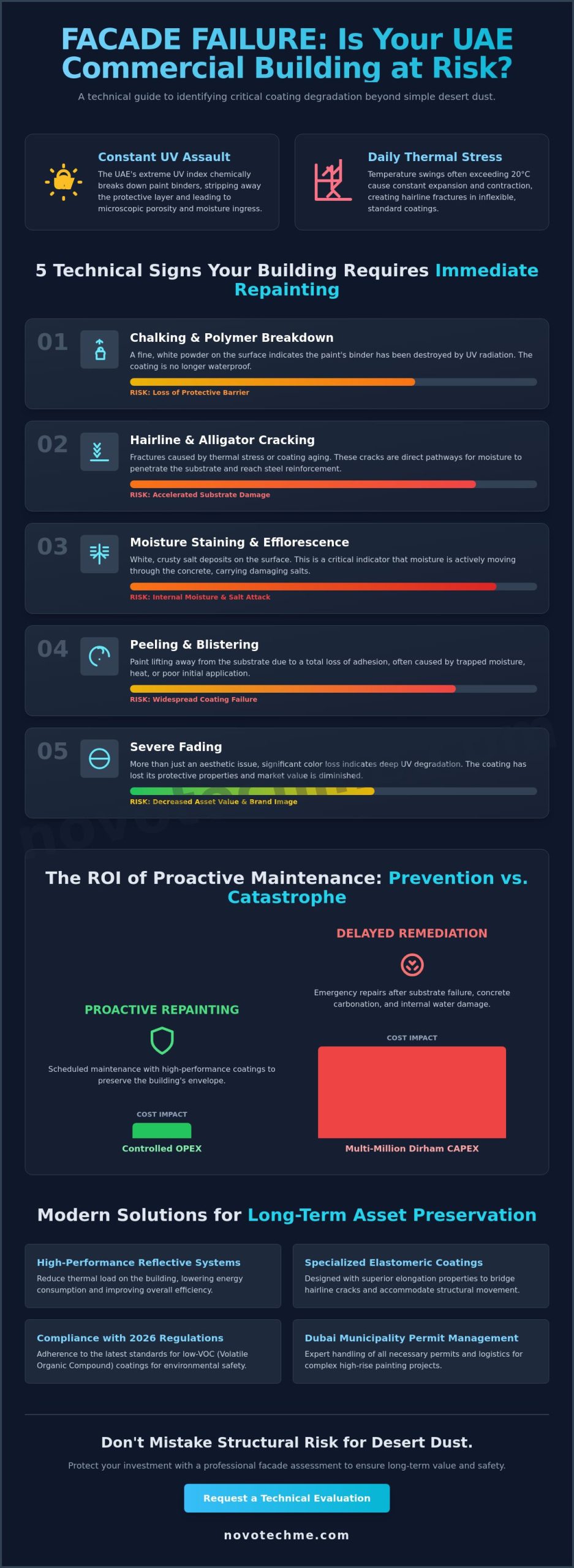
A common mistake among facility managers is assuming that a high-pressure wash restores a building’s integrity. While cleaning removes sand and surface pollutants, it does nothing to restore the chemical binder that the sun has stripped away. In fact, pressure washing a compromised surface can force moisture into microscopic fissures, accelerating internal concrete carbonation. Understanding the common causes of paint failure is essential for any stakeholder. These factors, such as chalking and peeling, indicate that the coating’s polymer chains have snapped, leaving the structure vulnerable to salt attack and moisture ingress.
The Impact of Extreme UV Radiation on Building Substrates
The UAE experiences some of the highest UV indices globally, which serves as a constant chemical assault on architectural finishes. This intense radiation acts as a catalyst, breaking down the synthetic resins that hold paint pigments together. Once these bonds fail, the coating loses its hydrophobic properties and becomes increasingly porous. UV degradation is a catalyst for microscopic surface porosity, allowing airborne salts and humidity to penetrate the render. This transition from vibrant branding to sun-bleached neglect isn’t just an aesthetic decline; it’s a measurable drop in the asset’s market valuation and protective capacity.
Thermal Expansion and Contraction in Dubai’s Climate
Dubai’s climate presents a unique mechanical challenge known as the daily “breathing” of concrete structures. With temperature swings often exceeding 20 degrees Celsius between midday peak heat and nighttime cooling, building materials undergo significant volumetric changes. Standard, inflexible paints cannot accommodate this constant movement. When the coating lacks the necessary elongation properties, it develops hairline fractures in the render. We utilize specialized elastomeric coatings designed to bridge these gaps, ensuring the protective barrier remains intact despite structural shifting. Identifying these fractures early is one of the primary signs your commercial building needs repainting before the internal steel reinforcement begins to oxidize.
5 Technical Signs Your Commercial Building Requires Immediate Repainting
Maintaining a commercial asset in the UAE requires a rigorous inspection protocol. Facility managers shouldn’t wait for visible decay before acting. Instead, they should monitor for specific technical benchmarks that indicate a failure of the protective envelope. Recognizing these signs your commercial building needs repainting early can prevent moisture from reaching the structural steel or concrete core. We recommend a semi-annual walkthrough to identify the following five indicators of material fatigue.
Identifying Chalking and Polymer Breakdown
Chalking appears as a fine, white, powdery residue on the surface of the paint. This occurs when the sun’s UV rays degrade the paint’s binder, releasing the pigment particles. A simple “Hand Test”, involving a swipe of the finger across the surface, reveals if the coating has turned to dust. Once this powder forms, the paint is no longer waterproof and has lost its ability to shield the building. For facilities with metal-clad structures or exposed steel elements, this breakdown often necessitates specialized anti-corrosive paint in the UAE to prevent rapid oxidation and rust bleed.
Moisture Staining and Efflorescence
Efflorescence presents as white, crusty salt deposits on masonry surfaces. It happens when moisture moves through the concrete, dissolving internal salts and carrying them to the surface. This process is often driven by internal AC condensation or high coastal humidity. Efflorescence compromises the bond between paint and concrete, leading to rapid delamination. Adhering to federal standards for building maintenance ensures that moisture issues are remediated before new coatings are applied. Bubbling or “blistering” paint is another critical warning; it indicates that water vapor is trapped behind the film, which will eventually cause the entire section to peel.
Surface Fissures, Peeling, and Brand Erosion
- Deep Fissures and Cracking: Often called “alligatoring”, these deep, interconnected cracks indicate that the paint film has lost all elasticity. Unlike simple surface scratches, these openings allow water to penetrate directly into the render.
- Peeling and Delamination: When large flakes of paint pull away from the substrate, the coating has lost its mechanical bond. This usually follows untreated chalking or occurs due to poor surface preparation during the previous painting cycle.
- Faded Branding: Corporate perception is an intangible but vital asset. If your building’s facade appears dull or sun-bleached, it signals a lack of operational excellence to stakeholders and potential tenants.
Proactive maintenance is a strategic investment that preserves the lifecycle of your infrastructure. If you observe these signs your commercial building needs repainting, consulting with professional painting specialists can help you determine the most durable system for your specific climate challenges.
Evaluating Material Fatigue: Surface Dirt vs. Deep Structural Risk
The UAE’s desert climate introduces mechanical wear that standard building maintenance models often overlook. Wind-blown particulates act as a continuous abrasive, effectively sandblasting the building’s finish and stripping away protective resins. While a pressure wash might restore the visual appeal of a dusty facade, it cannot replenish the chemical binders lost to years of abrasive sandstorms and high-intensity solar radiation. Distinguishing between surface grime and material fatigue is essential for accurate asset valuation. Dark vertical streaks near rooflines or AC drainage points, for instance, often indicate fungal colonies rather than simple carbon pollution, particularly in humid coastal zones.
To determine the true state of your facade, we utilize technical diagnostic methods like the “Scrape Test” to verify if the underlying primer remains chemically bonded to the substrate. For larger commercial assets, we often deploy thermographic imaging to detect moisture pockets trapped behind the paint film. These pockets indicate a breach in the building envelope that simple cleaning cannot resolve. Adhering to coatings industry best practices involves these regular technical assessments to ensure the structure remains hermetically sealed against the elements.
The Difference Between Aesthetic Wear and Functional Failure
Asset managers must categorize facade issues to prioritize capital expenditure. While cosmetic issues impact perception, structural risks threaten the building’s physical longevity. When these risks appear, a specialized protective coating system becomes mandatory to halt further degradation. Modern Dubai projects are increasingly adopting self-cleaning nanotechnology paints that use sunlight to break down organic dirt, though even these systems require periodic inspection for mechanical failure.
| Condition | Cosmetic Issue (Cleaning Suffices) | Structural Risk (Repainting Required) |
|---|---|---|
| Surface Texture | Accumulated sand and dust | Chalking, powdering, or “alligatoring” |
| Color Integrity | Uniform, light UV fading | Patchy discoloration or peeling layers |
| Wall Integrity | Minor surface staining | Deep fissures, cracks, or exposed rebar |
| Moisture | Water spots from irrigation | Efflorescence (salt deposits) or bubbling |
Corrosion Indicators on Metal and High-Rise Elements
Metal components, such as HVAC enclosures, window frames, and decorative cladding, show the earliest signs your commercial building needs repainting through oxidation. Buildings located within 5km of the coast are at extreme risk for chloride-induced corrosion. Rust “bleeding” onto the surrounding paint is a critical signal that the anti-corrosive barrier has failed. This requires immediate technical intervention with high-performance protective systems to prevent the structural weakening of metal supports and high-rise cradle anchors.
The ROI of Commercial Repainting: Beyond the Surface
Reflective Coatings and Cooling Cost Reduction
The science of Total Solar Reflectance (TSR) allows modern coatings to reflect a high percentage of solar energy away from the structure, effectively acting as a thermal mirror. By utilizing high-TSR paints, property owners can achieve substantial reductions in surface temperatures, which directly translates to a lower cooling load for HVAC systems. These “cool roof” and reflective wall technologies are essential for aligning with corporate ESG (Environmental, Social, and Governance) targets. Lowering the ambient temperature of the building envelope reduces the energy required to maintain interior comfort, providing a clear path to operational savings during the UAE’s peak summer months. We recommend evaluating these advanced systems as soon as you notice the first signs your commercial building needs repainting to maximize your energy efficiency gains.
Brand Authority and the ‘Halo Effect’
Beyond the financial and psychological benefits, repainting in 2026 is often a matter of regulatory compliance. Dubai Municipality’s green building guidelines mandate the use of low-VOC (Volatile Organic Compounds) paints to improve air quality and sustainability. Adhering to these standards during your next maintenance cycle ensures your asset remains compliant with the Dubai 2040 Urban Master Plan. To ensure your property meets these technical and aesthetic benchmarks, consider partnering with an expert team for your exterior building painting services.
Executing a High-Rise Commercial Painting Project in Dubai
High-rise maintenance in a metropolis like Dubai requires a convergence of engineering precision and regulatory compliance. Once you identify the technical signs your commercial building needs repainting, the focus shifts to logistical execution. This involves choosing between rope access technicians for complex architectural geometries and traditional cradle systems for large, vertical surfaces. Beyond the equipment, exterior building painting in Dubai necessitates a mandatory painting and maintenance permit from the Dubai Municipality, which carries a standard fee of AED 1,500 plus additional innovation fees. Property managers must also secure a No Objection Certificate (NOC) from major developers like Emaar or Nakheel and obtain specific color approval to ensure the facade aligns with the city’s urban aesthetic.
Selecting a Specialized Commercial Contractor
The NovoTech Approach: Integrated Excellence
Our methodology begins with a granular substrate analysis to ensure the surface is chemically prepared for new coatings. We don’t just apply paint; we install integrated protective systems that include anti-corrosive treatments and weather-resistant barriers designed for the UAE’s specific humidity and thermal profiles. This technical depth ensures that the signs your commercial building needs repainting don’t reappear prematurely due to poor adhesion or environmental stress. By taking total project ownership, we handle every detail from permit procurement to the final quality inspection. Consult with NovoTech for a comprehensive building condition assessment to establish a data-driven maintenance schedule that protects your asset’s structural integrity and long-term market value.
Strategic Asset Management for 2026 and Beyond
Protecting a commercial asset in the UAE requires a transition from reactive cleaning to a proactive technical preservation model. We’ve explored how identifying the early signs your commercial building needs repainting allows for the deployment of high-performance reflective coatings that reduce thermal stress and AC loads. Maintaining structural integrity isn’t just about aesthetics; it’s about adhering to Dubai’s evolving green building regulations and ensuring long-term market valuation through rigorous maintenance standards. Whether you’re managing a high-rise office or an industrial complex, the quality of your protective envelope determines the lifecycle of your investment.
As specialists in high-rise and industrial coatings with over 30 years of UAE experience, we provide the technical depth required for complex infrastructure projects. As an authorized Terraco applicator, we ensure every project meets the highest manufacturer standards for durability and environmental resistance. Taking action today prevents the multi-million dirham structural failures of tomorrow. Secure Your Property’s Future—Request a Professional Building Inspection from NovoTech Today. Your property deserves the precision and reliability of an expert strategic partner dedicated to integrated excellence.
Frequently Asked Questions
How often should a commercial building in Dubai be repainted?
Commercial buildings in the UAE typically require a full repainting every 5 to 7 years to maintain their protective envelope. While high-performance coatings can extend this duration, the intense UV index and constant sand abrasion necessitate regular technical inspections. Proactive maintenance ensures the substrate remains sealed against moisture and salt attack, preserving the asset’s long-term market valuation and structural integrity.
Can you paint a commercial building during the summer months in the UAE?
Yes, exterior painting is possible during the summer, provided the project follows strict technical protocols and labor regulations. Work is typically scheduled during the early morning or evening hours to avoid peak thermal stress on both the applicators and the coating. Specialized heat-resistant formulations are utilized to ensure proper curing and adhesion when ambient temperatures exceed 40 degrees Celsius.
What is the difference between standard paint and a protective coating system?
Standard architectural paint is primarily decorative, while a protective coating system is an engineered barrier designed for durability. These systems feature superior elastomeric properties, anti-carbonation qualities, and high solar reflectance. In the Dubai climate, standard emulsions often fail within 24 months, whereas technical protective systems provide long-term resistance to thermal expansion and chemical degradation of the concrete substrate.
Does commercial repainting require a permit from the Dubai Municipality?
A “painting and maintenance permit” is mandatory for all exterior commercial work within Dubai. This permit carries a standard fee of AED 1,500 plus additional innovation fees and is valid for one year. Property owners must also secure a No Objection Certificate (NOC) from major developers like Emaar or Nakheel and obtain official color approval before any site work commences.
How long does a typical high-rise painting project take to complete?
A standard high-rise project generally requires between 4 and 12 weeks, depending on the building’s scale and the chosen access method. Utilizing rope access technicians often accelerates the timeline compared to traditional cradle systems for complex architectural geometries. We utilize phased project management to ensure that exterior work proceeds systematically without disrupting the daily operations of corporate tenants or retail occupants.
What are the best colors for commercial buildings to resist UV fading?
Light, earth-toned colors and high-TSR (Total Solar Reflectance) whites are the most effective at resisting UV degradation and heat absorption. Dark pigments absorb significantly more thermal energy, leading to faster polymer breakdown and premature fading. Utilizing light grays, beiges, or off-whites helps maintain the building’s aesthetic longevity while reducing the overall cooling load on the facility’s HVAC systems.
How do I know if my building needs waterproofing or just a new coat of paint?
If you observe internal dampness, salt deposits known as efflorescence, or deep fissures in the render, your building likely requires a specialized waterproofing system. Recognizing the technical signs your commercial building needs repainting involves identifying when the existing film has lost its hydrophobic properties. A simple decorative coat won’t stop moisture ingress; instead, an integrated protective system is necessary to halt concrete carbonation.
What is the ROI of repainting a commercial property before a lease renewal?
Repainting provides a high return on investment by elevating the property to “Class A” status and increasing tenant retention rates. A well-maintained facade reinforces brand authority and justifies premium rental rates in a competitive real estate market. Additionally, modern reflective coatings can reduce surface temperatures by up to 15 degrees Celsius, offering measurable savings on energy costs that benefit both owners and occupants.