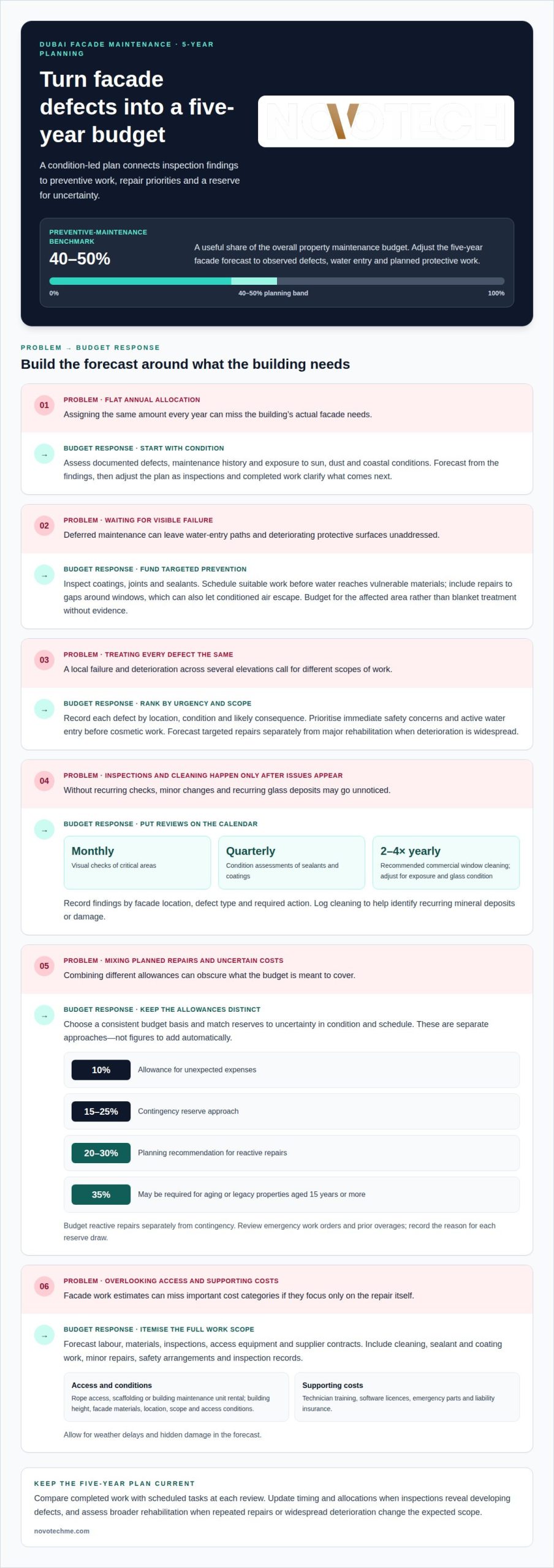
A five-year facade budget should be built around condition and prevention, not a single assumed repair cycle. For overall property maintenance, a 40-50% preventive maintenance allocation is a useful planning benchmark; creating a 5-year building facade maintenance budget means shaping that allowance around the building’s actual defects, exposure and repair priorities.
For a five-year building facade maintenance budget in Dubai, avoid assigning the same amount to every year without first assessing the building. Facade needs vary with age, maintenance history and exposure to sun, dust and coastal conditions. Start with a condition assessment, separate urgent repairs from planned work, and forecast costs across the five-year period.
This guide explains how to assess facade condition, rank maintenance needs, estimate costs and set a preventive allowance. It also shows how to update the budget as inspections and completed work clarify what the building needs next.
Key Takeaways
- Build the forecast from documented facade defects, maintenance history and exposure conditions rather than a blanket allowance.
- Separate immediate safety or water-infiltration concerns from routine work, then schedule repairs according to urgency and likely impact.
- Estimate each work item by scope, materials, access requirements and timing so the five-year plan can be adjusted as conditions change.
- Use regular condition reviews to identify when minor repairs are no longer sufficient and broader facade rehabilitation should be considered.
What percentage of budget should go to preventive maintenance?
Use 40-50% of the property maintenance budget as a preventive-maintenance planning benchmark. For a five-year facade forecast, adjust that share to reflect observed defects, water entry and planned protective work.
-
Budget for Protective Treatments
Allocate preventive funds to treatments suited to the facade’s recorded condition and exposure. Inspect coatings, joints and sealants for deterioration, then schedule appropriate maintenance before water reaches vulnerable materials. Water infiltration can damage interior finishes and affect building performance, while gaps around windows can let conditioned air escape. Include repairs that address these pathways in the forecast.
Use inspection findings to distinguish a local repair from broader surface treatment. If coating failure appears in one zone, for example, document its extent and budget for the affected area. Avoid planning blanket treatment without evidence, as it can divert funds from defects with greater implications for water entry or energy efficiency.
-
Balance Preventive and Reactive Work
Set the preventive allowance first, then reserve funds for reactive repairs that inspections cannot predict. Review emergency work orders and recurring facade issues to see whether deferred maintenance is driving more reactive work. Use that history to refine the five-year forecast instead of repeating last year’s allocation unchanged.
Include window cleaning in the schedule, because accumulated grime and mineral deposits can damage glass. Commercial building windows are recommended for cleaning 2-4 times per year. Adjust the planned frequency to the building’s exposure and observed glass condition, and record each service so later reviews can identify recurring deposits or damage.
-
Schedule Preventive Reviews
Make inspections a recurring budget line, not a response only to visible failure. Monthly visual checks of critical areas can identify minor issues, while quarterly condition assessments can track sealants and coatings. Record findings by facade location, defect type and required action to give managers a consistent basis for updating the forecast.
Compare completed work with scheduled tasks at each review. If inspections reveal a developing defect, revise the timing and allocation before it becomes an emergency repair. This keeps the preventive plan tied to actual building conditions throughout the five-year period.
Minor repairs and major facade rehabilitation
Classify facade work by scope, urgency and expected lifecycle cost. Create separate forecast lines for routine repairs, major rehabilitation and unexpected work.
-
Separate Minor Repairs from Rehabilitation
Record each defect by location, condition and likely consequence. A local sealant failure or isolated coating defect may need a targeted repair; widespread deterioration across several elevations may require major rehabilitation. Group defects only when they share a cause and treatment, so the budget reflects the full scope.
Prioritise immediate safety concerns and active water entry before cosmetic work. Continued repair may be appropriate when failures remain manageable, costs are consistent, parts are available and disruption is limited. Use inspection records to explain why each item needs attention now or can be scheduled for later.
-
Set Aside Repair Reserves
Build a contingency reserve for unexpected work, then keep it distinct from planned repairs. A 10% allowance for unexpected expenses and a 15-25% contingency reserve are separate budgeting approaches; don’t add them automatically. Choose a consistent budget basis and match the reserve to uncertainty in the building’s condition and work schedule.
Budget reactive repairs separately from contingency. A 20-30% maintenance allocation is a planning recommendation for reactive repairs; aging or legacy properties aged 15 years or more may require 35%. Review emergency work orders and prior overages to refine the allocation. Unplanned repairs can push property budgets above forecast, so record the reason for every reserve draw.
-
Compare Repair and Replacement
Compare the full lifecycle cost of continued repairs with replacement, not just the next annual expense. Consider recurring repairs, likely failure, parts availability, downtime and whether the facade component still meets the building’s needs. Consistent repair costs and manageable failures may support continued maintenance.
Plan replacement funding before reliability declines too far. Repeated repairs to the same facade area, for example, may justify assessing broader rehabilitation against cumulative costs and disruption. Document the assumptions and revisit them at each budget review, especially when new inspection findings change the expected scope.
Estimating costs and obtaining service-provider quotes
In Dubai and across the UAE, rope access, scaffolding and building maintenance unit rental costs depend on building height, facade materials, location, scope and access conditions. Include inspections, cleaning, sealant and coating checks, repairs, access, safety controls and documentation in the forecast, with an allowance for weather delays and hidden damage.
-
List Maintenance Cost Categories
Separate forecast lines for labour, materials, inspections, access equipment and external supplier contracts. Include facade cleaning, sealant and coating work, minor repairs, safety arrangements and inspection records. Add relevant supporting costs, such as technician training, software licences, emergency parts and liability insurance. This gives owners a clearer view of the annual budget and helps prevent overlooked expenses.
-
Estimate Access and Task Costs
Define each facade task and access method before requesting prices. Rope access, scaffolding and building maintenance unit rental have different requirements depending on the elevation, work duration and site conditions. Obtain three local quotes for each preventive maintenance service per asset type, then compare the inclusions. Different scopes are not directly comparable.
For each quote, record the work area, materials, access approach and exclusions. This makes the five-year forecast easier to update when task timing changes.
-
Evaluate Lifecycle Costs and Cost Factors
Compare the annual cost of repeated maintenance with the longer-term cost of a durable repair or treatment. Building height affects access planning, facade materials influence suitable repair methods, and location shapes exposure and logistics. Include these factors in each estimate rather than applying one rate across every elevation.
Review previous work orders and maintenance plans for duplicate tasks. Removing unnecessary work can reduce labour and material costs while keeping essential inspections and repairs in the schedule.
-
Account for Safety and Damage Risks
Include safe access planning and weather-related scheduling in the work scope. UAE summer temperatures can reach 50°C, and coastal humidity often exceeds 90%. These conditions can influence when exterior work is practical and how frequently facade materials need attention.
Allow for hidden damage found after work begins, such as deterioration beneath a coating or behind a joint. Document the basis for each allowance, then adjust it when inspections or completed repairs reveal the actual condition. This helps keep the forecast grounded in both planned tasks and site risks.
Assessing building condition and prioritising maintenance needs
Use inspection findings, maintenance history and building exposure to rank facade work. These records provide a practical basis for allocating attention across the five-year forecast.
-
Assess Facade Condition
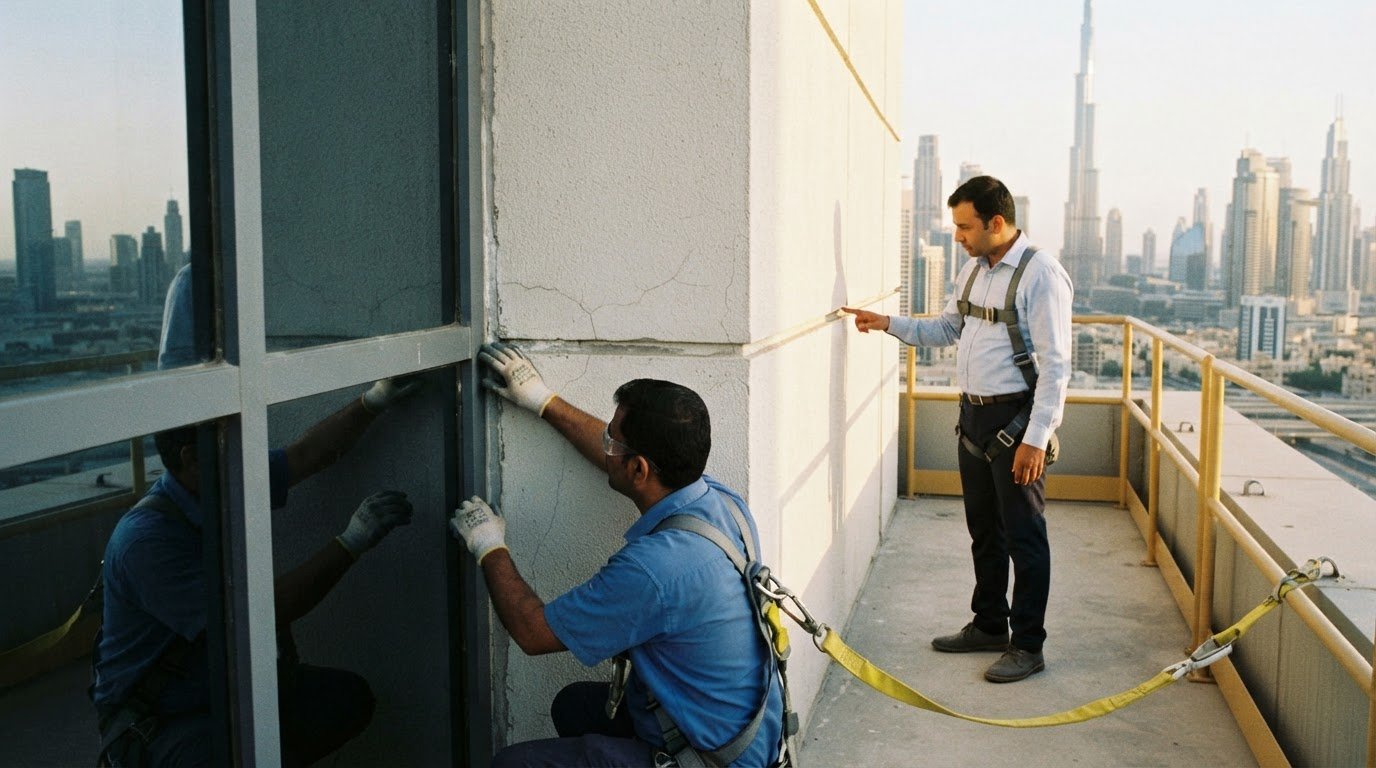
Start with a documented condition assessment of the facade, roof and connected building elements. Record defects by location, type, extent and likely consequence, then compare the findings with previous work orders. Recurring cracks, coating failure or water entry may point to a broader issue rather than an isolated surface defect.
Review each component’s age, expected lifespan and maintenance history. Include input from owners, facility managers, tenants and maintenance staff, who may report different symptoms. Prioritise immediate safety concerns before preventive tasks, then rank the remaining work by urgency, impact on building performance and the cost of delay.
-
Identify Applicable Requirements
Identify the municipal requirements and building rules relevant to the property and proposed facade work. Requirements in the UAE depend on the emirate, property and scope, so one rule may not cover every project. Review the building’s approvals and records, and identify the responsible authority before setting the budget.
Include periodic inspections and certifications for applicable safety systems in the maintenance plan. Record the system, inspection schedule and required follow-up actions. This keeps compliance-related work visible alongside facade repairs rather than outside the forecast.
- Turn findings into a prioritised work register. For each item, record its location, condition, urgency, planned year and estimated resource needs. Separate immediate hazards from defects that can be scheduled, and note dependencies such as access arrangements or related repairs.
Use quarterly condition assessments to track changes to sealants and coatings, update records and adjust task timing. An annual professional inspection can provide a broader evaluation of building systems. Use those records when creating a 5-year building facade maintenance budget, so recurring defects and unresolved causes inform future priorities.
- Account for local exposure when ranking facade zones. Intense UV radiation can degrade materials, while salt-laden coastal air can accelerate corrosion; sand and dust also affect properties across the UAE. Note which elevations face these conditions, then link them to inspection findings rather than assigning the same priority to every surface.
Use each ranked finding when creating a 5-year building facade maintenance budget, assigning funding to urgent work first and planned maintenance next. Discuss facade maintenance planning when assessment findings point to exterior work.
NovoTech: Renovations and Building Maintenance
NovoTech supports planned facade work through Renovations and Building Maintenance, Exterior Building Painting Services and Protective Painting Systems. Turn to the team when inspection findings point to exterior painting, coating maintenance or broader building work. Align the scope with documented conditions and priorities to connect planned work with the building’s maintenance schedule.
For high-rise properties, Exterior Building Painting Services address facade painting needs, while villa projects can draw on Villa Painting & Exterior Finishes. NovoTech also provides Interior Painting Solutions when interior painting forms part of the wider maintenance plan. The appropriate scope depends on the identified work and property requirements.
Share your facade maintenance priorities with NovoTech to discuss the relevant building maintenance work in Dubai.
Put the Facade Plan into Motion
A facade budget becomes more useful when it guides decisions beyond the spreadsheet. Treat creating a 5-year building facade maintenance budget as an ongoing planning process: connect approved work to inspection records, track completed tasks and revise priorities when new conditions emerge. This gives owners a clearer basis for deciding what to schedule, defer or reassess.
The next step is to turn the priority list into a defined scope of work. NovoTech can support relevant building maintenance needs, including exterior painting and villa finishes, as the plan moves from assessment to implementation.
Contact NovoTech about your facade budget to discuss the work your building needs. With a clear scope and a maintained record of decisions, you can move forward with greater confidence in your facade plan.
Frequently Asked Questions
Should capital projects be included in the annual maintenance budget or kept separate?
Track capital projects separately from routine annual maintenance so planned upgrades remain visible. A property maintenance budget can allocate 10-20% to capital projects, with funding recorded in a dedicated reserve. For example, a facade rehabilitation project can have its own forecast, approval status and timing, while recurring inspections and minor repairs stay in operating maintenance. Review both budgets together annually.
What should a facilities management budget include?
A facilities management budget should cover staff salaries, hiring and training, tools, parts, materials, external supplier contracts, energy, inspections, insurance and system licences. For a facade plan, distinguish direct work, such as cleaning and coating repairs, from supporting items such as access planning and documentation. Group costs by asset and task so owners can see where spending occurs and compare actual expenses with the forecast.
How do you assess facade condition and prioritise repairs?
Start with a location-based record of each visible defect, then compare it with past work orders and inspection notes. Recurring staining near a window, for example, may warrant investigation of the sealant and nearby interior finishes. Rank findings by safety, water entry and effects on building performance. Address urgent hazards first, then schedule lower-impact work according to condition and maintenance history.
What is the typical cost per square metre for facade inspection, cleaning and repairs in the UAE?
There is no single UAE rate per square metre for every facade task. Estimates for inspection, cleaning and repairs depend on the scope, building height, materials, access method, location and any damage found. For a useful comparison, define the area and tasks before requesting a quote, then compare what each estimate includes. The price depends on the project and is provided after a quote request.
How often should building facades be inspected and cleaned in the UAE climate?
Use monthly visual checks of critical areas, quarterly condition assessments and an annual professional inspection as planning intervals. Commercial building windows are recommended for cleaning 2-4 times per year to help prevent grime and mineral deposits from damaging glass. Increase attention to facade zones where inspections show recurring deposits or deterioration, and record findings so the schedule responds to observed conditions.
How should a five-year facade maintenance budget account for inflation and contingency?
Apply an annual inflation adjustment to forecast labour and materials; a 5-10% annual adjustment is a planning recommendation. Keep contingency as a separate line, informed by the building’s condition, past emergency work and uncertainty in planned scopes. Review actual spending against estimates each year, then revise later-year allowances when supplier quotes, inspection findings or completed repairs change the expected work.