In the UAE, your building’s concrete isn’t just a structural foundation; it’s a vulnerable asset under constant chemical and thermal siege. You understand that the combination of intense UV radiation, high humidity, and coastal salinity can quickly turn a premium facade into a costly maintenance liability. Engineering a resilient exterior requires more than just standard paint. Specialized protective coatings for concrete buildings act as a critical barrier against chloride-induced corrosion and carbonation, shielding the substrate from the region’s aggressive environmental factors.
It’s frustrating to watch a significant investment suffer from premature spalling or peeling finishes that demand frequent, expensive repairs. We’ve developed this 2026 engineering guide to help you move from reactive maintenance to proactive asset protection. You’ll discover how advanced materials like aliphatic polyurethanes and MMA acrylics ensure compliance with Dubai’s Al Sa’fat 2.0 Silver rating while providing an aesthetically pleasing finish. We’ll examine the technical specifications of high-performance systems and the strategic application methods that guarantee long-term structural safety and operational excellence across the Emirates.
Key Takeaways
- Identify the specific chemical mechanisms of carbonation and chloride ingress that accelerate structural degradation in the UAE’s high-salinity coastal zones.
- Evaluate the technical distinctions between polyurethane and acrylic protective coatings for concrete buildings to select the optimal barrier for your asset’s specific exposure.
- Determine the essential performance benchmarks for UV stability and crack-bridging ability required to prevent premature chalking and finish failure.
- Recognize the critical importance of moisture content testing and grit-blasting preparation in the professional application lifecycle for high-rise exteriors.
- Align your maintenance strategy with Dubai’s 2026 structural safety standards through the integration of authorized Terraco application systems.
The Science of Concrete Degradation in Extreme Climates
Concrete is often perceived as an indestructible material, yet in the context of the UAE’s environmental extremes, it’s a porous substrate vulnerable to rapid chemical and physical deterioration. We define protective coatings for concrete buildings as specialized barrier systems engineered to isolate the structural matrix from aggressive atmospheric pollutants, moisture, and salts. These systems don’t just provide a decorative finish; they serve as a primary defense mechanism against the specific chemical and thermal stresses that characterize the Gulf region. Without this protection, the integrity of a structure begins to decline from the moment of completion.
Thermal expansion remains a silent but persistent threat to structural longevity. In Dubai, daily temperature fluctuations can exceed 20 degrees Celsius between mid-day sun exposure and cooler nights. This constant cycling creates significant mechanical stress within the concrete, leading to micro-cracking. These cracks act as direct conduits for moisture and aggressive chemicals to reach the internal reinforcement. Maintaining a water-cement ratio at or below 0.45 during construction is a critical baseline, but even the best-poured concrete requires a high-performance coating to manage these inevitable thermal movements.
Carbonation and Reinforcement Corrosion
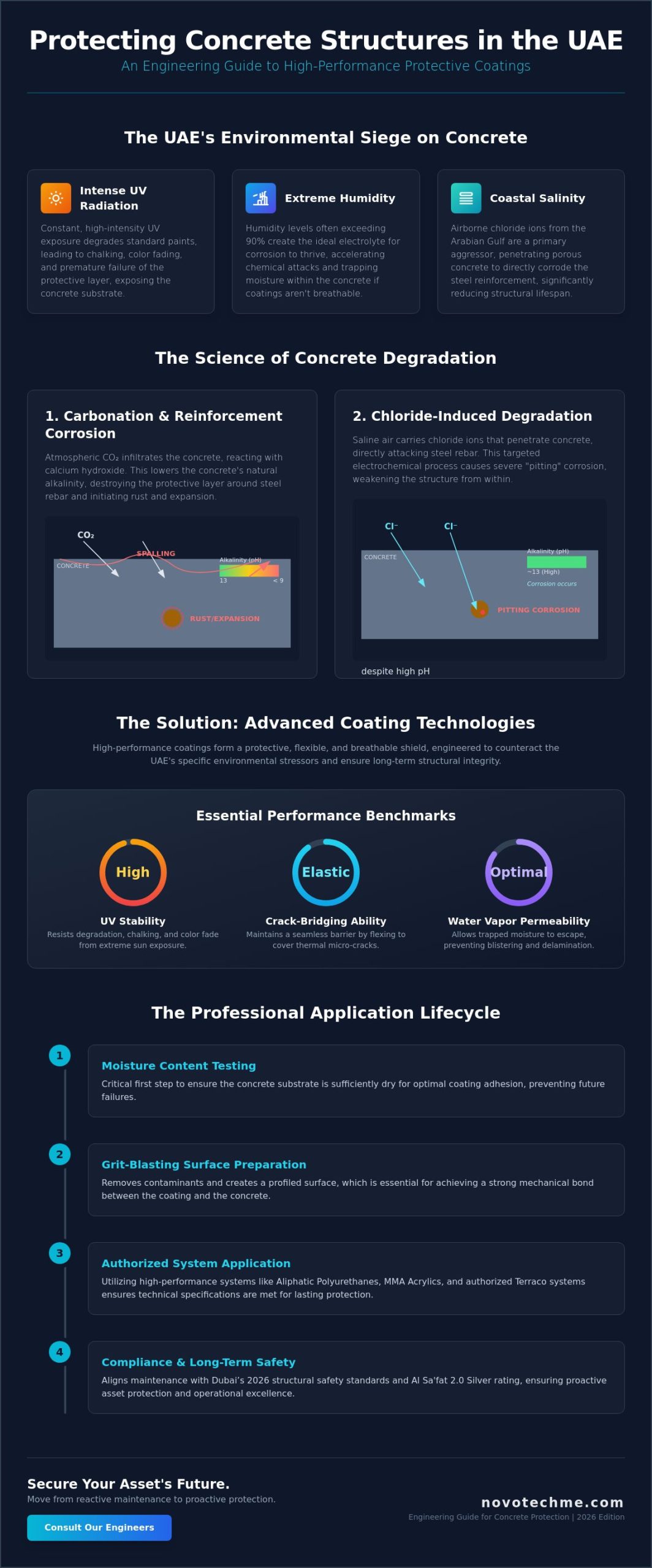
Carbonation occurs when atmospheric carbon dioxide (CO2) penetrates the concrete pores and reacts with calcium hydroxide. This chemical reaction forms calcium carbonate, which systematically lowers the concrete’s alkalinity from a healthy pH of around 13 to below 9. Once this threshold is crossed, the protective oxide layer surrounding the steel reinforcement dissolves. Without this barrier, the steel begins to rust. Rust occupies several times the volume of the original steel, generating intense expansive pressure from within. This pressure inevitably leads to spalling and structural cracking. High-rise buildings are particularly vulnerable to wind-driven carbonation, as higher altitudes often experience increased wind pressures that force CO2 deeper into the facade.
Chloride-Induced Degradation in Coastal Regions
For structures situated near the Arabian Gulf, chloride-induced corrosion represents the most significant threat to asset lifespan. Chloride ions from saline air penetrate the concrete and attack the steel reinforcement directly. This is an electrochemical process that can occur even if the concrete’s pH remains high. Unlike carbonation, chloride attack is often localized, causing “pitting” corrosion that can severely weaken a structural element before surface signs become visible. High humidity levels, which frequently exceed 90% during UAE summers, accelerate this process by providing the electrolyte necessary for corrosion to thrive. It’s a relentless cycle that requires a non-porous barrier to interrupt.
To understand the foundational differences between topical and penetrating systems, many engineers refer to the technical classifications of Concrete sealers. However, for large-scale infrastructure and commercial towers, we emphasize the need for advanced protective coatings for concrete buildings that offer both chemical resistance and the elasticity required to bridge thermal micro-cracks. Selecting a system that combines these properties is the only way to ensure a structure survives the unique environmental demands of the region.
Advanced Coating Technologies: Polyurethane, Acrylic, and Terraco Systems
Modern engineering solutions for concrete preservation rely on high-performance chemical matrices. While epoxy systems remain the standard for high-traffic industrial flooring, exterior protection typically involves acrylic or polyurethane formulations. These protective coatings for concrete buildings serve as a sophisticated shield, balancing surface hardness with the dynamic flexibility required for high-rise structures. Selecting the correct chemistry isn’t just about color; it’s about matching the resin’s molecular profile to the building’s specific exposure risks.
Breathability, or water vapor permeability, is a non-negotiable requirement for coatings in the UAE. If a coating is too restrictive, moisture trapped within the concrete during the humid summer months can’t escape. This buildup of hydrostatic pressure leads to blistering and delamination. For a deeper technical analysis of how these barriers function at a molecular level, the FHWA Guide to Corrosion Control provides extensive data on moisture-related degradation. We often see a powerful synergy when anti-corrosive paints are applied over cementitious waterproofing layers. This multi-layered approach ensures that while the cementitious layer manages liquid water ingress, the anti-corrosive topcoat provides the chemical barrier needed to halt chloride migration.
Acrylic vs. Polyurethane: Choosing the Right Matrix
Acrylic coatings are highly valued for their exceptional UV resistance and cost-efficiency. They’re an excellent choice for low-to-medium rise assets where ease of maintenance is a priority. Polyurethane systems, specifically aliphatic variants, offer superior tensile strength and elongation properties. These are essential for taller buildings subject to higher wind loads and structural vibration. Polyurethane’s enhanced chemical resistance makes it the preferred choice for areas with high atmospheric pollution or proximity to industrial zones. We evaluate each asset to determine which matrix will provide the longest service life before requiring a refresh.
Specialized Terraco Application and Performance
Terraco has established itself as a regional benchmark, offering integrated systems that combine aesthetic versatility with rigorous protection. As a leading choice for anti-corrosive paint in the UAE, Terraco’s silane-siloxane water repellents provide deep-penetrating protection that doesn’t compromise breathability. These systems are engineered to meet the stringent exterior building painting Dubai standards, ensuring long-term adhesion even on porous substrates. Our team of Terraco application specialists ensures that every layer, from primer to topcoat, contributes to a unified defense against environmental stressors. This integrated excellence is what distinguishes a standard paint job from a strategic asset management project.
Evaluating Performance: Adhesion, UV Stability, and Elasticity
Engineering high-performance protective coatings for concrete buildings in the UAE requires a shift from aesthetic selection to rigorous performance validation. In a climate where surface temperatures regularly exceed 50°C, standard specifications often fail. We prioritize three critical metrics: UV stability, adhesion strength, and elongation. These factors determine whether a coating remains a functional barrier or becomes a maintenance burden within twenty-four months of application. Selecting a system without these technical assurances risks structural compromise and inflated lifecycle costs.
Adhesion strength is particularly vital for Dubai’s high-rise towers, where wind loads at elevated altitudes can create significant negative pressure on the building envelope. If the bond between the coating and the substrate is weak, the film will delaminate, allowing moisture and chlorides to bypass the protection entirely. In specialized environments like parking structures, these requirements extend to mechanical durability. Coatings must resist “hot tire pickup,” a phenomenon where heated tires bond to the surface and pull the coating away from the concrete upon cooling. Our epoxy and MMA acrylic solutions are engineered to withstand this mechanical stress while shielding the concrete from oil and fuel spills.
UV Resistance and Colour Retention
Photodegradation is the primary cause of coating failure in the region. The extreme UV index breaks down standard polymer chains, leading to chalking, embrittlement, and pigment fading. We utilize inorganic pigments and UV-stable aliphatic resins to ensure long-term color retention. Beyond aesthetics, high-reflectivity coatings play a vital role in meeting Dubai’s Al Sa’fat 2.0 standards, which mandate a 20% energy reduction for new permits. By reflecting solar radiation, these systems lower the thermal load on the building envelope, significantly reducing HVAC demand and operational expenses.
Elasticity and Crack-Bridging Capacity
Concrete structures are dynamic. They experience constant movement from thermal expansion and structural settling, which creates both static and dynamic cracks. This necessitates protective coatings for concrete buildings with high crack-bridging capacity. Unlike rigid paints, elastomeric systems stretch to maintain a continuous waterproof seal over micro-cracks as they open and close. For a technical comparison of how different chemistries handle these stresses, engineers often consult a Performance Analysis of Protective Coatings. This data confirms that tensile recovery—the ability of a coating to return to its original shape—is as important as initial elongation for maintaining long-term structural integrity.
The Professional Application Lifecycle for High-Rise Structures
Success in preserving high-value assets depends less on the product choice and more on the technical precision of the application lifecycle. Even the most advanced protective coatings for concrete buildings will fail if the substrate isn’t prepared to receive them. We treat every high-rise project as a multi-stage engineering operation, moving from rigorous surface cleaning to environmental monitoring and final quality validation. This methodical approach ensures that the protective barrier becomes an integral part of the structure rather than a superficial layer.
Surface preparation begins with the removal of laitance, a weak, friable layer of cement dust and sand that prevents proper adhesion. We utilize high-pressure washing and grit blasting to achieve the required Concrete Surface Profile (CSP), typically between CSP 3 and 5 for high-performance systems. Once the surface is clean, any structural defects or spalled areas are restored using polymer-modified cementitious mortars. These materials are chosen for their compatibility with both the original concrete and the subsequent coating layers, ensuring a seamless load transfer across the repair site.
Surface Preparation and Repair
Moisture content testing is a critical, often overlooked step in the UAE’s humid climate. Applying coatings on damp concrete—where internal moisture exceeds 4-5%—traps water vapor that will eventually cause osmotic blistering. We use electronic moisture meters to verify substrate readiness before the primer is applied. The primer acts as the vital anchor between the porous concrete and the dense topcoat, penetrating the surface to create a robust mechanical bond. Without this intermediary layer, the risk of delamination under high wind loads increases significantly.
Execution and Environmental Monitoring
Environmental conditions in Dubai require constant monitoring of the dew point and ambient temperature. We strictly adhere to the 3-degree rule, ensuring the substrate temperature is at least 3 degrees Celsius above the dew point to prevent condensation at the bond line. Our multi-coat strategies involve precise Dry Film Thickness (DFT) monitoring using ultrasonic gauges to confirm each layer meets the engineering specification. These rigorous quality control measures, including periodic pull-off tests, ensure the system performs as intended throughout its service life.
Safety remains our highest priority during exterior high-rise building painting. We employ advanced cradles and rope access systems that allow our technicians to maintain precision at extreme heights while following strict municipality safety protocols. If you’re managing a major asset that requires specialized intervention, partner with our professional building maintenance team to ensure your project meets these exacting standards.
Strategic Asset Management: The NovoTech Integrated Approach
Effective structural preservation requires shifting from a transactional mindset to a lifecycle management model. We view the application of protective coatings for concrete buildings as a critical pillar within a broader framework of strategic asset management. This approach ensures that technical interventions align with the commercial goals of the property owner, prioritizing long-term durability over short-term cost savings. Integrating specialized coatings into a comprehensive plan for building maintenance in Dubai allows for a unified defense against the region’s aggressive environmental stressors.
Managing multiple vendors for painting, waterproofing, and structural renovation often leads to accountability gaps and increased overhead. Our integrated service model eliminates these inefficiencies by providing end-to-end responsibility for the building envelope. We combine technical expertise in protective coatings for concrete buildings with a deep understanding of regional building codes, ensuring that every project meets the latest Dubai structural safety standards. This holistic oversight simplifies the maintenance lifecycle and guarantees that each component of the protective system works in harmony.
Authorized Terraco Application Excellence
Precision in execution is what distinguishes a standard finish from an engineered protective barrier. NovoTech has built a 30-year history as a technical leader in the UAE, establishing ourselves as a dependable partner for large-scale infrastructure and commercial projects. Our status as authorized Terraco application specialists ensures that every installation follows the manufacturer’s exact technical protocols, which is vital for maintaining warranty validity and performance assurance. From luxury seaside villas to high-density commercial towers, our team undergoes rigorous training to handle the specialized demands of high-performance protective systems.
End-to-End Responsibility and Convenience
Proactive structural preservation is significantly more cost-effective than reactive repairs. We implement scheduled inspection protocols designed to detect micro-cracks and early signs of chloride ingress before they escalate into structural failures. These assessments allow us to provide customized coating specifications based on the building’s specific orientation, height, and proximity to the coast. By tailoring the solution to the asset’s unique exposure profile, we extend the lifespan of the structure and maintain its aesthetic value without the need for frequent, disruptive repainting.
Asset longevity depends on the quality of the partner you choose to manage your building’s envelope. Our methodical approach ensures that your property remains compliant, safe, and visually impressive in the face of the UAE’s extreme climate. To secure the structural integrity of your investment, Consult with NovoTech for a technical assessment and discover the value of integrated excellence.
Securing Structural Longevity in the Emirates
Protecting a major asset in the UAE requires a shift from superficial maintenance to disciplined engineering. We’ve examined how precise chemical selection and rigorous application protocols mitigate the relentless effects of salinity and thermal stress. Implementing high-performance protective coatings for concrete buildings isn’t just an operational choice; it’s a strategic investment in the safety and value of your property. Every layer we apply serves as a calculated barrier against the region’s unique environmental siege.
Our team leverages over 30 years of UAE experience to deliver integrated excellence across high-rise developments and luxury villa projects. As an authorized Terraco applicator, we provide the technical depth and end-to-end responsibility required for complex structural preservation. We invite you to move beyond reactive repairs and embrace a proactive management model that guarantees predictable results. Our history of handling large-scale projects ensures your technical needs are in expert hands.
Request a Technical Consultation for Your Building’s Protection to ensure your asset remains resilient against the region’s environmental challenges. We look forward to partnering with you on your next project.
Frequently Asked Questions
What are the best protective coatings for concrete buildings in the UAE?
Aliphatic polyurethanes and high-performance acrylic systems are the most effective options for the UAE’s high-UV climate. These chemistries provide the necessary balance of UV stability and elasticity required to survive extreme thermal cycling. We typically recommend authorized Terraco systems for high-rise assets due to their proven regional performance and integrated water-repellent properties.
How often should protective coatings be reapplied on high-rise structures?
Reapplication cycles generally range from 7 to 10 years, though this depends heavily on the initial system specification and the building’s exposure levels. Structures located in coastal zones may require more frequent inspections to monitor the barrier’s integrity against salt air. Regular technical assessments allow us to identify degradation before it necessitates a full structural restoration.
Can protective coatings prevent concrete carbonation?
Yes, specialized protective coatings for concrete buildings act as an anti-carbonation barrier by blocking the penetration of atmospheric carbon dioxide. This process maintains the concrete’s high alkalinity, which is essential for keeping the internal steel reinforcement in a passive, non-corroding state. High-performance systems are specifically engineered to stop this chemical shift and prevent internal rust expansion.
What is the difference between waterproof paint and a protective coating?
Waterproof paint primarily prevents liquid water from entering the substrate, while a protective coating offers a comprehensive defense against chlorides, CO2, and UV radiation. Coatings are engineered with higher tensile strength and elongation properties to bridge moving cracks. They’re designed for structural preservation rather than simple moisture management.
How does salt air affect concrete buildings in Dubai?
Salt air carries chloride ions that penetrate the concrete pores and attack the steel reinforcement directly. This triggers an electrochemical reaction that causes the steel to corrode and expand, leading to internal pressure and visible surface spalling. This type of degradation is particularly aggressive in high-humidity environments like the Dubai coastline, necessitating a non-porous protective barrier.
Is it necessary to remove old paint before applying a new protective coating?
Total removal of existing, failing finishes is essential to ensure a robust mechanical bond with the concrete substrate. We utilize grit blasting or high-pressure washing to achieve the correct Concrete Surface Profile for the new system. Applying protective coatings for concrete buildings over old paint often leads to premature delamination as the underlying layers fail.
What is the cost of professional concrete coating services in Dubai?
Professional service costs depend on the building’s total surface area, the height of the structure, and the extent of the required surface preparation. Factors such as rope access complexity and the volume of structural repairs needed also influence the project framework. We conduct detailed technical assessments to determine the most cost-effective specification for each asset’s specific lifecycle goals.