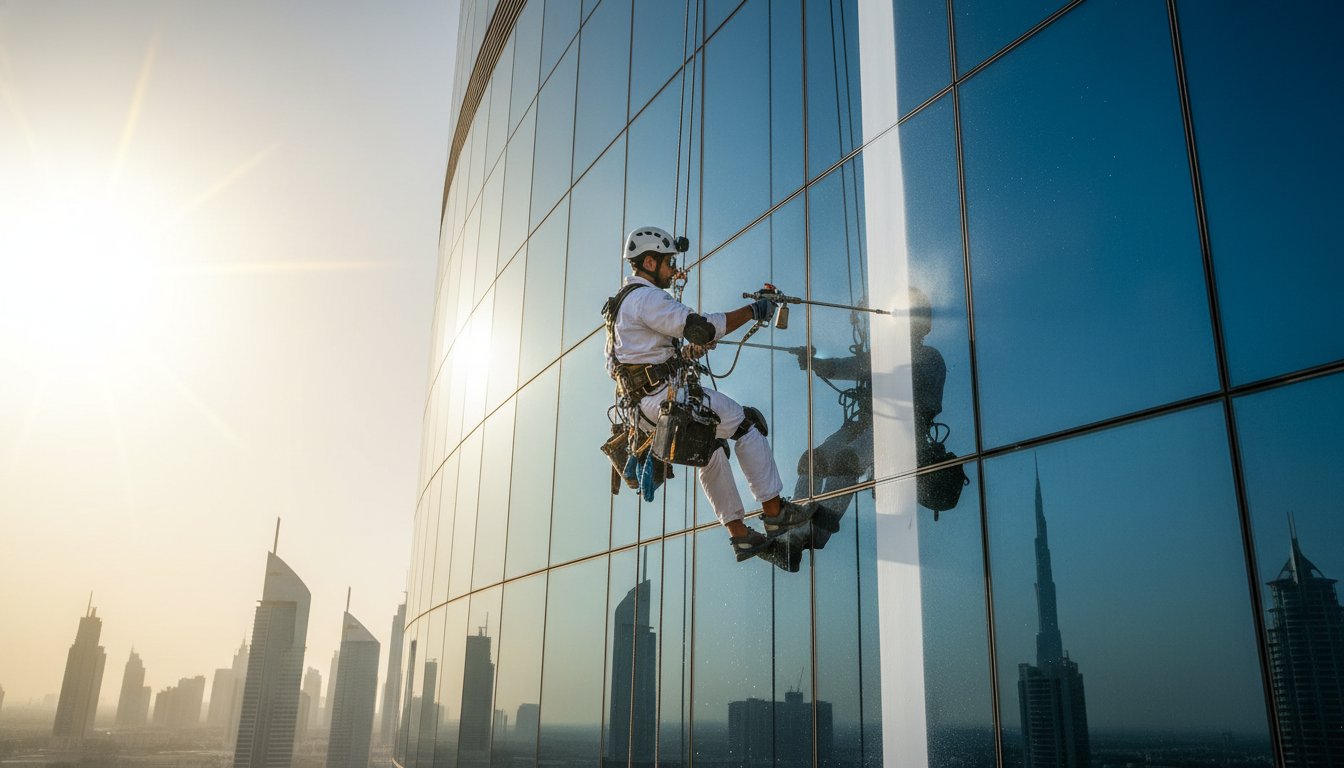
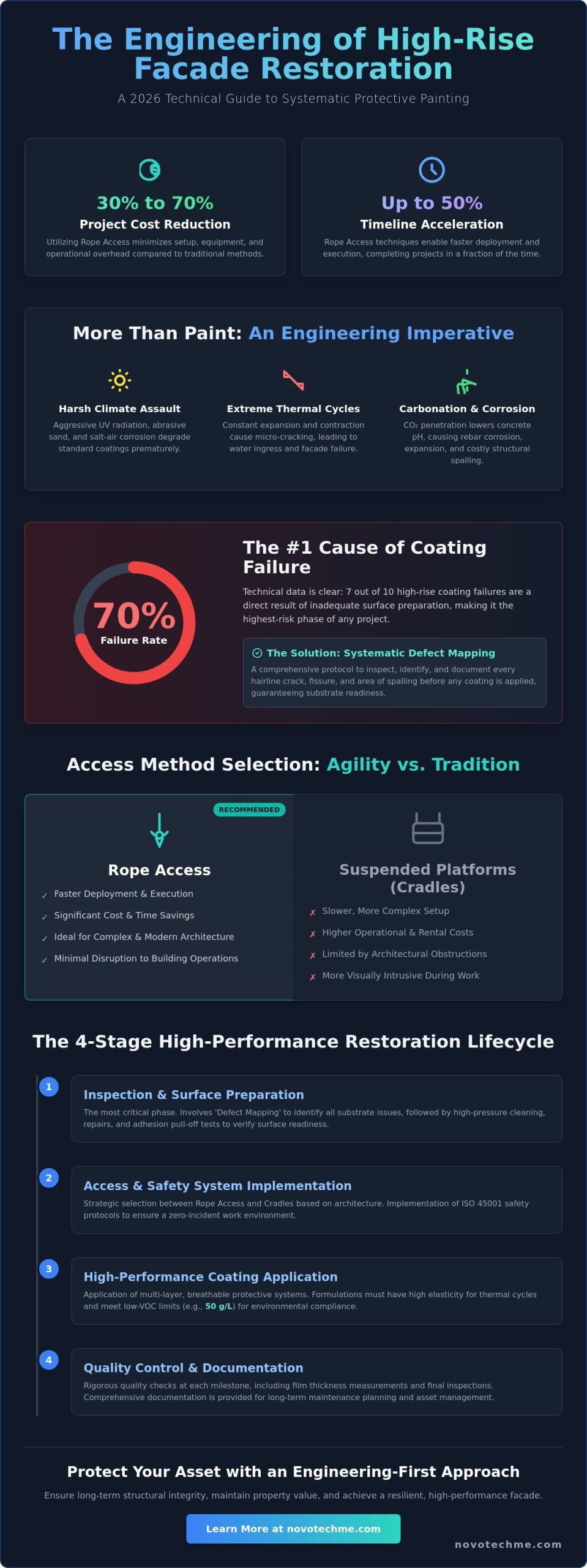
Did you know that utilizing rope access for high-altitude maintenance can reduce project costs by 30% to 70% while accelerating timelines by as much as 50%? For asset managers and developers, the building painting process for high rise is a complex intersection of safety logistics and material science. You likely feel the pressure of ensuring worker safety while battling a climate that causes standard coatings to peel and degrade prematurely. It’s a significant challenge that requires a sophisticated, engineering-first approach rather than a simple aesthetic refresh.
This 2026 technical guide provides a comprehensive breakdown of the multi-stage restoration lifecycle. We’ll examine everything from meeting the latest EPA VOC limits of 50 g/L to implementing ISO 45001 safety protocols that help reduce workplace incidents. You’ll gain a clear roadmap of the project lifecycle, including the technical nuances of protective painting systems and the criteria for selecting between rope access and cradle systems. This knowledge ensures you can vet contractor standards with confidence and achieve a resilient, high-performance facade that withstands extreme environmental stress.
Key Takeaways
- Understand why high-rise facade restoration is a vertical engineering project that requires a systematic approach beyond standard aesthetic painting.
- Discover the “Defect Mapping” techniques used during the building painting process for high rise to mitigate the 70% failure rate associated with inadequate surface preparation.
- Evaluate the logistical impact and operational efficiency of rope access versus suspended platforms based on your building’s specific architectural footprint.
- Learn how to specify multi-layer, breathable protective painting systems designed to withstand extreme thermal expansion and humidity in harsh climates.
- Implement rigorous quality control milestones and demand comprehensive documentation to ensure long-term structural integrity and maintenance predictability.
Understanding the Complexity of High-Rise Exterior Painting
High-rise exterior painting is a specialized engineering project that requires a systematic restoration approach. Unlike low-rise commercial projects, the building painting process for high rise involves intricate logistics and the application of high-performance coatings designed for extreme elevations. At these heights, structures face accelerated environmental degradation that standard residential paints cannot withstand. By 2026, the industry has transitioned toward sustainable, low-VOC formulas, with flat coatings now limited to 50 g/L to meet stricter environmental standards. This shift requires a deep understanding of material science to ensure long-term adhesion and protection.
Verticality introduces unique structural stresses. As building height increases, the intensity of wind loads and thermal exposure grows significantly. Asset managers must account for intense thermal expansion and contraction cycles that stress the building’s substrate throughout the day. Without specialized coatings that offer high elasticity, these movements lead to micro-cracking and eventual facade failure. To reach these heights safely and effectively, contractors utilize advanced Rope access techniques or suspended platforms, ensuring every square meter of the envelope receives consistent protection without compromising worker safety.
Structural and Environmental Challenges in the UAE
Buildings in the UAE operate in one of the world’s most demanding environments. Intense UV radiation aggressively breaks down standard paint polymers, which leads to chalking and rapid color loss. Additionally, wind-driven sand acts as a natural abrasive, physically wearing down the protective layers of the facade over time. For coastal properties, salt-air corrosion is a constant threat. Chloride ions penetrate porous concrete and initiate the degradation of internal steel reinforcements, making the building painting process for high rise a critical defensive measure against structural decay.
Why Regular Painting is a Maintenance Necessity
Proactive facade maintenance is essential for preventing carbonation, a process where carbon dioxide penetrates concrete and lowers its pH, eventually causing rebar corrosion. Once internal steel begins to rust, it expands, which leads to concrete spalling and incredibly expensive structural repairs. Investing in professional protective painting systems provides a high ROI by extending the lifecycle of the building’s exterior. This strategic upkeep preserves property value, ensures tenant satisfaction in a competitive market, and maintains the building’s status as a premium asset.
The Critical Pre-Painting Phase: Inspection and Surface Preparation
Data from technical forensics indicates that 70% of coating failures in the building painting process for high rise are the direct result of insufficient surface preparation. At the vertical scale, the margin for error is non-existent. A facade might appear structurally sound, yet harbor microscopic contaminants or high alkalinity that prevents proper bonding. Neglecting a rigorous diagnostic phase ensures that even premium protective systems will eventually suffer from bubbling, peeling, or delamination under the stress of extreme climates.
We implement a comprehensive ‘Defect Mapping’ protocol to mitigate these risks. This systematic approach involves a granular inspection to identify hairline cracks, deep structural fissures, and areas of concrete spalling. By documenting these anomalies before application begins, we establish a technical baseline for the restoration project. Technicians must utilize OSHA-compliant fall protection while conducting these tactile assessments. This phase isn’t merely about cleaning; it’s about verifying the structural integrity of the substrate itself.
To ensure the highest quality of application, we utilize adhesion testing, specifically pull-off tests, to quantify substrate readiness. This empirical data confirms that the surface can support the mechanical load of new coating layers. Without this verification, the risk of multi-layer delamination increases significantly, especially in high-wind zones where the facade experiences constant pressure fluctuations.
Professional Surface Assessment and Repair
Accurate assessment distinguishes between aesthetic hairline fractures and structural cracks that require technical intervention. Concrete repair is a mandatory prerequisite. We patch spalled areas where corroded rebar has forced the concrete to break away, stopping the cycle of decay before it compromises the building’s skeleton. We also verify the pH neutrality of the substrate. Excessive alkalinity can cause chemical reactions that destroy paint binders. For those overseeing complex assets, an integrated building maintenance and renovation strategy ensures these defects are rectified before they become catastrophic liabilities.
Technical Cleaning and Substrate Neutralization
Standard cleaning methods often fall short of high-rise requirements. Our protocols utilize high-pressure water jetting to eliminate ‘laitance’, the weak layer of cement residue, and industrial pollutants. In dense urban centers, we carefully manage water runoff to protect surrounding infrastructure. We also prioritize substrate neutralization to prevent efflorescence, which is the migration of salts to the surface that causes unsightly staining. Ensuring a chemically stable and physically clean surface is the cornerstone of the building painting process for high rise.
Selecting Access Methods: Rope Access vs. Suspended Platforms
Selecting the vertical access strategy is a pivotal phase in the building painting process for high rise. This decision dictates the project’s logistical footprint and the overall timeline. While traditional scaffolding remains a staple in certain large-scale construction scenarios, modern high-rise maintenance frequently favors more agile solutions. We evaluate building architecture to determine if rope access or suspended platforms offer the most efficient path forward. This evaluation balances speed, cost, and the safety of both technicians and the public. It’s a strategic choice that directly impacts the project’s bottom line and the building’s daily operations.
Verified industry data indicates that rope access typically offers cost savings between 30% and 70% compared to scaffolding for high-rise maintenance. It’s also significantly faster, often reducing project duration by 50% to 70% because it eliminates the lengthy assembly and disassembly phases required for rigid structures. These efficiencies are critical for maintaining operational continuity in busy urban centers. However, safety remains the primary metric for any vertical engineering project. OSHA mandates that suspension ropes support a minimum of six times the maximum intended load, a standard that underpins every rigging plan we develop for the building painting process for high rise.
Managing exclusion zones is another critical component of the logistical footprint. High-altitude work creates a potential risk for falling objects, necessitating strictly controlled areas at the ground level. We utilize detailed rigging plans to minimize these zones, ensuring that building entrances and public walkways remain accessible whenever possible. This precision prevents the “bottleneck” effect often associated with large-scale facade projects, allowing the building to function normally while restoration work continues overhead.
Industrial Rope Access (IRATA) Standards
Industrial Rope Access Trade Association (IRATA) standards represent the global benchmark for high-altitude safety and technical competence. Utilizing IRATA-certified technicians ensures that the facade restoration is executed with disciplined precision. One of the primary advantages is the minimal disruption for tenants. Because equipment is deployed from the roof and removed daily, there’s a zero ground-level footprint. This method is especially effective for complex architectural shapes and deep recesses where rigid platforms simply cannot reach, providing a level of agility that traditional systems lack.
Cradle Systems and BMU Logistics
For projects involving heavy materials or long-duration structural repairs, utilizing existing Building Maintenance Units (BMUs) or temporary suspended platforms (TSPs) is often the most practical choice. These systems provide a stable base for multiple technicians and heavy equipment. However, they are subject to rigorous safety protocols; OSHA requires top rails on guardrail systems to be between 38 and 45 inches high. In the UAE, high-wind conditions frequently ground cradle operations, making it essential to have a flexible access strategy that accounts for regional weather patterns to avoid costly delays.
High-Performance Coating Application for Extreme Climates
The actual application phase represents the culmination of technical planning and material science. In the building painting process for high rise, we utilize a rigorous three-layer architecture consisting of a high-adhesion primer, a structural intermediate coat, and a resilient protective topcoat. This system isn’t merely aesthetic; it’s a multi-layered barrier against the aggressive climatic conditions of 2026. Breathable coatings are a non-negotiable requirement for modern facades. They allow moisture vapor to escape from the substrate while preventing liquid water from entering, which effectively stops the internal vapor pressure that causes bubbling and peeling.
Precision during application is verified through continuous Wet Film Thickness (WFT) monitoring. This measurement ensures that the coating is applied at the manufacturer’s exact specified thickness to achieve the engineered dry film performance required for high-altitude exposure. In the UAE, managing application timing is a critical logistical factor. We strictly avoid the peak midday heat to prevent “flash drying.” This phenomenon occurs when the paint surface dries too quickly, trapping solvents beneath the skin and leading to structural weakness and premature film failure.
Adherence to the latest EPA regulations is also paramount. By 2026, non-flat coatings are restricted to 100 g/L of VOCs, necessitating the use of advanced water-based and sustainable formulas. These modern coatings offer superior color retention and flexibility compared to older solvent-based counterparts, provided they’re applied under controlled environmental conditions. Our technicians monitor ambient temperature and humidity levels to ensure every layer cures correctly, creating a monolithic shield over the building’s exterior.
Primer Systems and Adhesion Promotion
Primers are selected based on the specific porosity of the substrate, whether it’s concrete, render, or metal elements. We ensure absolute chemical compatibility between the existing facade and the new system to prevent catastrophic delamination. Primers act as a neutralizing barrier that prevents the high alkalinity of the concrete from attacking and breaking down the binders in the new paint layers. This chemical stabilization is the foundation of a long-lasting finish.
Advanced Protective Topcoats: Terraco and Anti-Corrosive Systems
For metal facade elements and structural steel, we integrate specialized anti-corrosive paint uae solutions that provide high-performance protection against salt-air oxidation. Terraco coatings are frequently preferred for their exceptional elasticity and UV resistance, allowing them to bridge micro-cracks during extreme thermal expansion. We also utilize dust-repellent finishes to reduce long-term maintenance costs in sandy environments. For comprehensive protection of your vertical assets, explore our exterior building painting services to ensure your high-rise remains resilient and visually striking.
Quality Control and Long-Term Maintenance Strategies
Quality control in the building painting process for high rise is a continuous engineering discipline rather than a singular event. It begins with the validation of substrate preparation and extends through every coat application to ensure the final finish meets technical specifications. By maintaining a multi-stage inspection regime, we verify that adhesion, film thickness, and color uniformity align with the project’s performance goals. This methodical oversight minimizes the risk of latent defects and ensures the facade remains resilient against atmospheric stressors.
Upon completion, providing a comprehensive ‘As-Built’ report is essential for sophisticated asset management. This document serves as a technical record of the products used, application conditions, and specific repair locations. It’s a vital tool for future maintenance planning and insurance compliance. We also emphasize the importance of understanding warranty structures. A clear distinction exists between product warranties provided by the manufacturer and labor warranties provided by the contractor. While the former covers material performance, the latter addresses the application’s integrity, ensuring you’re protected from both material failure and technical errors.
Establishing a proactive 5-year maintenance cycle is the final step in securing the building’s exterior. This schedule allows for the early detection of issues before they escalate into structural concerns. A standard vertical maintenance cycle typically includes:
- Detailed visual inspections to identify early signs of thermal stress or micro-cracking.
- Scheduled soft-washing to remove corrosive salt deposits and industrial pollutants.
- Technical reviews of expansion joints and sealant integrity to prevent water ingress.
NovoTech’s Sophisticated Handover Protocol
Our handover process utilizes high-resolution photography and drone footage to provide a granular view of the finished work at every elevation. This transparency allows property managers to verify the quality of the building painting process for high rise without the need for manual high-altitude inspections. We also prioritize clear tenant communication throughout the project’s conclusion, ensuring a smooth transition as equipment is demobilized and access is restored. For a deeper look at regional standards, see our full exterior building painting dubai guide for more details.
Planning for Facade Longevity in Dubai
Longevity in extreme climates requires more than just a high-quality initial application. Scheduled soft-washing is critical to remove the abrasive sand and corrosive salt buildup typical of the region. Spot-repairing high-impact areas prevents minor abrasions from developing into widespread coating failure. The expertise of professional building maintenance companies in dubai plays a central role in extending the life of protective systems, ensuring the building’s aesthetic and structural integrity remains uncompromised for the long term.
Securing the Future of Your Vertical Assets
Executing a successful building painting process for high rise requires more than just aesthetic vision; it demands a rigorous technical framework built on precision engineering and advanced material science. We’ve explored how systematic defect mapping and the selection of breathable, high-performance coatings are essential to preventing premature facade failure in extreme climates. By prioritizing certified vertical access methods and adhering to a disciplined maintenance cycle, asset managers can significantly extend the lifecycle of their properties while ensuring long-term structural integrity.
Our team brings over 30 years of specialized UAE experience to every restoration project. As an Authorized Terraco Applicator utilizing Certified IRATA Rope Access Teams, we provide the technical depth required to handle the most complex high-altitude challenges. We invite you to partner with NovoTech for your high-rise facade project to ensure your investments are protected by industry-leading expertise and innovative coating technologies. Let’s work together to transform your building’s exterior into a resilient, high-performance asset that stands the test of time.
Frequently Asked Questions
How long does the building painting process for high-rise structures typically take?
The duration of the building painting process for high rise varies based on the structure’s total surface area and the complexity of the architectural design. For a typical 40-story tower, projects generally span between three to six months. This timeline accounts for essential phases such as defect mapping, surface neutralization, and the multi-layer application of protective coatings, while allowing for variables like high-wind delays and logistical coordination.
Is rope access safer than using a cradle for high-rise painting?
Both rope access and cradle systems are safe when implemented according to IRATA and OSHA standards. Rope access is frequently considered superior in safety for complex facades because it utilizes independent anchor points and lacks the heavy mechanical components of a cradle that are prone to failure. Our teams prioritize rigorous rigging inspections and redundant safety lines to eliminate risk during high-altitude operations, ensuring total project safety.
What is the best time of year to paint a high-rise building in Dubai?
The optimal window for facade restoration in Dubai is between October and April. During these months, lower ambient temperatures and reduced humidity levels provide the ideal environment for coating systems to cure correctly. Executing the building painting process for high rise during this cooler period avoids the technical risks of flash drying and solvent entrapment associated with the extreme summer heat, ensuring a more durable and resilient finish.
How often should a high-rise building be repainted in the UAE climate?
High-rise structures in the UAE typically require a full repaint every seven to ten years to maintain structural and aesthetic integrity. However, we recommend a five-year technical inspection cycle to identify early signs of UV degradation or salt-air corrosion. Proactive maintenance, including soft-washing and minor spot repairs, can significantly extend the performance lifecycle of the protective coating system and prevent the need for premature full-scale restoration.
Does building painting help with energy efficiency or cooling costs?
Utilizing specialized solar-reflective coatings can contribute to lower internal building temperatures by reducing solar heat gain on the facade. These high-performance finishes reflect a significant portion of infrared radiation, which decreases the thermal load on the building’s HVAC systems. While not a replacement for structural insulation, these protective systems serve as a functional layer in an integrated energy management strategy, providing measurable value in extreme climates.
What certifications should I look for in a high-rise painting contractor?
A reputable contractor should hold ISO certifications for quality management (9001), environmental systems (14001), and occupational health and safety (45001). Additionally, verify that their technical teams are IRATA-certified for rope access and that the firm is an authorized applicator for premium coating brands like Terraco. These credentials ensure the provider adheres to international engineering standards and rigorous safety protocols throughout the project lifecycle.
Can high-rise painting be done without disturbing the tenants?
High-rise painting can be executed with minimal impact on building occupants, particularly when utilizing rope access techniques. Unlike scaffolding, rope systems are deployed and retracted daily, maintaining clear window views and ensuring zero ground-level obstruction. We coordinate closely with property management to provide scheduled updates and precise work zones, ensuring that tenant privacy and building accessibility remain uncompromised throughout the entire duration of the project.
What happens if the facade has structural cracks before painting?
Structural cracks must be technically remediated before any coating application begins. Our process involves deep-cleaning the fissures, treating any exposed reinforcement steel with anti-corrosive solutions, and utilizing high-strength polymer-modified mortars for repair. This ensures the substrate is structurally sound and prevents moisture from migrating behind the new paint film, which would otherwise lead to rapid delamination and compromise the integrity of the protective system.