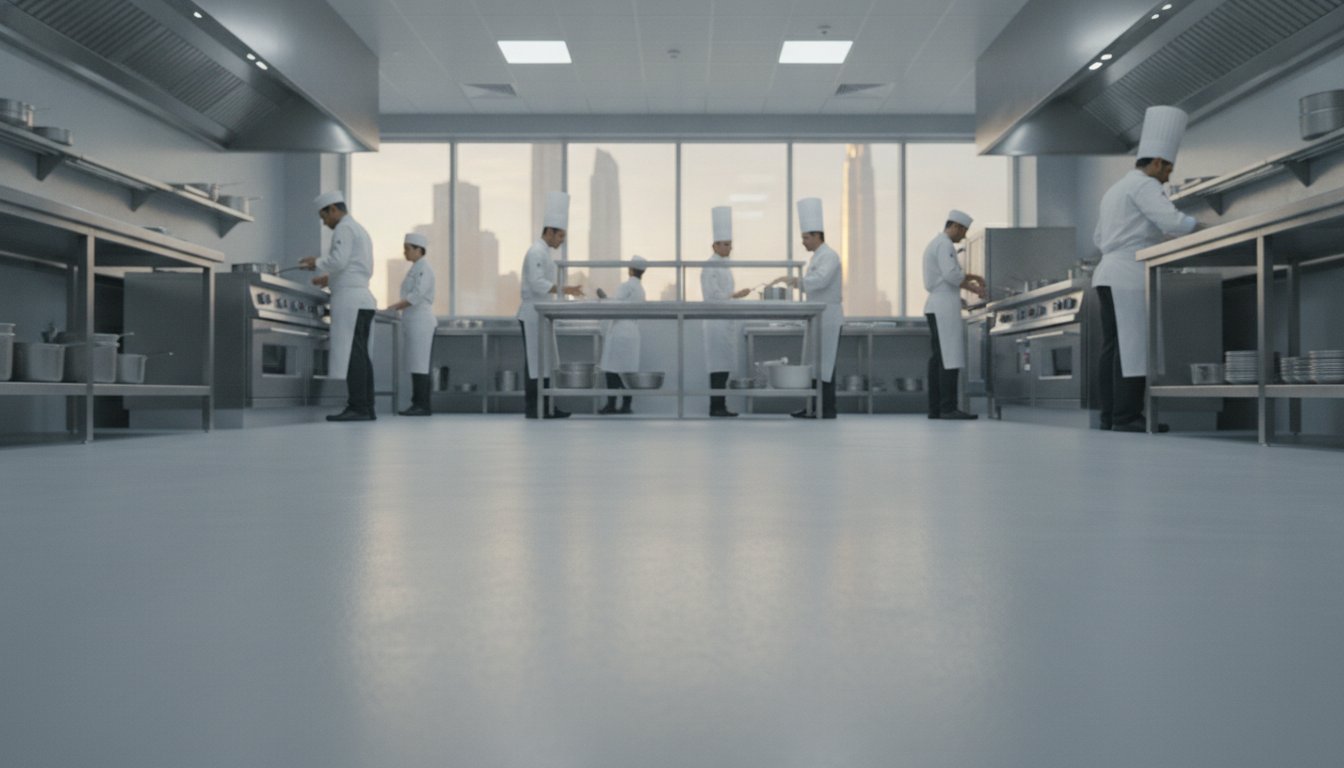
In a high-pressure culinary environment, your floor is far more than a foundation; it’s a critical safety and hygiene system that directly impacts your operational viability. If you’ve dealt with peeling coatings near high-heat equipment or the constant worry of a failed Dubai Municipality inspection due to absorbent surfaces, you know that standard finishes are insufficient. Selecting the right commercial kitchen flooring solutions dubai requires a strategic approach that balances technical performance with strict regulatory adherence.
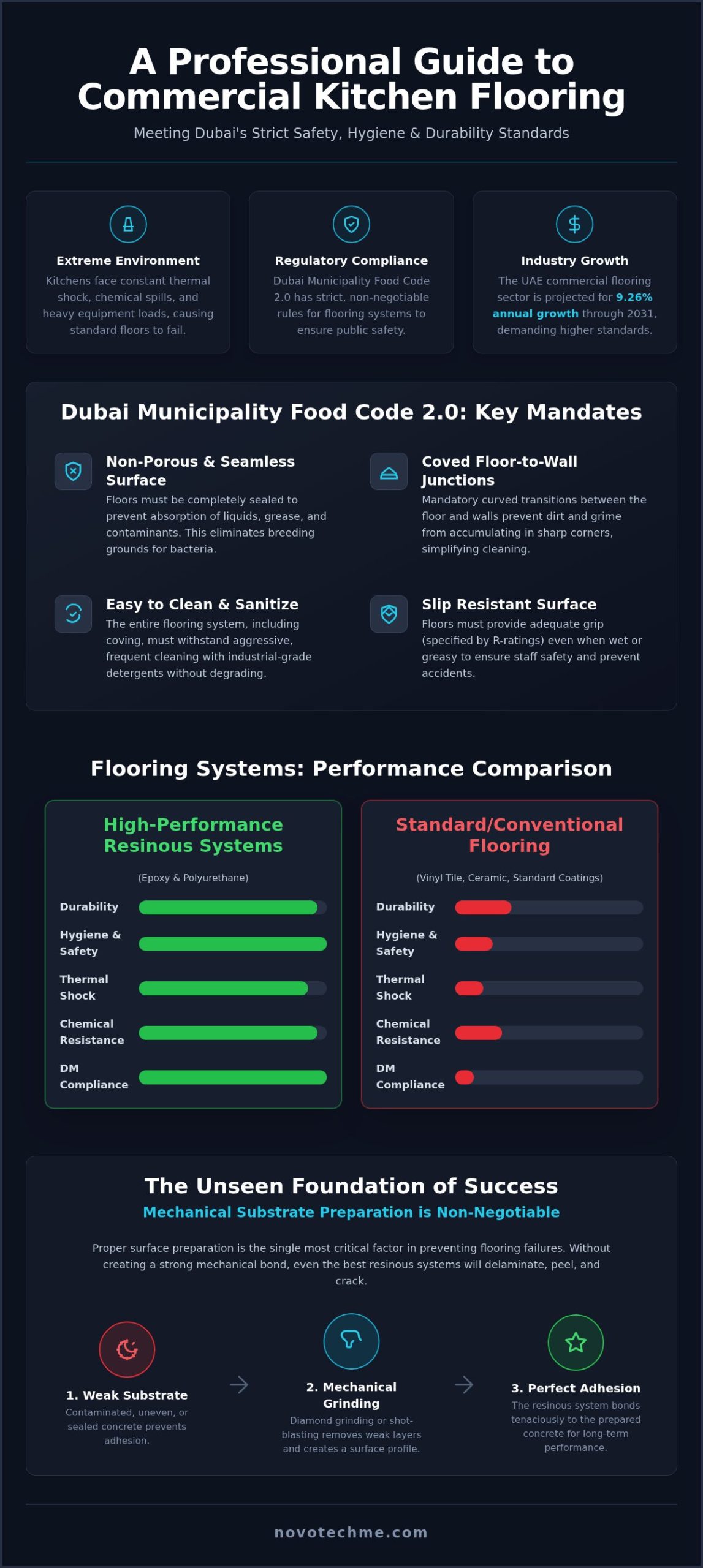
We recognize that a seamless, easy-to-clean environment is non-negotiable for modern facilities, especially as the UAE commercial flooring sector continues its projected 9.26% annual growth through 2031. This 2026 professional guide explores high-performance, HACCP-compliant systems designed to withstand extreme thermal shock and heavy equipment loads. You’ll learn how to navigate the latest Food Code 2.0 requirements, including essential coving and non-toxic material standards. We’ll provide the technical clarity needed to transform your kitchen floor into a durable, compliant asset that supports your team’s safety and your brand’s reputation for excellence.
Key Takeaways
- Understand the mandatory Dubai Municipality Food Code 2.0 standards, including the requirement for coved wall-to-floor junctions and non-porous surfaces to ensure full regulatory compliance.
- Learn how to select high-performance commercial kitchen flooring solutions dubai that utilize industrial-grade resinous systems to withstand extreme thermal shock and chemical exposure.
- Discover why mechanical substrate preparation, such as diamond grinding or shot-blasting, is the critical technical step to prevent the vast majority of common flooring failures.
- Evaluate the importance of slip-resistance R-ratings and antimicrobial properties in maintaining a safe, high-traffic workplace that meets international hygiene benchmarks.
- Identify the strategic advantages of partnering with an authorized Terraco applicator to implement protective systems that offer long-term durability under heavy industrial equipment.
High-Performance Commercial Kitchen Flooring Solutions in Dubai
In the high-velocity environment of a professional kitchen, the floor serves as the literal foundation for operational integrity. We view commercial kitchen flooring solutions dubai not merely as a surface finish, but as a critical infrastructure component that must harmonize safety, hygiene, and long-term durability. In Dubai’s specific climate, where ambient humidity often exceeds 60% and external temperatures soar, the technical demands on these systems are significantly higher than in temperate regions. Standard materials that don’t account for these environmental stressors will inevitably fail, leading to costly repairs and safety hazards.
Residential-grade materials or standard Vinyl composition tile often fail under these rigorous conditions. While such materials might suffice for domestic use or light-traffic retail, they lack the structural density to withstand the aggressive environment of a high-output commercial facility. They frequently suffer from delamination and cracking when exposed to the constant cycle of heat and moisture common in the UAE. We prioritize seamless resinous systems because they offer a unified surface that resists the penetration of liquids and contaminants, ensuring the facility remains structurally sound under pressure.
The Role of Flooring in Food Safety and HACCP
Maintaining a non-porous surface is the first line of defense against microbial proliferation. We implement specialized epoxy and polyurethane systems that eliminate the grout lines found in traditional tiling, which are notorious for harboring bacteria and grease. These systems are essential for compliance with the Dubai Municipality Food Code 2.0, which mandates surfaces that are easy to clean and sanitize.
A critical requirement for any modern facility is the installation of coving. These rounded transitions between the floor and wall prevent the accumulation of organic matter in hard-to-reach corners. During a Dubai Municipality inspection, the integrity of these junctions is often a primary focus. A failure to maintain a seamless, washable surface can lead to immediate compliance issues and potential operational downtime. Our approach ensures that every square meter of your kitchen meets these stringent hygiene benchmarks.
Durability Under Extreme Kitchen Stress
The technical challenge of kitchen flooring involves managing thermal shock. This occurs when a surface is rapidly transitioned from the ambient heat of an oven line to the sub-zero temperatures of a walk-in freezer or during high-temperature pressure washing. Without the specific elasticity provided by industrial-grade coatings, the substrate will crack, allowing moisture to seep underneath and destroy the bond.
Our systems are engineered to handle the massive compressive stress of heavy equipment, such as industrial ranges and refrigeration units, without indenting or shifting. They also offer superior chemical resistance. In a busy kitchen, the floor must remain impervious to hot oils, acidic food waste, and the aggressive alkaline detergents required for deep cleaning. By choosing an integrated, high-performance solution, we ensure your facility remains functional and safe for years to come.
Comparing Industrial Epoxy and Specialized Coatings for Kitchens
Selecting the optimal resinous system for a professional kitchen involves more than aesthetic preference. It’s a technical decision based on the specific operational stresses of your facility. While generic providers might suggest vinyl or standard tiles, these materials often fail under the extreme heat of commercial ranges. We focus on advanced resinous commercial kitchen flooring solutions dubai that provide a unified, chemically bonded surface capable of withstanding industrial-scale food production. These systems are categorized by their chemical composition, each offering distinct advantages for different kitchen zones.
Epoxy Floor Coatings: The Versatile Workhorse
Epoxy floor painting & coatings remain a primary choice for general preparation and storage areas due to their exceptional bond strength and chemical resistance. Ensuring your facility aligns with Dubai Municipality food safety standards requires a surface that is both non-absorbent and chemically inert. Epoxy systems achieve this by creating a dense, cross-linked molecular structure that prevents oils and proteins from penetrating the substrate.
We customize these coatings to meet specific safety requirements through aggregate broadcast systems. By incorporating specialized sands or quartz into the wet resin, we create a textured finish that provides essential slip resistance even in wet or greasy conditions. Additionally, epoxy allows for clear color-coding of different zones. You can designate high-traffic thoroughfares, washing stations, and cooking lines with distinct colors to enhance workflow efficiency and employee safety. For facilities requiring a tailored technical assessment, consulting with a specialist in high-performance epoxy floor painting & coatings ensures the system matches your specific operational load.
PU Screeds vs. Standard Epoxy
In high-heat environments, such as areas surrounding heavy-duty ovens and deep fryers, Polyurethane (PU) screeds are often the superior choice. Unlike standard epoxy, PU systems possess a degree of flexibility that allows them to expand and contract at a rate similar to the concrete substrate. This property is vital for resisting thermal shock, which occurs during rapid temperature shifts from boiling liquids or industrial steam cleaning. In a 24/7 kitchen operation, the longevity of a PU screed often justifies the initial investment, as it significantly reduces the risk of delamination over time.
For renovation projects where business continuity is the priority, we may recommend Methyl Methacrylate (MMA) systems. MMA coatings offer an incredibly rapid cure time, often reaching full mechanical and chemical strength within two hours of application. This allows for overnight installations that don’t disrupt your daily service. Whether you prioritize the rapid turnaround of MMA or the heavy-impact resistance of a 6mm PU screed, the goal is to implement a protective system that serves as a long-term asset rather than a recurring maintenance liability.
Why Substrate Preparation is Critical for UAE Commercial Kitchens
We’ve observed that approximately 90% of failures in commercial kitchen flooring solutions dubai are the direct result of inadequate substrate preparation rather than material defects. In a high-pressure culinary environment, the bond between the resinous coating and the concrete slab is the most vulnerable point. If the substrate isn’t correctly profiled, the flooring system effectively floats on the surface, leading to inevitable delamination under the stress of heavy equipment and thermal shifts. We treat the concrete slab as a technical component that requires precise mechanical intervention before any protective system is applied.
Mechanical surface preparation is the industry standard for ensuring long-term adhesion. We utilize shot-blasting for heavy-duty PU screeds to create an aggressive surface profile that allows the resin to anchor deeply into the concrete. For thinner epoxy coatings, diamond grinding is the preferred method to remove surface laitance and open the concrete pores. This process is especially vital in Dubai’s coastal environment, where moisture vapor transmission (MVT) can create hydrostatic pressure beneath the slab. Without a properly prepared and sealed substrate, this vapor pressure leads to osmotic blistering, eventually rupturing the floor finish.
Testing and Diagnosis of Concrete Floors
A successful installation begins with a rigorous diagnostic phase. We conduct moisture content testing to ensure the slab’s relative humidity is within the permissible limits for the chosen resin system. If the concrete is too wet, we must pivot to moisture-tolerant materials to avoid bond failure. We also verify the concrete’s compressive strength, ensuring it can handle the concentrated loads of industrial ranges and walk-in freezers. Furthermore, we meticulously identify and remove deep-seated contaminants like grease and animal fats that have leached into the porous concrete over time, as these substances act as bond-breakers for new coatings.
Advanced Priming and Moisture Barriers
To secure the facility against the region’s unique environmental stressors, we employ specialized moisture-tolerant primers. These primers act as a strategic barrier, preventing moisture from migrating upward and compromising the decorative or functional topcoats. In wet zones where water use is constant, we often integrate high-performance waterproofing membranes into the flooring buildup. As one of the expert waterproofing companies in Dubai, we recognize that structural protection starts from the ground up. This integrated approach ensures that your kitchen remains a dry, stable, and compliant workspace for its entire operational lifecycle.
Compliance and Maintenance: Meeting Dubai Municipality Standards
Achieving operational compliance in Dubai’s food and beverage sector requires a rigorous adherence to the Dubai Municipality Food Code. Inspections focus heavily on the physical environment, where the floor is often the first point of scrutiny. High-performance commercial kitchen flooring solutions dubai must be non-absorbent, non-toxic, and light-colored to facilitate visual hygiene checks. We ensure every installation features integrated coving, creating a seamless 50mm to 100mm radius transition from floor to wall. This eliminates the 90-degree angles where organic debris and bacteria typically aggregate, satisfying a core requirement of the DM inspection checklist.
Hygiene and Cleanability Requirements
In high-spec culinary facilities, traditional ceramic or porcelain tiles are increasingly being phased out. The inherent weakness of tiles lies in the grout lines, which are porous and prone to cracking under thermal stress. Once grout is compromised, moisture and fats seep into the substrate, creating a permanent source of odor and bacterial growth. Our resinous systems provide a monolithic surface that withstands daily high-pressure washing and steam cleaning. We often incorporate antimicrobial additives within the resin matrix. These agents actively inhibit the growth of bacteria, fungi, and molds, providing an invisible layer of protection that works 24/7.
Safety Standards and Slip Resistance
Workplace safety is a critical pillar of Dubai’s labor regulations. Balancing slip resistance with cleanability is a technical challenge we solve through precision aggregate broadcasting. For commercial kitchens, we typically target an R10 to R12 rating, depending on the specific zone. Preparation areas with constant water exposure require a higher texture profile to prevent slip-and-fall accidents. However, the texture must not be so aggressive that it traps dirt or shreds cleaning equipment. Just as we use anti-corrosive paint in the UAE to protect metal structures from environmental degradation, our specialized floor textures protect your most valuable asset: your workforce.
Long-term durability isn’t just about the initial application; it’s about a structured maintenance protocol. We recommend avoiding harsh abrasive tools that can micro-scratch the resin surface. Instead, use pH-neutral industrial degreasers and soft-bristle scrubbers to maintain the floor’s integrity. Regular professional audits can identify minor mechanical impacts before they develop into structural issues. If you’re preparing for a facility upgrade or need to ensure your current space meets 2026 standards, you can consult with our technical team for a compliance audit to identify potential risks before they become liabilities.
Professional Kitchen Flooring Installation with NovoTech
Selecting high-performance commercial kitchen flooring solutions dubai is only half the battle; the technical execution determines the long-term return on investment. We bring over 30 years of specialized UAE regional expertise to every project, positioning ourselves as a strategic partner rather than a mere service provider. Our status as an authorized Terraco applicator provides our clients with access to premium, industrial-grade protective systems that are specifically engineered for the Middle East’s environmental challenges. This certification isn’t just a badge. It’s a guarantee that the application follows strict manufacturer protocols for mix ratios, ambient temperature control, and curing times.
We understand that a kitchen renovation often involves more than just the floor. Our integrated service model covers the entire project lifecycle, including gypsum partition and ceiling work to ensure a fully compliant, food-safe environment. By managing these adjacent requirements, we eliminate the coordination gaps that often lead to project delays. We prioritize efficiency in our scheduling to minimize operational downtime, utilizing rapid-cure systems where necessary to return your facility to full service as quickly as possible.
The NovoTech Renovation Advantage
Our capability extends beyond the kitchen interior. We often coordinate flooring upgrades with broader facility requirements, such as Exterior Building Painting Dubai, to provide a comprehensive aesthetic and functional overhaul. This holistic approach ensures that every aspect of your infrastructure, from anti-corrosive protective painting systems on exposed metalwork to the seamless resinous floors beneath your feet, meets the highest standards of integrated excellence. We don’t believe in one-size-fits-all solutions. Our team works collaboratively with your operations staff to understand your specific traffic patterns and equipment loads, tailoring the system buildup to your unique operational goals.
Requesting Your Commercial Flooring Consultation
An accurate project quote requires a detailed understanding of your existing substrate condition. We provide on-site technical assessments across Dubai and Sharjah to diagnose moisture issues, identify structural cracks, and recommend the most cost-effective resinous system for your needs. These assessments are conducted by seasoned experts who understand both the technical engineering requirements and the strategic business goals of a high-output commercial kitchen. Consult with NovoTech for your kitchen flooring renovation today. We’ll provide the technical depth and operational reliability required to secure your facility’s future.
Securing Your Culinary Infrastructure for 2026 and Beyond
Developing a high-performance workspace requires a shift from viewing flooring as a cosmetic finish to treating it as a strategic technical asset. We’ve highlighted that successful commercial kitchen flooring solutions dubai depend on the precise integration of mechanical substrate preparation, resinous material selection, and strict adherence to Dubai Municipality Food Code 2.0 standards. Prioritizing seamless, coved transitions and R-rated slip resistance isn’t just about passing inspections; it’s about protecting your workforce and ensuring long-term operational continuity in the UAE’s demanding climate.
As an authorized Terraco applicator with over 30 years of UAE experience, NovoTech provides the technical depth required for large-scale comprehensive projects. We offer end-to-end responsibility, from initial technical assessments to protective coatings and full building maintenance. This commitment to integrated excellence ensures your facility remains durable under the heaviest industrial loads while maintaining the highest hygiene benchmarks. We invite you to contact NovoTech for an expert kitchen flooring quote and take the first step toward a more resilient, compliant, and efficient commercial kitchen environment. Your facility deserves a foundation built on precision and expert engineering.
Frequently Asked Questions
What is the best flooring for a commercial kitchen in Dubai?
The most effective commercial kitchen flooring solutions dubai involve industrial-grade resinous systems, specifically Polyurethane (PU) screeds for cooking lines and high-build epoxy for preparation zones. These systems provide the necessary thermal shock resistance and chemical durability required for professional environments. We recommend seamless, non-porous finishes that eliminate grout lines, ensuring your facility remains fully compliant with regional hygiene standards while withstanding the daily rigors of heavy equipment and high-temperature cleaning.
How long does it take to install epoxy flooring in a restaurant kitchen?
A standard installation typically requires three to five days to ensure proper mechanical bonding and chemical curing. The process involves one day for diamond grinding or shot-blasting, followed by priming, base coat application, and the final protective topcoat. While rapid-cure Methyl Methacrylate (MMA) systems can be returned to service in as little as 24 hours, our technical team schedules the application to minimize operational downtime while prioritizing long-term structural integrity.
Does epoxy flooring meet Dubai Municipality and HACCP standards?
High-performance resinous flooring is fully compliant with Dubai Municipality Food Code 2.0 and HACCP standards when installed correctly. To meet these regulations, the surface must be seamless, non-toxic, and light-colored to facilitate visual hygiene inspections. We integrate mandatory coved transitions between the floor and walls to prevent bacterial accumulation. These protective systems ensure your kitchen remains impervious to liquids and oils, which is a primary requirement for passing municipality health audits.
How do I prevent my kitchen floor from peeling or bubbling?
Peeling and bubbling are almost always caused by poor substrate preparation or moisture vapor transmission from the concrete slab. To prevent these failures, we utilize mechanical grinding to remove surface contaminants like grease and fats that act as bond-breakers. Additionally, applying a moisture-tolerant primer is critical for ground-floor facilities in Dubai. This creates a dedicated barrier that prevents hydrostatic pressure from causing osmotic blistering, ensuring the coating remains permanently bonded to the substrate.
Is epoxy flooring slippery when wet in a kitchen environment?
Standard epoxy can be slippery, but we eliminate this risk by broadcasting specialized aggregates into the resin matrix during application. We tailor the texture to achieve specific R-ratings, typically R10 to R12 for commercial wet areas. This provides a high-traction surface that protects staff from slip-and-fall accidents even when the floor is covered in water or oils. The result is a safe workspace that remains easy to sanitize with standard industrial equipment.
Can PU screeds be applied over existing tiles in a kitchen renovation?
While some contractors offer over-tile applications, we strongly advise removing existing tiles to access the concrete substrate. Tiles and their grout lines are prone to cracking and harbor moisture, which can lead to the failure of the new coating. By stripping the floor back to the base slab and performing mechanical profiling, we ensure a monolithic bond. This technical approach prevents delamination and provides a much more durable foundation for heavy-duty kitchen equipment.
What is the typical lifespan of industrial kitchen flooring in the UAE?
In the UAE’s demanding climate, a professionally installed industrial floor typically has a lifespan of 10 to 15 years. This durability depends on the thickness of the system; for example, a 6mm PU screed offers superior resistance to thermal shock and heavy impact compared to thinner coatings. Regular maintenance using pH-neutral degreasers and avoiding abrasive mechanical cleaning tools will further extend the service life of your commercial kitchen flooring solutions dubai.
How does NovoTech manage moisture issues in ground-floor kitchens?
Our management process begins with rigorous moisture content testing of the concrete slab to identify potential vapor transmission risks. If high moisture levels are detected, we apply specialized damp-proof membranes or moisture-tolerant primers that are engineered to withstand hydrostatic pressure. This technical intervention is essential for ground-floor facilities in coastal areas, as it prevents the upward migration of moisture that would otherwise cause the protective resin system to delaminate or blister.