In the aggressive coastal environment of the UAE, a standard paint finish isn’t a layer of protection; it’s a countdown to structural failure. Engineering professionals recognize that the synergy of high humidity and airborne chlorides quickly turns minor surface cracks into catastrophic spalling and reinforcement corrosion. Specifying high-performance protective coatings for concrete structures dubai is a technical necessity to safeguard against the region’s unique carbonation and thermal stress challenges.
We understand the urgency of protecting capital assets from the high cost of structural repairs due to failed coatings. This guide helps you master the technical specifications required to extend your structure’s service life by 15+ years while ensuring compliance with the updated 2026 Dubai Municipality safety and maintenance standards. We’ll navigate the complexities of Dubai Law No. 7 of 2025 and evaluate the specific ASTM and ISO standards that define modern concrete protection in the Emirates. By the end of this guide, you’ll have a clear framework for selecting and applying systems that withstand the most demanding environmental conditions.
Key Takeaways
- Understand the biochemical mechanisms of chloride-induced corrosion and carbonation that specifically compromise Dubai’s coastal concrete infrastructure.
- Master the technical criteria for specifying high-performance protective coatings for concrete structures dubai to align with the 2026 Dubai Municipality safety and maintenance standards.
- Learn why precision engineering in surface preparation and substrate moisture analysis is the primary determinant of long-term coating adhesion and system integrity.
- Evaluate the strategic benefits of climate-engineered Terraco systems and how 30 years of regional performance data can inform your facility’s long-term maintenance planning.
- Gain a structured framework for managing end-to-end responsibility in coating projects to achieve a documented service life extension of 15 or more years.
The Science of Concrete Degradation in the Dubai Environment
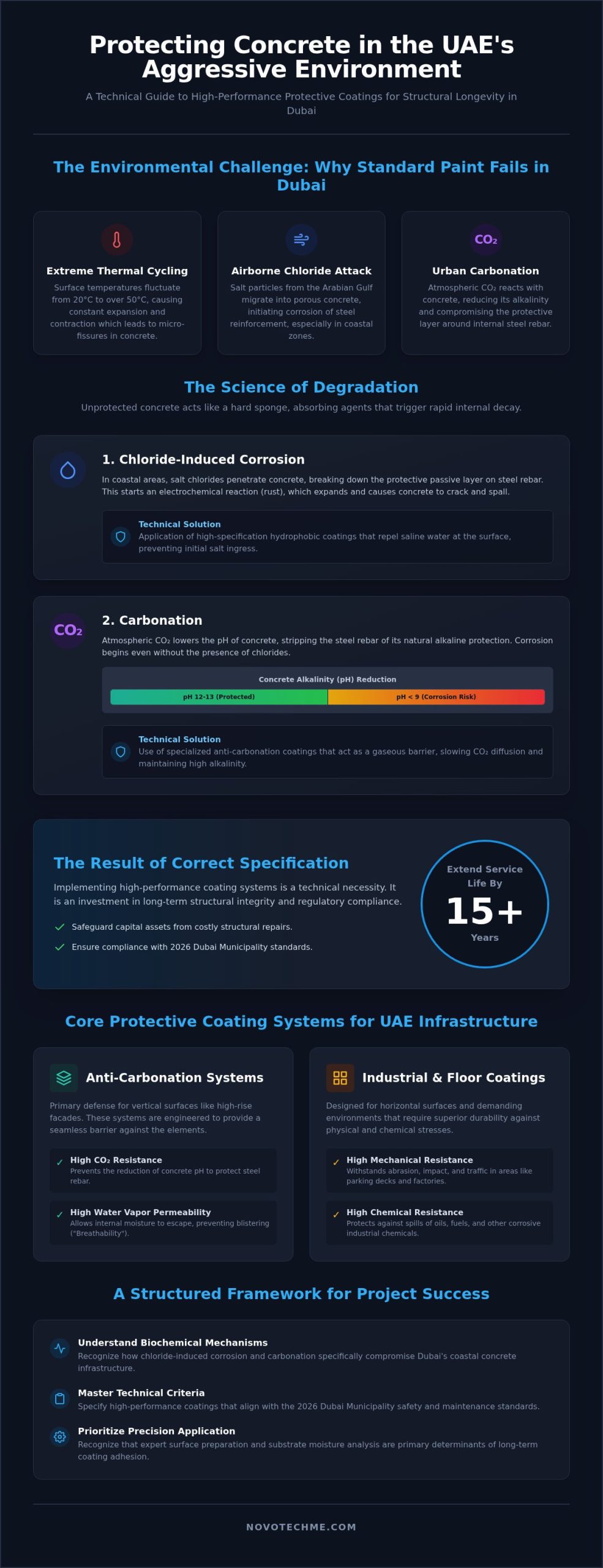
Concrete is often perceived as an immutable material, but in Dubai’s hyper-arid and saline environment, it’s remarkably porous. Without specialized protective coatings for concrete structures dubai, the material acts like a hard sponge, absorbing moisture, salts, and atmospheric gases that trigger rapid internal decay. These coatings serve as engineered barriers, preventing the ingress of harmful substances that would otherwise compromise the structural core. We view these systems as a critical layer of technical defense rather than a mere aesthetic finish.
One of the most aggressive factors in the region is extreme thermal cycling. In Dubai, surface temperatures can fluctuate from 20°C at night to over 50°C during peak summer hours. This constant expansion and contraction creates micro-fissures in the concrete matrix. These cracks provide a direct pathway for contaminants, necessitating the use of Concrete sealers and elastic coating systems that can bridge these gaps without rupturing. When the substrate breathes but remains impermeable to liquid water, the structural lifespan is significantly preserved.
Chloride Attack and Rebar Corrosion
Salt particles from the Arabian Gulf are a constant threat to coastal developments in areas like Dubai Marina and Palm Jumeirah. These chlorides migrate through the concrete’s pore structure until they reach the steel reinforcement. Once the chloride threshold is exceeded, the protective passivity layer on the rebar breaks down. This initiates an electrochemical reaction, leading to rust. Because rust occupies a larger volume than the original steel, it exerts internal pressure that causes concrete spalling and significant structural weakening. High-specification hydrophobic coatings are essential in these zones to repel saline water at the surface and prevent the initial salt ingress.
Carbonation and Structural Integrity
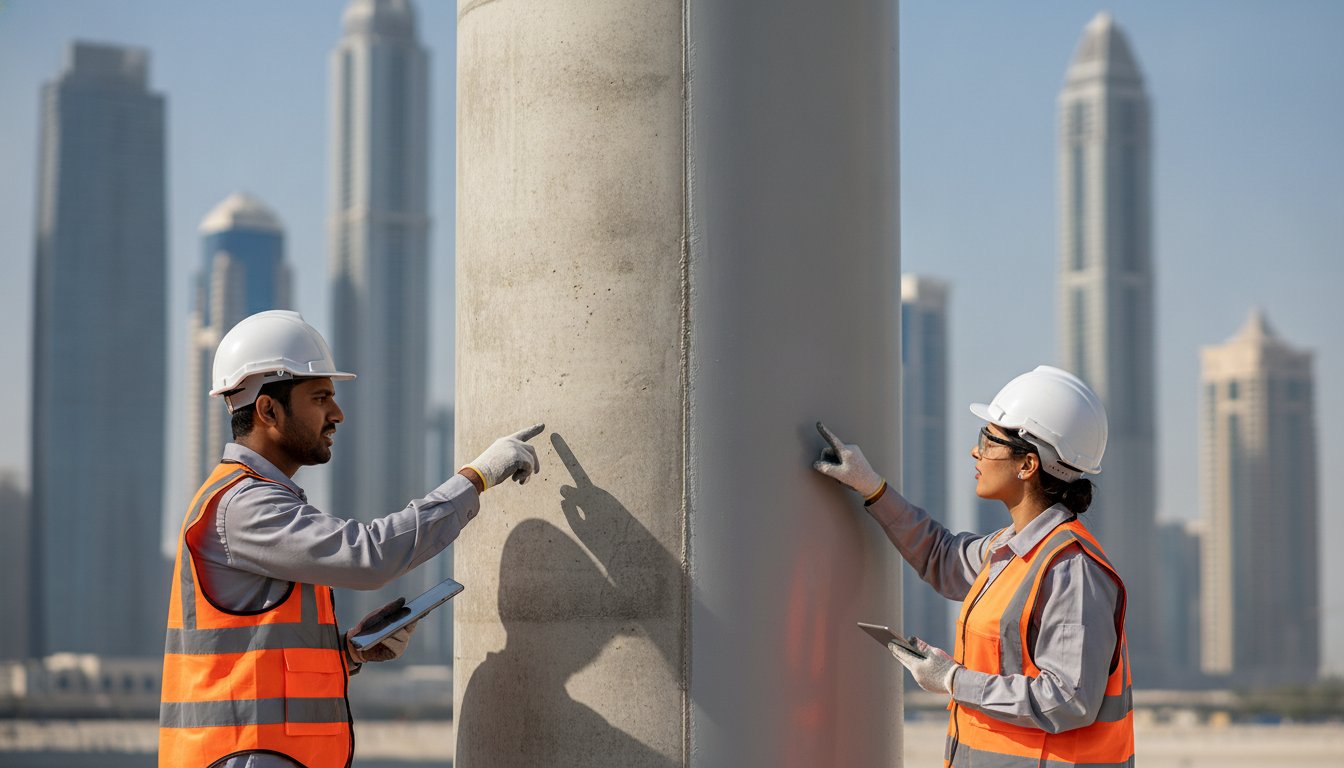
In urban and industrial zones, atmospheric carbon dioxide (CO2) reacts with the calcium hydroxide in concrete. This process, known as carbonation, gradually reduces the alkalinity of the concrete from a pH of 12-13 to below 9. At this lower pH level, the steel reinforcement is no longer protected and begins to corrode even without chloride presence. Identifying carbonation early often involves spotting fine, hairline cracks on high-rise facades. Left unaddressed, the carbonation front will eventually reach the rebar, leading to widespread structural failure. Specialized protective coatings for concrete structures dubai act as a gaseous barrier, significantly slowing the rate of CO2 diffusion into the substrate and maintaining the alkaline environment necessary for rebar health.
Core Types of Protective Coating Systems for UAE Infrastructure
Selecting the correct protective coatings for concrete structures dubai requires a deep understanding of the specific exposure zone and the intended service life of the asset. A high-rise facade in Downtown Dubai faces different chemical and thermal challenges than a basement substructure or an industrial floor. We categorize these systems based on their polymer chemistry and their ability to resist specific environmental stressors such as UV radiation, carbon dioxide ingress, and chloride penetration.
High-Performance Anti-Carbonation Systems
Anti-carbonation coatings act as the primary defense for vertical concrete surfaces. These specialized systems must provide high CO2 diffusion resistance to prevent the lowering of concrete pH, yet they must also maintain high water vapor permeability. This “breathability” is vital. It allows internal moisture to escape as vapor without causing the coating to blister or delaminate. For large-scale assets, these systems are often integrated into comprehensive exterior building painting Dubai projects, where aesthetic finish and technical protection are equally weighted. When properly specified, these coatings bridge micro-cracks and maintain a seamless barrier against the elements.
Specialized Industrial and Floor Coatings
Horizontal concrete surfaces and industrial environments demand higher mechanical and chemical resistance. The application of epoxy floor coating in the UAE is a standard for protecting slabs from impact, abrasion, and chemical spills. However, engineering success depends on balancing these properties with UV stability. While epoxy provides superior adhesion and hardness for interiors, exterior-exposed areas like car park decks or rooftops require polyurethane or polyaspartic topcoats. These UV-resistant layers prevent the chalking and degradation that typically occur under the intense Arabian sun. Engaging a strategic partner to audit your substrate’s specific needs ensures that the chosen system won’t fail prematurely due to mismatched material properties.
Beyond these primary systems, other specialized barriers play crucial roles in infrastructure longevity:
- Cementitious Waterproofing: These polymer-modified coatings are ideal for sub-structures, water tanks, and wet areas where they provide a rigid or semi-flexible moisture barrier.
- Acrylic-Based Systems: Often used for residential villas, these provide a cost-effective, breathable solution that offers moderate protection against carbonation while allowing for a wide range of decorative finishes.
- Anti-Corrosive Primers: Essential for exposed rebar during repair phases to halt existing oxidation before the final coating application.
The efficacy of these systems isn’t just in the product choice; it’s in the technical integration of the entire coating stack. Each layer must be chemically compatible to ensure a cohesive bond that lasts decades.
Precision Application: The Engineering Lifecycle of a Coating Project
Technical success in applying protective coatings for concrete structures dubai is never accidental. It’s the result of a rigorous engineering lifecycle that begins long before the first liter of material is mixed. We view the application process as a series of critical hold points, where each phase must meet documented technical criteria to ensure the system’s long-term adhesion and integrity. Success is 80% preparation and 20% material science; neglecting the substrate inevitably leads to costly structural repair.
Before any coating begins, we conduct a thorough substrate inspection. This includes pull-off strength testing to verify the concrete’s tensile integrity and moisture content analysis. Applying high-performance systems to damp concrete is a primary cause of osmotic blistering. We ensure that the moisture level is within the manufacturer’s specified limits, typically below 4%, before proceeding with the protective layers.
Substrate Preparation Standards
The foundation of any high-performance system is the surface profile. For aggressive environments, we adhere to stringent cleaning standards such as Sa 2.5 (near-white blast cleaning) or Sa 3 for associated steel elements, ensuring the removal of all mill scale, rust, and contaminants. On the concrete itself, achieving the correct Concrete Surface Profile (CSP) through abrasive blasting or mechanical grinding is non-negotiable. We also prioritize the removal of soluble salts, which are prevalent in Dubai’s coastal air. If these salts aren’t neutralized, they can trap moisture through osmosis, leading to premature delamination and coating failure.
During the layering phase, we emphasize the “stripe coat” technique. This involves hand-applying an extra layer of coating to edges, joints, and corners. These are areas where surface tension often causes liquid coatings to pull away, leaving the structure vulnerable. This meticulous attention to detail prevents localized corrosion and ensures uniform protective coatings for concrete structures dubai across complex geometries.
Quality Control and Documentation
Our quality assurance protocol relies on empirical data rather than visual inspection. We utilize calibrated Dry Film Thickness (DFT) gauges to verify that each layer meets the engineering specifications. For critical sub-structures or water-retaining assets, holiday detection (high-voltage spark testing) is employed to identify microscopic voids or pinholes in the coating. Environmental monitoring is equally vital; we track the relationship between substrate temperature and the dew point to prevent condensation from compromising inter-coat adhesion. At the project’s conclusion, we provide facility managers with comprehensive “As-Built” reports. These documents serve as a vital record for future maintenance cycles and warranty validation, reflecting our commitment to total project ownership.
Selecting the Right System: The Terraco and NovoTech Advantage
Success in large-scale infrastructure projects depends on the synergy between material science and field execution. Terraco systems are specifically engineered for the Middle Eastern climate, addressing the high UV indices and extreme thermal shifts that characterize the region. While many global brands offer generalized solutions, Terraco’s regional focus ensures that their protective coatings for concrete structures dubai maintain their chemical properties even when surface temperatures exceed 50°C. This specialized engineering prevents the premature embrittlement often seen in coatings designed for temperate climates.
Asset managers must distinguish between product and application guarantees. A manufacturer’s warranty typically covers material defects, but it doesn’t account for failures caused by improper substrate preparation or environmental contamination during application. By choosing an authorized applicator, you ensure a unified warranty that covers the entire system performance. This provides a clear path of accountability, which is essential for compliance with the 2026 Dubai Municipality rating systems that now scrutinize project quality and technical expertise more strictly than ever before.
The Authorized Applicator Synergy
As an authorized partner, we provide direct manufacturer collaboration to develop bespoke project specifications. This is particularly critical when integrating specialized anti-corrosive paint in the UAE for structures with high-risk rebar exposure. Our technical teams follow certified protocols that validate the warranty from day one, ensuring that the protective coatings for concrete structures dubai are applied exactly as the engineers intended. This collaborative model eliminates the ambiguity often found in fragmented supply chains, positioning us as a strategic partner rather than a mere vendor.
Integrated Waterproofing and Protection
We advocate for a “Total Envelope” approach to building longevity. This strategy combines high-performance surface coatings with expert waterproofing in Dubai to seal the structure against both liquid and gaseous ingress. Whether we are customizing systems for a high-rise facade in Business Bay or protecting a commercial villa exterior, the goal remains the same: total project ownership. This integrated model is also a fundamental requirement for sustainability in 2026. We prioritize Low-VOC and water-based systems to meet the stringent Dubai Green Building Regulations, ensuring your asset remains compliant with the city’s evolving environmental standards.
For a technical audit of your facility’s exterior needs, partner with our structural maintenance experts today.
NovoTech: 30 Years of Authoritative Structural Care in Dubai
NovoTech’s presence in the UAE since 1993 represents more than just longevity; it signifies a deep repository of data on material performance in one of the world’s most aggressive climates. We’ve spent three decades refining the technical application of protective coatings for concrete structures dubai, moving beyond simple aesthetics to provide rigorous structural defense. Our “Collaborative Ally” model is built on the principle that a coating project is a strategic engineering intervention. We take total project ownership, managing everything from the initial substrate analysis to the final documentation, ensuring that facility managers have a single point of technical accountability.
Our approach is grounded in international engineering standards and a commitment to transparency. We don’t just follow manufacturer guidelines; we adapt them to the specific micro-climates of the UAE, from the salt-heavy air of the coast to the heat-trapping urban canyons of the city center. This level of precision is why we’ve remained a trusted partner for some of the region’s most prominent high-rise and commercial villa developments.
A Partner for Facility Management
Modern facility management in Dubai requires a shift toward sophisticated lifecycle planning. We provide the technical insights necessary for accurate maintenance budgeting, ensuring that capital expenditure is optimized for maximum structural longevity. Our site assessments help identify the “silent” signs of carbonation or chloride ingress in aging infrastructure, allowing for proactive intervention. During execution, we prioritize operational continuity. We coordinate our teams to ensure that large-scale applications of protective coatings for concrete structures dubai occur with minimal disruption to tenants or commercial operations, maintaining the asset’s functionality throughout the project lifecycle.
Protecting the Future of Dubai’s Assets
As the Dubai construction sector moves toward performance-driven engineering in 2026, the demand for verified quality has never been higher. Compliance with the updated contractor rating systems and Dubai Law No. 7 of 2025 is a core component of our service delivery. We invite project engineers and property owners to transition from reactive maintenance models to predictive asset protection. By engaging our experts for a technical consultation, you gain access to engineering-led solutions designed for high-value property preservation. Contact us today to discuss how our three decades of expertise can safeguard the future of your structural assets.
Maximizing Structural Longevity through Integrated Excellence
The preservation of concrete assets in the UAE’s aggressive climate is a technical challenge that demands more than just topical applications. Success relies on the synergy between advanced material science and NACE-aligned application standards. As we’ve detailed, the selection of high-performance protective coatings for concrete structures dubai is a strategic requirement for meeting the rigorous 2026 safety and maintenance benchmarks set by the Dubai Municipality.
With over 30 years of operational history in the Emirates, we’ve seen how precision engineering and authorized application protocols prevent the high costs of structural repair. As an authorized Terraco applicator, we’re prepared to help you navigate the complexities of Dubai Law No. 7 of 2025 while extending your asset’s service life by 15 or more years. Our team ensures that every phase of the project, from substrate inspection to final quality assurance, meets international engineering standards.
Take the first step toward predictive asset protection and request a technical site assessment for your structural coating project today. We look forward to securing your infrastructure for the decades ahead.
Frequently Asked Questions
How long do protective coatings last on concrete structures in Dubai?
High-performance protective coatings for concrete structures dubai can extend the service life of an asset by 15 or more years when applied to engineering specifications. The actual duration depends on the specific exposure zone, such as coastal versus inland, and the quality of the initial substrate preparation. We recommend a technical inspection every five years to identify localized wear or micro-cracking before they compromise the underlying reinforcement.
What is the difference between anti-carbonation paint and regular exterior paint?
Regular exterior paint is primarily decorative and offers limited resistance to gaseous ingress. In contrast, anti-carbonation coatings are engineered as specialized barriers that prevent carbon dioxide from lowering the concrete’s pH. These systems must maintain high water vapor permeability, allowing the structure to breathe while blocking the chemical triggers of rebar corrosion. This technical distinction is vital for maintaining the structural integrity of high-rise facades.
Can protective coatings be applied to old or damaged concrete?
Protective systems can be applied to aging structures, but they aren’t a substitute for structural repair. Any existing spalling, cracks, or corroded rebar must be treated using specialized mortars and anti-corrosive primers before the final coating application. Applying a barrier over damaged concrete merely traps contaminants, which can accelerate internal decay. A thorough structural audit is the first step in restoring and then shielding older assets.
What technical standards (ISO/ASTM) should I look for in a coating contractor?
You should specify contractors who adhere to BS EN 1504 standards for the products and systems used in concrete protection. Key technical tests include ASTM D4541 for pull-off strength and ISO 12944 for corrosion protection categories. It’s also critical to verify that the applicator employs NACE-trained inspectors to monitor environmental conditions and dry film thickness. These standards ensure the application meets the rigorous requirements of Dubai’s 2026 building regulations.
How often should high-rise buildings in Dubai be recoated?
High-rise buildings typically require a full technical recoating every 10 to 12 years, though this interval can be extended with proactive maintenance. In Dubai’s harsh environment, the topcoat may experience UV-induced chalking sooner, requiring a refresh of the sacrificial layer every 7 years. Regular cleaning and localized touch-ups of protective coatings for concrete structures dubai help maintain the barrier’s efficacy and prevent the need for premature, large-scale structural interventions.
Are there eco-friendly or Low-VOC protective coatings available in the UAE?
Yes, the UAE market has shifted toward sustainable construction practices in line with the Net Zero 2050 commitment. Modern systems, such as those provided by Terraco, are formulated as low-VOC and water-based to comply with the Dubai Green Building Regulations. These eco-friendly options provide the same level of chloride and carbonation resistance as traditional solvent-based systems while significantly reducing the environmental impact and improving safety for application teams.
How does high humidity in Dubai affect the application of concrete coatings?
High humidity levels, often exceeding 80% in Dubai’s summer months, directly impact the curing process and inter-coat adhesion. We monitor the dew point constantly; application must stop if the substrate temperature is within 3°C of the dew point. If moisture is trapped under the coating, it leads to osmotic blistering and delamination. Precision application requires adjusting the project schedule to work within the optimal environmental windows for the specific polymer chemistry.
What is the cost-benefit of applying protective coatings vs. structural repairs?
The cost of applying a high-performance protective coating is typically less than 10% of the expense required for major structural repairs. Once rebar corrosion and concrete spalling begin, the scope of work shifts from maintenance to complex engineering restoration. Investing in a robust barrier system early in the building’s lifecycle prevents the need for invasive repairs, minimizes operational downtime, and preserves the asset’s long-term market value in the competitive Dubai real estate sector.