With fines for building non-compliance now reaching up to AED 1,000,000 under Dubai’s Law No. (3) of 2026, treating facade damage as a minor cosmetic issue is a risk no property owner can afford. You’ve likely seen persistent hairline fractures reappear just months after a standard filler was applied, often because the repair didn’t account for the city’s extreme thermal cycling. Mastering exterior wall crack repair before painting is no longer just about aesthetics; it’s a critical engineering step required to secure your mandatory Quality and Safety Certificate and ensure structural longevity.
We understand the frustration of watching sand and moisture ingress compromise your internal structures despite recent maintenance. This 2026 guide empowers you with the professional techniques and climate-specific material selections, such as high-performance polyurethane resins and fiber-reinforced fillers, needed to ensure a permanent bond. We’ll detail how to achieve a seamless finish that meets Al Sa’fat Silver sustainability standards and withstands 50°C UV radiation. By following this technical framework, you’ll protect your long-term ROI and ensure your villa or high-rise remains compliant with Dubai’s rigorous new safety inspections.
Key Takeaways
- Analyze the mechanics of Dubai’s thermal expansion cycles to understand how 50°C temperature fluctuations and high humidity levels fatigue masonry structures.
- Distinguish between cosmetic hairline fractures and critical structural patterns to determine the appropriate engineering response for your facade maintenance.
- Implement the professional V-Groove technique and high-pressure preparation protocols essential for effective exterior wall crack repair before painting.
- Select specialized, UV-resistant fillers and Terraco systems designed specifically to withstand the intense UAE solar index and prevent premature material degradation.
- Align your maintenance strategy with the 2026 Dubai building safety laws to secure mandatory certifications and maximize the long-term ROI of your painting project.
The Impact of Dubai’s Climate on Exterior Wall Integrity
Dubai’s environmental conditions are among the most taxing in the world for masonry structures. During the peak of summer, ambient temperatures regularly exceed 48°C, while direct solar radiation on dark-colored facades can push surface temperatures above 70°C. This extreme heat causes building materials to expand significantly during the day and contract rapidly as temperatures drop at night. Without a rigorous approach to exterior wall crack repair before painting, these cyclical stresses inevitably tear through standard decorative coatings. Many property owners make the mistake of applying paint as a first step, only to find the finish flaking within six months because the underlying substrate movement wasn’t stabilized.
Thermal Movement and Masonry Fatigue
Different building materials, such as concrete blocks, steel reinforcements, and common types of plaster, possess unique coefficients of thermal expansion. They move at different rates under the UAE sun, creating internal friction at the material interfaces. Thermal shock occurs when rapid temperature shifts, such as sudden cooling from a rare rainstorm or the sharp transition from day to night, cause immediate stress fractures in brittle finishes. Using rigid, non-flexible retail fillers in these high-heat environments is a recipe for failure. These materials lack the elasticity to move with the building, leading to the re-cracking phenomenon that plagues substandard maintenance projects. Effective exterior wall crack repair before painting requires elastomeric solutions that maintain their integrity up to 80°C.
Salt-Air Ingress and Reinforcement Corrosion
For properties in coastal areas like Dubai Marina, Palm Jumeirah, or Jumeirah Beach Residence, the atmosphere is heavily laden with salt and moisture. High humidity, which often hits 90% during summer nights, acts as a transport mechanism for chloride ions. When a crack is left unsealed, these ions penetrate deep into the substrate, eventually reaching the internal steel rebar. This leads to carbonation and reinforcement corrosion. As the steel rusts, it expands up to four times its original volume, causing the concrete to spall or break away. Professional repair serves as a vital barrier, preventing this structural degradation before it requires expensive reconstruction. This principle of building integrity is universal; for instance, experts like Pro Torch Roofing note that whether dealing with walls or a roof, a sealed exterior is the only way to prevent environmental decay from reaching the structure’s core.
New developments in Dubai also face the challenge of initial structural settling. As the ground shifts under the weight of massive new villas or high-rises, minor movement is expected. However, under the 2026 mandate for Quality and Safety Certificates, these surface cracks must be addressed with technical precision rather than cosmetic masking. Simply painting over these gaps is a temporary fix that hides deeper issues. Within a single season, the pressure of trapped moisture and thermal movement will cause the new paint to peel and fail, resulting in a total loss of your maintenance investment and potential fines under Law No. (3) of 2026.
Identifying and Categorizing Wall Cracks in UAE Properties
Accurate diagnosis is the foundation of any high-value maintenance project. In the context of Dubai’s rigorous 2026 building safety regulations, distinguishing between a superficial blemish and a structural threat is mandatory for compliance. Effective exterior wall crack repair before painting depends on a forensic understanding of the substrate’s condition. While minor shrinkage is common in the region’s cement renders, ignoring the underlying cause of a fracture can lead to catastrophic coating failure and significant financial penalties under Law No. (3) of 2026.
Hairline vs. Structural: A Diagnostic Framework
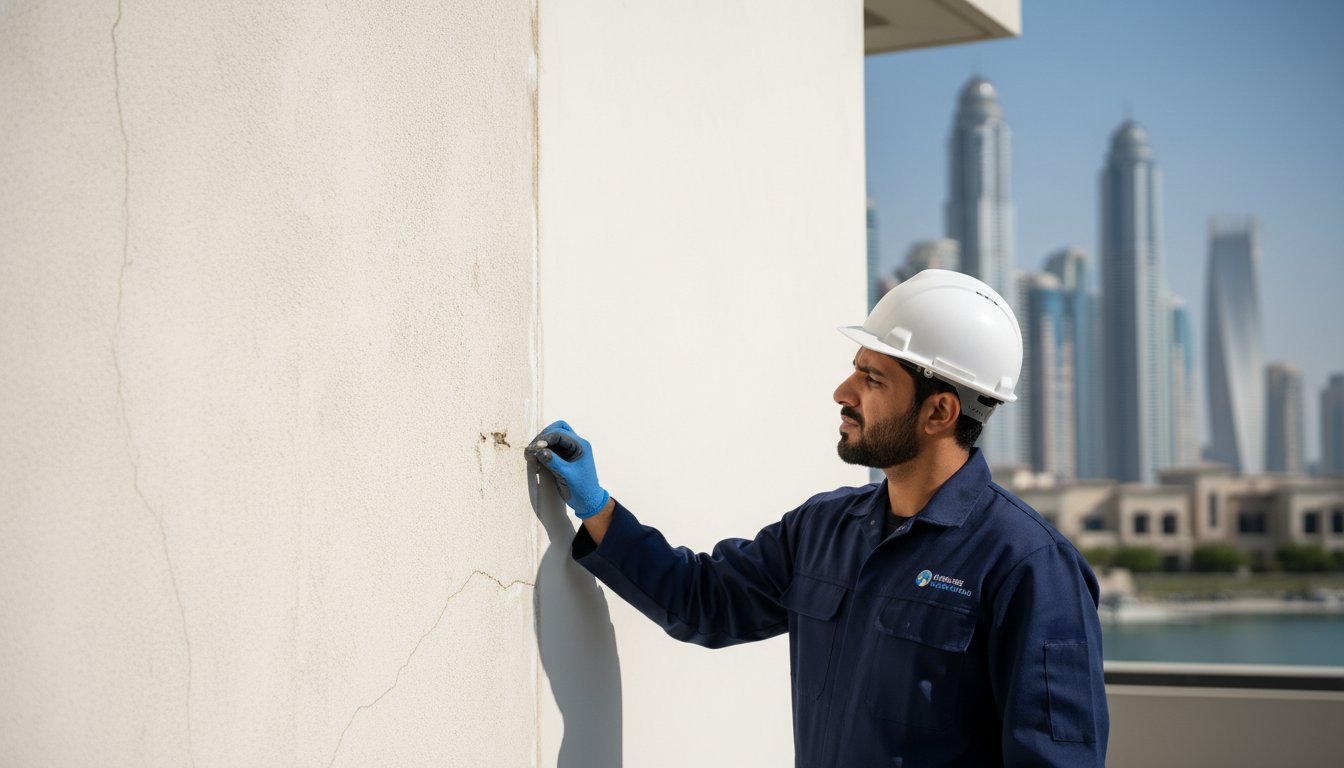
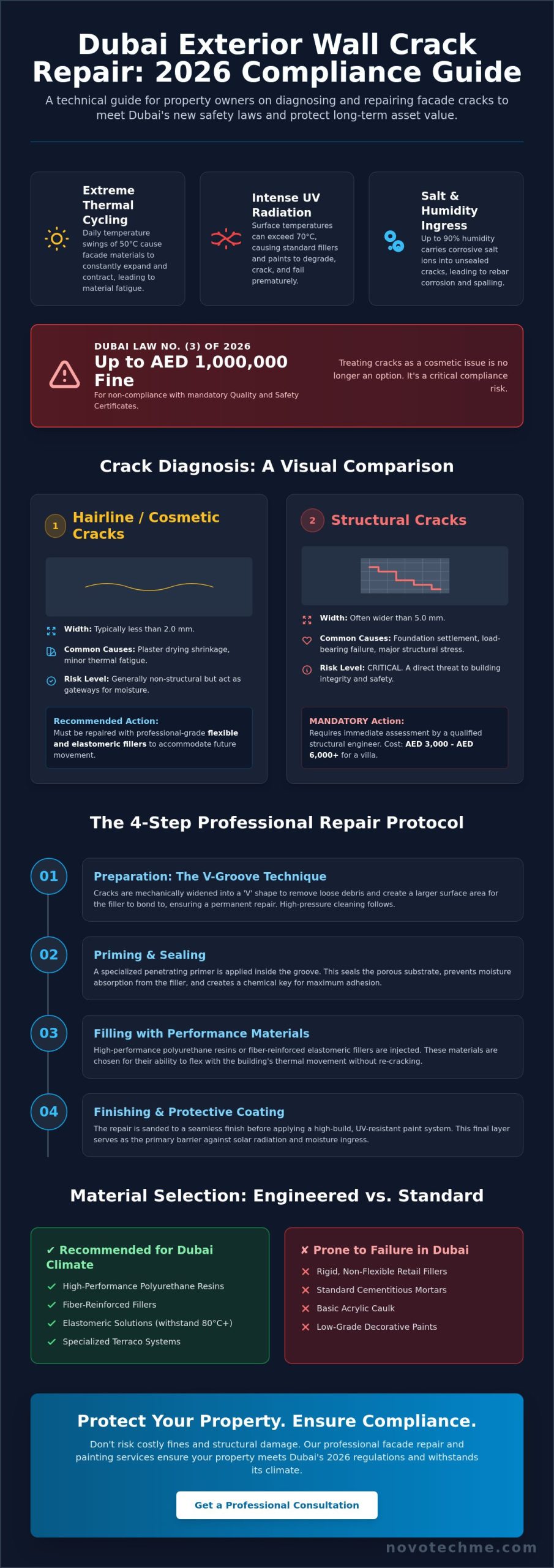
Property managers must categorize cracks based on width, orientation, and depth. Hairline cracks, typically less than 2.0mm wide, often result from initial drying shrinkage or the thermal fatigue discussed in previous sections. These are generally considered non-structural but require elastic fillers to manage ongoing movement. Conversely, structural cracks often present as “stair-step” patterns in blockwork or wide horizontal gaps exceeding 5.0mm. These indicate foundation settlement or load-bearing failures. If you identify such patterns, a structural engineering assessment, which typically costs between AED 3,000 and AED 6,000 for a Dubai villa, is a prerequisite before the painting crew arrives. For high-rise assets, our exterior building painting services include a preliminary survey to ensure all structural repairs meet the latest Dubai Building Code requirements.
The Mapping Process for Large-Scale Buildings
Technical excellence in facade restoration requires a methodical documentation process. For turnkey commercial projects, professional teams utilize a comprehensive mapping protocol to log every substrate defect. This ensures that the repair strategy is bespoke to the specific needs of each elevation. We employ several technical diagnostic tools during this phase:
- Digital Moisture Meters: These detect internal dampness levels that could prevent proper adhesion of anti-corrosive systems.
- Ultrasonic Pulse Velocity Testing: Used primarily for commercial towers to assess the depth of cracks and the integrity of the internal concrete.
- Crack Stitching Logs: A detailed record of where structural reinforcement has been applied, providing a transparent audit trail for the mandatory Quality and Safety Certificate.
Determining whether a crack is static or dynamic is the final critical step. A static crack has ceased moving and can be filled with standard high-performance materials. A dynamic crack, however, continues to expand and contract with the daily 50°C thermal cycle. These require specialized “V-Groove” widening and the application of elastomeric membranes that can bridge the gap without rupturing. Failing to identify a dynamic crack before painting is the primary reason why 40% of standard maintenance projects in the UAE require rework within the first twenty-four months.
Selecting High-Performance Repair Materials for Desert Conditions
Standard retail wall putty is fundamentally ill-equipped for the Middle Eastern climate. In a region where the UV index frequently exceeds 11 during summer months, basic fillers undergo rapid photo-degradation. This process breaks down polymer chains, causing the material to shrink, chalk, and lose adhesion within weeks. High-performance exterior wall crack repair before painting necessitates a transition from generic hardware store products to industrial-grade systems that maintain chemical stability under intense solar radiation. Selecting the correct material is not merely a preference; it’s a technical requirement for ensuring the longevity of the facade.
Terraco Systems and Advanced Protective Coatings
Terraco has established itself as a benchmark for Middle Eastern masonry due to its specialized formulations. As authorized Terraco application specialists, we utilize systems like Handycoat Exterior, which is specifically engineered to handle the high alkalinity of UAE concrete. These acrylic-based fillers provide a breathable yet water-resistant barrier that prevents salt ingress while allowing the substrate to vent internal moisture. Integrating anti-corrosive paint in the UAE into this repair workflow ensures that once the fracture is stabilized, the internal steel reinforcement remains shielded from the humid, saline air prevalent in coastal Dubai neighborhoods. This comprehensive approach prevents the chemical reactions that lead to concrete spalling and structural fatigue.
Elastomeric Fillers for Dynamic Movement
Flexibility is the primary technical requirement for any filler used in Dubai. While cementitious fillers are suitable for static, “dead” cracks that show no signs of ongoing movement, they are too brittle for the city’s thermal expansion cycles. For dynamic fractures, elastomeric sealants are essential. These materials offer elongation properties often exceeding 300%, allowing them to stretch as the building expands during 50°C days and compress as it cools at night. This “bridging” capability prevents the crack from telegraphing through the final decorative layer. Professional-grade elastomeric systems maintain their rubber-like consistency for years, providing a permanent bond that rigid cement-based products simply cannot match.
The efficacy of these materials depends heavily on the use of high-penetration bonding agents. Applying a filler directly to a dusty or porous substrate results in poor mechanical adhesion. Our protocols involve the application of specialized primers that consolidate the loose particles within the crack and create a high-tack surface. This technical step is what distinguishes a temporary cosmetic fix from a permanent structural restoration. By ensuring a robust chemical bond between the substrate and the repair material, we deliver a surface that is ready for a seamless, long-lasting paint application.
The Professional Step-by-Step Repair Process Before Painting
Execution is the stage where technical planning translates into structural durability. For large-scale assets in Dubai, the workflow for exterior wall crack repair before painting must be methodical to counteract the high failure rates seen in budget repairs. High-pressure washing is the non-negotiable first step. We utilize industrial equipment capable of 3,000 PSI to clear desert dust, loose debris, and microscopic salt crystals from the substrate. These contaminants act as bond-breakers; if they aren’t removed, even the most expensive elastomeric fillers will eventually delaminate from the masonry surface.
Excavation and Cleaning
Professional teams utilize mechanical grinders to execute the V-Groove technique. This involves widening a hairline fracture to approximately 6mm to 10mm in a “V” shape. While it seems counterintuitive to make a crack larger, this process creates a clean, stable channel and increases the surface area for chemical bonding. During this phase, we identify and remove “hollow” render, which are sections where the plaster has detached from the blockwork. In a desert environment, the presence of even a thin layer of dust inside the crack can reduce adhesion by 60%. Consequently, we follow mechanical excavation with a secondary compressed air cleaning to ensure the substrate is pristine before the primer is applied.
Filling and Finishing
The application of repair materials requires a tiered layering approach. In the UAE’s low-humidity, high-heat environment, rapid evaporation causes “flash drying,” where the outer surface hardens while the interior remains wet. This leads to internal air pockets and subsequent shrinkage cracks. We apply fillers in thin increments, allowing each layer to cure according to the manufacturer’s technical data sheets. If the fractures show signs of active moisture ingress or dampness, we consult with expert waterproofing companies in Dubai to ensure the structural core is dry before the final decorative coating is installed.
The final stage involves sanding and texturing the repair to match the existing building profile. Achieving a seamless transition is essential for the aesthetic integrity of high-end villas and commercial towers. Once the repair is flush, we apply a high-tack alkali-resistant primer. This creates a uniform suction across the wall, preventing the “ghosting” effect where repair patches become visible through the final paint layers. By strictly adhering to these engineering standards, we ensure that the facade remains compliant with the 2026 Quality and Safety Certificate requirements. For a comprehensive facade restoration that stands the test of time, secure your property’s exterior with our villa painting and exterior finishes solutions.
Why Integrated Structural Repair is Vital for Dubai Painting Projects
Adopting a strategic approach to facade maintenance is the only way to safeguard large-scale assets in the UAE’s volatile environment. Many property owners view maintenance as a recurring overhead, yet high-quality exterior wall crack repair before painting transforms this expense into a long-term capital protection strategy. Patchwork solutions and cheap fillers don’t just fail; they accelerate substrate degradation by trapping moisture behind the paint film. This leads to a cycle of annual touch-ups that, over a five-year period, often cost double the price of a single, professionally engineered intervention. Doing it right once isn’t just about quality; it’s about financial logic.
Long-Term ROI and Property Value
A flawless exterior finish is a primary driver of valuation for luxury villas in neighborhoods like Emirates Hills or Palm Jumeirah. Beyond the immediate aesthetic appeal, a crack-free facade signals to surveyors and potential buyers that the property’s structural integrity has been rigorously maintained. Proactive maintenance prevents the progression of minor fractures into major structural failures that can require remediation costing upwards of AED 100,000 in severe cases. By stabilizing the building envelope now, you eliminate the risk of salt-air corrosion and concrete spalling. For a deeper look at managing these assets, refer to our exterior building painting Dubai guide for the full project lifecycle.
The NovoTech Advantage: Integrated Excellence
NovoTech delivers a turnkey solution that moves beyond the capabilities of standard painting contractors. Our role as an authorized Terraco applicator ensures that every repair utilizes materials specifically formulated for the Middle Eastern solar index. We don’t just apply paint; we provide a comprehensive diagnostic survey followed by a protective system designed to withstand 50°C thermal cycles. This methodology ensures your property remains fully compliant with the 2026 Quality and Safety Certificate requirements mandated by Dubai’s latest building safety laws.
With a 30-year legacy in UAE building maintenance, our team understands the granular technical requirements of both high-rise commercial towers and residential villas. We operate as a technology partner, extending the expertise of your own management team to ensure every project is delivered with precision and transparency. This commitment to excellence is what preserves the structural health of Dubai’s skyline. To protect your investment with a seamless, durable finish, contact NovoTech for a comprehensive exterior building painting quote today.
Securing Your Property’s Future with Technical Excellence
Maintaining the structural integrity of a Dubai facade in 2026 requires more than a standard coat of paint. You’ve seen how the 50°C thermal expansion cycle and saline humidity levels demand engineering-grade materials rather than brittle retail fillers. By prioritizing a methodical exterior wall crack repair before painting, you ensure your asset complies with the latest Quality and Safety Certificate mandates while avoiding the trap of costly annual rework. This proactive approach preserves long-term ROI and protects your internal reinforcements from the corrosive effects of the Arabian Gulf’s humidity.
NovoTech provides the technical depth needed for complex high-rise and villa restorations across the Middle East. As an authorized Terraco applicator with over 30 years of UAE experience, we deliver turnkey solutions that bridge the gap between architectural vision and structural durability. Our team handles the entire lifecycle, from diagnostic surveys to the application of advanced protective systems. Don’t leave your property’s compliance to chance. Request a Professional Exterior Assessment from NovoTech to secure a seamless, high-performance finish that withstands the desert’s harshest elements. We’re ready to help you achieve integrated excellence for your next project.
Frequently Asked Questions
Can I just paint over hairline cracks on my villa exterior?
No, painting directly over hairline fractures is a temporary cosmetic fix that inevitably fails. In Dubai’s climate, even a 1mm crack will telegraph through new paint as the building expands in 50°C heat. Without professional stabilization, the new coating will likely crack and peel within 6 to 12 months. Proper exterior wall crack repair before painting ensures the substrate is unified before the decorative layer is applied.
How do I know if a crack in my Dubai property is structural or cosmetic?
Identification depends on the crack’s width, orientation, and pattern. Cosmetic cracks are usually superficial, random, and less than 2mm wide. Structural cracks often exceed 5mm, appear in stair-step patterns across blockwork, or run horizontally. If a crack is wide enough to insert a 1-dirham coin, you must consult a structural engineer before starting any exterior wall crack repair before painting to ensure the foundation is stable.
What is the best material for exterior wall crack repair in the UAE heat?
High-performance elastomeric sealants and specialized Terraco fillers are the most effective materials for the Middle East. Standard retail putties often fail when the UV index exceeds 11, leading to rapid degradation. Professional grade materials like Terraco Handycoat Exterior maintain their chemical integrity and flexibility up to 80°C. This allows the repair to move with the building during extreme daily temperature fluctuations without rupturing or losing adhesion.
How long should I wait after repairing cracks before applying exterior paint?
You should generally wait 24 to 48 hours for the filler to cure, though deep repairs may require 72 hours in high humidity. Curing times are vital in Dubai to prevent “flash drying” or trapped moisture. If the paint is applied prematurely, internal vapors will cause the finish to blister. Our teams use digital moisture meters to ensure the substrate level is below 5% before proceeding with the final protective coating.
Does NovoTech provide crack repair for high-rise buildings in Dubai?
Yes, NovoTech delivers comprehensive turnkey solutions for high-rise commercial structures and residential villas. Our expertise includes large-scale facade restoration, structural cleaning, and protective painting systems. We ensure all projects comply with the mandatory building inspections required by Law No. (3) of 2026. This professional oversight is essential for obtaining the Quality and Safety Certificate now required for all existing structures in Dubai’s free zones and municipalities.
Why do cracks keep reappearing on my exterior walls every summer?
Cracks reappear because of thermal fatigue and the use of rigid, non-flexible repair materials. When surface temperatures swing from 25°C at night to over 70°C in direct sunlight, masonry expands significantly. If the filler cannot stretch with this movement, it snaps and detaches. Using elastomeric bridging systems is the only way to ensure repairs remain intact during the peak summer months when thermal stress is at its highest.
What is the “V-groove” method and why is it used for professional repairs?
The V-groove method involves using a mechanical grinder to widen a crack into a “V” shape before filling it. This technique increases the surface area for the bonding agent and creates a deeper channel for the repair material. It’s a critical engineering step that prevents the filler from popping out. By creating a stable mechanical bond, we ensure the repair can withstand the intense pressure of the city’s thermal cycling.
Can salt air from the Dubai coast cause wall cracks to expand?
Yes, salt air accelerates crack expansion through a process called reinforcement corrosion. Chloride ions from the Arabian Gulf penetrate open cracks and reach the internal steel rebar. As the steel rusts, it expands up to 400% of its original volume. This internal pressure forces the concrete to crack further or even break away in large chunks, a condition known as spalling, which requires immediate professional intervention to fix.