A salt-resistant label alone won’t protect a JBR exterior if the surface beneath it hasn’t been properly assessed and prepared. Salt-laden air, humidity, and intense UV exposure affect façades and metalwork in different ways, so the right approach depends on each surface’s condition and material. That’s the principle behind specifying salt-resistant coatings for beachfront properties JBR: preparation and substrate-specific choices matter as much as the coating itself.
It’s understandable to want one solution to help limit corrosion, peeling, and repeat maintenance. But protective painting and waterproofing address different concerns, and neither compensates for surface damage or inadequate preparation. This guide explains how coastal exposure affects common exterior materials, what to assess before choosing a coating system, and how to plan a painting project for a JBR property.
We’ll also cover project specifications and coordination with building management. NovoTech brings more than 30 years of experience in exterior painting and protective coating projects, with Terraco application expertise to support a project-specific approach.
Key Takeaways
- Learn why coastal exposure calls for a planned coating strategy, while recognizing that risk varies by surface and building condition.
- Understand how salt, moisture, and UV exposure can affect exterior materials, and which visible changes warrant closer inspection.
- Compare salt-resistant coatings for beachfront properties JBR by substrate, exposure, preparation needs, and intended protective function.
- Use a project workflow that covers inspection, surface preparation, application, handover, and coordination with building management.
- See how NovoTech’s Dubai exterior painting and protective coating experience, including its authorized Terraco applicator status, supports project-specific planning.
Why JBR beachfront properties need a salt-resistant coating strategy
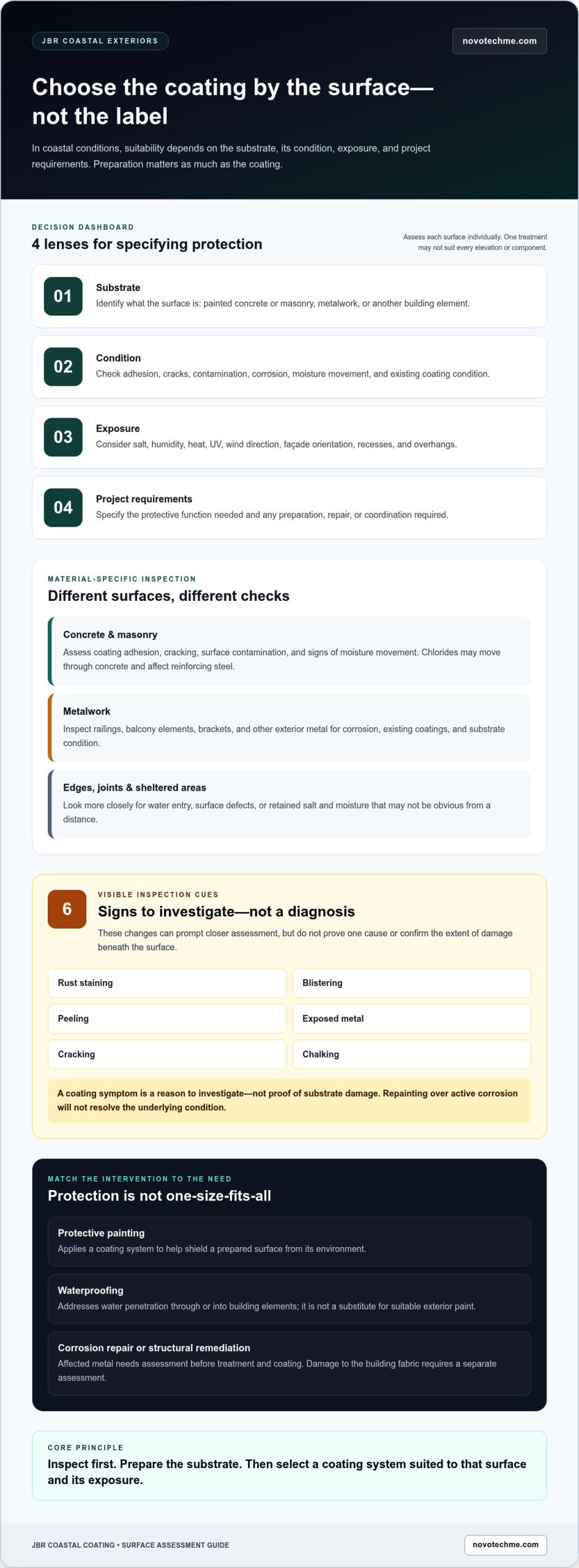
For JBR buildings, choosing a coating based only on a “salt-resistant” label can overlook the factors that determine whether it suits the job. Salt-resistant coatings for beachfront properties JBR are protective systems selected for the exposure, substrate, existing surface condition, and project requirements. The aim is to match the system and preparation to each surface, rather than assume one coating will perform the same way across an entire building.
Salt deposits and moisture can contribute to corrosion on susceptible metal surfaces. Corrosion is the underlying deterioration process. Heat and UV exposure can also affect exterior coatings, while humidity and deposited salts add to the demands on exposed materials. Wind direction, façade orientation, recesses, overhangs, building geometry, and maintenance history all influence where deposits collect and how surfaces weather. These factors make planned inspection useful, but they don’t mean every elevation or component has the same level of risk.
How JBR’s coastal setting affects building exteriors
On an exposed railing, salt and moisture may be direct concerns for both the metal and its coating. A sheltered façade may face different conditions, while edges and joints can be affected by water entry or existing surface defects. Heat and UV can contribute to coating changes, but fading, chalking, blistering, or peeling are prompts to inspect, not proof of a single cause. Assessment helps distinguish environmental wear from preparation or adhesion issues.
Which building surfaces may need different protection
Painted concrete and masonry need assessment for coating adhesion, cracking, surface contamination, and signs of moisture movement. Metal railings, balcony elements, brackets, and other exterior metalwork need attention to corrosion, existing coatings, and substrate condition. Balcony edges and joints may require closer examination, while sheltered areas can retain deposits or moisture that aren’t obvious from a distance.
Protective painting applies a coating system to help shield a prepared surface from its environment. Waterproofing addresses water penetration through or into building elements, and isn’t a substitute for a suitable exterior paint system. Corrosion repair involves treating affected metal before coating, while structural remediation addresses damage to the building fabric and requires a separate assessment. Painting over active defects can conceal symptoms without resolving their cause.
An inspection helps determine whether a surface needs coating, preparation, repair, or another intervention before work proceeds. It should consider substrate type, condition, exposure, and visible defects, rather than prescribe a uniform treatment for dissimilar materials.
Coating suitability depends on the substrate’s condition and the quality of its preparation.
How salt, humidity, and UV exposure affect JBR exterior coatings
Coastal coating problems aren’t always limited to a worn paint film. Salt deposits can remain on exposed surfaces, and moisture can carry dissolved salts into contact with metal. The Whole Building Design Guide’s overview of corrosion risks for waterfront and coastal facilities explains why salt and moisture matter in coastal environments. For JBR property owners, the practical point is to assess both the visible coating and the substrate beneath it.
Chloride ions are negatively charged particles released when salts dissolve in moisture. On susceptible metal, their presence can support corrosion processes, especially where a coating is damaged, thin, or no longer securely bonded. On reinforced concrete, chlorides may move through the concrete and affect the reinforcing steel within it. Deterioration can occur beneath a painted surface, so a visual check alone may not establish the full condition.
What chloride exposure can mean for exposed metalwork
Rust staining, blistering, peeling, or exposed metal are reasons to arrange a closer assessment of railings, brackets, balcony components, and other exterior metalwork. These signs can be associated with corrosion or coating failure, but they don’t identify the cause or extent by themselves. Repainting over active corrosion won’t resolve the underlying condition. The affected area needs assessment before repair and coating decisions are made.
How coatings can deteriorate in coastal conditions
UV exposure, moisture, substrate condition, and the quality of earlier surface preparation can all influence how an exterior coating changes over time. Loss of adhesion, cracking, chalking, and peeling are visible symptoms. They may indicate a coating issue, but don’t independently confirm corrosion beneath the film or damage within concrete. A coating symptom is a reason to investigate, not proof of substrate damage.
Diagnosis should come before selecting a repair method or protective coating system. An assessment considers where deterioration appears, whether the coating remains attached, the condition of exposed metal or masonry, and whether moisture or another defect may be involved. This helps distinguish surface renewal from work that requires corrosion treatment or a separate building repair. Applying a new layer without addressing the identified cause can leave the original problem unresolved.
Learn about NovoTech’s exterior painting and protective coating services for project-specific assessment and a coordinated exterior painting approach.
How to compare salt-resistant coating approaches for JBR buildings
Compare a proposed system against the surface it will protect, not just a broad “coastal” or “salt-resistant” claim. For salt-resistant coatings for beachfront properties JBR, the specification should connect the substrate, exposure, condition, preparation, and intended function. The table is a starting framework. Final selection depends on site assessment and compatibility with existing coating layers.
| Substrate | Exposure | Condition to assess | Preparation focus | Intended coating function |
|---|---|---|---|---|
| Painted concrete or masonry | Open façade, balcony edge, or sheltered recess | Adhesion, cracking, chalking, contamination, and signs of moisture movement | Clean and prepare the surface; address defects identified during assessment | Protective exterior finish suited to the substrate and exposure |
| Exposed metalwork | Railings, brackets, and balcony components with varying exposure | Rust, coating breakdown, exposed metal, and condition of existing layers | Remove or treat deteriorated material as specified; prepare for compatible system layers | Anti-corrosive system for a suitable metal substrate |
| Areas requiring water-entry control | Joints or building elements with suspected water penetration | Moisture pathways and condition of the building element | Diagnose the source and define the required repair scope | Waterproofing where needed, not a substitute for an exterior paint coating |
Match the coating function to the JBR substrate
Concrete and masonry coatings are selected for the condition and requirements of those surfaces. Metalwork may need an anti-corrosive paint system, but only after the substrate and existing layers have been assessed. These approaches serve different purposes, so a coating suitable for a façade shouldn’t automatically be specified for railings. Waterproofing membranes manage water penetration; paint coatings protect and finish surfaces. They aren’t interchangeable.
AMPP discusses marine coating challenges, including corrosion and UV exposure, in its overview of a comprehensive marine coatings program. For a JBR project, the practical takeaway is to define the coating’s function and match it to the material and exposure, rather than assume one system addresses every issue.
What a project-specific specification should explain
A useful specification records substrate condition, preparation method, compatible primer, coating layers, and application conditions. It should also define the work limits and identify defects requiring separate treatment. Manufacturer guidance describes the system’s stated requirements; project-specific recommendations explain how those requirements apply to the assessed building. Keeping the two distinct clarifies the proposed scope and helps prevent incompatible layers or unresolved surface problems.
How to prepare and apply coatings on a JBR beachfront property
A durable exterior painting project is a managed sequence, not simply the application of a new finish. For salt-resistant coatings for beachfront properties JBR, inspection and preparation should shape the scope before materials or application methods are set. On a tower, access and resident coordination also affect how the work can be planned and carried out.
- Coordinate access and site planning. Align proposed work areas, access arrangements, schedule, resident communication, and site requirements with JBR building management. Plan safe access for the building and task, and account for occupied areas and daily operations.
- Inspect and document surfaces. Record existing coating layers, adhesion concerns, corrosion indicators, cracks, contamination, and locations that may need repair. Note differences between façade sections, balcony edges, railings, and sheltered areas so the scope reflects actual conditions.
- Define preparation and repairs. Cleaning, removal of unsound coating, and repairs depend on the substrate and inspection findings. Follow the requirements of the selected coating system. Applying over poorly bonded paint, contamination, or unresolved defects can undermine the new system’s performance.
- Confirm the coating specification. Match coating layers and a compatible primer to the substrate, existing layers, and intended protective function. Set application conditions according to system guidance and the project scope, rather than applying one fixed recipe to every surface.
- Sequence application and handover. Organize work around access, weather conditions, building operations, and resident safety. At handover, record the areas completed, relevant system and maintenance information, and any items requiring follow-up.
Inspect and prepare the surface before coating
Preparation starts with a clear condition record. For example, rust staining on a railing and cracking on an adjacent concrete edge are different findings and may call for different treatment. Adhesion and substrate condition influence what can be retained, what needs removal, and how the coating system should be specified. Select cleaning and repairs to address the inspection findings, then carry them out to the requirements of the chosen system.
Plan application, access, and ongoing inspections
Before work begins, coordinate access and resident notices with building management, and agree how site requirements and work areas will be managed. Application timing should account for relevant weather conditions and building activity. After completion, retain inspection and maintenance records, including observed coating changes and their locations, so future reviews can compare condition over time.
A site-specific scope connects access planning, surface condition, preparation, and coating selection. For broader project-planning context, see our exterior building painting Dubai guide. Details about NovoTech’s JBR exterior coating projects are available on our website.
Plan a JBR salt-resistant coating project with NovoTech
Planning salt-resistant coatings for beachfront properties JBR calls for more than selecting a coating category. The project scope needs to reflect what inspection reveals about each substrate, its exposure, existing coating layers, and the building’s operational requirements. NovoTech brings more than 30 years of experience in Dubai exterior painting and protective coating work, supporting residential and commercial projects with a coordinated approach.
What NovoTech brings to a coastal painting project
Our capabilities include exterior building painting, protective painting systems, and anti-corrosive painting. As an authorized Terraco applicator, we bring Terraco application expertise to relevant projects without assuming that one system is appropriate for every surface. Selection depends on the assessed substrate and project requirements.
Coordination matters alongside the coating work itself. Different façades, balcony elements, and metal components may have distinct condition and preparation needs. Connecting the assessment, surface preparation, coating specification, access arrangements, and application plan helps ensure each workstream reflects the conditions of the surfaces involved.
Move from inspection to a tailored coating plan
A practical project scope turns inspection findings into clear decisions. It documents the substrate and exposure, identifies existing coating layers and defects, sets out the required preparation, and describes the intended coating system and application requirements. This record helps stakeholders understand why different areas may need different treatments and which issues require attention before painting.
Building owners, managers, and project stakeholders can also align access planning and maintenance priorities before work begins. That coordination helps define work areas, resident communication, site requirements, and how coating condition will be recorded after handover. A site-specific plan is more useful than a generic promise because it ties the scope to observed conditions and documented system guidance.
For broader system context, NovoTech’s guide to protective coatings for UAE buildings can help readers understand how protective painting fits into exterior maintenance planning. For a project tailored to your building’s inspected surfaces and requirements, explore protective painting with NovoTech.
Build a More Informed Coastal Coating Plan
For JBR properties, effective exterior protection starts with understanding how exposure and building condition vary across façades, balconies, and metalwork. Salt-resistant coatings for beachfront properties JBR should be selected for the assessed substrate and its existing coating layers, not from a broad label alone.
Inspection and preparation guide the specification: coating symptoms need diagnosis, and surface repairs may be required before application. Protective painting, anti-corrosive systems, and waterproofing each serve different functions, so the project scope should match the intervention to the issue. Coordinated access planning and clear maintenance records also help building stakeholders manage the work and track surface condition over time.
NovoTech brings more than 30 years of experience in the UAE market, exterior painting and protective coating capabilities, and authorized Terraco applicator status. We tailor project scopes to inspected surfaces and building requirements. Discuss a tailored coastal coating project with NovoTech to plan the next steps for your property.
Frequently Asked Questions
Can salt-resistant coatings protect a JBR property from coastal corrosion?
Suitable coatings can help protect compatible, properly prepared surfaces, but they can’t prevent every form of corrosion or repair existing damage by themselves. Suitability depends on exposure, substrate condition, compatibility with existing layers, and application quality. For salt-resistant coatings for beachfront properties JBR, start with a condition assessment of exposed surfaces and metalwork. The findings can guide a project-specific system without assuming a fixed lifespan or guaranteed outcome.
Which coating is best for a beachfront property in JBR?
There’s no single best coating for every JBR surface. The appropriate approach depends on whether the substrate is concrete, masonry, or metal, as well as its condition, previous coatings, and exposure. Protective exterior painting and anti-corrosive systems serve different purposes, while waterproofing addresses water ingress. A site-specific assessment should inform a compatible specification, rather than applying one coating choice across the entire property.
How does salt air damage exterior paint and metalwork?
Salt deposits and moisture can contribute to corrosion on susceptible metal, while heat and UV exposure can affect exterior coating condition. Peeling, blistering, and rust staining are signs that warrant assessment, but they can have different causes and don’t establish the extent of damage. Corrosion concealed beneath a coating or damage within a building element may require more than repainting. A condition assessment helps identify the appropriate next step.
Do JBR buildings need a different coating approach from inland Dubai properties?
Coastal exposure can make it especially important to assess salt deposits, moisture, and exposed metalwork, while inland properties face their own environmental demands. Not every JBR building needs the same coating system. Orientation, sheltered areas, substrate condition, existing coatings, and maintenance history all influence the specification. A site-specific inspection helps determine whether the approach should differ and which surfaces need coating, preparation, or another intervention.
How should a surface be prepared before applying a coastal protective coating?
Preparation begins by checking the existing coating, substrate condition, contamination, and signs of corrosion or damage. Cleaning, removing unsound material, making repairs, and priming depend on the surface and selected coating system. Existing layers also need to be compatible with the proposed specification. There’s no single preparation method for every JBR surface, so work should follow assessment findings and the requirements of the chosen system.
How often should salt-resistant coatings on a beachfront property be inspected?
There isn’t a universal inspection interval that suits every property or coating system. Establish a plan based on exposure, substrate, coating specification, building maintenance arrangements, and observed condition. Record signs such as peeling, cracking, blistering, rust staining, or exposed surfaces for assessment. Consistent inspection notes help track changes over time and identify coating concerns before they develop into a larger maintenance project.
Are protective coatings the same as waterproofing for JBR buildings?
No. Protective paint coatings and waterproofing systems have different functions, even though both can contribute to building protection. A coating may protect a compatible surface, while waterproofing addresses water ingress through a specified assembly. Neither should substitute for diagnosing leaks, corrosion, or structural problems. The right scope depends on the affected area’s condition and purpose, and assessment helps determine whether painting, waterproofing, repair, or a combination is appropriate.