In the high-salinity environments of Dubai and Abu Dhabi, the climate functions as a relentless chemical catalyst that can accelerate the degradation of building components by up to 300% compared to temperate regions. For developers and asset managers, investing in specialized protective coatings for coastal buildings uae is no longer a discretionary aesthetic choice; it’s a technical necessity for structural preservation. You’ve likely witnessed the rapid onset of paint peeling and chloride-induced corrosion that compromises even the most prestigious coastal developments shortly after completion.
We understand that maintaining the integrity of a luxury asset requires more than standard paint. It demands an integrated engineering approach. This 2026 guide details how advanced anti-corrosive systems and high-performance finishes shield structures from the UAE’s extreme UV radiation and humidity. We’ll explore the impact of Dubai Law No. (3) of 2026 on maintenance standards, the requirements for Al Sa’fat 2.0 compliance, and the technical methodologies that successfully mitigate carbonation to extend your building’s operational lifecycle and reduce long-term maintenance costs.
Key Takeaways
- Understand how salt-laden air and extreme UV radiation penetrate building substrates, necessitating specialized protective coatings for coastal buildings uae to prevent structural degradation.
- Identify the technical advantages of acrylic-based anti-carbonation systems and polyurethane finishes for ensuring long-term color retention and substrate integrity.
- Learn the critical role of high-pressure surface preparation and substrate repair in achieving compliance with Dubai Law No. (3) of 2026 and Al Sa’fat 2.0 standards.
- Evaluate the financial return on investment through lifecycle cost analysis, comparing high-performance technical barriers against the high costs of frequent, standard repainting.
- Discover how partnering with authorized Terraco application specialists provides the technical precision required to protect high-value assets in Dubai Marina and Palm Jumeirah.
The Coastal Challenge: Why UAE Buildings Face Accelerated Decay
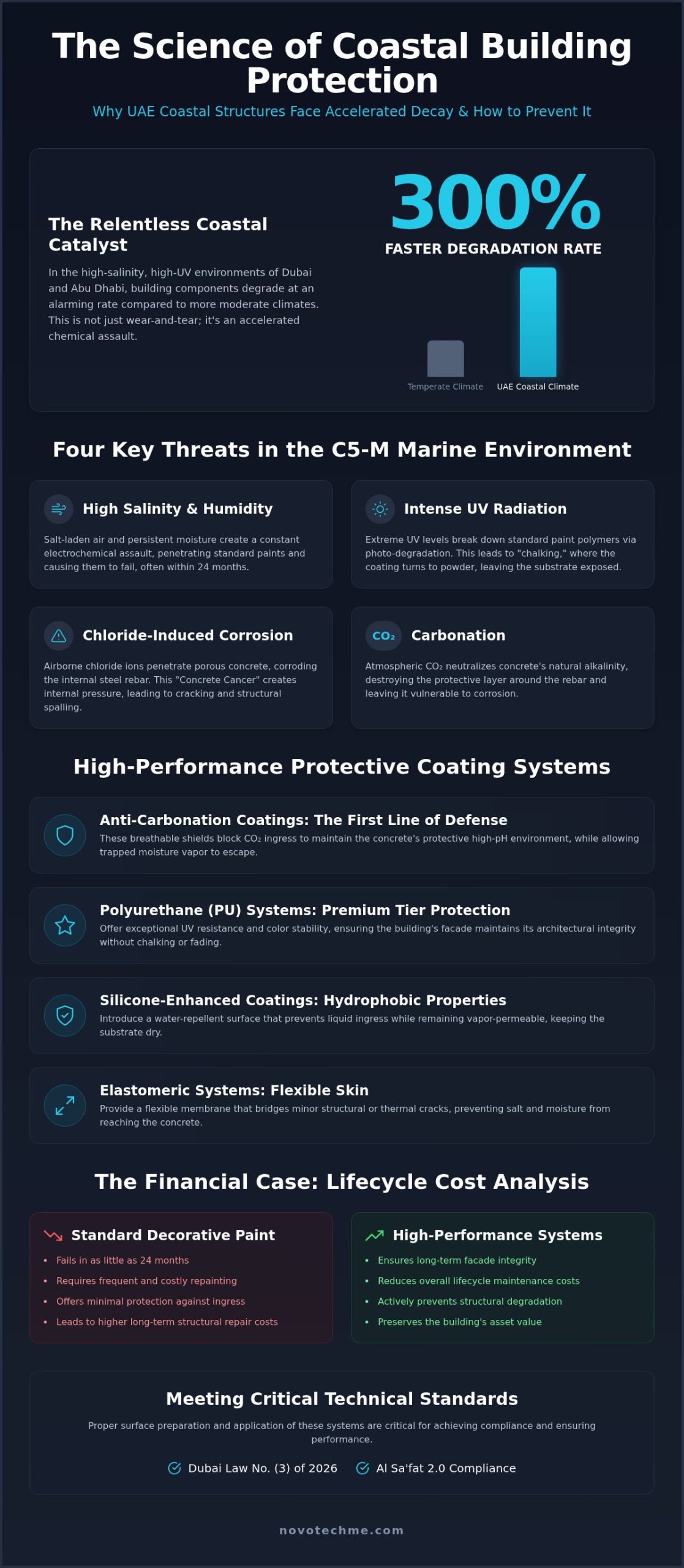
Coastal assets in the UAE exist in one of the most aggressive atmospheric corrosivity categories globally, specifically classified as C5-M (Marine). This environment isn’t just hot; it’s chemically active. The combination of high salinity and persistent humidity creates a constant electrochemical assault on building envelopes. We’ve observed that standard exterior finishes often fail within 24 months because they lack the technical density required to block microscopic salt ions. Implementing high-performance protective coatings for coastal buildings uae is the only viable method to intercept the natural process of corrosion before it reaches the structural core.
Solar energy in the UAE goes beyond mere heat. Intense UV radiation, which frequently reaches extreme levels, breaks down the chemical bonds of standard paint polymers through photo-degradation. This results in chalking, where the protective resin turns to powder, leaving the building substrate exposed. When you add the ‘Humidity-Heat’ cycle common in Dubai Marina or Palm Jumeirah, where nighttime moisture trapped in the substrate expands rapidly under the morning sun, the pressure can cause standard coatings to blister and delaminate. This cycle accelerates aging by up to 300% compared to buildings in more temperate regions.
Chloride-Induced Reinforcement Corrosion
Salt-laden air carries chloride ions that travel deep into masonry through capillary pores. Once these ions reach the steel reinforcement, they trigger an expansive oxidation reaction. This phenomenon, often termed ‘Concrete Cancer’, creates internal pressure that leads to cracking and significant structural spalling. Standard decorative paints are too porous to offer a defense; they allow moisture and chlorides to pass through while trapping them against the concrete, accelerating the decay they were meant to prevent.
Carbonation and the pH Balance of Concrete
Concrete is naturally alkaline, which creates a protective passivating layer around the internal rebar. However, carbon dioxide (CO2) from the atmosphere gradually penetrates the surface, lowering the pH and neutralizing this protection. Anti-carbonation coatings function as a breathable shield that prevents CO2 ingress while allowing internal moisture vapor to escape. By maintaining the substrate’s high-pH environment, these technical systems ensure the building’s structural health remains intact despite the high-carbon, high-salt coastal air.
Types of High-Performance Protective Coating Systems
Selecting a technical barrier for high-value real estate requires a deep understanding of polymer chemistry. We don’t view paint as a mere color choice but as a functional layer engineered to withstand the C5-M marine environment. High-performance protective coatings for coastal buildings uae must provide a multifaceted defense against various atmospheric stressors. Standard decorative finishes lack the cross-linking density required to resist salt ingress, making specialized formulations essential for operational longevity. Standard paints fall short.
Polyurethane (PU) systems represent a premium tier for coastal assets, offering exceptional UV resistance and color stability. These durable finishes for coastal environments ensure that facades maintain their architectural intent without the chalking or fading common in the region. Additionally, silicone-enhanced masonry coatings introduce hydrophobic properties that repel liquid water while remaining vapor-permeable. For structures prone to minor thermal movement, elastomeric systems provide a flexible skin that bridges structural cracks, preventing salt and moisture from reaching the concrete substrate during extreme temperature fluctuations.
Anti-Carbonation Coatings: The First Line of Defense
Technical specifications for anti-carbonation systems focus on two competing requirements: CO2 diffusion resistance and water vapor permeability. A high-quality anti-corrosive paint uae must block carbon dioxide from neutralizing the concrete’s alkalinity while allowing internal moisture to escape. If a coating is too tight, it traps vapor, leading to hydrostatic pressure and coating failure. We specify systems with an Sd value (water vapor diffusion-equivalent air layer thickness) of less than 4 meters to ensure the substrate remains dry and structurally sound.
Terraco Protective Systems for the Middle East
Terraco remains a gold standard for regional asset protection because their formulations are specifically tested against the UAE’s high-salinity and high-heat benchmarks. These systems offer specialized textures and finishes that effectively mask minor structural imperfections often found in large-scale masonry. As authorized Terraco application specialists, NovoTech ensures that every layer is applied to the manufacturer’s precise technical standards. Our thirty years of regional experience allows us to tailor these systems for specific coastal microclimates, from the high-rise corridors of Dubai Marina to the exposed villas of Palm Jumeirah. If you are managing a high-exposure project, consulting with a technical partner early in the planning phase can prevent costly remedial work later.
The Application Process for Coastal High-Rises
The efficacy of protective coatings for coastal buildings uae depends entirely on the precision of the application process. Even the most advanced polymer systems will fail prematurely if the underlying substrate is compromised by latent contaminants or structural defects. A methodical, multi-stage approach ensures that the protective barrier achieves its engineered lifecycle. This process begins with rigorous decontamination and ends with verified dry film thickness (DFT) measurements. We don’t cut corners on preparation because the cost of remedial work far exceeds the investment in a correct initial application.
Surface preparation is the most critical phase. In the UAE’s marine environment, concrete facades act as sponges for airborne chlorides. We utilize professional-grade high-pressure washing to strip away salt deposits and loose friable material. Following decontamination, we conduct substrate repairs to address any existing spalling or structural degradation. Using alkali-resistant primers is essential for coastal masonry; they stabilize the surface pH and ensure a robust bond between the concrete and the subsequent protective layers. Achieving the correct DFT is non-negotiable. Our teams apply multiple coats to reach the manufacturer’s specified thickness, ensuring the barrier is dense enough to block chloride ingress while maintaining vapor permeability.
Salt Removal and Surface Decontamination
Painting over salt is a recipe for catastrophic failure. Hygroscopic salt crystals trapped beneath a coating film will draw moisture through the membrane via osmosis. This creates pressure that leads to osmotic blistering, delamination, and peeling. Before any application begins, we perform field tests to verify that chloride levels are within acceptable limits. Professional-grade pressure washing in high-density areas like Dubai Marina is the only way to ensure a clean, neutral surface ready for technical bonding.
Safe Application on High-Rise Structures
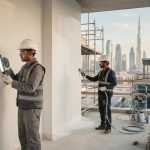
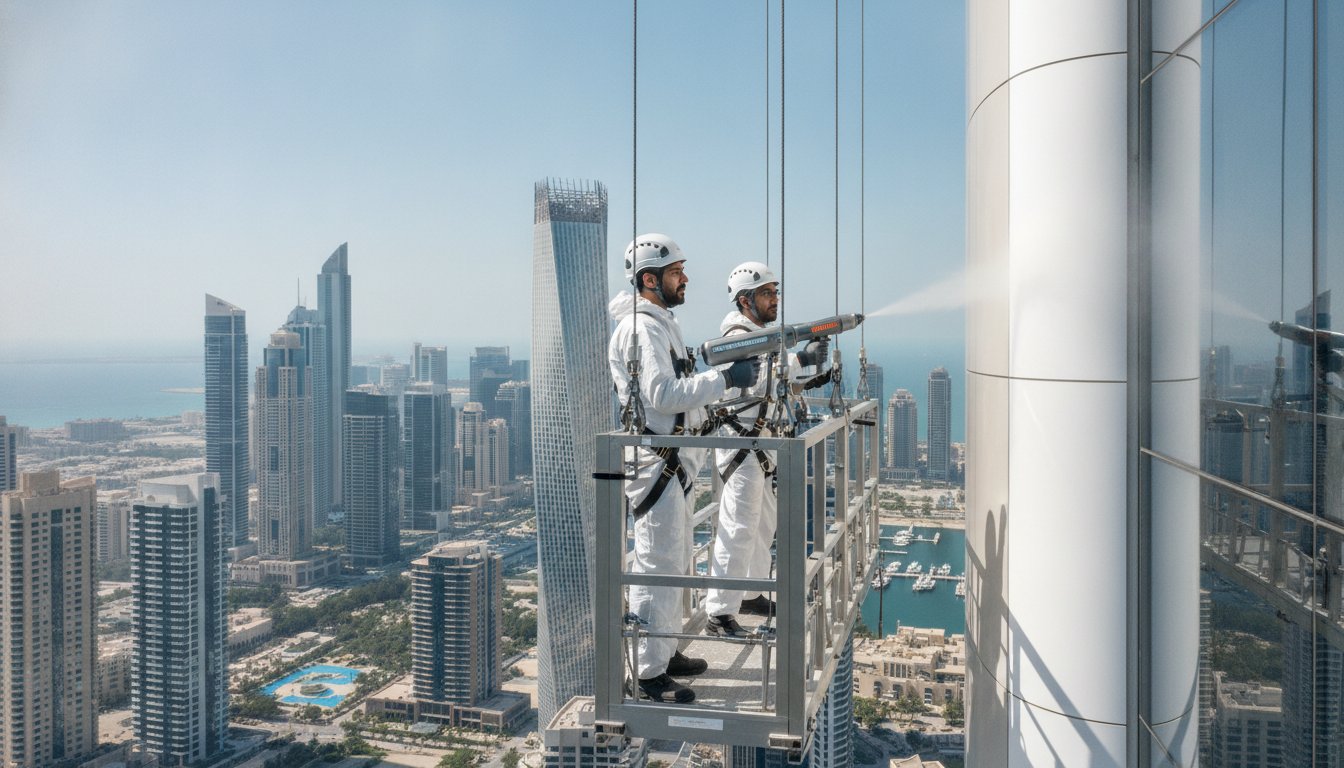
Executing a large-scale project requires specialized access strategies tailored to the building’s architecture. We deploy both rope access and cradle systems depending on the facade’s complexity and the project’s logistical requirements. Environmental monitoring is a constant factor; our teams strictly manage application windows based on wind speeds and relative humidity levels. Excessive humidity can interfere with the curing process, while high winds pose safety risks and affect the uniformity of the finish. For a deeper look at these logistics, see our comprehensive guide on exterior building painting dubai. Adhering to these technical constraints is how we maintain our reputation for integrated excellence across the Emirates.
Maintenance Strategy and ROI for Property Managers
Strategic asset management in the UAE’s coastal zones requires shifting the perspective from short-term cost savings to long-term lifecycle value. While standard exterior paints might offer a lower initial price point, their high failure rate in marine environments necessitates frequent repainting, often every two to three years. In contrast, high-performance protective coatings for coastal buildings uae are engineered to provide a service life exceeding ten years, significantly reducing the total cost of ownership. We advocate for a data-driven approach where the initial investment is justified by the avoidance of structural decay and the preservation of the asset’s premium market value.
A robust maintenance strategy for a coastal high-rise or luxury villa should include:
- Detailed lifecycle cost analysis comparing technical coatings against standard paint.
- Scheduled inspection intervals every 24 months to monitor coating integrity.
- Implementation of solar-reflective technologies to reduce thermal stress.
- Preservation of the aesthetic ‘glistening’ finish that defines premium coastal real estate.
Solar Reflective Index (SRI) and Energy Savings
Cool roof and wall technologies utilize high Solar Reflectance Index (SRI) values to reflect a greater portion of solar radiation. In the peak of the UAE summer, where ambient temperatures regularly exceed 45°C, surface temperatures on non-reflective facades can reach 80°C. This thermal load causes significant expansion and contraction in the masonry, leading to hairline cracks that allow chloride ingress. Under the Al Sa’fat 2.0 green building system, utilizing high SRI coatings is a critical component for achieving mandatory sustainability ratings. By reflecting solar energy, these systems mitigate thermal stress and lower internal building temperatures, directly reducing HVAC energy consumption and operational costs.
Preventative Maintenance vs. Reactive Repair
Reactive repair is always more expensive than preventative protection. Once carbonation reaches the reinforcement steel, the resulting structural remediation can cost ten times more than the original coating application. We recommend building a 10-year maintenance plan that prioritizes the building envelope’s integrity. Integrating these systems with professional moisture barriers is essential; as one of the leading waterproofing companies in dubai, we ensure the building envelope is sealed against both liquid water and atmospheric gases. Our technical team can provide a detailed lifecycle cost analysis for your property; contact us to discuss our protective painting systems today and secure your asset’s future.
NovoTech: Authorized Experts in Coastal Protection
NovoTech brings over 30 years of operational history to the UAE’s construction and maintenance sector. We’ve developed a deep technical understanding of how local environmental stressors affect structural integrity across Dubai and the Northern Emirates. Our expertise isn’t limited to simple aesthetics; we specialize in delivering high-performance protective coatings for coastal buildings uae that serve as a robust technical barrier. By managing the entire project lifecycle, from initial substrate assessment to final quality inspection, we ensure that high-value assets remain resilient against accelerated decay. Our seasoned teams understand that in marine environments, the margin for error is non-existent.
We’ve successfully executed a diverse portfolio of projects, ranging from high-rise residential towers in Dubai Marina to luxury villa developments. This operational depth allows us to anticipate the specific challenges of different coastal microclimates. We don’t just apply paint; we integrate advanced protective painting systems that align with the strategic goals of asset managers and developers. Our commitment to technical competence and transparent communication has established us as a dependable strategic partner for those who prioritize long-term structural health over short-term fixes.
Why Partner with an Authorized Terraco Applicator?
We take pride in our status as an authorized Terraco applicator. This partnership ensures that our clients receive verified material quality and application standards that align with manufacturer-backed technical requirements. Terraco systems are specifically engineered for the Middle East’s high-salinity and high-heat benchmarks, offering superior performance compared to generic alternatives. Our teams have direct access to the latest innovations in anti-corrosive and anti-carbonation technologies. This technical alignment allows us to execute projects with a level of precision that protects the building’s structural core while adhering to strict project timelines. We ensure every layer of a protective coatings for coastal buildings uae system is applied to exact specifications.
Comprehensive Coastal Services
Our capabilities extend beyond the application of protective painting systems to offer an all-encompassing service model. We provide a full suite of solutions designed to maintain the operational safety and aesthetic value of coastal properties. This includes specialized exterior high-rise building painting, villa exterior finishes, and essential building maintenance. We also handle gypsum partition and ceiling work, as well as comprehensive renovations, ensuring a single point of responsibility for asset preservation. Whether managing a complex facade restoration or a high-end villa interior painting project, our approach remains methodical and logical.
Protecting a coastal asset requires a partner who understands the intersection of engineering and environmental science. We invite property managers and owners to leverage our three decades of regional expertise to secure their investments. Contact NovoTech for a technical coastal coating assessment to ensure your building meets the highest standards of protection and compliance in 2026.
Securing Long-Term Value for Coastal Assets
The aggressive marine environment of the Emirates necessitates a shift from standard aesthetic painting to technical building preservation. By implementing specialized protective coatings for coastal buildings uae, property managers effectively intercept chloride-induced corrosion and carbonation before structural integrity is compromised. These advanced polymer systems, when combined with rigorous surface preparation and solar-reflective technologies, extend the operational lifecycle of high-value real estate while ensuring compliance with Dubai’s evolving 2026 safety regulations.
NovoTech provides the technical depth required to manage these complex infrastructure projects with precision. Our 30+ years of UAE-specific experience, combined with our status as an authorized Terraco applicator, ensures that your property receives the highest standard of protection available in the Middle East. Whether utilizing our specialized high-rise rope access teams for a Marina tower or applying high-performance finishes to a Palm Jumeirah villa, we act as a dependable strategic partner for your asset’s longevity. We don’t just apply coatings; we provide total project ownership and integrated excellence.
Request a Technical Consultation for Your Coastal Property today to secure your building against the relentless coastal climate. We look forward to helping you transition from reactive repairs to a proactive, value-driven maintenance strategy.
Frequently Asked Questions
How often should coastal buildings in the UAE be repainted?
Coastal structures require repainting every 10 to 12 years when high-performance technical systems are utilized. Standard decorative paints typically fail within 24 to 36 months due to the aggressive C5-M marine environment. We recommend biennial inspections to monitor for localized delamination or chalking, ensuring minor issues don’t escalate into structural repairs that compromise the building’s core.
What is the best type of paint for buildings near the sea in Dubai?
Polyurethane (PU) and acrylic-based anti-carbonation coatings represent the gold standard for marine exposure. These systems provide the necessary cross-linking density to block chloride ions while resisting extreme UV radiation. For assets in Dubai Marina or Palm Jumeirah, we specify Terraco systems to ensure the building envelope remains resilient against high salinity and persistent humidity.
Do protective coatings really prevent concrete carbonation?
Engineering-grade protective coatings for coastal buildings uae function as a breathable barrier that specifically resists CO2 diffusion. By blocking carbon dioxide ingress, these coatings maintain the substrate’s high alkalinity, which protects the internal steel reinforcement from oxidation. Without this technical layer, carbonation lowers the concrete’s pH, leading directly to reinforcement corrosion and structural spalling.
Can I use standard exterior paint for my villa on the Palm Jumeirah?
Standard exterior paints lack the chemical resistance required for the Palm Jumeirah’s high-salinity microclimate. These products are often too porous, allowing salt-laden moisture to penetrate the masonry and cause osmotic blistering. We exclusively recommend anti-corrosive painting systems that are specifically formulated to withstand the constant salt spray and extreme thermal expansion characteristic of island properties.
How does salt air affect building facades in the UAE?
Salt air introduces chloride ions that penetrate concrete pores and attack the internal rebar. This electrochemical reaction causes the steel to expand, resulting in internal pressure that cracks the facade from the inside out. Additionally, salt crystals are hygroscopic; they draw moisture into the substrate, which leads to coating delamination and accelerated decay in high-humidity coastal zones.
What is the difference between waterproof and anti-carbonation coatings?
Waterproof coatings are designed primarily to block liquid water ingress, whereas anti-carbonation coatings focus on resisting the penetration of carbon dioxide gas. A high-quality anti-carbonation system must also be vapor-permeable, allowing internal moisture to escape without causing the coating to blister. We often integrate both technologies to provide a comprehensive shield for coastal assets.
How long does a professional protective coating system last in coastal UAE?
A professionally applied protective coatings for coastal buildings uae system typically offers a service life of 10 to 15 years. This longevity is contingent upon rigorous surface preparation, including high-pressure washing and substrate repair, followed by application to the correct dry film thickness. Investing in these technical systems significantly reduces the long-term frequency of maintenance cycles for property managers.
Does NovoTech provide warranties for coastal coating projects?
Warranty terms for coastal projects are typically determined by the specific coating system selected and the manufacturer’s technical requirements. As authorized Terraco applicators, we ensure all work meets the rigorous standards necessary for manufacturer-backed quality assurance. Clients should discuss specific project parameters with our technical team to understand the documentation and maintenance protocols required for long-term asset protection.