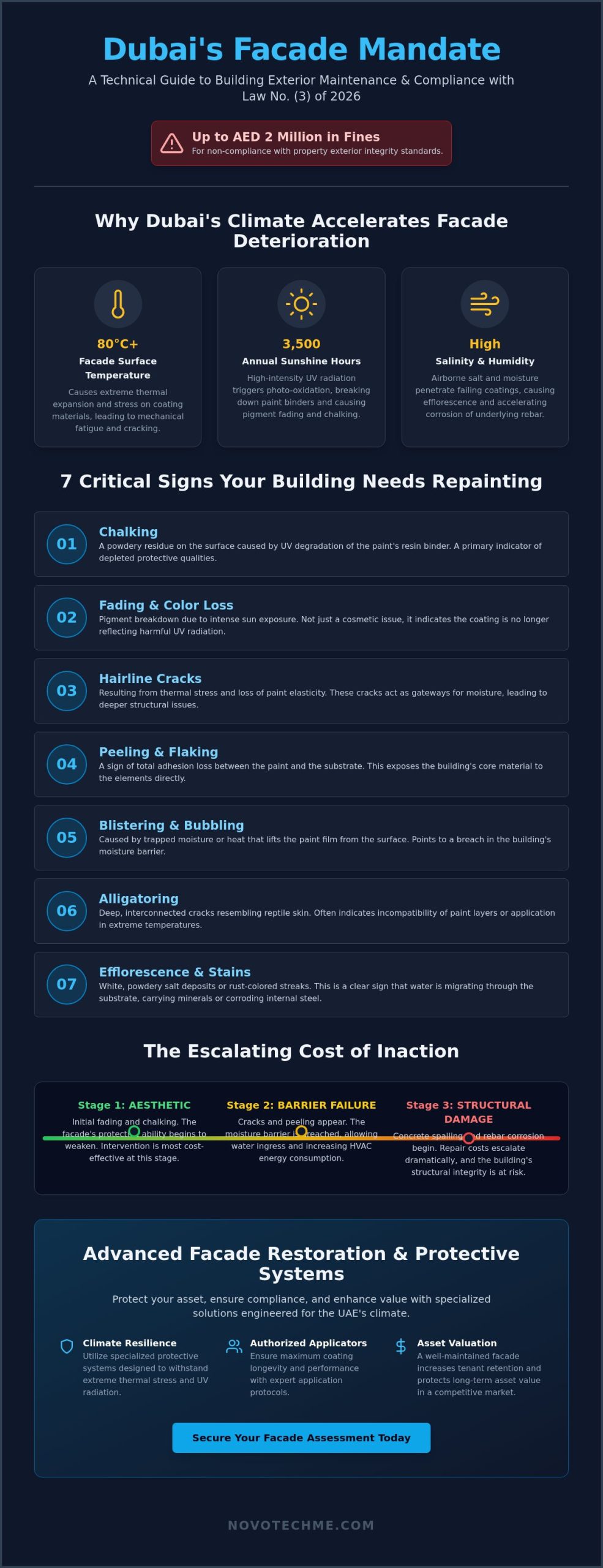
Under Dubai’s Law No. (3) of 2026, failing to maintain your property’s exterior integrity can now result in fines reaching AED 2 million. In a climate where facade temperatures frequently exceed 80°C, your building’s paint isn’t a cosmetic choice; it’s a high-performance shield against extreme thermal stress and coastal salinity. Recognizing the early signs your building needs repainting in Dubai is essential for any property manager who wants to avoid regulatory penalties and protect their asset’s long-term value.
We recognize the challenge of balancing rising maintenance costs with the need for high tenant retention and structural safety. If you’ve noticed fading or minor surface cracks, you’re likely wondering if these issues are purely aesthetic or indicative of deeper failures. This guide provides the technical clarity you need to make informed decisions. We’ll outline seven critical indicators of exterior paint degradation, from chalking caused by 3,500 annual sunshine hours to the subtle moisture traps that lead to corrosion. By following this 2026 framework, you’ll ensure your property remains compliant, efficient, and visually prestigious.
Key Takeaways
- Identify the critical signs your building needs repainting in Dubai, such as surface chalking and pigment fading, to prevent expensive structural repairs.
- Analyze how extreme UV radiation and thermal expansion cycles at 80°C facade temperatures accelerate the molecular breakdown of exterior coatings.
- Quantify the impact of facade restoration on asset valuation and tenant retention within Dubai’s competitive real estate market.
- Determine the ideal “Golden Window” for repainting projects to ensure optimal curing conditions and maximum coating longevity.
- Evaluate the benefits of utilizing specialized protective systems and authorized applicators for high-rise maintenance and regional climate resilience.
Identifying the 7 Critical Signs of Exterior Paint Failure
Maintaining a commercial or residential asset in the UAE demands a rigorous inspection protocol. The facade isn’t just a visual element; it’s a protective membrane. When this membrane breaches, the structural costs can escalate rapidly. Identifying the specific signs your building needs repainting in Dubai allows property managers to transition from reactive repairs to strategic lifecycle management.
Chalking serves as one of the most prevalent indicators of UV-induced binder breakdown. This occurs when the intense solar radiation of Dubai’s 3,500 annual sunshine hours decomposes the resins holding the paint together. Peeling and flaking follow, signaling a total loss of adhesion to the substrate. These aren’t merely cosmetic flaws; they represent the collapse of the building’s primary thermal and moisture barrier. Understanding these common types of paint failure is the first step in technical remediation.
Hairline cracks and bubbling often emerge after high-humidity cycles or rare but intense rain events. These openings allow moisture to migrate behind the coating, creating pressure that lifts the film. If left unaddressed, these small fractures expand through thermal expansion stress, eventually exposing the concrete core to the elements and compromising the building’s envelope.
Visible Surface Degradation
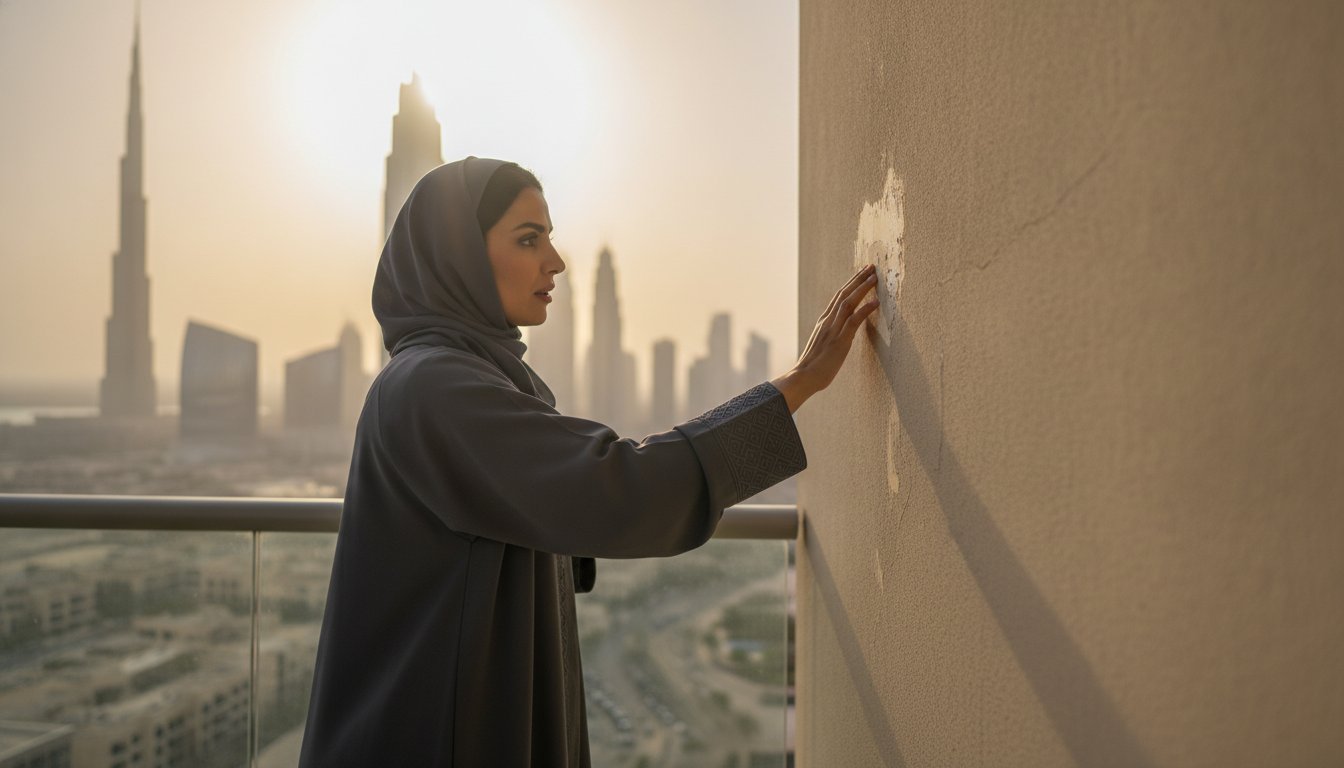
A simple ‘touch test’ remains a reliable diagnostic tool for property managers. If a firm wipe of the facade leaves a chalky residue on your hand, the paint’s protective qualities are depleted. Another critical sign is ‘alligatoring,’ where the surface develops deep, interconnected cracks resembling reptile skin. This typically indicates that previous coating layers were incompatible or that the application didn’t account for the extreme temperature fluctuations of the region. Deep-seated staining, particularly rust-colored streaks, suggests that water ingress has already reached the internal hardware or structural steel.
Substrate and Structural Indicators
Coastal properties often exhibit efflorescence, which appears as white, powdery salt deposits on the surface. This happens when moisture carries minerals through the concrete and evaporates, leaving the salt behind. This process is a precursor to concrete carbonation, where the alkalinity of the concrete drops, leading to rebar corrosion and eventual spalling. Beyond structural risks, failing paint significantly impacts operational efficiency. As the coating loses its reflective properties and thermal integrity, the building absorbs more heat, leading to measurable increases in HVAC energy consumption to maintain interior temperatures.
The Science of Decay: Why Dubai’s Climate Accelerates Deterioration
Dubai’s environment is one of the most aggressive in the world for architectural coatings. While the previous section detailed the visual indicators of failure, understanding the underlying physics of degradation is vital for long-term asset protection. The primary driver of these signs your building needs repainting in Dubai is the synergistic effect of solar radiation and mechanical stress. Property managers must recognize that these signs are the final stage of a long-term molecular decay process.
High-intensity UV radiation acts as a catalyst for photo-oxidation. This process breaks down the molecular chains of the paint’s polymer binders, leaving the pigments unsupported and vulnerable to the environment. Research into how weather degrades exterior paint confirms that solar energy is the most destructive force for organic coatings. In Dubai, where facade surface temperatures can exceed 80°C, this chemical breakdown is significantly accelerated compared to temperate climates.
Thermal expansion adds another layer of complexity to facade maintenance. With summer temperatures reaching 50°C, building materials expand significantly during the day and contract at night. This constant cycling creates mechanical fatigue. If the paint film has lost its elasticity due to UV damage, it cannot withstand this movement, leading to the cracking and delamination discussed earlier. Additionally, Shamal winds introduce a “sandblasting” effect, physically eroding the paint film and reducing its thickness over time.
These principles of environmental degradation apply to any structure exposed to high UV and temperature swings; for homeowners in similar climates, Vester’s Painting & Improvements offers the expertise needed to select coatings that withstand these specific mechanical and solar stresses.
UV Degradation and Colour Loss
Pigment stability is the first casualty of Dubai’s sun. Standard decorative paints often lose their aesthetic and protective integrity within 24 months because they lack the high-performance resins required for this latitude. High-performance systems are engineered to maintain a high Solar Reflectance Index (SRI), which is a measure of a surface’s ability to stay cool in the sun by reflecting solar radiation and emitting thermal radiation. Maintaining a high SRI isn’t just about looks; it directly correlates to lower cooling loads and reduced structural heat gain.
Humidity and Salt Air Challenges
For properties in the Marina or Palm Jumeirah, coastal salinity is a silent killer. Salt is hygroscopic, meaning it attracts and holds moisture even in relatively dry air. This moisture, laden with chlorides, penetrates porous or failing paint to reach the concrete substrate. Once inside, it initiates the corrosion of internal steel reinforcements. Utilizing anti-corrosive paint uae solutions is a technical necessity for these zones rather than an optional upgrade. Proactive application of protective painting systems ensures your building’s envelope remains impermeable to these aggressive ions.
Evaluating the Impact: Curb Appeal vs. Structural Integrity
Property management in the UAE has transitioned from simple maintenance to complex asset protection. With the enactment of Law No. (3) of 2026, Dubai now mandates that all buildings obtain a Quality and Safety Certificate. Neglecting the visible signs your building needs repainting in Dubai isn’t just an aesthetic oversight; it’s a regulatory risk. Non-compliance can lead to significant financial penalties, with fines ranging from AED 100 to AED 1 million, potentially doubling to AED 2 million for repeat offenses. Proactive facade management is the most effective way to ensure your property meets these stringent safety assessments.
The financial impact of a building’s exterior condition extends beyond legal compliance. A well-maintained facade serves as a technical shield, but it also functions as a primary driver of market value. We see a direct correlation between facade integrity and the following business outcomes:
- Asset Valuation: Impeccable exterior conditions maintain the “Grade A” status of commercial towers, protecting the long-term equity of the owner.
- Occupancy Rates: High-quality aesthetics reduce tenant turnover by fostering a sense of prestige and safety for both residential and commercial occupants.
- Operational Efficiency: Modern protective coatings reflect solar heat, reducing the thermal load on the building and lowering annual utility expenditures.
Commercial Value and Market Perception
In high-stakes districts like DIFC or Business Bay, a building’s facade condition is a non-negotiable metric for corporate tenants. A weathered exterior suggests internal neglect, often leading to lower lease negotiations. For luxury residential assets in Emirates Hills or Jumeirah, the facade is the first point of contact for potential high-net-worth residents. Adhering to professional exterior building painting dubai standards ensures that your property remains competitive in a market that prioritizes visual and structural excellence.
Preventing Long-term Asset Degradation
The progression from a hairline crack to spalling concrete is a rapid and expensive journey in Dubai’s saline environment. Once the protective paint film fails, carbonation begins to lower the pH of the concrete, leading to the oxidation of internal steel reinforcements. This structural instability is far more costly to remediate than a planned repainting cycle. Because of this, specialized waterproofing companies in dubai are often brought in to work alongside painting teams to seal the envelope completely. Investing in high-performance protective systems every 7 to 10 years offers a far higher ROI than reactive structural repairs that can cost ten times the original maintenance budget.
Timing Your Project: When to Schedule Repainting for Optimal Results
Strategic scheduling is as critical as the choice of coating itself. Once you’ve identified the technical signs your building needs repainting in Dubai, the project timeline must align with the region’s specific meteorological windows. Unlike temperate climates where painting can occur throughout the year, Dubai’s extreme thermal environment dictates a strict operational calendar to ensure chemical curing and long-term substrate adhesion.
The “Golden Window” for facade restoration typically spans from October to March. During these months, ambient temperatures remain within the optimal range for paint polymers to form a cohesive, durable film. Outside of this window, high-rise logistics become increasingly complex. Wind patterns, particularly at elevations exceeding 50 floors, can halt cradle operations for days. Professional contractors monitor real-time wind speeds and humidity levels, specifically the dew point, to prevent microscopic moisture from being trapped beneath the new coating.
Post-storm inspections have become a non-negotiable part of the 2026 property manager’s toolkit. Recent increases in intense rain events in the UAE can accelerate the failure of already weakened paint films. These storms often reveal hidden ingress points that were previously obscured by dust or minor chalking. An immediate facade check after a significant weather event allows for targeted repairs before moisture leads to the structural spalling and rebar corrosion discussed in previous sections.
Seasonal Weather Planning
Applying architectural coatings in temperatures exceeding 45°C is a recipe for technical failure. Excessive heat causes flash-drying, where the solvent evaporates too quickly for the binder to wet the substrate properly. This results in poor adhesion and premature peeling. High humidity further complicates this by extending the drying time of specialized epoxy and acrylic systems, leading to sagging or blushing of the finish. Because of these factors, early morning starts are critical for exterior work in Dubai to capitalize on lower surface temperatures before peak solar radiation hits the facade.
Frequency of Repainting
Maintenance cycles in the Middle East are significantly shorter than those in Europe or North America. While a building in London might require repainting every 10 to 12 years, Dubai assets typically require a fresh protective system every 5 to 7 years. Properties located in high-salinity coastal zones or those exposed to constant sand abrasion in desert-fringe developments may need even more frequent monitoring. For a comprehensive approach to asset protection, many managers consult with epoxy floor coating uae specialists to synchronize exterior facade work with parking deck and podium maintenance. To ensure your project aligns with these technical requirements, request a professional facade assessment to determine your building’s specific maintenance interval.
NovoTech: Advanced Facade Restoration and Protective Systems
NovoTech doesn’t just apply paint; we integrate advanced protective systems designed to counteract the specific environmental stressors of the UAE. With over 30 years of operational history in the region, we’ve developed a deep understanding of local substrate behavior and the unique challenges posed by high-rise maintenance. Our role is that of a seasoned expert and strategic partner, ensuring that once you identify the signs your building needs repainting in Dubai, the remediation is permanent and technically superior.
We specialize in exterior high rise building painting and anti-corrosive paint solutions, particularly for assets located in aggressive coastal zones. Our teams are trained as Terraco Application Specialists, utilizing world-class coatings specifically engineered for the Middle East’s climate. This technical depth allows us to handle large-scale, comprehensive projects with a level of precision that standard maintenance firms cannot match. Our capability extends to the most complex structures, ensuring that every square meter of the building’s envelope is fortified against decay.
The Terraco Advantage
Terraco coatings outperform standard decorative paints because they’re formulated for high UV resistance and thermal stability. For buildings exhibiting hairline cracks, we deploy elastomeric coatings. These systems possess the elasticity to bridge existing fractures and accommodate future thermal expansion without rupturing the protective film. Beyond durability, these modern, low-VOC protective systems align with Dubai’s 2026 sustainability goals, providing a high Solar Reflectance Index (SRI) while minimizing environmental impact and reducing cooling costs.
Our Professional Methodology
Our project lifecycle begins with a methodical assessment of the facade’s health. We don’t skip steps; thorough surface preparation, including high-pressure washing and substrate repair, is non-negotiable for ensuring long-term adhesion. We recognize that property managers must balance maintenance with tenant satisfaction. Our execution strategy is designed to minimize disruption, utilizing advanced access systems and efficient scheduling to ensure project momentum. This transparency and operational excellence define our approach to every contract.
We invite you to examine our work firsthand. By reviewing a villa renovation case study dubai, you’ll see how our integrated approach transforms weathered facades into resilient, high-value assets. Whether managing a commercial tower or a private estate, our goal is total project ownership, providing you with the reliability and technical competence your investment deserves.
Secure Your Asset’s Future Through Technical Facade Management
Proactive maintenance is the cornerstone of asset longevity in Dubai’s high-stress climate. The 2026 regulatory environment and extreme thermal cycles leave no room for delayed repairs or cosmetic-only fixes. Recognizing the early signs your building needs repainting in Dubai is your first line of defense against structural carbonation and escalating operational costs. By prioritizing high-performance coatings and professional application cycles, you ensure your property remains both legally compliant and commercially competitive.
NovoTech brings over 30 years of UAE engineering experience to every project. As an Authorized Terraco Applicator, we specialize in high-rise and luxury villa restoration using systems engineered for regional resilience. Protect your investment with a partner who understands the complex science of the building envelope. Request a Professional Facade Inspection and Quote from NovoTech. We’re ready to help you maintain your building’s excellence and structural integrity for years to come.
Frequently Asked Questions
How often should a building be repainted in Dubai?
Repainting intervals in the UAE typically range from five to seven years. This frequency is significantly shorter than in temperate climates due to the 3,500 annual sunshine hours and intense coastal salinity. Property managers should monitor for the technical signs your building needs repainting in Dubai every quarter to catch binder breakdown before it leads to substrate damage.
What is the best type of paint for the UAE’s high-heat climate?
High-performance elastomeric coatings and specialized protective systems are the industry standard for the Middle East. These materials provide superior UV resistance and a high Solar Reflectance Index (SRI). We recommend systems designed specifically for regional environmental stress to ensure long-term adhesion and thermal protection against facade temperatures that can exceed 80°C.
Can you paint a building during the summer months in Dubai?
While technically possible with specialized additives and early morning shifts, we don’t recommend major exterior painting during peak summer months. Ambient temperatures exceeding 45°C cause architectural coatings to flash-dry. This prevents the binder from properly wetting the substrate, which leads to poor adhesion and premature failure of the new paint film.
How do I know if a crack is just in the paint or in the concrete?
Identifying the signs your building needs repainting in Dubai early helps distinguish between cosmetic hairline cracks and structural spalling. Surface cracks usually follow the pattern of the paint film, whereas structural cracks often appear wider and may show salt deposits or rust streaks. If a crack exceeds 2mm, a professional technical assessment is required to check for concrete carbonation.
Does the colour of the paint affect the building’s internal temperature?
Paint colour and chemical composition directly impact a building’s thermal load. Light-coloured coatings with specialized heat-reflective properties can reduce interior temperatures by up to 5°C according to UAE Green Building Council research. This reduction lowers HVAC energy consumption and decreases the mechanical strain on your building’s cooling systems during peak summer months.
What is the difference between standard paint and a protective coating system?
Standard paints focus primarily on aesthetics, while protective coating systems serve as technical membranes. These systems include anti-carbonation properties, UV stabilizers, and elastomeric qualities that allow the film to expand and contract with the building. They provide a comprehensive shield against the specific chemical and mechanical stressors found in the Gulf region, such as sand abrasion and salt air.
How long does a professional exterior painting project usually take for a high-rise?
A comprehensive high-rise restoration typically requires between three and six months to complete. This timeline accounts for rigorous surface preparation, cradle logistics, and mandatory safety protocols. External factors like high wind speeds or humidity levels can influence the project duration, as we prioritize application quality and dew point monitoring over speed.
Are there specific Dubai Municipality rules for building colours?
Dubai Municipality and master developers like Emaar or Nakheel enforce strict aesthetic guidelines and permit requirements. You must obtain a municipal permit for any exterior work, and many communities require a No Objection Certificate (NOC) for specific colour palettes. Compliance ensures your asset aligns with regional urban planning standards and helps avoid fines under Law No. (3) of 2026.