As of early 2026, owners of Dubai properties aged 20 years or older face a critical mandate to secure a Quality and Safety Certificate under Law No. (3) of 2026. This regulation places structural integrity at the forefront of asset management, making the mitigation of metal degradation a matter of strict legal compliance. We recognize the immense pressure of managing infrastructure when 50°C heat and relentless coastal salinity cause rapid deterioration of expensive fixtures. It’s a challenge that demands more than just a standard coat of paint; it requires a specialized engineering approach to survive the Gulf’s unique atmospheric demands.
This structural guide provides the technical strategies you need for preventing steel corrosion in UAE climate. You’ll master the selection of high-performance protective coating systems and the rigorous surface preparation standards, such as Sa 2.5, required to extend your asset’s lifespan. We’ll explore the integration of anti-corrosive solutions that align with current VOC limits and UAE safety standards. From analyzing industrial barrier coatings to implementing specialized Terraco systems, this overview of modern corrosion science will help you reduce maintenance costs and protect your long-term investments with total confidence.
Key Takeaways
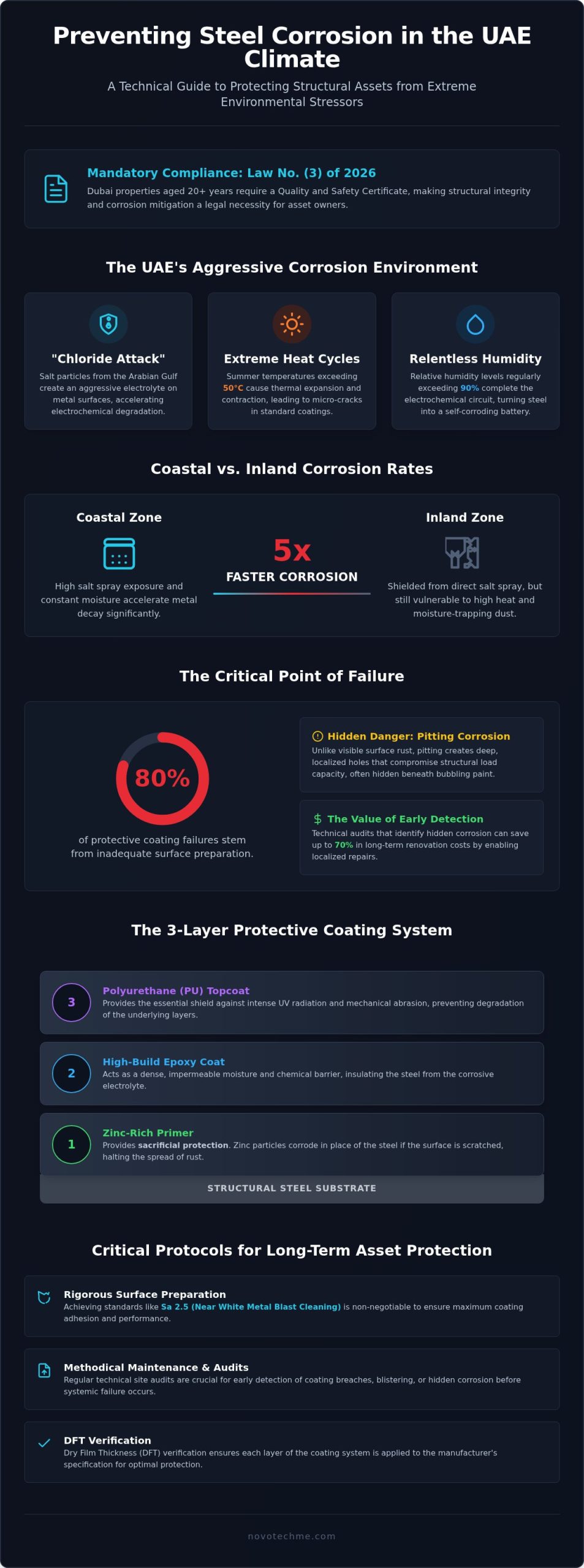
- Understand how the “Chloride Attack” and humidity levels exceeding 90% trigger rapid electrochemical degradation in Gulf environments.
- Explore the technical synergy of multi-layer protective systems, utilizing zinc-rich primers to provide essential sacrificial protection for steel.
- Evaluate the lifecycle cost-benefit of 316L stainless steel versus hot-dip galvanization to optimize material selection for coastal infrastructure.
- Identify why 80% of coating failures stem from inadequate surface preparation and how to mitigate this risk when preventing steel corrosion in UAE climate.
- Learn the importance of methodical maintenance protocols, including technical site audits and DFT verification, to ensure long-term asset compliance.
The Science of Steel Corrosion in the UAE Environment
The Science of Steel Corrosion in the Arabian Peninsula is defined by a relentless “Chloride Attack.” Salt particles from the Arabian Gulf settle on exposed surfaces, drawing moisture directly from the atmosphere to create an aggressive electrolyte. When relative humidity levels regularly exceed 90%, this electrochemical circuit is completed, turning structural steel into an active battery that consumes its own mass. It isn’t just a surface issue; chloride ions penetrate deep into the metal’s crystalline structure, causing rapid and irreversible damage. This chemical degradation is the primary driver behind the premature failure of many industrial assets in the region.
Physical stressors add a second layer of complexity to the problem. The UAE’s 50°C+ summers introduce extreme thermal expansion and contraction cycles. Standard coatings often lack the high-performance elasticity required to handle these shifts, leading to micro-cracks that invite moisture and salt. UV radiation further degrades organic paint binders, while wind-borne sand acts as a mechanical abrasive, physically eroding protective surface layers over time. Successfully preventing steel corrosion in UAE climate requires a system that addresses both chemical and mechanical threats simultaneously, ensuring the barrier remains intact despite the harsh desert elements.
Coastal vs. Inland Corrosion Rates
Proximity to the shoreline is the most significant variable in determining the speed of metal decay. Properties in Jumeirah or the Palm Jumeirah face 5x faster corrosion rates compared to inland sites just a few kilometers away. High-rise structural steel is especially prone to the “salt spray” effect, where coastal winds carry concentrated brine hundreds of meters above sea level. This creates a vertical corrosion gradient that standard maintenance schedules often miss. Inland projects, while shielded from direct salt spray, still deal with high heat and desert dust that trap moisture against the metal, acting as a catalyst for oxidation during the humid night hours.
Identifying Early Signs of Structural Oxidation
Early detection is the most effective way to manage maintenance budgets and ensure safety. Distinguishing between harmless surface rust and deep pitting corrosion can be the difference between a minor touch-up and a full structural overhaul. Pitting is particularly dangerous because it creates small, deep holes that compromise the load-bearing capacity of a beam without showing massive surface damage. We often find “hidden” corrosion beneath bubbling paint layers, where the metal is already significantly compromised. Identifying these indicators during a technical audit can save up to 70% in long-term renovation costs by allowing for localized repairs before the damage becomes systemic.
Advanced Protective Coating Systems for UAE Structures
Achieving long-term durability in the Gulf requires a sophisticated multi-layer defense strategy. We don’t rely on a single coat of paint; instead, we deploy Advanced Protective Coating Systems that act in synergy to insulate the metal from environmental stressors. This systematic approach is the cornerstone of preventing steel corrosion in UAE climate, where a single breach in the barrier can lead to rapid structural failure. By utilizing a three-tier system of primers, intermediate coats, and topcoats, we create a redundant shield that accounts for the extreme salinity and humidity of the region.
The foundation of this defense starts with zinc-rich primers. These coatings provide sacrificial protection; if the surface is scratched or impacted, the zinc particles oxidize in place of the steel, effectively halting the spread of rust. We follow this with high-build epoxy coatings that function as a dense, impermeable moisture and chemical barrier. Finally, Polyurethane (PU) topcoats are applied to provide the essential shield against the UAE’s intense UV rays. Without this PU layer, the underlying epoxy would chalk and degrade under the sun, compromising the entire structural integrity of the asset.
Terraco Anti-Corrosive Solutions
As authorized Terraco application specialists, we utilize systems specifically engineered for Middle Eastern humidity profiles. These anti-corrosive solutions are designed to maintain high adhesion levels even in environments where moisture levels regularly fluctuate. Our methodology integrates these coatings with exterior building painting dubai projects to ensure total facade protection. By partnering with an authorized applicator, asset managers receive a validated warranty and the assurance that the chemical bonding between layers meets rigorous international standards.
Specialized Coatings for Different Steel Assets
Different structural assets require tailored chemical profiles based on their exposure and function. Architectural steel and decorative villa gates demand finishes that provide high-end aesthetics without compromising on anti-corrosive properties. Conversely, heavy-duty industrial assets like pipelines and rooftop plant machinery require thicker, more robust coatings capable of withstanding constant thermal cycling and mechanical vibration. We also provide intumescent coatings for critical structural members, which combine essential fire protection with a high-performance barrier against oxidation. If you’re looking to upgrade your asset’s defense, our team can recommend the most effective Protective Painting Systems for your specific infrastructure needs.
Material Selection vs. Applied Protection: A Strategic Comparison
Choosing the right substrate is the first technical decision in any infrastructure project. While 316L stainless steel offers superior resistance to chloride-induced pitting, its initial procurement cost is often prohibitive for large-scale structural frames. In marine zones like Dubai Marina or the Port of Jebel Ali, the molybdenum content in 316L provides a critical advantage against the salt spray. However, for most commercial developments, carbon steel remains the primary choice due to its versatility and structural properties. This necessitates a sophisticated strategy for preventing steel corrosion in UAE climate through high-performance barrier systems that compensate for the base metal’s vulnerability.
Total Cost of Ownership (TCO) is the metric that matters most to seasoned asset managers. Over a 20-year building lifecycle, carbon steel paired with a high-quality coating system often proves more economical than stainless steel, provided the maintenance schedule is strictly followed. Hot-dip galvanization is another viable alternative for structural beams, offering a metallurgical bond that resists mechanical damage during construction. Yet, in the UAE’s high-salinity environment, galvanization alone may not suffice. We often recommend a “duplex system.” This involves combining galvanization with a specialized topcoat to significantly extend the service life of the asset beyond what either system could achieve alone.
When to Retrofit vs. When to Replace
Structural integrity loss is typically measured by the reduction in a beam’s cross-sectional area. If oxidation has consumed more than 10% of the metal’s thickness, replacement is usually the only safe path forward to maintain load-bearing capacity. However, if the damage is limited to surface oxidation, abrasive blasting to Sa 2.5 standards followed by a technical recoating can restore the asset. We follow Professional Application and Maintenance Protocols to ensure that retrofitted coatings bond effectively to the aged substrate, preventing future delamination in high-load areas. Ignoring these signs in high-rise structures can lead to catastrophic safety implications and massive legal liabilities.
The Role of Cathodic Protection
For specialized maritime structures or foundations in high-salinity soil, coatings work alongside cathodic protection. Sacrificial anodes, typically made of zinc or aluminum, are attached to the steel to ensure they corrode instead of the primary structure. This provides a critical fallback mechanism if the coating is breached. Modern hybrid systems are now being integrated into reinforced concrete to protect rebar from the electrochemical decay mentioned in previous sections. These integrated models represent the pinnacle of preventing steel corrosion in UAE climate, ensuring that even hidden steel remains shielded from the region’s aggressive atmospheric conditions.
Professional Application and Maintenance Protocols
The success of any structural protection project depends entirely on the precision of the application phase. We adhere to the 80/20 rule of industrial coatings: 80% of premature failures are caused by inadequate surface preparation rather than the quality of the product itself. Even the most advanced polymer will fail if applied over microscopic salt contaminants or mill scale. Achieving a durable bond for preventing steel corrosion in UAE climate requires a rigorous mechanical cleaning process. We utilize Abrasive Blasting to Sa 2.5 standards to create a specific “anchor profile” that allows the primer to lock into the metal substrate, ensuring it can withstand the thermal stresses of the Dubai sun.
Environmental monitoring is a mandatory component of our workflow. In the UAE, relative humidity levels can spike within minutes, especially during the coastal transition hours. If the substrate temperature isn’t at least 3°C above the dew point, moisture can become trapped between the steel and the coating, leading to osmotic blistering. Professional anti-corrosive paint uae application involves real-time data logging of ambient conditions to ensure the chemical cure occurs within the manufacturer’s specified window. This methodical approach eliminates the variables that lead to delamination and mid-term structural decay.
The Inspection Lifecycle
Coastal properties in high-density areas like Dubai Marina and JBR require a more aggressive inspection frequency than inland assets. We recommend quarterly visual inspections for coastal high-rises to identify early salt accumulation or mechanical breaches. On an annual basis, we perform pull-off adhesion testing to verify the coating’s bond strength hasn’t been compromised by internal electrochemical reactions. Modern thermal imaging is also utilized to detect hidden moisture ingress behind external cladding panels, allowing us to address issues before they manifest as visible rust streaks.
Localized Repair Strategies
Mechanical damage from maintenance cradles or equipment upgrades is inevitable over a building’s lifespan. We focus on spot-repairing these breaches immediately to prevent the “creep” of oxidation beneath the surrounding intact coating. Compatibility is a primary concern during these repairs; we perform solvent rub tests to ensure the new repair material bonds chemically with the aged system. Maintaining detailed maintenance logs is vital for preserving asset value. These records provide documented proof of structural health during property valuations and safety audits. For a comprehensive technical assessment of your facility’s steelwork, our Protective Painting Systems team provides detailed site audits and maintenance planning.
NovoTech: 30 Years of Corrosion Protection Excellence in Dubai
NovoTech has spent three decades refining the technical science of preventing steel corrosion in UAE climate. Our operational history in Dubai isn’t just a measure of time; it’s a repository of specialized data gathered from the region’s most demanding high-rise and luxury villa projects. We recognize that structural integrity is a holistic endeavor. This is why our deep expertise as one of the leading waterproofing companies in dubai directly informs our approach to steel protection. Both disciplines require an absolute mastery of moisture barrier technology and chemical bonding in environments where temperatures frequently exceed 50°C.
Our methodical approach begins long before the first protective layer is applied. Every project starts with a comprehensive technical site audit to identify specific environmental stressors and existing substrate conditions. We don’t rely on guesswork. Our team utilizes high-precision testing equipment to verify surface profiles after abrasive blasting and ensures that final Dry Film Thickness (DFT) meets the exact engineering specifications required for long-term durability. We also provide integrated solutions like epoxy floor coating uae, creating a seamless protective environment for industrial facilities where steel infrastructure and flooring must withstand heavy mechanical use and chemical exposure.
The NovoTech Technical Advantage
Our status as an authorized Terraco applicator gives our clients exclusive access to systems specifically formulated for the Gulf’s unique atmospheric chemistry. We employ certified applicators who’ve been trained in advanced protective systems, ensuring that every layer is applied with technical precision. Beyond the application, we provide end-to-end project management. This is critical for high-rise and commercial renovations where logistics and safety protocols are as important as the coating itself. We take total ownership of the project lifecycle, from initial preparation to final quality assurance and verification.
Partnering for Long-Term Asset Integrity
We view ourselves as a strategic partner rather than a transactional supplier. Our customized maintenance contracts are designed for commercial property portfolios, providing predictable costs and documented compliance with UAE safety and environmental regulations. This proactive model ensures that your assets remain protected against the 2026 regulatory standards discussed earlier in this guide. We’re committed to precision and efficiency in every project we handle. To secure your infrastructure’s future and extend the lifespan of your metal assets, we invite you to engage with our technical team for a comprehensive structural audit.
Securing Your Structural Legacy in the Emirates
Securing your structural assets against the Gulf’s aggressive atmospheric conditions requires a methodical transition from reactive maintenance to technical prevention. We’ve established that the synergy between zinc-rich primers and UV-resistant topcoats is essential for shielding carbon steel from the relentless chloride attack. By prioritizing rigorous surface preparation and adhering to the latest 2026 safety regulations, property owners can significantly reduce their long-term repair expenditures while ensuring structural compliance.
Our 30 years of regional experience as an authorized Terraco applicator provides us with the unique perspective needed for preventing steel corrosion in UAE climate. We utilize specialized high-rise equipment and high-precision testing to verify every micron of protection we apply. This technical depth ensures your infrastructure remains a durable, high-value asset for decades to come.
If you’re ready to implement a professional defense strategy, Request a Technical Site Audit for Your Property today. We’re here to help you navigate the complexities of structural preservation with total confidence.
Frequently Asked Questions
How long does anti-corrosive paint last in the UAE climate?
A high-performance anti-corrosive system typically provides a service life of 10 to 15 years in the UAE, provided it’s applied according to rigorous ISO standards. In high-salinity coastal areas like the Palm Jumeirah or Dubai Marina, this window may shorten due to aggressive chloride exposure. Regular maintenance and localized touch-ups are necessary to reach the maximum design life of the protective coating.
Can I apply anti-corrosive coatings over existing rust?
Applying protective coatings directly over existing rust is a primary cause of premature system failure. Rust acts as a porous layer that traps moisture and oxygen against the steel substrate, allowing oxidation to continue beneath the new paint. We mandate abrasive blasting to Sa 2.5 standards to remove all oxidation and provide a clean anchor profile for the primer to bond correctly.
What is the best type of steel for coastal construction in Dubai?
316L stainless steel is the superior choice for coastal construction because its molybdenum content resists chloride-induced pitting. However, for large-scale structural frames, high-grade carbon steel remains the industry standard when protected by a robust multi-layer coating system. This combination effectively balances structural load requirements with long-term durability in the Gulf’s maritime zones.
How often should I inspect the steel structures on my property?
We recommend quarterly visual inspections for coastal properties to identify early signs of salt accumulation or mechanical damage. For inland structures, a comprehensive annual assessment is usually sufficient. These regular checks are vital for preventing steel corrosion in UAE climate, as they allow for minor repairs before oxidation compromises the structural integrity of the asset.
Why is standard exterior paint not enough to prevent rust in the UAE?
Standard exterior paints are designed for aesthetics and lack the chemical density required to block chloride ions and moisture. In the UAE, extreme UV radiation quickly breaks down the binders in decorative paints, leading to chalking and cracking. Specialized anti-corrosive systems utilize zinc-rich primers and high-build epoxies specifically engineered to survive these intense environmental stressors.
Does humidity during application affect the durability of the coating?
Humidity is a critical variable that directly impacts the chemical bonding of the coating to the steel. If the relative humidity is too high or the substrate temperature is too close to the dew point, moisture can become trapped, causing osmotic blistering and delamination. We strictly monitor ambient conditions to ensure application occurs only within the manufacturer’s specified environmental window.
What is the difference between galvanization and protective painting?
Hot-dip galvanization involves dipping steel into molten zinc to create a metallurgical bond that provides sacrificial protection. Protective painting is a multi-layer barrier system applied to the surface to insulate the metal from the atmosphere. While galvanization is durable, it often requires a topcoat in the UAE’s high-salinity environment to prevent the zinc layer from being consumed too quickly.
How much does professional anti-corrosion treatment cost in Dubai?
The cost of professional anti-corrosion treatment is determined by the total surface area, the required level of abrasive blasting, and the complexity of the coating system. Factors such as site accessibility for high-rise equipment and the specific environmental exposure zone also influence the project’s scope. We provide detailed technical audits to outline the necessary steps and resource requirements for your specific infrastructure.