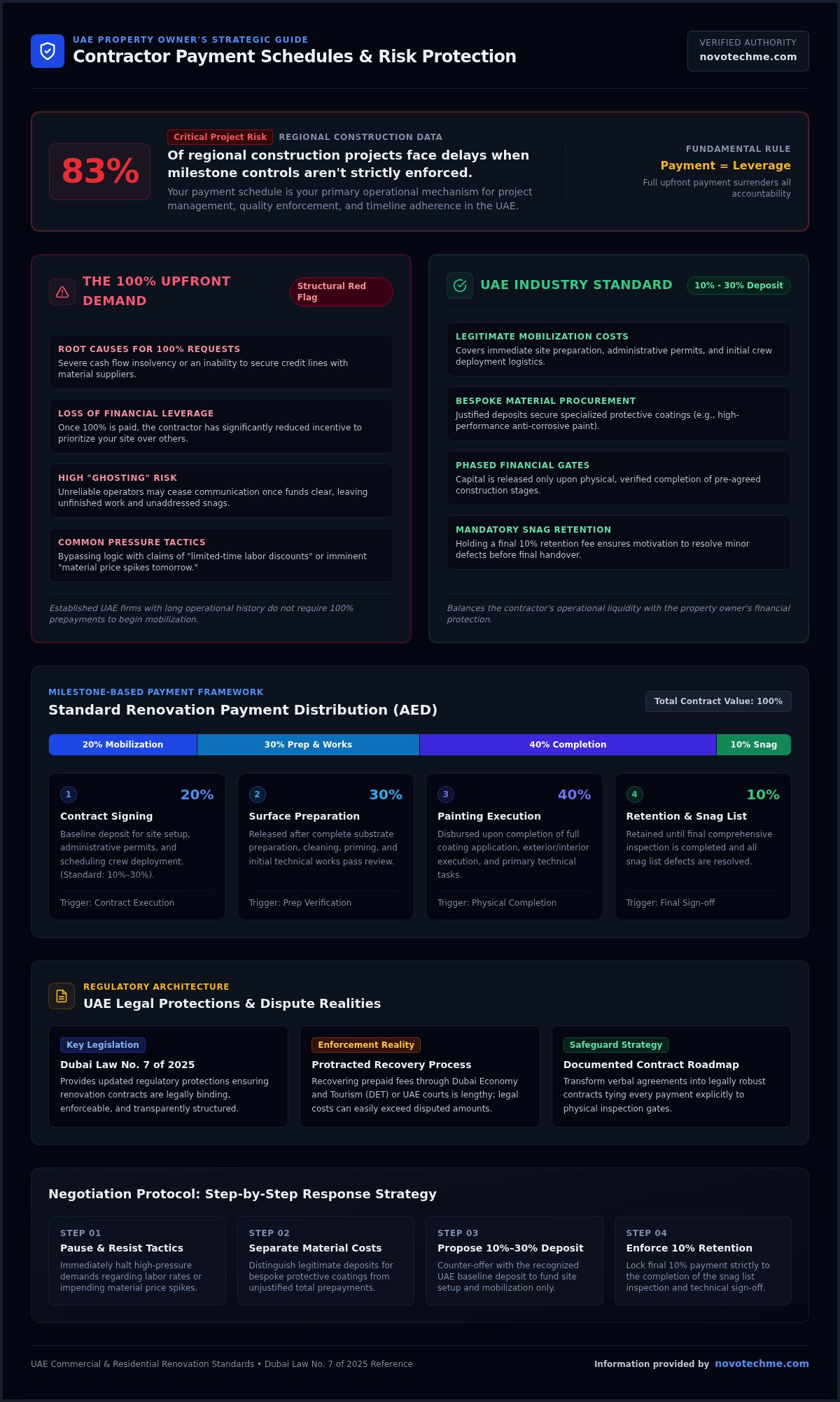
Recent reports show that 83% of regional construction projects face delays when milestone controls aren’t strictly enforced. This data highlights a critical reality for property owners in the UAE: your payment schedule is your most effective tool for project management. If you’re currently wondering what to do if a contractor asks for full payment upfront, it’s vital to recognize this demand as a significant departure from professional standards. While some firms claim they need immediate capital for materials, a request for 100% payment before work begins is a structural red flag that compromises your financial security.
We recognize the pressure to begin your villa painting or renovation project quickly. It’s natural to feel uncertain about local norms or worry about losing a preferred team by pushing back. This article provides the expert clarity you need to handle these negotiations with confidence. You’ll learn about the latest UAE legal protections, including Dubai Law No. 7 of 2025, and discover how to structure payments in AED that keep your contractor accountable. We’ll give you the specific language and frameworks required to ensure your project stays on track and your investment remains protected through every stage of the process.
Key Takeaways
- Recognize why a demand for full payment serves as a significant operational red flag, signaling potential instability or a lack of professional commitment to project quality.
- Adopt the standard UAE payment framework of a 10% to 30% initial deposit, ensuring remaining funds are strictly tied to verified completion milestones.
- Distinguish between predatory payment demands and legitimate mobilization costs, such as the procurement of specialized protective coatings for high-rise projects.
- Learn exactly what to do if a contractor asks for full payment upfront by utilizing professional counter-offer strategies that align with UAE industry standards.
- Leverage the latest UAE regulatory updates, including Dubai Law No. 7 of 2025, to ensure your renovation contract remains legally robust and transparent.
The Risks of Paying a Contractor 100% Upfront
In the UAE renovation market, your primary mechanism for ensuring quality and adherence to timelines is the control of capital. When you release 100% of the project value before a single brushstroke is applied, you effectively surrender your only tool for accountability. This loss of financial leverage creates a power imbalance that most professional firms avoid; it undermines the collaborative nature of a technical project. A contractor who has already received the total contract value has significantly less incentive to prioritize your site over others where payments are still pending.
If you’re wondering what to do if a contractor asks for full payment upfront, the first step is to recognize the legal reality in the Emirates. Recovering a total project fee through local courts or the Dubai Economy and Tourism (DET) department is a protracted process. While legal protections exist, the time and cost involved in litigation often exceed the value of the initial dispute. Retaining a portion of the fee until final handover ensures the contractor remains motivated to resolve the “snag list” and meet the standard construction contract terms established at the start. Without this retention, “ghosting” becomes a high risk, where a contractor may simply stop returning calls once the check clears.
Why Do Contractors Ask for Full Payment?
Contractors typically demand full payment due to severe cash flow insolvency or an inability to secure credit lines with suppliers. While it’s legitimate for a firm to request a deposit for specialized materials, such as high-performance anti-corrosive paint uae, these costs rarely justify a 100% upfront demand. Predatory requests often target first-time property owners who aren’t familiar with the 10% to 30% deposit standard common in Dubai’s professional sector. Established firms with decades of operational history don’t require your total project funds to begin mobilization.
The Psychology of the Upfront Request
Many unreliable operators utilize high-pressure sales tactics to bypass your logical defenses. They might claim a “limited time offer” on labor rates or insist that material prices will spike tomorrow. It’s crucial to distinguish between a “commitment deposit,” which secures your place in a busy schedule, and a “full prepayment.” A professional partner focuses on long-term reliability rather than forcing a rushed financial decision. Knowing what to do if a contractor asks for full payment upfront involves pausing the conversation to demand a transparent, milestone-based alternative that protects both parties.
Standard Payment Schedules for Renovation in the UAE
Professional standards in the Emirates favor a phased approach to project financing. A 10% to 30% deposit is the recognized baseline for mobilization; this amount covers the immediate costs of site preparation, administrative permits, and initial crew deployment. Any demand exceeding this range without a justification for bespoke procurement should be scrutinized immediately. When determining what to do if a contractor asks for full payment upfront, the most effective response is to propose a structured schedule that mirrors the project’s physical progress. This ensures the contractor has the liquidity needed to operate while you retain the leverage required to maintain quality.
Professionalism in the UAE contracting sector is further defined by the “snag list” period. Holding a 10% retention fee until the final inspection is completed protects your interest against unfinished details or minor defects. This practice is consistent with FTC advice on avoiding home improvement scams, which emphasizes that payments should always be tied to specific, verifiable work stages. Documenting this schedule within your formal contract is not just a preference; it’s a critical safeguard that transforms a verbal agreement into a legally binding roadmap for both parties.
Milestone-Based Payment Frameworks
A successful project relies on clear financial gates that align with technical output. A typical framework might include 20% on contract signing, 30% after surface preparation, 40% upon completion of painting, and a final 10% after successful inspection. This structure is particularly vital for complex tasks like exterior building painting dubai, where logistics and weather-dependent stages require careful coordination. Linking disbursements to these visible milestones ensures the contractor’s cash flow remains healthy while your investment is protected by tangible results at every stage.
Local UAE Regulations and DED Norms
The Dubai Department of Economy and Tourism (DET) provides a robust framework for consumer protection that all property owners should utilize. Every contractor receiving funds must possess a valid UAE trade license relevant to their specific activity. You should always insist on a formal Tax Invoice that includes the company’s Tax Registration Number (TRN) for every AED transferred. These documents are essential if a dispute arises, as they form the legal basis for any complaint filed through the DET’s consumer protection channels. For a secure and transparent experience, partnering with an established firm like NovoTech guarantees strict adherence to these local regulatory standards.
When is a Deposit Actually Reasonable?
While we’ve established that 100% payment is a major risk, it’s important to understand when a reasonable deposit is justified. Professional contractors in the UAE often face significant upfront costs before the first coat of paint is applied. For instance, high-rise projects in Dubai require specialized scaffolding, municipality permits, and crew mobilization. If you’re unsure what to do if a contractor asks for full payment upfront, start by requesting a breakdown of these initial expenses. A transparent partner will provide a detailed Bill of Quantities (BOQ) that separates mobilization costs from labor, ensuring every AED is accounted for before work begins.
Material procurement is another area where a partial advance is commercially sound. High-performance anti-corrosive paint uae often requires specialized ordering and batching. These aren’t off-the-shelf products; they’re engineered systems designed for the harsh Gulf climate. In these cases, a deposit covering the material value is standard practice. This aligns with the FTC’s guidance on avoiding home improvement scams, which suggests that while large upfront payments are dangerous, covering the cost of custom-ordered or specialized materials is a legitimate exception to the rule.
The Role of Specialized Materials
Projects involving epoxy floor coating uae or Terraco systems differ significantly from standard interior repainting. These advanced coatings involve complex chemical compositions and multi-stage application protocols. Contractors must secure these materials in advance to ensure color consistency and system compatibility. Differentiating between labor costs and material procurement allows you to fund the project’s physical needs without over-exposing your capital. A reasonable deposit ensures these high-value components are on-site and ready for application according to the technical schedule.
Assessing Contractor Credibility
The best defense against predatory payment terms is verifying the contractor’s operational history. A company with a 30-year presence in Dubai, like NovoTech, demonstrates a level of stability that smaller, transient firms cannot match. When reviewing a portfolio for villa painting services sharjah, look for authorized applicator certifications. These credentials prove that the contractor’s technical competence has been vetted by major material manufacturers. If a firm lacks a physical office or a verifiable history of large-scale projects, their request for an oversized deposit becomes much more suspicious.
How to Negotiate a Fair Payment Plan
Negotiating terms isn’t just about price; it’s about establishing a framework for accountability. When you’re deciding what to do if a contractor asks for full payment upfront, your strongest asset is a well-structured counter-offer. Professional firms in the UAE respect clients who approach project finance with commercial maturity. Instead of a flat refusal, propose a tiered schedule that aligns with physical progress. This strategy demonstrates that you’re ready to fund the project but require the security of milestone-based disbursements to ensure the technical specifications are met.
In the UAE, your choice of payment method also serves as a critical layer of protection. Whenever possible, utilize corporate credit cards for initial deposits. Local banking regulations often provide dispute mechanisms for services not rendered, offering a safety net that cash transfers or personal checks lack. For large-scale structural renovations, you might even suggest a third-party management system to hold funds until specific stage-gates are certified. If a contractor refuses to move from a 100% upfront demand despite these professional alternatives, it’s a clear signal to exercise your walk-away power. A refusal to negotiate is often the final red flag of a poorly capitalized operation.
Professional Scripts for Declining Upfront Requests
Using precise, professional language helps maintain a collaborative relationship while setting firm boundaries. You don’t need to be confrontational; you simply need to be clear about your requirements. Consider using these scripts during your next negotiation:
- The Milestone Approach: “I value your expertise, but my policy is to pay based on completed milestones to ensure project alignment and maintain a clear audit trail for my records.”
- The Material Compromise: “I’m happy to cover the cost of specialized materials directly to the supplier or provide a 20% mobilization deposit in AED to get the crew on-site.”
- The Snagging Requirement: “For a project of this scale, our legal counsel requires a 10% retention fee held until the final snagging list is fully cleared and inspected.”
Documentation You Must Have Before Paying
Before any funds leave your account, you must secure specific documentation to protect your legal standing in the UAE. A signed contract featuring a comprehensive Scope of Work (SOW) is the foundation of your agreement. You must also demand a copy of the contractor’s valid UAE Trade License and their VAT certificate. These documents aren’t just formalities; they’re essential for verifying that the entity is legally authorized to operate in Dubai or Sharjah. For a partner that prioritizes this level of transparency and integrated excellence, you should consult with an established UAE painting specialist before signing any agreement.
NovoTech’s Commitment to Transparent Project Billing
NovoTech has maintained a consistent operational presence in the UAE since 1993. This 30-year history is built upon a foundation of financial stability and professional integrity. We recognize that clients often struggle with what to do if a contractor asks for full payment upfront, especially in a market where smaller operators may lack the capital to mobilize. Our approach is fundamentally different. We prioritize transparent, project-based fees that align with actual progress, ensuring our interests are always synchronized with yours. An established integrator with three decades of regional experience does not require total prepayment to execute high-value technical projects.
Our methodology for exterior building painting dubai utilizes a rigorous milestone-based framework. We manage the procurement of specialized Terraco and anti-corrosive systems through direct supplier relationships. This allows us to offer clear invoicing for materials without demanding 100% of the project value at the start. This professional business ethic provides property owners with the confidence that their investment is being managed by a seasoned expert. Every project we undertake is backed by a guarantee of quality workmanship, reflecting our status as a dependable strategic partner for large-scale infrastructure maintenance.
The NovoTech Project Life Cycle
The lifecycle of a NovoTech project is designed for predictability and order. We move from a detailed initial assessment to a transparent quoting phase, followed by engineer-certified stage gates. This structured flow ensures property owners are protected against the risks of abandonment or substandard delivery. Whether we’re managing a complex villa finish or an office renovation dubai, our team maintains end-to-end responsibility. We believe that total project ownership includes a fair financial roadmap where final handover is only triggered once the snagging list meets our exacting standards.
Get a Professional, Transparent Quote Today
Securing a reliable partner starts with a comprehensive site survey. Our technical consultants evaluate the specific environmental needs of your building, whether it requires protective coatings for harsh climates or premium aesthetic finishes. A NovoTech proposal isn’t just a price point; it’s a technical justification that outlines every milestone and material specification. If you’re currently evaluating what to do if a contractor asks for full payment upfront, we invite you to compare their terms with our transparent model. Contact NovoTech for a professional painting and renovation consultation to secure a partner that values precision and long-term relationships.
Securing Your Renovation with Strategic Financial Oversight
Maintaining financial control is the most effective way to ensure the technical success of your UAE property project. As established throughout this guide, a demand for total prepayment shifts all risk to the owner and removes the contractor’s incentive to meet rigorous quality standards. By adhering to the regional standard of a 10% to 30% mobilization deposit and linking further disbursements to verified physical milestones, you establish a partnership based on transparency and performance. Knowing what to do if a contractor asks for full payment upfront is essential for protecting your capital and ensuring your villa or commercial building receives the expert attention it deserves.
A professional integrator with long-term regional stability doesn’t need to front-load costs at your expense. Since 1993, we’ve delivered integrated excellence across luxury villas and high-rise structures as an authorized Terraco applicator. We invite you to Request a Transparent Renovation Quote from NovoTech to experience a milestone-driven approach that prioritizes your project’s integrity. Your renovation should be a seamless transformation; with the right financial framework in place, you can move forward with absolute confidence in your investment.
Frequently Asked Questions
Is it ever normal for a contractor to ask for 50% upfront in Dubai?
Generally, a 50% upfront demand is not the professional standard for painting or renovation projects in Dubai. Reputable firms typically require an initial mobilization deposit ranging from 10% to 30%. A request for half the project value often indicates a lack of working capital or high operational risk. If you’re faced with this demand, request a line-item breakdown to justify such a significant advance before any technical work begins on your property.
What should I do if a contractor refuses to work without full payment?
If a firm refuses to proceed without 100% of the funds, you should terminate the negotiation immediately. Professional stability is a hallmark of the UAE’s leading integrators. Established companies with decades of regional history don’t rely on a single client’s prepayment to remain solvent. Knowing what to do if a contractor asks for full payment upfront often means recognizing when a partner’s financial instability poses a direct threat to your project’s completion and quality.
Can I pay for the materials myself to avoid a large deposit?
Direct procurement of materials is an excellent strategy to mitigate financial risk while demonstrating your commitment to the project. You can offer to pay the supplier directly for specialized coatings or Terraco systems once the contractor provides the official quote. This approach ensures the materials are secured for your site without exposing you to the risks associated with large cash advances. It effectively separates material costs from the labor-based progress milestones.
How do I check if a Dubai painting contractor is legitimate?
Verification begins with a request for the company’s valid UAE Trade License and VAT certificate. You should cross-reference these details with the Dubai Department of Economy and Tourism (DET) registry to ensure the license is active and covers the specific activity of painting or renovation. Legitimate firms also maintain a physical office in the region. Reviewing a portfolio of completed high-rise or villa projects provides tangible evidence of their technical competence and historical reliability.
What is a “retention fee” and how much should it be?
A retention fee is a percentage of the total contract value, usually 5% to 10%, held back until the final handover is complete. This amount serves as security to ensure the contractor addresses every item on the final snagging list. In the UAE, it’s standard practice to release this only after a successful inspection. This mechanism maintains the contractor’s incentive to deliver precision in the final details, protecting the long-term integrity of your renovation.
Are verbal payment agreements legally binding in the UAE?
While verbal agreements are recognized under UAE civil law, they’re difficult to enforce in a dispute. Every financial commitment should be documented in a formal written contract that outlines specific milestone gates. This document must include the contractor’s legal name, trade license number, and a detailed Scope of Work. Relying on verbal promises for payment schedules leaves you vulnerable to misunderstandings that can stall your project or lead to significant financial loss.
What happens if I pay upfront and the work is poor quality?
Paying the total fee before work is verified leaves you with virtually no leverage to demand corrections for substandard workmanship. If you’ve already paid and the quality is poor, your primary recourse is to file a formal complaint with the Dubai Economy and Tourism (DET) Consumer Protection Department. This process requires documented evidence of the agreement and proof of payment. Retaining a portion of the fee until the final inspection remains the most effective preventative measure.
How do I document a payment to a contractor for legal safety?
Every transfer of funds should be supported by a formal Tax Invoice that includes the contractor’s Tax Registration Number (TRN). You should execute payments through verifiable corporate bank accounts rather than personal transfers or cash. This creates a clear audit trail that’s essential for any legal proceedings or insurance claims. Always ensure the invoice matches the exact trade name on the license to maintain full legal safety within the UAE’s regulatory framework.