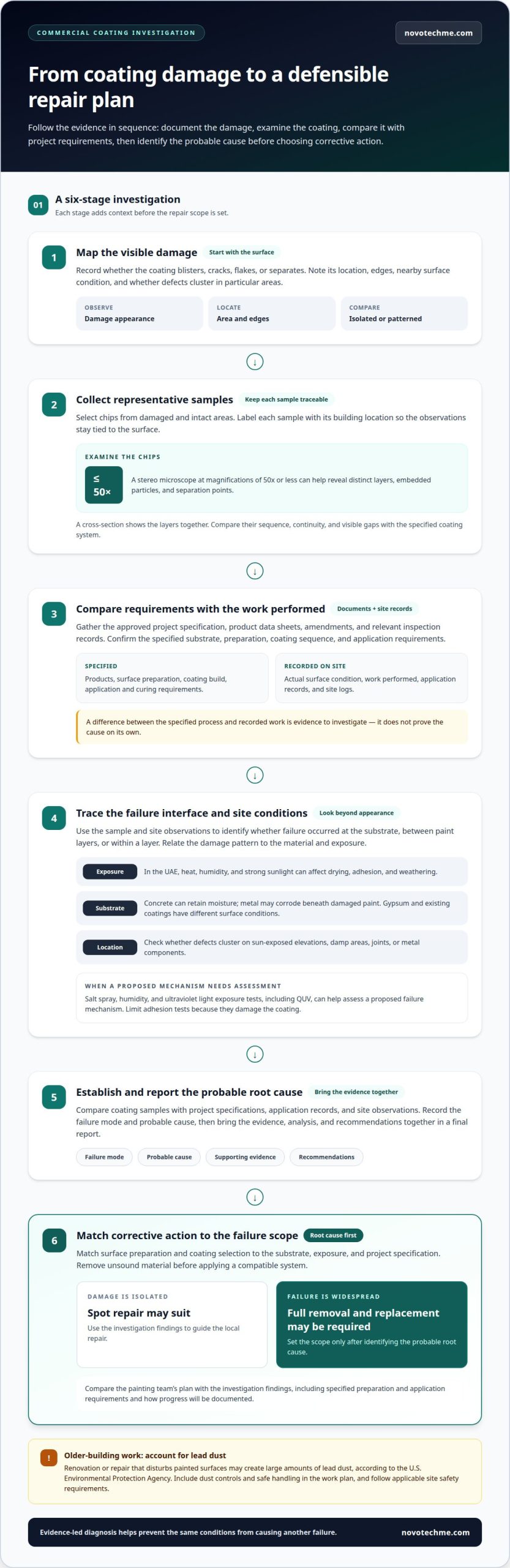
Start by asking what the coating was meant to do. Paint failure analysis for commercial properties reviews the project specifications, examines the failed coating, and maps the damage to identify the failure mode and probable cause. Establish the root cause before repairs so the same conditions do not lead to another failure.
Peeling, blistering, cracking, and corrosion can signal different problems, but appearance alone rarely reveals the full story. The specification, substrate condition, application records, and exposure conditions help distinguish inadequate preparation from a coating system that does not suit its environment.
This guide explains how to review specifications, inspect failed coatings, and interpret the location and pattern of damage. It also covers when laboratory exposure tests can help assess a proposed failure mechanism and how to use the findings to plan corrective action.
Key Takeaways
- Compare the project specification and product data sheets with application records and site conditions to identify where requirements may have diverged.
- Inspect coating damage across the surface, then examine representative chips under a stereo microscope at magnifications of 50x or less.
- Map where failures occur and compare their appearance to distinguish isolated defects from patterns that may point to a broader cause.
- Determine the probable root cause before recommending spot repairs or full coating removal and replacement.
Failure causes and corrective action recommendations
Connect the failed coating to its likely cause before choosing repairs. In Dubai, climate exposure, substrate condition, application records, and relevant testing all help inform corrective action.
-
Investigate Coating Failure Root Causes
Trace the defect to the layer where adhesion or cohesion failed. Compare coating samples with project specifications, application records, and site observations: a break at the substrate may have a different cause from separation between paint layers. Record the failure mode and probable cause, then bring the evidence, analysis, and recommendations together in a final report. Salt spray, humidity, and ultraviolet light exposure tests, including QUV, can help assess a proposed mechanism. Limit adhesion tests because they damage the coating.
-
Assess Climate and Building Material Effects
Compare the damaged area’s exposure with its substrate and coating system. In the UAE, heat, humidity, and strong sunlight can affect how a coating dries, adheres, and weathers. Concrete can retain moisture, while metal may corrode beneath damaged paint; gypsum and existing coatings have different surface conditions. Check whether defects cluster on sun-exposed elevations, damp areas, joints, or metal components. The pattern can help distinguish environmental stress from preparation or coating compatibility problems.
-
Recommend Prevention and Contractor Selection
Set corrective actions only after identifying the probable root cause; otherwise, the same conditions may cause another failure. Match surface preparation and coating selection to the substrate, exposure, and project specification, and remove unsound material before applying a compatible system. Ask the painting team to explain how the work will meet the specified preparation and application requirements and how progress will be documented. Compare the plan with the investigation findings, not just the visible defect. Isolated damage may suit a spot repair; widespread failure may require full removal and replacement.
Macroscopic and microscopic examination of failed coatings
Begin with the visible damage, then use samples to investigate layer condition and coating performance. Before recommending repairs, compare observations with the project specification and product data sheet.
-
Examine Failed Coatings
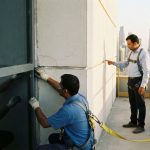
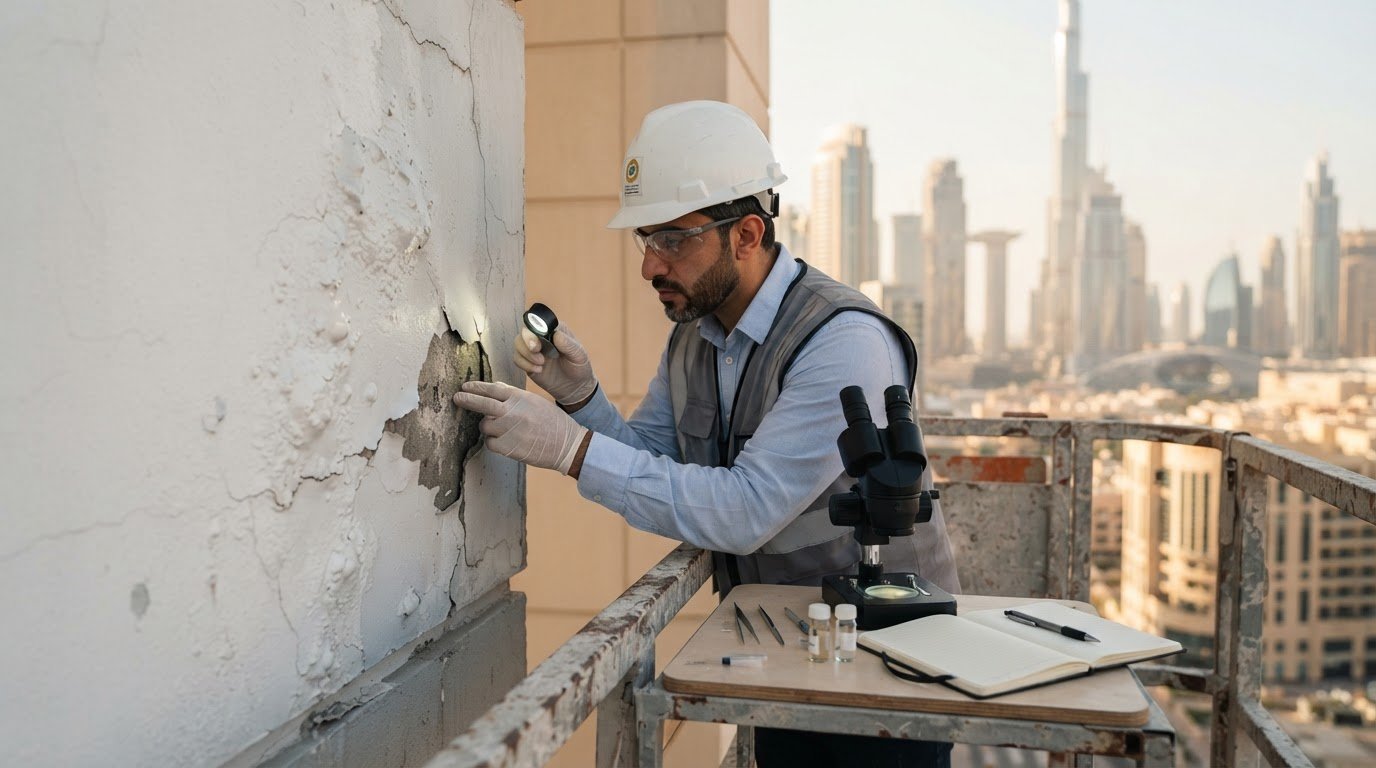
Map the defect before removing material. Record whether the coating blisters, cracks, flakes, or separates, and note its location, edges, and nearby surface condition. A stereo microscope can examine paint and coating chips at magnifications of 50x or less. Inspect chip faces for distinct layers, embedded particles, or separation points. Choose representative samples from damaged and intact areas, and label each sample with its location so observations remain tied to the building.
-
Analyze Coating Cross-Sections
Prepare a cross-section from a representative chip to see the coating layers together. Compare their sequence, continuity, and visible gaps with the specified system and product data sheet. This can show whether separation occurred at the substrate, between coats, or within a layer. Check the specification for surface preparation and coating build requirements, then compare them with the sample. Measure thickness at appropriate locations and record the method and results; a single reading does not prove coverage is uniform.
-
Measure Coating Thickness
Use thickness readings alongside the cross-section and specification, not as a stand-alone diagnosis. The required coating build depends on the specified system and substrate, so compare measurements with the project documents. For commercial repainting, follow the specified preparation and application requirements, and document deviations before choosing a repair. Repair costs do not follow a fixed ratio: a spot repair may address local defects, while widespread failure may require full removal and replacement. Inspection and analysis costs depend on access, sampling, testing, and reporting scope; pricing is provided after a quote request.
For older buildings, renovation or repair that disturbs painted surfaces may create large amounts of lead dust, according to the U.S. Environmental Protection Agency. Include dust controls and safe handling in the work plan, and follow applicable site safety requirements. For a project that needs corrective coating work, explore commercial painting solutions.
Reviewing project specifications and product data sheets
Compare the intended coating system with the materials, application records, and conditions documented on site. This helps establish whether the failure relates to a specification mismatch, an application deviation, or another cause.
- Gather the approved project specification, product data sheets, amendments, and relevant inspection records. Confirm the specified substrate, surface preparation, coating sequence, and application requirements. Match each product named in the specification to its data sheet; similar descriptions do not mean two coatings are interchangeable. Note document revisions so the investigation uses the requirements that applied to the work.
- Trace each coating requirement through the project documents. Check whether the specified system suits the substrate and exposure at the failed location. Compare preparation instructions with records of the actual surface condition and work performed, then review application and curing requirements against site logs. A difference between the specified process and recorded work is evidence to investigate, but does not prove the cause on its own.
- Build a chronology from dated work records, inspection notes, photographs, and correspondence. Link each entry to the area coated, product applied, preparation completed, and any recorded interruption or rework. For example, compare a peeling wall’s location with the preparation and coating sequence documented for that elevation. Flag missing entries and conflicting descriptions; do not assume undocumented work followed the specification.
- Organize evidence by location and defect type, and link each item to its source. Label sample records, photographs, inspection findings, and relevant correspondence so observations can be traced to the affected surface. Compare intact and failed areas against the same specifications and application records. Separate direct observations, such as visible cracking, from interpretations about cause. A clear evidence trail supports reasoned conclusions and practical recommendations.
Identifying failure patterns
Map defects across the building before drawing conclusions. Their location, shape, and distribution can help distinguish isolated damage from a pattern affecting a wider coating system.
- Mark defect locations on a building elevation plan, then photograph each area from a consistent viewpoint. Note whether damage appears near joints, openings, roof edges, or ground level. Peeling concentrated around window edges, for example, differs from defects spread across an entire elevation. A location map helps compare affected surfaces with exposure, substrate, and documented application areas.
- Classify visible defects by type, such as blistering, cracking, flaking, or corrosion staining. Note whether each has sharp boundaries or fades gradually into intact paint. Blisters clustered in a damp area suggest a different investigation path from fine cracking across several elevations. Record observations separately from interpretations so the pattern is not mistaken for a confirmed cause.
- Compare affected areas with nearby surfaces that remain sound. Check whether they share the same substrate, coating sequence, exposure, and construction detail. If failures follow a concrete repair line but not the adjacent concrete, record the boundary and compare the relevant project documents. If corrosion staining appears around metal fixings, inspect nearby coating breaks and substrate interfaces before defining the affected area.
- Assess whether the failure is isolated or repeated across the building. Spot repairs may address isolated coating failures, while failures observed throughout may require full removal and replacement. Use the distribution, condition of surrounding paint, and investigation findings to define the repair scope. Don’t treat a single damaged patch as representative of every elevation. For a corrective repainting plan, discuss your building’s coating needs with NovoTech.
NovoTech: Exterior Building Painting Services
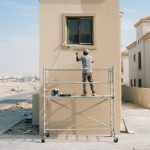
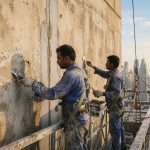
NovoTech provides Exterior Building Painting Services for commercial properties that need corrective repainting after a coating failure investigation. This service suits a defined repair scope, from preparing and repainting affected exterior surfaces to renewing a broader coating system.
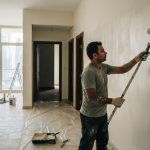
When planning the project, share the investigation findings, relevant specifications, and areas requiring attention. This helps align the painting work with the diagnosed cause and the building’s needs. For interior surfaces, NovoTech also provides Interior Painting Solutions. Other relevant services include Villa Painting & Exterior Finishes and Epoxy Floor Painting & Coatings.
Contact NovoTech to discuss your commercial building’s exterior painting requirements.
Move From Diagnosis to a Defined Project
A coating investigation can guide more than the immediate repair. Use the findings to define a clear project scope, document affected surfaces, and align future maintenance decisions with the building’s needs. This makes paint failure analysis for commercial properties a practical basis for planning, not just a record of defects.
When repainting is the next step, NovoTech offers Exterior Building Painting Services, Interior Painting Solutions, and Villa Painting & Exterior Finishes. The right service depends on the surfaces and project scope identified in the investigation.
Share the relevant findings and discuss the painting work required for your property. Contact NovoTech about paint failure and take the next step toward a well-defined project.
Frequently Asked Questions
What was supposed to be done?
The approved project scope defines what the coating work was intended to achieve. It should identify the substrate, preparation requirements, coating system, application sequence, and inspection criteria. For example, if the specification calls for a protective system over prepared metal, compare that requirement with the actual surface and recorded products. This helps establish whether the failure may relate to the system’s design or to how the work was carried out.
What is paint failure analysis for commercial properties?
Paint failure analysis is a structured investigation into how and why a commercial building’s coating failed. It connects visible defects with project requirements, site conditions, application history, and physical sample findings. The aim is to establish a probable failure mechanism and guide a suitable repair scope. For example, it can help distinguish a localized coating defect from a broader problem affecting several areas of a building.
What are the common causes of commercial paint failure, such as peeling, blistering, cracking, and fading?
These defects can result from poor adhesion, trapped moisture, incompatible coating layers, unsuitable surface preparation, or weather exposure. Peeling often indicates separation from the surface or another coat; blistering can point to pressure or moisture beneath the film. Cracking may develop as coatings lose flexibility or move with the substrate, while fading can follow prolonged sunlight exposure. Consider each symptom alongside its location and surrounding conditions before assigning a cause.
How do professionals diagnose paint failure in commercial buildings?
A thorough assessment documents defect locations, compares affected areas with intact surfaces, and reviews project specifications and application records. Representative coating samples can reveal layer separation or other physical evidence, which is then considered alongside building exposure and substrate condition. The final assessment separates direct observations from interpretations, states the probable failure mode, and ties corrective recommendations to the evidence rather than appearance alone.
What tests are used in commercial paint failure analysis, including adhesion, moisture, and coating thickness tests?
Testing may include adhesion checks, substrate moisture assessment, and coating thickness measurements, selected to answer specific questions. Adhesion testing damages the coating, so limit test locations and document each one. Compare thickness readings with the project specification rather than treating a measurement as a stand-alone diagnosis. Salt spray, humidity, and ultraviolet light exposure tests, including QUV, can help assess a proposed failure mechanism.
What are the steps for repairing paint failure on commercial buildings?
First define the repair area and address the condition responsible for the failure. Remove unsound coating, prepare the exposed substrate, and correct relevant surface defects before applying a compatible system that meets project requirements. Document the completed preparation and application for future maintenance records. An isolated defect may need a localized repair, while widespread failure may call for broader removal and replacement.