In the UAE’s aggressive coastal environment, concrete protection is not a cosmetic upgrade; it is a critical form of structural insurance. We understand that the combination of extreme UV exposure, high humidity, and airborne chlorides creates a relentless assault on building envelopes. These conditions often lead to premature rebar corrosion and costly spalling that compromise long-term asset value. You need a solution that goes beyond standard paint to ensure structural stability against these environmental pressures.
This guide explores how a specialized concrete protection coating UAE system can mitigate these risks and secure your infrastructure against carbonation. By utilizing advanced protective painting systems, you can extend the lifespan of your building and comply with rigorous local standards such as the 2026 RTA and Dubai Municipality specifications. We will examine the strategic shift toward high-performance materials and cool roof coatings that align with the UAE Net Zero 2050 vision. You will discover how technical precision in coating application reduces maintenance costs while maintaining the highest safety standards for high-rise developments and commercial villas alike.
Key Takeaways
- Understand how the UAE’s extreme UV index and salinity drive chemical ingress, necessitating specialized barriers to prevent structural decay.
- Identify the technical distinctions between anti-carbonation systems for high-rise facades and heavy-duty epoxy solutions for industrial environments.
- Learn why a high-performance concrete protection coating UAE offers superior dry film thickness and crack-bridging capabilities compared to standard exterior paints.
- Discover the essential stages of a professional application process, including substrate pull-off tests and rigorous mechanical surface preparation.
- Explore how leveraging authorized application expertise ensures building longevity and full compliance with regional maintenance regulations.
The Science of Concrete Decay in the UAE Climate
Concrete is often perceived as an indestructible material, yet its porous nature makes it highly vulnerable to rapid deterioration in the Gulf region. A high-performance concrete protection coating UAE system acts as a sophisticated technical barrier designed to prevent the ingress of water, carbon dioxide, and chloride ions. Without this specialized shield, the structural integrity of a building faces a constant countdown. The UAE’s unique combination of high UV radiation and fluctuating humidity levels accelerates the internal chemical reactions that lead to failure. We see this most prominently in the “Coastal Effect,” where airborne salts from the Arabian Gulf settle on surfaces and penetrate deep into the concrete matrix, initiating a cycle of decay that is difficult to reverse without professional intervention.
Thermal Stress and Micro-Cracking
Summer surface temperatures in the UAE frequently surpass 50°C, causing significant volumetric changes in concrete elements. This constant expansion and contraction lead to the formation of micro-cracks, which serve as direct conduits for moisture and aggressive contaminants. Thermal fatigue in concrete structures is defined as the progressive structural damage that occurs when a material is subjected to cyclic thermal loading. These cracks may be invisible to the naked eye initially, but they represent the first stage of structural compromise. It’s why elastic, crack-bridging coatings are essential for maintaining a sealed envelope that moves with the building’s thermal cycles.
High Salinity and Chloride Attack
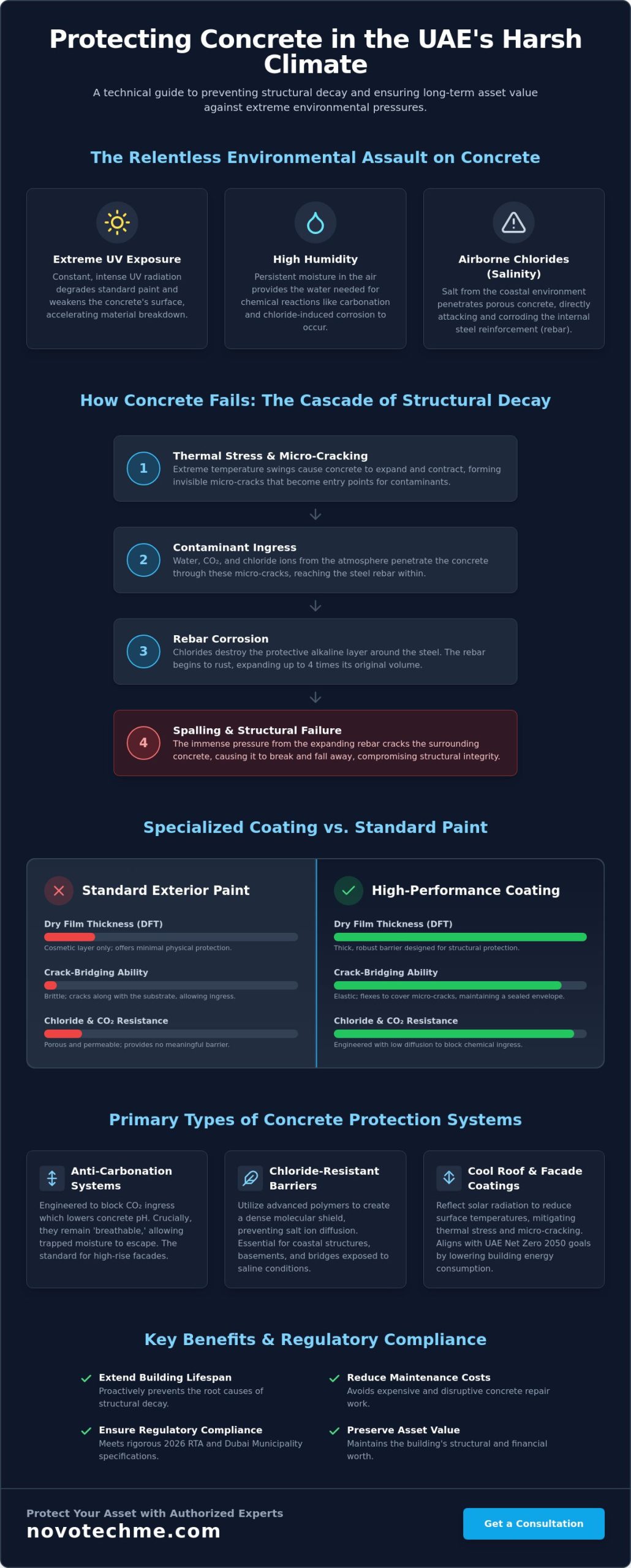
For properties in Dubai and across the Emirates, chloride ion diffusion stands as the primary catalyst for premature structural failure. When salts penetrate the concrete, they trigger an electrochemical process that destroys the protective passive layer around the reinforcement steel. As the rebar corrodes, it expands up to four times its original volume, exerting internal pressure that causes the surrounding concrete to crack and eventually fall away. This process is known as spalling. Research into the causes of concrete degradation highlights that coastal buildings require significantly higher-grade protective barriers than inland structures. These systems must provide a low diffusion coefficient to effectively block salt penetration and preserve the internal steel reinforcement for the building’s intended lifecycle.
To mitigate these risks, we utilize advanced concrete protection coating UAE solutions that are specifically formulated for high-salinity environments. These systems don’t just sit on the surface; they bond with the substrate to create an impermeable shield. By addressing the electrochemical root of corrosion, we ensure that the structural core remains dry and alkaline, preventing the onset of carbonation and chloride-induced decay before they require expensive remedial work.
Primary Types of Concrete Protection Coatings
Selecting the correct protective system depends on the specific environmental stresses a structure faces. A comprehensive concrete protection coating UAE strategy involves a tiered approach, utilizing different chemistries for facades, foundations, and high-traffic surfaces. We categorize these systems based on their chemical composition and their ability to mitigate specific forms of ingress, ensuring that each building component receives targeted protection.
Anti-Carbonation Systems
These coatings are engineered to block carbon dioxide from penetrating the concrete matrix. CO2 lowers the pH of concrete, which compromises the alkaline environment that naturally protects steel reinforcement. Effective systems must provide high CO2 diffusion resistance while remaining vapor permeable. This ‘breathability’ allows internal moisture to escape without causing the coating to blister or delaminate. For large-scale projects, integrating these into exterior building painting dubai ensures both aesthetic uniformity and long-term structural health. These systems are the standard for high-rise facades where exposure to atmospheric pollutants is constant.
Chloride-Resistant Barriers
In coastal regions, blocking salt ions is the priority. These barriers often utilize advanced polymers that create a dense molecular structure, preventing chloride diffusion. They’re essential for bridges, basements, and coastal villas where salt spray or saline groundwater is a persistent threat. Utilizing these specialized systems often works in tandem with anti-corrosive paint uae to provide a dual-layer defense for both the concrete and any exposed metallic components. Academic research on concrete for the UAE climate continues to refine how these materials interact with local environmental stressors, reinforcing the need for technically precise application.
Beyond facades and coastal barriers, other specialized systems serve critical roles in infrastructure maintenance:
- Epoxy and Polyurethane Systems: These are the preferred choice for heavy-duty industrial floors. Epoxy provides exceptional chemical resistance and compressive strength, while polyurethane offers superior UV stability and flexibility for outdoor parking decks.
- Silane-Siloxane Water Repellents: These penetrative treatments line the pores of the concrete to create a hydrophobic surface. They provide invisible, breathable protection that is ideal for natural stone finishes or architectural concrete where the original appearance must be preserved.
- Cementitious Coatings: Best suited for water tanks and underground structures, these polymer-modified coatings can withstand significant hydrostatic pressure, ensuring that foundations remain dry and secure.
If you’re managing a commercial asset, consulting with a technical coating partner can help determine the optimal system for your specific site conditions. Matching the chemistry of the coating to the specific decay mechanism of the site is the only way to guarantee structural longevity.
Why Standard Exterior Paint Fails UAE Structures
Many property managers mistake a fresh coat of decorative paint for structural protection. While standard exterior paint provides aesthetic value, it lacks the technical properties required to shield concrete from the aggressive UAE environment. The primary difference lies in the Dry Film Thickness (DFT). A typical decorative paint might achieve a DFT of 50 to 100 microns, whereas a professional concrete protection coating UAE system is applied at much higher thicknesses, often exceeding 300 microns. This additional mass isn’t just for show; it provides the necessary density to block carbon dioxide and moisture ingress over long durations.
Lifespan expectations also vary significantly between these two categories. In the extreme heat of the Emirates, standard paints often begin to degrade within 3 to 5 years, requiring frequent re-application. High-performance protective coatings are designed for a service life of 10 years or more. For commercial assets, this significantly lowers the Total Cost of Ownership (TCO). By investing in a robust protective system early, you reduce the frequency of maintenance cycles and, more importantly, prevent the underlying structural decay that leads to expensive concrete repairs.
The Myth of Aesthetic Protection
A building that looks “new” isn’t necessarily a building that’s safe. Standard paints are highly susceptible to “chalking,” a process where UV radiation breaks down the binder at the surface, leaving a powdery residue. Once the binder fails, the paint becomes porous, allowing water and salts to reach the substrate. While standard paints are essentially rigid and brittle once cured, high-performance protective coatings are engineered with elastic properties that accommodate the structural shifts common in the Emirates. This elasticity is what separates a mere finish from a functional barrier.
Crack-Bridging Ability (CBA)
Thermal expansion in the UAE is a daily reality. As structures expand in 50°C heat and contract at night, static micro-cracks often become dynamic. Standard paint will crack along with the concrete, opening a direct path for chloride attack. Crack-Bridging Ability (CBA) is the technical measure of a coating’s capacity to remain intact and waterproof even when the concrete underneath experiences movement. Specialized coatings can bridge cracks up to 2mm wide, maintaining a continuous, impermeable seal. This capability is vital for ensuring that moisture never reaches the reinforcement steel, effectively stopping the cycle of corrosion before it starts.
Selecting and Applying the Right Coating System
The success of a concrete protection coating UAE project depends on a rigorous, methodical application process. We view the application not as a single event, but as a technical lifecycle that begins long before the first liter of material is opened. Achieving a bond that withstands 50°C thermal cycles requires a five-step engineering approach:
- Substrate Analysis: We conduct pull-off tests to verify the concrete’s tensile strength. If the surface is weak or contaminated, the coating will fail regardless of its quality.
- Mechanical Preparation: High-pressure washing or abrasive blasting is used to remove the “laitance”—the weak, friable layer of cement and sand on the surface.
- Structural Repair: Existing cracks are treated with compatible fillers that match the elasticity of the final coating system.
- Technical Priming: A dedicated primer seals the concrete pores and creates a mechanical key for the subsequent layers.
- Precision Application: A multi-coat system is applied to reach the manufacturer-specified Dry Film Thickness (DFT), ensuring a continuous, pinhole-free barrier.
The Critical Role of Surface Preparation
Industry data confirms that 80% of coating failures are the direct result of poor surface preparation. In the UAE’s dusty environment, even a thin layer of fine sand can prevent a coating from bonding. Removing oils, salts, and laitance is non-negotiable for structural longevity. For projects involving older structures with active water ingress, we often collaborate with specialized waterproofing companies in dubai to ensure the substrate is dry and stable before the protective system is applied. A clean, profiled surface is the only way to guarantee the 10-year service life expected of professional systems.
Environmental Constraints During Application
The UAE climate dictates a strict application window. Applying coatings in the direct midday summer sun causes “flash drying,” which leads to solvent entrapment and surface blistering. Conversely, night-time applications must account for the “Dew Point.” The surface temperature should be at least 3°C above the dew point to prevent condensation from forming between coats, which would compromise inter-coat adhesion. Our on-site quality control teams utilize digital hygrometers and infrared thermometers to monitor these parameters in real-time. This precision ensures that the concrete protection coating UAE cures correctly, forming the dense, impermeable shield your structure requires.
For large-scale infrastructure or commercial assets, we recommend a technical consultation for protective painting systems to align the application schedule with your project’s specific environmental constraints.
NovoTech: Authorized Terraco Applicators in the UAE
NovoTech has spent three decades refining the standards for structural preservation in the Gulf. Our 30-year legacy in the UAE protective coating market allows us to approach complex projects with a level of technical depth that few can match. We don’t view a project as a simple service delivery; we see it as an exercise in “Integrated Excellence,” where material science, site-specific engineering, and precision application converge. This holistic approach is why we’re trusted with both iconic high-rise building painting and the protection of private residential assets. Our role as a technology integrator means we handle the end-to-end responsibility of the project, ensuring that the final result aligns with your strategic business goals.
Authorized status as Terraco Application Specialists is a core pillar of our service model. In a market where standard materials often fail, we leverage Terraco’s specialized anti-carbonation systems to provide a durable shield against the environmental stressors discussed earlier. Our expertise ensures that every concrete protection coating UAE project we undertake meets the highest international and local performance standards. We act as a collaborative ally to our clients, providing the technical justification and operational history needed to secure large-scale infrastructure.
Why Terraco Systems for the Middle East?
Terraco has built a global reputation for climate-specific engineering, creating products that are specifically formulated to withstand the Middle East’s high-alkalinity and UV-heavy conditions. Systems like Terracrete and Flexicoat represent the pinnacle of this research, offering exceptional durability and aesthetic versatility. For residential owners, these systems provide a level of protection that far exceeds conventional finishes. We frequently apply these advanced technologies through our villa painting services sharjah, ensuring that luxury homes maintain their structural integrity and visual appeal despite the aggressive coastal salinity.
Expert Application and Quality Assurance
Even the most advanced chemical formulation is only as effective as its application. As an authorized applicator, NovoTech’s teams undergo rigorous, ongoing training to master the specific handling and layering requirements of Terraco’s protective systems. This commitment to technical precision allows us to offer long-term warranties that give property managers and developers total peace of mind. We maintain strict on-site quality control, documenting every stage of the process from initial pull-off tests to final DFT verification. This transparency is the hallmark of a dependable strategic partner who understands that structural longevity is a non-negotiable requirement.
If your asset requires a professional-grade barrier against carbonation and chloride attack, our team is ready to provide a detailed assessment. Contact NovoTech for a structural coating consultation to ensure the long-term longevity of your infrastructure.
Securing Structural Integrity for the Next Decade
Securing structural longevity in the Middle East requires a shift from reactive maintenance to proactive engineering. We’ve established how the “Coastal Effect” and extreme thermal cycles necessitate specialized anti-carbonation and chloride-resistant barriers that standard paints simply can’t provide. By selecting a high-performance concrete protection coating UAE system, you aren’t just improving aesthetics; you’re ensuring the fundamental stability of your asset against the relentless assault of heat and salinity.
As an Authorized Terraco Applicator with over 30 years of experience in the region, NovoTech brings integrated excellence to every project. Whether you’re managing a high-rise commercial tower or a luxury private villa, our technical depth ensures that your structure complies with evolving safety standards while minimizing long-term repair costs. We remain committed to handling large-scale, complex projects with the precision and operational reliability your investment deserves.
The path to a resilient building starts with an expert assessment of your substrate and environmental exposure. Take the first step toward safeguarding your property’s structural future today. Request a Technical Consultation for Your Building’s Protection
Frequently Asked Questions
What is the difference between concrete paint and concrete protection coating?
Concrete paint is a decorative finish whereas a concrete protection coating UAE system is a functional barrier engineered for structural preservation. Coatings possess a much higher Dry Film Thickness (DFT) and elastomeric properties that enable crack-bridging. While standard paint only changes the surface color, protective coatings actively block the ingress of carbon dioxide and chlorides to prevent rebar corrosion.
How often should concrete protection coatings be reapplied in the UAE?
High-performance protective systems generally offer a service life of 10 to 15 years before requiring a technical re-evaluation. This durability far exceeds standard exterior paints, which typically degrade within 3 to 5 years under the UAE’s intense UV radiation. The exact interval depends on the building’s proximity to the coast and the specific chemical exposure of the site.
Can protective coatings stop existing concrete carbonation?
Protective coatings halt the progression of carbonation by creating an impermeable shield against further carbon dioxide ingress. They cannot reverse chemical changes that have already occurred within the concrete matrix. If carbonation has already reached the reinforcement steel, professional remedial repairs must be completed before the protective coating is applied to seal the structure.
Is concrete protection coating necessary for inland desert structures?
Protective coatings are vital for inland structures to mitigate the effects of carbonation and extreme thermal expansion. Even without high salt concentrations, desert buildings face surface temperatures exceeding 50°C, which leads to micro-cracking. A specialized concrete protection coating UAE system bridges these cracks and prevents atmospheric pollutants from compromising the structural core.
What are the best anti-carbonation coatings for high-rise buildings in Dubai?
Specialized elastomeric systems from manufacturers like Terraco are considered the regional benchmark for high-rise facade protection. These systems are specifically engineered to provide high CO2 diffusion resistance while maintaining vapor permeability. Utilizing these technical coatings ensures the building envelope remains breathable while meeting the stringent durability requirements of Dubai Municipality.
How much does concrete protection coating cost per square meter in the UAE?
The investment per square meter depends on the substrate’s current condition and the complexity of the required surface preparation. Factors such as the building’s height, accessibility requirements, and the specific protective chemistry chosen will influence the total project cost. A technical site survey is the most reliable way to determine a precise budget for your structural protection needs.
Does concrete coating help with energy efficiency in buildings?
Reflective protective coatings can significantly enhance energy efficiency by increasing the building’s Solar Reflectance Index (SRI). These systems reduce the amount of thermal energy absorbed by the concrete walls and roof, which lowers the internal cooling load. This technical advantage helps property managers reduce electricity consumption while complying with regional green building standards.
Can I apply concrete protection coatings myself (DIY)?
Professional structural coatings are not suitable for DIY application because they require specialized mechanical surface preparation and precise environmental monitoring. Achieving a durable bond requires technical expertise in substrate pull-off testing and moisture content verification. Improper application often leads to delamination, which can mask ongoing structural decay and result in significantly higher long-term repair expenses.