A renovation quote can look precise while leaving part of the final cost uncertain. A provisional sum is an estimate for work that cannot yet be fully described or measured, so the amount may change once the actual scope and cost are established. Understanding provisional sums in a renovation quote means recognising that this allowance is not a fixed price.
It is reasonable to want a clear budget before work begins, especially when costs could change as details emerge. This guide explains why provisional sums appear in renovation quotes, what they cover and how they differ from prime cost items, which are allowances for specific items that have not yet been selected.
You will also see how an overrun affects the total budget and why the allowance’s assumptions, inclusions and adjustment method matter. With these distinctions clear, you can assess a quote more accurately and identify where its final cost remains uncertain.
Key Takeaways
- Treat provisional sums as estimates, not fixed prices; the final amount depends on the work actually required.
- Clarify each allowance’s scope, assumed quantities, inclusions and adjustment method so you can see what may change.
- Distinguish work allowances from prime cost allowances for unselected items, and assess each against the right scope.
- Track allowance changes against your overall renovation budget, and consider NovoTech’s renovation and building maintenance services when planning project work.
Why is a quote with many provisional sums riskier?
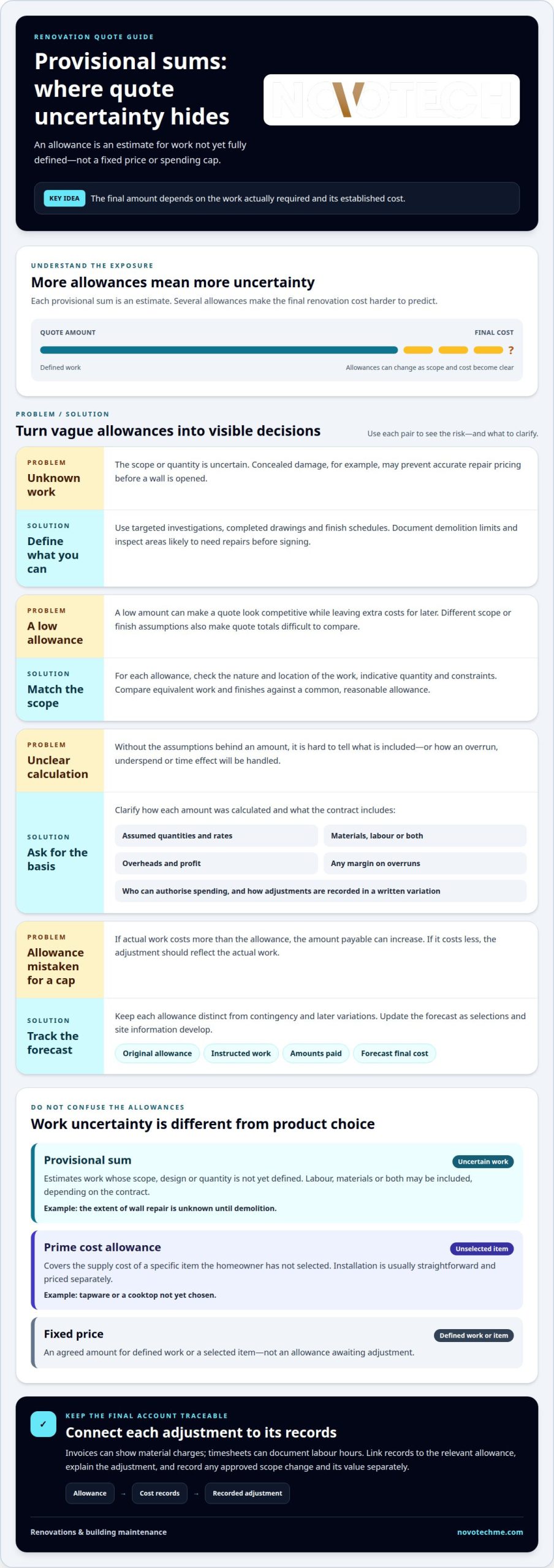
Each provisional sum is an estimate, not a fixed price. Several allowances therefore increase uncertainty about the final cost.
Allowances for Unknown Work and Unselected Items
A provisional sum covers work whose scope or quantity remains uncertain, while an item allowance may cover something not yet selected. For example, concealed damage can prevent accurate repair pricing before a wall is opened. An allowance for unselected finishes also depends on the eventual specification. In both cases, the actual cost may differ from the quoted amount and affect the budget.
Matching Allowances to Scope and Finish
A useful allowance describes the work’s nature, location, indicative quantity and constraints. Compare these details with your intended scope and finish: a flooring allowance should reflect the areas included and the specified finish level. A low allowance can make a quote appear competitive while leaving you exposed to extra costs later. Comparing quotes based on the same scope and finish assumptions is more meaningful.
To compare provisional sums across renovation quotes, list each allowance, match equivalent work, and compare inclusions and exclusions. Then assess each quote against a common, reasonable allowance. A lower total may simply reflect thinner allowances, not a lower cost for equivalent work.
Before signing, ask how each amount was calculated, including assumed quantities and rates. Clarify whether it covers materials, labour or both, and whether overheads and profit are included. Ask whether a margin applies to overruns, who can authorise spending, and how underspend, additional costs and time effects are recorded in a written variation.
Targeted investigations, completed drawings and finish schedules can reduce uncertainty before signing the contract. For example, documenting demolition limits and inspecting areas likely to need repairs can help define the work. Pre-construction documents should explain each allowance’s scope, assumptions, exclusions and adjustment method. As specifications develop, confirm quantities promptly so updated costs can inform decisions before work proceeds.
How are provisional sums different from prime cost items?
The key distinction is what remains uncertain in the construction contract. A provisional sum estimates work whose scope, design or quantity is not yet defined. A prime cost allowance covers a specific item the homeowner has not selected, such as a tap or cooktop. One concerns work; the other concerns a product choice.
For a provisional sum, labour, materials or both may form part of the estimate, depending on the contract. For a prime cost item, the supply cost is uncertain, while installation is usually straightforward and priced separately. A quote should label each allowance clearly so its calculation basis is visible before signing.
Consider a bathroom renovation. If the exact tapware is undecided, its supply can be listed under a prime cost allowance. If the extent of wall repair remains unknown until demolition, that work may need a provisional sum. A fixed price is different: it applies to defined work or selected items at an agreed amount, rather than an allowance awaiting adjustment.
Both allowances are reconciled against actual costs later. If a selected item costs less than its prime cost allowance, the difference is deducted; if it costs more, the client pays the difference. Provisional-sum work is adjusted when its scope and actual cost are established. Contract terms determine how any agreed margin or related costs are treated.
Cost records make these adjustments traceable. For completed work, invoices can show material charges, while timesheets document labour hours. The final account should link those records to the relevant allowance and explain any adjustment. If a variation changes the scope, recording its approval and value separately helps distinguish the change from the original estimate.
Before signing, identify whether each line covers a selected item or uncertain work, and how installation is priced. This distinction makes the contract easier to interpret and prevents an allowance from being mistaken for a fixed price.
How provisional sum overruns affect renovation budgets
An overrun occurs when the actual cost exceeds an allowance for work, increasing the amount payable under the contract. Its impact depends on the scope, supplies, labour, any agreed margin, and changes to selections or site conditions.
Contingency for Provisional Sum Overruns
A contingency is a separate reserve for project changes and cost uncertainty, not another provisional sum. Keep it distinct from allowances and later variations to avoid counting the same cost twice. For UAE renovations, record in the signed contract how allowances are adjusted, overruns approved and contingency managed. This makes the forecast easier to update as actual costs emerge.
Budget Risks and Common Mistakes
Budget risk rises when a quote relies on numerous or low provisional sums: its headline figure may exclude work that is ultimately required. Calculate each allowance from the defined scope, assumed quantities and applicable rates, then state what it includes. For UAE projects, the contract should explain how actual costs replace the estimate and how any agreed margin applies. Separate supply, labour and related costs to make comparisons meaningful.
A common mistake is treating an allowance as a spending cap. If concealed damage requires additional repair, the final cost can exceed the original figure; if the work costs less, the contract adjustment should reflect the actual work. Record each allowance separately from client contingency and later variations so one change does not disappear inside another budget line.
As selections and site information develop, update the forecast promptly. Track the original allowance, instructed work, amounts paid and forecast final cost. This makes the effect of each decision visible and helps distinguish a genuine scope change from an overrun on existing work.
Why renovation quotes include provisional sums
Renovation quotes use provisional sums when the design, scope or quantity of work cannot yet be defined. They allow a quote to account for expected work without presenting an uncertain amount as a fixed price. The allowance is a placeholder, not the actual cost, and is based on stated assumptions.
For homeowners, understanding provisional sums in a renovation quote starts with identifying why uncertainty exists. Before a wall is opened, hidden damage may prevent accurate repair pricing. An allowance can cover anticipated work, then be adjusted when the exposed area makes its extent measurable.
Design information also affects whether work can be priced accurately. A plan may show a new partition but leave its exact location or finish undefined. These details influence quantities, labour and materials. Completing drawings and schedules before signing can make more of the work defined and priced.
A useful allowance identifies the work’s nature and location, gives an indicative quantity, and notes constraints that affect planning. Its breakdown can distinguish expected labour from materials and explain what may change the amount. Without these details, it is harder to assess whether the estimate reflects the intended scope.
Provisional sums can cover unknown work or items not yet selected, but those uncertainties differ. A repair behind existing finishes depends on site conditions; an unselected finish depends on its eventual specification. Targeted investigations, specialist input and prompt design decisions can reduce uncertainty before work begins.
A practical approach to understanding provisional sums in a renovation quote is to identify what remains unknown, why it cannot yet be priced, and how the actual cost will be established. If drawings or inspections resolve the uncertainty, the work can be priced more precisely. Otherwise, a clear breakdown keeps the remaining risk visible in the renovation budget.
NovoTech: Renovations and Building Maintenance
NovoTech provides Renovations and Building Maintenance for projects where defining the work can help turn renovation plans into a practical scope. If your project includes interior or exterior painting, identifying the areas and finish requirements helps clarify what the quote covers. NovoTech also provides Interior Painting Solutions, Exterior Building Painting Services and Villa Painting & Exterior Finishes.
For a renovation involving these services, outline the areas, intended finishes and known repair requirements as a next step. This gives the project team a clearer basis for discussing the scope and planning the work. Contact NovoTech to discuss your renovation requirements.
Move from quote review to a clearer project plan
Use your quote review to shape a practical project brief. Record the intended outcome, confirmed decisions and remaining unknowns in one place. This gives everyone a shared reference as plans develop and keeps project discussions focused on the work that matters most to you.
A practical understanding of provisional sums in a renovation quote can guide your next planning conversation. Bring the brief, relevant drawings and finish preferences together so the proposed work can be discussed as a coordinated project rather than as disconnected tasks.
For renovation plans that include painting, NovoTech offers Exterior Building Painting Services, Interior Painting Solutions and Villa Painting & Exterior Finishes. These services can suit projects where the finish and work areas form part of the wider renovation plan.
Contact NovoTech about your renovation to discuss your project requirements. A clear brief is a strong starting point for moving ahead with confidence.
Frequently Asked Questions
What is a provisional sum?
A provisional sum is an estimated amount for work that cannot be precisely priced when the renovation contract is prepared. For example, a quote might include an allowance to repair flooring whose condition is hidden beneath existing finishes. The estimate gives the work a place in the budget, but the amount is reconciled once the required work and its cost are established.
Can my builder change the price of a provisional sum without my approval?
The contract’s adjustment and approval terms determine how a provisional sum changes. A cost difference may reflect the actual work required, but the quote should explain how it will be valued and recorded. For clarity, the contract can state who authorises spending, how the builder gives notice of a proposed increase, and how a variation is documented before additional work proceeds.
Does a provisional sum include the builder’s margin?
Not necessarily. The contract should state whether a margin is included in the allowance or applied to the actual cost later. For example, the final account might show the work cost separately from an agreed margin. Check how the contract treats both the original allowance and any amount above it, so you can understand the adjustment from the cost records.
How do provisional sums relate to contingency?
A provisional sum is an allowance within the contract for particular uncertain work; contingency is a separate budget reserve for project uncertainty. For example, a renovation budget might keep a reserve for unforeseen decisions rather than using it to disguise an undersized work allowance. Track them separately and update the forecast when a provisional item is valued or a scope change is approved.
Is it illegal for a builder to deliberately understate a provisional sum?
A low allowance alone does not establish deliberate deception or illegality. Relevant questions include what the builder knew, which assumptions supported the estimate, whether material limitations were disclosed, and what the contract says. In a Dubai renovation, preserve the quote, scope documents and written explanations. These records help distinguish genuine estimating uncertainty from a disputed representation. Obtain UAE legal advice for a specific dispute.
What happens when the work is instructed?
Once the work is instructed, the original allowance is removed from the account and replaced with the properly valued work, with related contract costs and programme effects recorded. For example, the project record can link the instruction to invoices, labour records and any agreed time impact. Formal variation documentation keeps the revised value traceable through payment and the updated budget forecast.