In the UAE’s aggressive climate, your building’s exterior paint isn’t just a decorative choice; it’s a sacrificial protective layer under constant chemical and thermal assault. We recognize that property owners often view surface wear as a minor aesthetic issue, yet ignoring the specific signs of paint failure on buildings UAE assets face can lead to structural compromise and rapid devaluation. With the implementation of Law No. (3) of 2026, maintaining exterior integrity is no longer optional. It’s a legal mandate that requires a sophisticated understanding of how extreme UV radiation and salt-air corrosion impact specialized technical coatings.
We understand the immense pressure of managing high-rise structures or luxury villas where sand abrasion and thermal-mechanical stress are daily realities. This technical guide promises to help you accurately diagnose early warning signs like chalking, blistering, and deep-seated cracking before they escalate into prohibitive restoration costs. We’ll provide a clear roadmap to protect your property from environmental stress, ensuring your asset remains compliant with the latest Dubai Civil Defense regulations and secures its mandatory Quality and Safety Certificate.
Key Takeaways
- Understand how thermal cycling and 50°C heat compromise polymer binders to accurately identify the early signs of paint failure on buildings UAE assets face.
- Learn to distinguish between cosmetic surface chalking and critical moisture-related issues like efflorescence that indicate a deeper structural crisis.
- Tailor your preservation strategy to your specific asset class, whether addressing wind loading on high-rises or irrigation-induced dampness on villa boundary walls.
- Implement the “70/30 Rule” of surface preparation and utilize high-performance anti-corrosive solutions to significantly extend the lifecycle of your exterior coatings.
- Align your maintenance cycles with Law No. (3) of 2026 requirements by leveraging manufacturer-backed application standards and professional building preservation expertise.
The Science of Paint Failure: Why UAE Climates Are Brutal on Facades
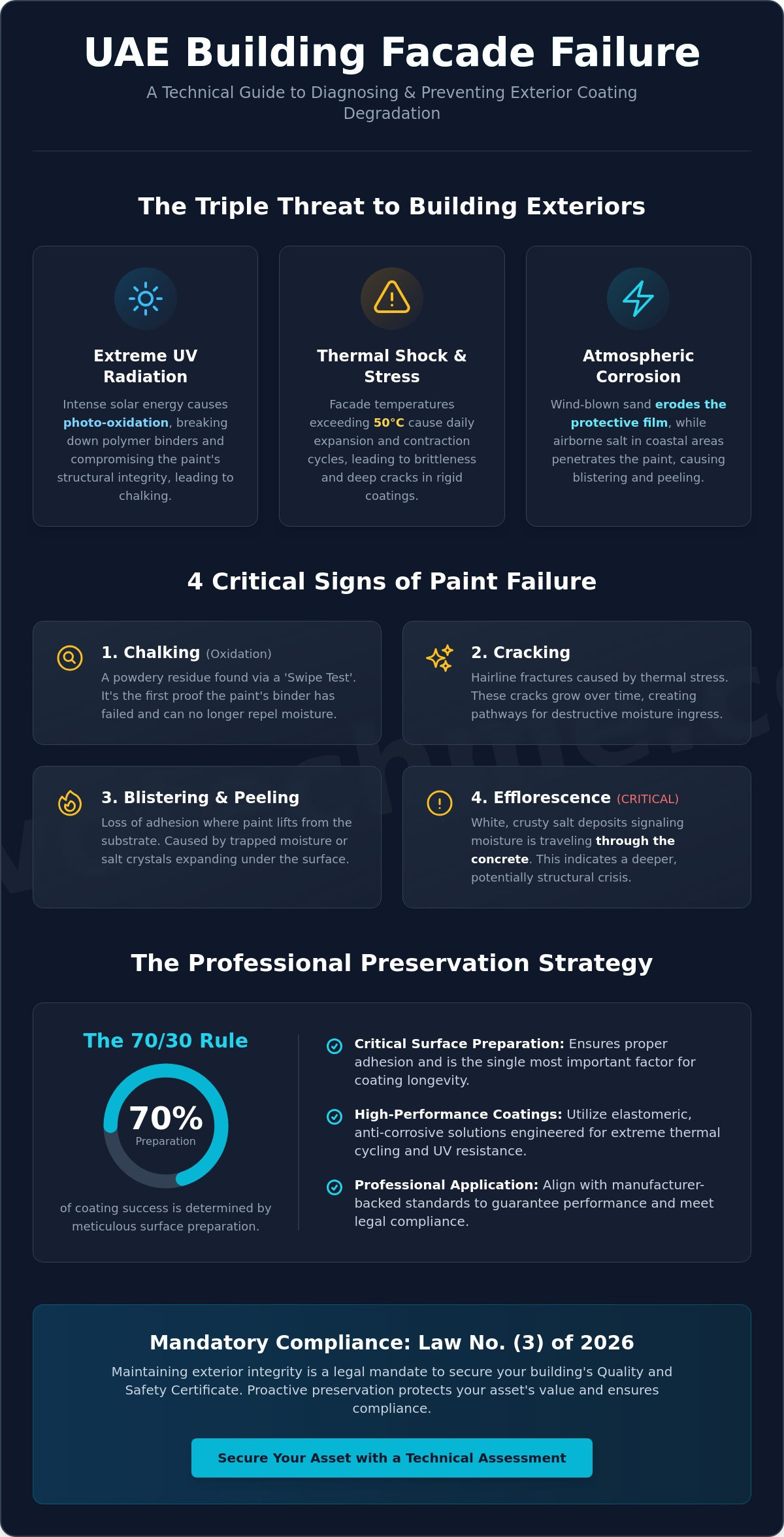
The UAE environment serves as an extreme laboratory for material degradation. For property managers and owners, understanding The Science of Paint Failure is the first step in protecting high-value assets. Unlike temperate regions, the Emirates subject building envelopes to a relentless combination of high-intensity solar energy, extreme temperature fluctuations, and abrasive atmospheric conditions. We’ve found that these factors don’t just age the paint; they fundamentally alter its chemical structure through a process that’s as much mechanical as it is chemical.
UV Radiation and Photo-Oxidation
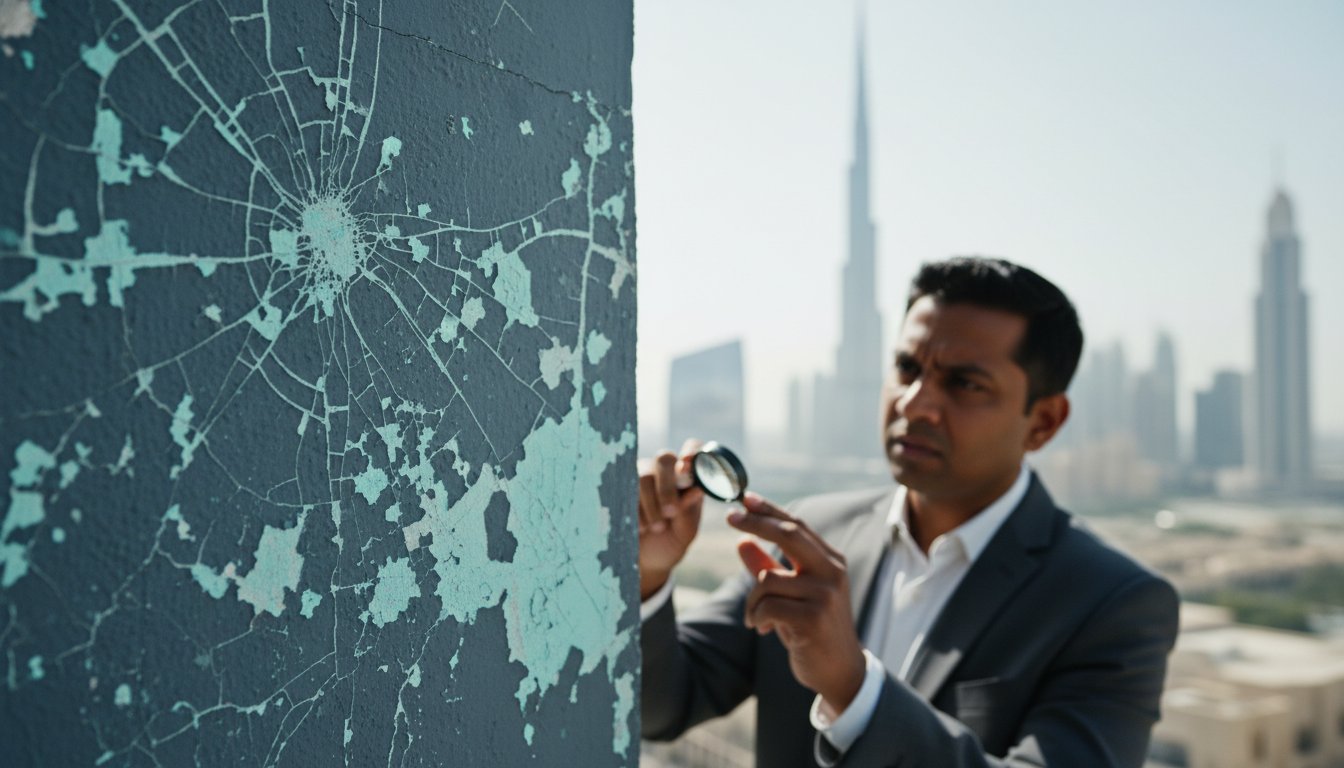
The sun’s intensity in the Gulf is among the highest globally. High-energy UV rays penetrate the paint film and strike the polymer binders that hold pigments in place. This process, known as photo-oxidation, systematically breaks the molecular bonds of the binder. As the binder degrades, it loses its ability to hold the pigment particles together. This leads to one of the most common signs of paint failure on buildings UAE owners encounter: chalking. You’ll notice this as a fine, powdery residue on the surface that wipes away easily. We’ve observed that south-facing facades in Dubai, which receive the most direct solar exposure, often show these symptoms significantly faster than shaded areas due to this accelerated binder breakdown.
Thermal Expansion and Contraction Stress
Thermal cycling represents a physical challenge that many standard coatings simply can’t survive. During a typical UAE summer day, surface temperatures on facades can exceed 50°C. This intense heat causes the concrete substrate to expand. When the sun sets and temperatures drop, the building material contracts. This “thermal shock” creates immense mechanical stress on the exterior finish.
Low-quality or rigid paints lack the necessary elastomeric properties to move with the building. Instead of stretching, the paint film becomes brittle and eventually snaps. This results in hairline fractures that eventually grow into deep cracks. We advocate for high-performance protective painting systems specifically engineered to maintain flexibility under these extreme conditions. Without this elasticity, even the most expensive aesthetic finish will fail when the substrate begins its inevitable daily expansion cycle.
Sandblasting and Atmospheric Erosion
The physical environment adds another layer of complexity to building preservation. Desert winds carry fine silica particles that act like a continuous, low-grade sandblaster against the building’s exterior. Over time, this constant abrasion thins the paint film, stripping away its protective capacity and leaving the substrate vulnerable. When combined with high humidity and salt-laden air in coastal areas, the result is a rapid loss of adhesion. Salt crystals can become trapped beneath the paint, expanding as they crystallize and forcing the paint to peel or blister away from the wall. This chemical and physical assault makes professional exterior building painting services a technical necessity rather than a luxury.
5 Critical Signs of Paint Failure and Structural Degradation
Recognizing the signs of paint failure on buildings UAE owners frequently encounter is vital for maintaining asset value and ensuring compliance with Law No. (3) of 2026. Surface degradation is rarely just an aesthetic concern. It’s an early warning system for the building’s structural envelope. We approach these signs as technical data points that indicate how the protective system is responding to environmental loads and thermal stress.
The ‘Swipe Test’ for Oxidation
Property managers can perform a simple diagnostic known as the ‘swipe test’ to evaluate binder health. Run a dark, clean cloth or your hand across a section of the facade. If a white, powdery residue transfers to your skin, the paint’s polymer binder has undergone photo-oxidation. Chalking is the first sign the paint has lost its water-shedding capability. This residue proves the film is no longer a continuous barrier, allowing moisture and airborne salts to penetrate the porous substrate beneath.
Efflorescence and Moisture Ingress
When white, crusty salt deposits appear on your building’s exterior, you’re looking at efflorescence. This occurs when moisture travels through the concrete, dissolves internal salts, and then evaporates at the surface. The resulting crystalline growth exerts enough pressure to lift the paint film entirely. If you identify these blooms, the structure likely requires expert waterproofing before any restorative painting begins. Ignoring this sign can lead to internal rebar corrosion and significantly higher repair costs.
Distinguishing between hairline cracks and structural fissures is another critical skill for property maintenance teams. Hairline cracks often result from the relentless thermal expansion cycles common in the Emirates. While they seem minor, they act as direct conduits for salt-air corrosion. In contrast, deep, jagged fissures may suggest underlying structural movement or significant moisture expansion. Technical literature on Strategic Prevention for Exterior Coatings emphasizes that early intervention with elastomeric systems can bridge these minor gaps and prevent moisture from reaching the reinforcement steel.
Blistering and peeling generally point to poor initial adhesion or trapped vapor trying to escape the substrate. Fading is also a technical red flag. While it looks like a simple loss of color, it actually signals that the coating’s UV-absorbers are exhausted. We recommend that villa and high-rise owners monitor these changes quarterly to avoid full-scale paint failure. If you notice localized peeling or deep cracking, our exterior high rise building painting specialists can conduct a forensic assessment to protect your investment.
Assessing Damage by Property Type: High-Rises vs. Luxury Villas
The specific signs of paint failure on buildings UAE owners observe vary significantly based on building height and geographical proximity to the coast. We distinguish between inland properties, where sand abrasion dominates, and coastal assets, where salt-induced corrosion is the primary threat. Identifying these nuances is essential for developing a targeted maintenance strategy that preserves the structural integrity of the building envelope.
High-Rise Facade Maintenance in Dubai
High-altitude environments amplify solar stress. Facades above the 30th floor experience unfiltered UV radiation that accelerates binder degradation exponentially compared to ground-level structures. Wind loading also plays a critical role. At significant heights, the wind exerts higher pressure, forcing abrasive sand particles into the paint film and creating micro-fissures.
We utilize specialized rope access teams to conduct forensic inspections of these upper tiers. Standard scaffolding often proves impractical for high-rise assets, making professional exterior building painting in Dubai a high-stakes technical operation. For these structures, we mandate the use of heat-reflective coatings. These systems don’t just provide color; they actively lower the surface temperature of the facade, reducing the thermal expansion stress discussed in previous sections.
Villa Exterior Preservation Challenges
Luxury villas face a different set of environmental hazards, primarily centered around localized moisture management. Boundary walls are particularly susceptible to dampness. This often stems from constant irrigation overspray or poor AC condensate drainage systems that leak directly onto the render. When water sits against a villa’s exterior, it triggers rapid peeling and unsightly discoloration.
Our experience shows that villa painting in Sharjah and other residential hubs requires a focus on moisture-permeable coatings. These allow the substrate to “breathe,” preventing vapor pressure from building up behind the paint film. We also prioritize the protection of natural stone finishes. These porous materials require specialized clear sealants rather than standard paints to prevent the salt-pitting common in coastal residential communities.
Industrial properties and coastal assets represent the extreme ends of the failure spectrum. In Jebel Ali or coastal areas like Dubai Marina, the salt-laden air creates a highly corrosive environment for any metal fixtures or reinforced concrete. This chemical exposure leads to deep blistering and the rapid oxidation of anti-corrosive layers. In contrast, inland industrial zones suffer from heavy sand abrasion that physically erodes the paint film until it’s thin enough to expose the bare substrate to the elements. Recognizing whether your property is failing due to chemical attack or physical erosion dictates the entire restoration approach.
Strategic Prevention: Extending the Life of Exterior Coatings
Proactive building maintenance is a calculated investment in asset longevity, not a recurring expense. We operate by the “70/30 Rule,” which dictates that 70% of a coating’s lifespan is determined by the quality of surface preparation. Even the most advanced protective systems will fail if they’re applied over latent salt deposits or unstable substrates. By moving beyond reactive maintenance, property owners can effectively mitigate the early signs of paint failure on buildings UAE typically experience, shifting from crisis management to strategic asset preservation.
Advanced Protective Systems and Material Selection
While standard acrylics are common in the market, they often lack the technical depth required for the Emirates’ climate. High-performance elastomeric coatings provide the necessary elongation to bridge the thermal fissures caused by 50°C heat cycles. For inland properties where sand accumulation is a primary concern, silicone-modified renders offer superior dust repellency, ensuring the facade remains clean and the paint film intact.
Integrating specialized solutions for different building components is equally vital. Metal fixtures and structural steel require high-performance anti-corrosive paint in the UAE to halt oxidation before it compromises the surrounding render. Similarly, protecting the building’s base and parking structures with epoxy floor coating creates an impermeable barrier against rising dampness and chemical exposure, securing the structure from the ground up.
Professional Surface Preparation Standards
Technical excellence in painting begins with mechanical cleaning. High-pressure washing is often insufficient for coastal properties where salt crystals are deeply embedded in the porous concrete. We advocate for a multi-stage preparation process:
- Mechanical Abrasion: Removing oxidized binder layers to reach a sound substrate.
- pH Testing: Ensuring new concrete has cured sufficiently to prevent “alkaline burnout,” which chemically destroys paint binders.
- Stabilizing Primers: Utilizing specialized primers that penetrate deep into the substrate to create a uniform surface for adhesion.
As authorized Terraco application specialists, we ensure that these complex textured systems are applied according to manufacturer-backed protocols. Utilizing heat-reflective “cool” paints can also reduce surface temperatures by up to 15°C, providing a direct boost to HVAC efficiency and reducing the mechanical stress on the building envelope. If you’re ready to upgrade your building’s defense against the elements, our team provides comprehensive exterior building painting services tailored to the UAE’s unique environmental demands.
NovoTech’s Technical Approach to Building Preservation
We bring over 30 years of operational history to the UAE’s painting and renovation sector. This extensive tenure has allowed us to refine a methodology that treats the building envelope as a complex technical system rather than just a surface. When property managers identify the early signs of paint failure on buildings UAE assets endure, they aren’t just looking at cosmetic wear; they’re seeing the results of environmental stress that requires a forensic response. Our role is to act as a strategic partner, ensuring that every restoration project aligns with long-term valuation goals and the strict compliance standards of Law No. (3) of 2026.
We don’t rely on visual inspection alone. Our diagnostic phase utilizes moisture meters and detailed substrate analysis to determine if peeling is caused by hydrostatic pressure or simple binder oxidation. As authorized Terraco application specialists, we provide a bridge between manufacturer-grade material science and on-site execution. This status ensures that our protective painting systems are applied according to rigorous protocols that carry manufacturer-backed quality assurances, a critical factor for large-scale commercial and residential assets.
Why UAE Property Owners Trust NovoTech
Reliability in the B2B space is built on transparency and technical competence. We provide fixed-price, transparent contracts that eliminate the ambiguity often found in large-scale renovation projects. Whether we’re managing high-rise rope access operations in Dubai Marina or delivering precision villa painting and exterior finishes in Sharjah, our project management remains consistent. We operate as an extension of your team, taking total ownership of the project lifecycle from the initial diagnostic report to the final application of weather-resistant coatings.
Our portfolio spans a diverse range of high-performance projects, demonstrating our ability to handle complex technical requirements. We understand that an exterior building painting project is often part of a broader maintenance cycle. Because our expertise includes gypsum partition and ceiling work alongside structural renovations, we provide a holistic approach to building health that standard painting contractors cannot match.
Request a Professional Facade Assessment
Precision is our baseline. Before we recommend a coating system, we analyze the substrate’s integrity and check for latent moisture issues that could compromise new applications. This data-driven approach prevents the premature failure of expensive finishes and ensures your property remains a premium asset in the UAE market. We combine aesthetic transformation with structural preservation to deliver results that withstand the Emirates’ extreme thermal loads.
If your building is approaching its 20-year Quality and Safety Certificate milestone or is showing signs of environmental degradation, expert intervention is required. Contact NovoTech for a professional building exterior consultation to secure your property’s future with integrated excellence and technical authority.
Securing Asset Value Through Technical Preservation
Identifying the early signs of paint failure on buildings UAE assets face is only the beginning of a robust asset management strategy. We’ve established that the Emirates’ extreme thermal cycling and UV intensity require more than just aesthetic reapplications. Success lies in a methodical approach that combines forensic substrate analysis with high-performance protective systems. By addressing these markers before they escalate, you ensure your property remains compliant with the mandatory Quality and Safety Certificate requirements of Law No. (3) of 2026.
We offer over 30 years of specialized expertise in high-rise and luxury villa projects across the region. As an authorized Terraco applicator, we deliver manufacturer-backed quality and technical precision that standard contractors simply can’t guarantee. Our team is ready to help you transition from reactive repairs to a strategic preservation model that secures your property’s market valuation. Schedule your professional building exterior consultation with NovoTech to protect your investment for the long term. Your building’s envelope is its first line of defense; let’s ensure it’s built to endure.
Frequently Asked Questions
Is it better to repaint during the summer or winter in the UAE?
The optimal period for exterior painting in the Emirates is during the cooler months, specifically from October to April. Applying coatings in the extreme 50°C summer heat causes the paint to dry too rapidly, preventing the film from leveling correctly and leading to poor adhesion. High humidity during summer nights can also trap moisture within the curing layers, which eventually results in premature blistering.
Why does my building’s paint look ‘chalky’ after only two years?
A chalky appearance is a definitive symptom of photo-oxidation, where high-intensity UV radiation destroys the paint’s polymer binder. This is one of the most frequent signs of paint failure on buildings UAE owners observe when standard-grade paints are used. When the binder fails, the pigment particles sit loosely on the surface, leaving the substrate vulnerable to moisture and salt ingress.
Can high-quality paint really last 7 years in Dubai’s heat?
Yes, achieving a seven-year lifecycle is possible if you utilize high-performance elastomeric or silicone-modified coatings. These systems are specifically engineered to withstand the UAE’s thermal loads and UV index. Longevity depends heavily on the “70/30 Rule” of surface preparation, ensuring the substrate is chemically stable and free of contaminants before the first coat is applied.
How does proximity to the sea affect my repainting schedule?
Coastal properties in areas like Dubai Marina or Palm Jumeirah require a more aggressive maintenance cycle due to constant salt-air corrosion. Salt crystals are hygroscopic, meaning they attract moisture even in dry conditions, which accelerates the breakdown of protective barriers. Owners of waterfront assets should expect to conduct technical inspections every three to five years to prevent deep-seated structural damage.
What is the difference between standard acrylic paint and elastomeric coatings?
Standard acrylic paint is relatively rigid, whereas elastomeric coatings are designed with high elongation properties. In a climate where concrete surfaces expand and contract daily due to thermal shock, elastomeric systems can stretch and bridge hairline cracks without snapping. This flexibility is essential for maintaining a waterproof seal on large-scale facades and high-rise structures.
Do commercial buildings in Dubai have specific facade maintenance regulations?
Yes, Law No. (3) of 2026 mandates a “Quality and Safety Certificate” for all buildings in Dubai. For structures over 20 years old, this certificate must be renewed every five to ten years depending on the building’s total age. Compliance requires that the exterior envelope, including all protective coatings and fire-rated paints in common areas, meets current Dubai Civil Defense and Municipality standards.
Can I just wash my building exterior instead of repainting it?
Pressure washing is an effective maintenance tool for removing surface dust, but it cannot reverse chemical degradation. If your facade passes the “swipe test” and shows no signs of cracking or peeling, a professional wash can extend the finish’s life. However, if the binder has already oxidized, washing may force water into the porous concrete, potentially accelerating internal rebar corrosion.
How much does a professional building exterior assessment cost in Dubai?
The cost of a technical assessment depends on the building’s height, total surface area, and the access methods required, such as specialized rope access teams. A comprehensive evaluation involves moisture mapping and substrate pH testing to identify the root cause of any signs of paint failure on buildings UAE assets are displaying. We recommend consulting with a technical specialist to determine the specific diagnostic requirements for your property.