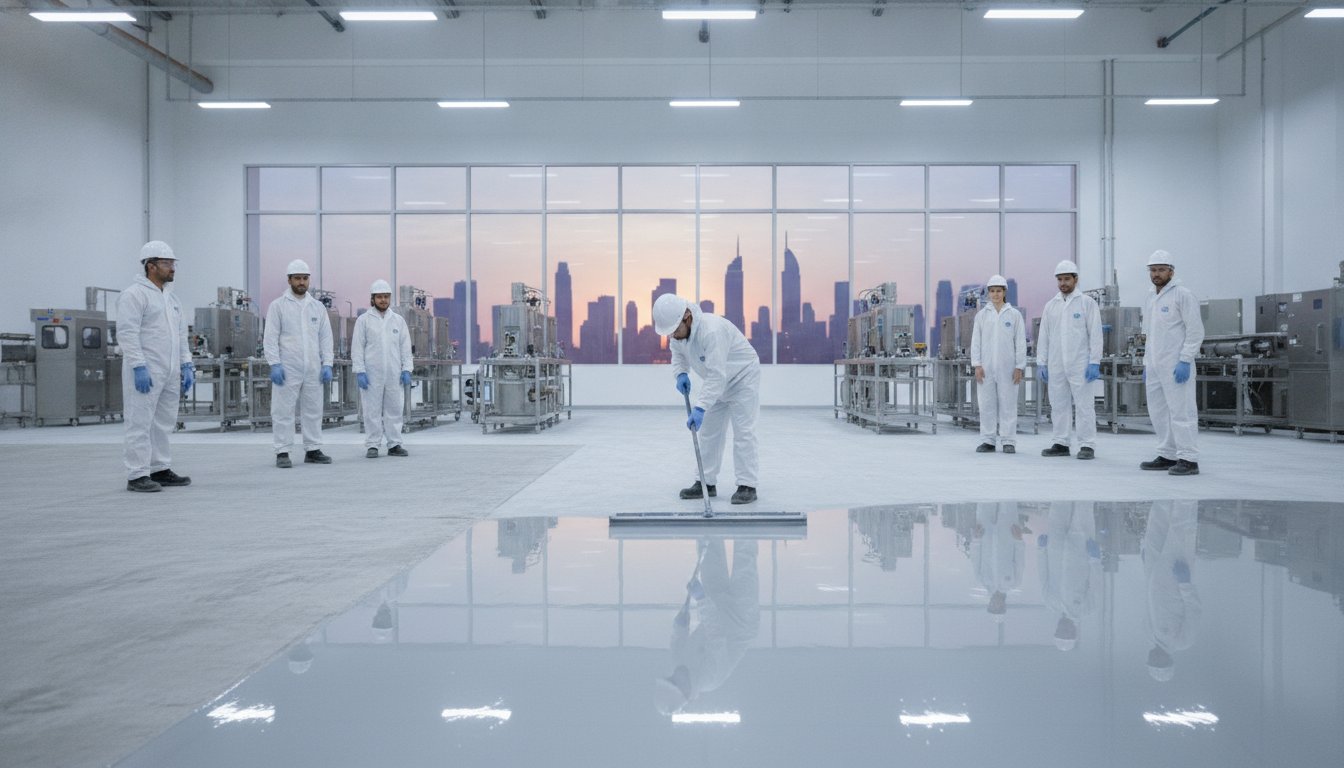
In the high-stakes industrial corridors of the UAE, your facility’s floor isn’t just a surface. It’s a critical component of your technical infrastructure that must endure 2026’s rigorous operational demands. We recognize that managing a facility in this region involves battling unique environmental pressures, from extreme humidity that triggers premature delamination to the constant threat of concrete corrosion from aggressive chemical spills. You shouldn’t have to settle for frequent operational downtime or dusting that compromises your inventory quality. As an authorized Terraco applicator with over 30 years of regional experience, we understand that durability in this climate requires more than just a standard application.
This 2026 industrial guide provides the technical roadmap to select and install high-performance chemical resistant flooring dubai that thrives in extreme environments. We’ll show you how to achieve a seamless, chemically inert surface that meets every Dubai Municipality HSE standard and aligns with the latest Green Building Regulations. By focusing on the integration of climate-engineered resins and precision mechanical preparation, we’ll help you secure a long-term ROI through reduced maintenance and improved facility safety. We’ll also examine how the updated 2026 contractor rating systems influence your selection process to ensure your project remains in expert hands.
Key Takeaways
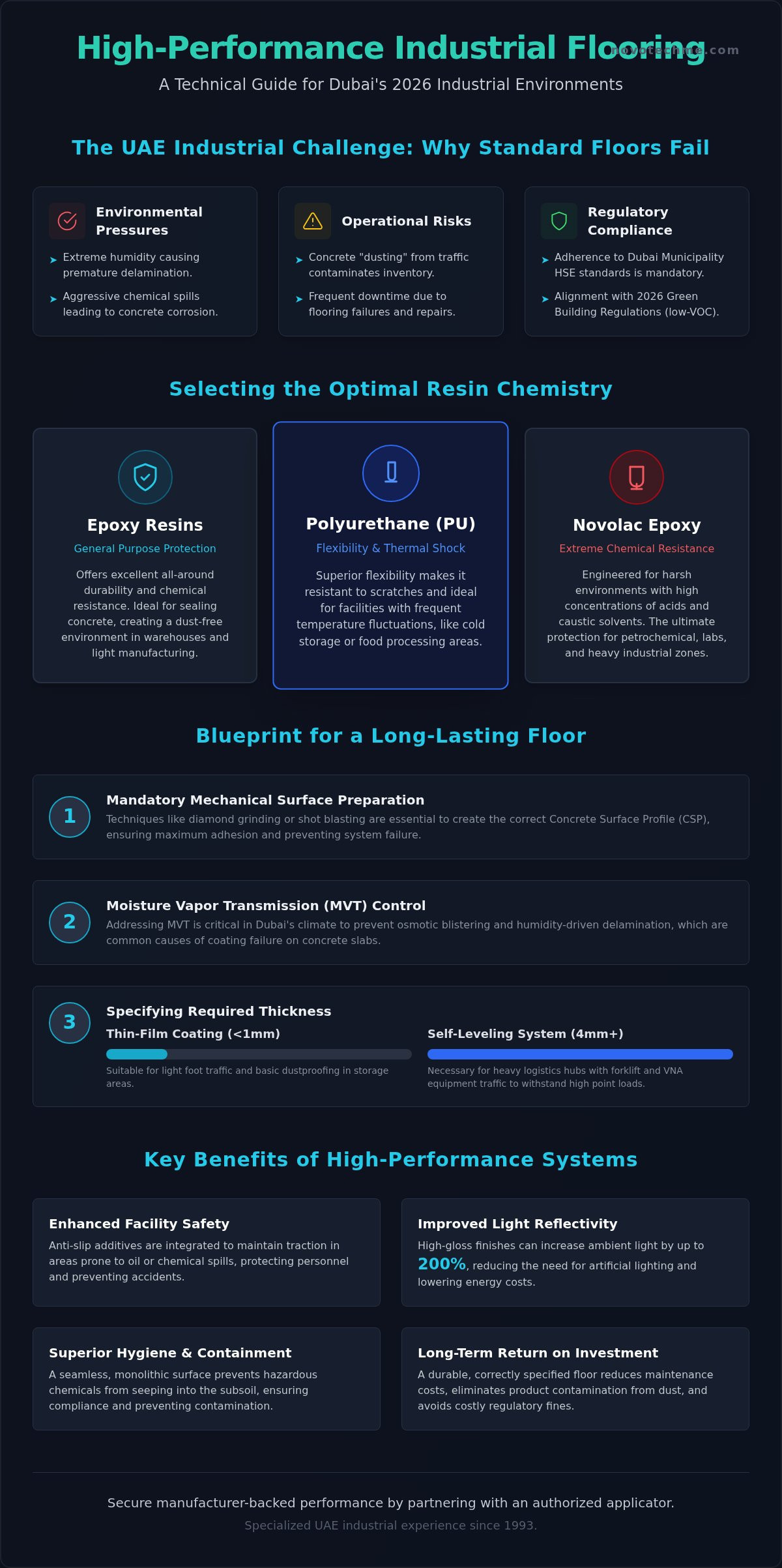
- Identify the optimal resin chemistry, whether Epoxy, Polyurethane, or Novolac, to match your facility’s specific chemical exposure and load requirements.
- Mitigate the risks of osmotic blistering and humidity-driven delamination when installing chemical resistant flooring dubai by addressing Moisture Vapor Transmission in concrete slabs.
- Ensure long-term system adhesion by implementing mandatory mechanical surface preparation techniques like diamond grinding or shot blasting to achieve the required Concrete Surface Profile.
- Maintain full compliance with 2026 Dubai Municipality HSE standards and Green Building Regulations through the selection of low-VOC, high-performance protective systems.
- Secure manufacturer-backed performance by partnering with an authorized Terraco applicator that brings over 30 years of specialized UAE industrial experience.
Why Chemical Resistant Flooring in Dubai is Essential for Industrial Safety
Industrial facilities in Dubai operate under rigorous conditions where standard concrete surfaces quickly fail. We define high-performance chemical resistant flooring as specialized resin systems engineered to withstand prolonged exposure to caustic solvents, acids, and alkalis. These systems provide a chemically inert barrier, protecting the structural integrity of the facility from corrosive agents. In sectors like petrochemicals, pharmaceuticals, or food processing, installing chemical resistant flooring dubai isn’t merely an aesthetic choice; it’s a fundamental safety requirement that protects the asset for decades.
Seamless flooring plays a vital role in maintaining hygiene and preventing subsoil contamination. Unlike tiled surfaces with porous grout lines, resinous coatings create a monolithic layer that prevents hazardous chemicals from seeping into the ground. This containment is critical for compliance with Dubai Municipality HSE standards, especially in highly regulated zones like JAFZA and Dubai South. Our experience since 1993 has shown that failing to secure these surfaces often leads to costly environmental remediation projects and regulatory fines that far exceed the initial cost of a protective system.
The Impact of Concrete Dusting on Warehouse Operations
Untreated concrete is naturally porous and prone to “dusting.” This occurs when the surface of the concrete wears down under the weight of heavy forklift traffic, creating fine particulate matter that remains suspended in the air. This dust settles on sensitive electronic components and high-value inventory, often leading to equipment failure or product rejection. By utilizing Epoxy resins or polyurethane coatings, we seal the substrate, creating a dust-free environment that protects both automated machinery and employee respiratory health in enclosed warehouse spaces.
Enhancing Facility Safety and Light Reflectivity
Safety extends beyond chemical containment. High-gloss finishes on industrial floors can increase ambient light levels by up to 200%. This improved light distribution reduces the need for additional electrical lighting in large-scale logistics hubs, directly impacting energy efficiency and reducing operational overhead. We also integrate anti-slip additives into these coatings to maintain traction in areas prone to oil or chemical spills. This precision-engineered approach ensures that the facility remains safe, bright, and compliant with modern industrial standards while providing a high-performance surface for daily operations.
Selecting the Right Specification for Chemical Resistant Flooring in Dubai
Specifying the correct resin chemistry is the most critical decision in the lifecycle of an industrial floor. While standard epoxy systems offer excellent general-purpose protection, specific environments require more specialized formulations. For instance, Polyurethane (PU) systems provide superior flexibility and thermal shock resistance, making them ideal for facilities with frequent temperature fluctuations. In contrast, Novolac epoxy systems are engineered for high-acid environments where traditional resins would degrade. In food production zones, we ensure all installations align with FDA flooring regulations, focusing on nonabsorbent, smooth surfaces that facilitate rigorous sanitization protocols.
Determining the required thickness is equally vital for long-term performance. Thin-film coatings, typically under 1mm, are suitable for light foot traffic and dustproofing. However, for heavy logistics hubs in Dubai, we specify 4mm+ self-leveling systems. These thicker applications are necessary to achieve the Compressive Strength and Shore D Hardness required to withstand the high point loads of reach trucks and Very Narrow Aisle (VNA) equipment. Selecting an inadequate thickness often results in premature cracking and substrate exposure under heavy mechanical stress.
Self-Leveling vs. Mortar Systems for High-Traffic Zones
Self-leveling epoxy creates a perfectly seamless, high-gloss finish that’s essential for distribution centers requiring high hygiene standards and easy maintenance. When we encounter environments subject to extreme mechanical impact, such as heavy engineering bays, we transition to epoxy mortar systems. These trowel-applied resins incorporate graded aggregates to provide exceptional durability against dropped tools and heavy machinery. Achieving a perfectly flat floor is paramount for high-reach warehouse operations; even a minor deviation can cause significant safety risks when operating at full mast heights. For a technical assessment of your facility’s specific load requirements, our team at NovoTech provides expert specification consulting tailored to the UAE’s industrial landscape.
Specialized ESD and Anti-Static Flooring for Tech Hubs
Dubai’s expansion into technology manufacturing and data centers has increased the demand for electrostatic discharge (ESD) protection. Conductive flooring systems utilize a specialized carbon-filled primer and copper grounding tapes to safely dissipate static electricity into the building’s earthing system. This prevents catastrophic damage to sensitive electronic components and reduces the risk of fire in explosive environments. For electronic component manufacturing in the UAE, ESD flooring must maintain a consistent resistance range between 1.0 x 10^4 and 1.0 x 10^9 ohms to ensure operational safety and product integrity.
The Dubai Climate Challenge: Overcoming Heat and Humidity
Dubai’s environmental profile presents a significant engineering challenge for industrial coatings. High ambient temperatures and extreme humidity levels, particularly in coastal zones or low-lying areas, accelerate Moisture Vapor Transmission (MVT) through concrete slabs. When moisture from the subsoil moves upward, it creates hydrostatic pressure beneath the floor’s surface. If a non-breathable resin is applied without proper mitigation, this pressure results in osmotic blistering, effectively detaching the coating from the substrate. Selecting the right chemical resistant flooring dubai requires a technical understanding of when to specify breathable cementitious urethane systems versus traditional non-breathable epoxies.
Thermal shock is another critical factor for facility managers to consider. Facilities such as cold storage units or processing areas adjacent to loading docks experience rapid temperature swings. These fluctuations cause the concrete and the coating to expand and contract at different rates. Without high thermal stability, the floor will crack or delaminate under the strain. Additionally, semi-exposed industrial bays require UV-stable topcoats to prevent yellowing or chalking. This ensures the surface remains compliant with National Floor Safety Institute standards for long-term visibility and operational safety.
Managing Thermal Expansion in Large Industrial Slabs
Large-scale industrial slabs are dynamic structures that require precise engineering. In the Middle East, rigid flooring systems often fail because they can’t accommodate the structural movement caused by extreme diurnal temperature shifts. We prioritize the use of flexible joint sealants that move with the slab, preventing stress cracks from migrating through the finished surface. Our approach to structural renovation involves meticulous joint treatment and maintenance, ensuring the floor’s integrity isn’t compromised by the natural expansion of the building’s footprint during peak summer months.
Moisture Vapor Barriers and Waterproofing Integration
A robust Damp Proof Membrane (DPM) is a non-negotiable requirement for ground-bearing industrial slabs in the UAE. Before we begin any resin application, we perform rigorous moisture testing using ASTM F1869 or F2170 protocols to quantify the moisture emission rate. If levels exceed manufacturer specifications, we integrate specialized moisture barriers to neutralize the risk of failure. This integrated approach is why we’re recognized among the expert waterproofing companies in Dubai, providing end-to-end protection that extends from the sub-base to the final chemical-resistant finish.
The Professional Installation Blueprint: Precision and Efficiency
Precision installation is the differentiator between a coating that lasts and one that fails within months. Mechanical surface preparation is mandatory to ensure the long-term adhesion of chemical resistant flooring dubai. Without this step, even the most advanced resin systems will eventually delaminate. We evaluate the required Concrete Surface Profile (CSP) based on the specified resin thickness. For thin-film coatings, a CSP 2 achieved through diamond grinding is often sufficient. However, heavy-duty 4mm+ systems require a CSP 3 to 5, typically achieved through shot blasting, to create the necessary surface area for a permanent bond.
The application sequence follows a methodical, multi-layer process designed for maximum durability. It begins with a high-penetration primer that seals the concrete pores and prevents outgassing. This is followed by a base coat and, depending on the specification, an intermediate broadcast of silica to enhance impact resistance. The process concludes with a high-performance topcoat engineered to resist specific chemical exposures. This structured approach ensures every layer serves a technical purpose, from substrate protection to final aesthetic finish.
Mechanical Preparation: Diamond Grinding vs. Shot Blasting
Diamond grinding is our preferred method for removing surface laitance and smoothing minor imperfections in the concrete. It uses rotating diamond-segmented heads to shave the surface, providing a clean substrate for thin-film applications. Shot blasting, conversely, uses high-velocity steel pellets to strip away old coatings and contaminants, exposing the aggregate for a “welded” bond. Both methods utilize dust-free vacuum systems, which are essential for protecting sensitive inventory and maintaining air quality in active warehouse environments. Creating this mechanical “key” is the only way to guarantee the resin won’t lift under the stress of heavy forklift traffic.
Safety Demarcations and Operational Continuity
Integrating safety markings during the final coating phase is a strategic way to minimize facility downtime. We apply high-visibility, chemical-resistant epoxy paint to define permanent aisle markings, pedestrian walkways, and hazard zones. This ensures your facility remains compliant with Dubai Municipality safety regulations without the need for frequent repainting. To maintain your production schedule, we often implement phased installations, allowing your team to remain partially operational while we renovate specific zones. This meticulous planning mirrors our approach to applying anti-corrosive paint in the UAE for critical infrastructure. For a customized installation blueprint that aligns with your operational timeline, contact our technical team at NovoTech for a professional site assessment.
The NovoTech Advantage: Authorized Terraco Application and 30 Years of Expertise
Since 1993, we’ve remained at the forefront of the UAE’s industrial evolution, providing specialized protective systems that safeguard critical infrastructure. Choosing an authorized Terraco applicator is a strategic decision that extends beyond simple procurement. It ensures your chemical resistant flooring dubai is backed by manufacturer-certified performance and direct technical support. This level of oversight is vital for large-scale projects where structural integrity and regulatory compliance are non-negotiable. Our 30-year history allows us to provide a level of quiet competence that reassures corporate clients their complex technical needs are in expert hands.
We pride ourselves on integrated excellence, offering a comprehensive service model that encompasses structural renovation, waterproofing, and high-performance coatings. This approach provides our clients with single-point responsibility, eliminating the risks associated with managing multiple subcontractors. By taking total ownership of the project lifecycle, we ensure that every technical justification aligns with the long-term strategic goals of the facility, delivering a superior ROI through precision and durability.
Terraco Systems: Engineered for the Middle East
Terraco’s advanced resin technology is specifically engineered to withstand the Middle East’s high-ambient-heat zones. While generic resins might soften or lose their chemical resistance when exposed to elevated temperatures, Terraco systems maintain their Shore D hardness and compressive strength. We utilize manufacturer-specified primers tailored for high-porosity concrete slabs, ensuring the system achieves a deep, permanent bond. To understand how these specialized resins fit into a broader facility maintenance plan, explore our comprehensive guide on Epoxy Floor Coating in the UAE.
Operational Continuity for Large-Scale Projects
Executing complex renovations in high-traffic logistics hubs like JAFZA requires a partner who understands the value of time. We specialize in managing large-scale projects without compromising your operational continuity. Our team utilizes rapid-curing resin options for critical zones like loading docks and main corridors, significantly reducing the window of operational downtime. This efficiency is a hallmark of our service model, reflecting a deep-seated commitment to precision and the technical lifecycle of Dubai’s industrial assets. We don’t just deliver a floor; we provide a durable technical asset that supports your facility’s long-term growth and safety standards.
Securing Your Facility’s Industrial Future
Your industrial floor is more than a surface; it’s a strategic asset that dictates the safety and efficiency of your entire operation. By prioritizing precise resin specifications and addressing the technical challenges of the UAE’s high-humidity environment, you ensure long-term operational longevity. Implementing chemical resistant flooring dubai with a focus on mechanical adhesion and moisture mitigation prevents the costly downtime associated with delamination and substrate corrosion.
As an Authorized Terraco Applicator with over 30 years of UAE industrial expertise, we specialize in high-performance protective coatings designed for the region’s extreme conditions. We combine structural renovation and technical precision to deliver results that exceed local HSE standards. Don’t leave your facility’s integrity to chance when you can partner with a team that understands the regional context of industrial maintenance. We’re ready to help you optimize your facility’s performance and safety. Request a Technical Consultation for Your Industrial Flooring today to begin your structural transformation.
Frequently Asked Questions
How long does chemical resistant flooring last in a typical Dubai warehouse?
A professionally installed system typically lasts between 10 to 15 years depending on the intensity of chemical exposure and mechanical traffic. In the UAE’s climate, durability is heavily influenced by the quality of the initial substrate preparation and moisture mitigation. Regular maintenance and prompt spill cleanup can extend this lifecycle significantly. We leverage our three decades of regional experience to specify systems that withstand these specific environmental pressures without premature failure.
Can chemical resistant epoxy be applied over old or oil-stained concrete?
Application over old concrete is possible provided the substrate undergoes rigorous mechanical preparation. We use shot blasting or diamond grinding to remove the top layer of contaminated concrete, exposing a clean, porous surface. If oil penetration is deep, specialized oil-tolerant primers are required to ensure a permanent bond. Without these technical steps, any new coating will likely fail due to poor adhesion caused by residual surface contaminants that prevent the resin from bonding.
What is the difference between standard epoxy and Novolac chemical resistant coatings?
Novolac coatings feature a higher cross-linking density compared to standard systems, providing superior resistance to concentrated acids and aggressive solvents. While standard epoxy is suitable for general warehouse use, Novolac is engineered for secondary containment and chemical processing areas. Choosing the right chemical resistant flooring dubai specification depends on the specific pH levels and temperatures of the chemicals used within your facility to prevent structural degradation and ensure long-term containment.
How long is the curing time before a warehouse floor can return to full forklift traffic?
Most industrial resin systems require 24 hours for light foot traffic and 48 to 72 hours for light mechanical loads. However, a full chemical and mechanical cure typically takes 7 days in Dubai’s climate. Operating heavy forklift or VNA equipment before this period can lead to permanent surface indentations or bond failure. We provide precise curing schedules based on the specific resin chemistry and the ambient humidity levels at your site to ensure operational safety.
Is chemical resistant flooring suitable for cold storage facilities in the UAE?
Specialized polyurethane and cementitious urethane systems are ideal for cold storage because they withstand thermal shock better than rigid epoxies. These floors remain flexible at sub-zero temperatures, preventing cracks when the facility undergoes washdowns with hot water. We specify these systems for logistics hubs in Dubai South and JAFZA to ensure the floor maintains its integrity despite the extreme temperature differentials between the storage zones and loading bays during peak summer months.
What are the maintenance requirements for industrial resin flooring?
Maintenance is straightforward but essential for long-term ROI. Daily cleaning should involve dust mopping to remove abrasive grit, followed by a damp mop using a pH-neutral detergent. You must avoid using harsh abrasive pads that can dull the high-gloss finish or compromise the chemical-resistant topcoat. For large-scale facilities, we recommend using automatic floor scrubbers with soft brushes to maintain the surface’s hygiene and light reflectivity without damaging the protective resin layers.
Does chemical resistant flooring help with light reflectivity and energy efficiency?
High-gloss resin finishes significantly enhance ambient light levels by reflecting up to 200% more light than dull, unfinished concrete. This improvement allows facility managers to reduce the number of active light fixtures or lower the wattage of their LED systems, leading to measurable energy savings. In large distribution centers, this increased visibility also enhances employee safety by clearly illuminating aisle markings and potential hazards throughout the warehouse floor during night shifts.
What are the specific safety requirements for industrial flooring in Dubai Municipality?
Dubai Municipality mandates compliance with Health, Safety, and Environmental (HSE) standards, including the use of low-VOC materials as per the Dubai Green Building Regulations and Specifications (DGBRS). Industrial floors must provide adequate slip resistance, particularly in wet or oily zones, to meet fire safety and workplace hazard protocols. Our status as an authorized Terraco applicator ensures that every chemical resistant flooring dubai installation meets these rigorous local standards while providing manufacturer-backed technical documentation.