A single regulatory oversight on a UAE high-rise project can now result in penalties as high as AED 2,000,000 under the stringent 2026 building safety laws. We recognize that for building owners and facility managers, the pressure to maintain vertical assets is often weighed against the fear of workplace accidents and the complexity of shifting Dubai Municipality mandates. It’s a challenging environment where technical precision is the only path to project success.
This guide ensures you master the high rise painting safety standards UAE authorities require for 2026, moving your operations from simple compliance to a model of integrated excellence. We’ll provide a technical analysis of IRATA-certified rope access versus cradle systems, the implications of new digital inspection platforms, and how specialized protective coatings like Terraco ensure long-term structural integrity. You’ll gain the clarity needed to execute large-scale painting projects with zero accidents and absolute regulatory confidence, positioning your organization as a leader in safety and quality.
Key Takeaways
- Identify the specific regulatory mandates from Dubai Municipality and MOHRE to navigate the 2026 legal landscape and avoid significant financial liabilities.
- Understand why IRATA and IPAF certifications are the required benchmarks for personnel safety and how they mitigate risk on complex vertical projects.
- Evaluate the technical differences between rope access and cradle systems to ensure your project adheres to the high rise painting safety standards UAE authorities mandate.
- Master the environmental thresholds for wind speed and heat exposure that dictate safe operational windows in the unique Middle Eastern climate.
- Learn how to align safety compliance with the application of high-performance systems like Terraco to ensure both worker protection and long-term asset preservation.
The UAE Regulatory Framework for High-Rise Painting Operations
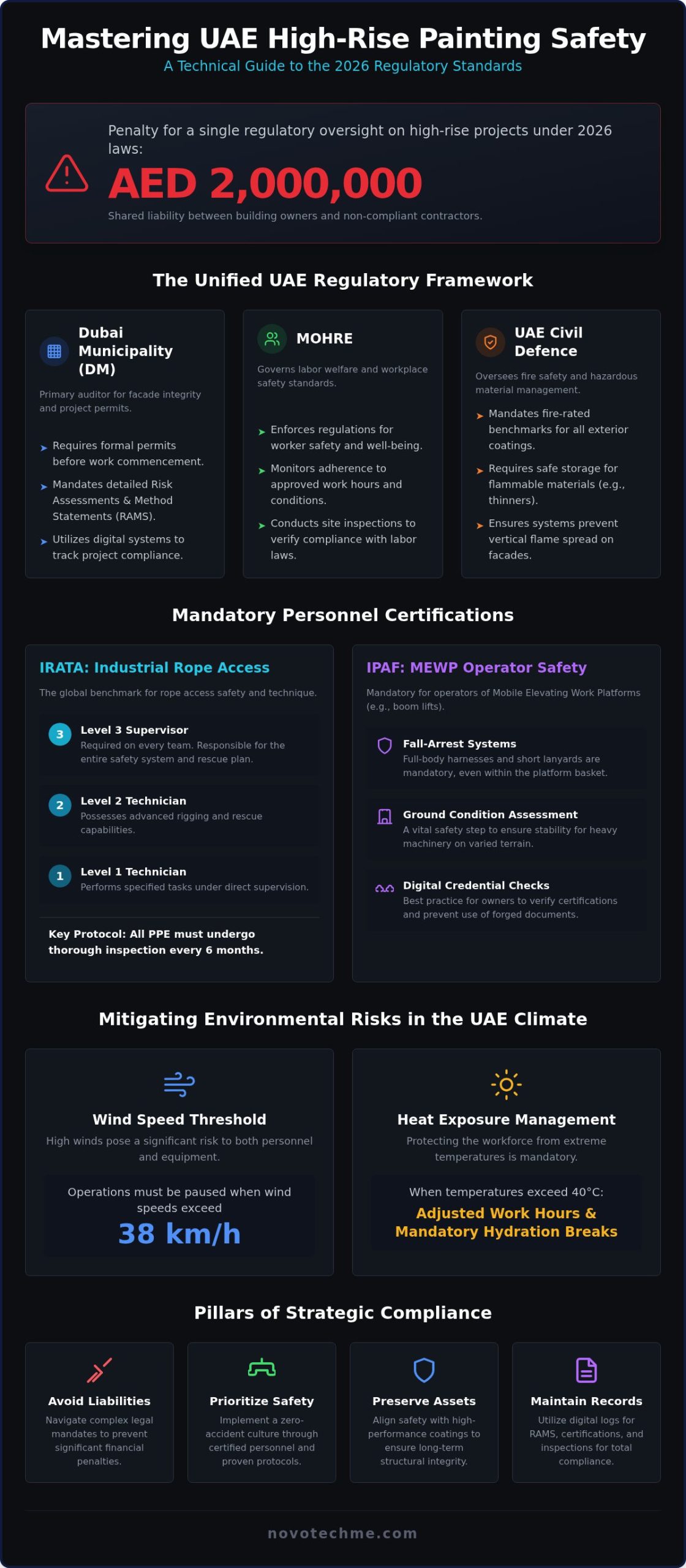
Compliance in the UAE is no longer a simple checklist; it’s a rigorous legal imperative. The 2026 regulatory landscape, anchored by Dubai Law No. (3) of 2026, centralizes oversight under the Dubai Municipality (DM). While the DM governs building quality and safety, the Ministry of Human Resources and Emiratisation (MOHRE) regulates labor welfare, and the UAE Civil Defence oversees fire safety and hazardous material storage. Adhering to high rise painting safety standards UAE requires a unified approach across these three pillars. Failure to select a certified contractor leads to shared liability, with fines for non-compliance reaching up to AED 2,000,000 for repeat offenses.
Dubai Municipality (DM) Compliance Codes
DM serves as the primary auditor for facade maintenance and structural integrity. Every project requires a formal permit before work begins. This process involves submitting detailed Risk Assessments and Method Statements (RAMS) that outline the specific Rope access techniques or cradle systems to be used. DM inspectors now utilize a digital building management system to track compliance throughout the project lifecycle. To maintain project momentum, we ensure all documentation is digitally logged, including:
- Valid contractor classification under Dubai Law No. 7 of 2025.
- Approved facade access permits.
- On-site RAMS and daily safety logs.
- Third-party equipment certification records.
Civil Defence and Fire Safety Standards
Fire safety is critical when applying exterior systems. UAE Civil Defence mandates that all exterior paint and cladding systems meet specific fire-rating benchmarks to prevent vertical flame spread. This is especially relevant when applying specialized protective systems like Terraco. Safe storage is equally vital. Highly flammable materials, such as thinners and solvent-based paints, must be stored in ventilated, fire-rated cabinets on-site. Our operational history allows us to implement the high rise painting safety standards UAE inspectors expect, ensuring zero-accident project execution and total regulatory alignment. This integrated approach protects both the workforce and the building’s structural reputation.
Mandatory Personnel Certifications: IRATA and IPAF Standards
High-altitude painting in the UAE demands more than technical skill; it requires verified competency. International certifications serve as the baseline for all high-rise projects to ensure adherence to Mandatory Personnel Certifications and global safety protocols. Third-party training providers in the region, accredited by international bodies, bridge the gap between theoretical knowledge and the specific rigors of the Middle Eastern climate. Every high-rise site must employ a dedicated Safety Officer whose sole responsibility is the continuous monitoring of these standards. Verification is critical. It’s best practice for building owners to demand digital credential checks or QR code scans for all technicians to prevent the use of forged or expired documentation.
IRATA Certification for Industrial Rope Access
IRATA is the premier standard for rope access. Technicians are classified into three levels. Level 1 technicians perform specific tasks under supervision, while Level 2 technicians possess more advanced rigging and rescue skills. Every rope access team must be led by a Level 3 Supervisor. This individual is responsible for the entire safety system and rescue plan. Equipment logs are non-negotiable. All personal protective equipment (PPE) must undergo thorough inspections every six months to remain compliant with high rise painting safety standards UAE protocols. This rigorous cycle ensures every harness and carabiner is fit for purpose.
IPAF and MEWP Operator Safety
While rope access is common, many projects utilize Mobile Elevating Work Platforms (MEWPs). IPAF certification is mandatory for operators of boom lifts and telescopic platforms. In urban environments like Dubai, ground condition assessments are a vital safety step. Heavy machinery requires stable, level surfaces, which can be challenging on sandy or uneven terrain. Operators must also utilize specific fall-arrest systems, including full-body harnesses and short lanyards, even when inside the platform basket. This multi-layered approach to safety is what defines a professional operation. Partnering with exterior high rise building painting experts ensures that all personnel meet these strict international benchmarks.
Technical Standards for Height Access Equipment
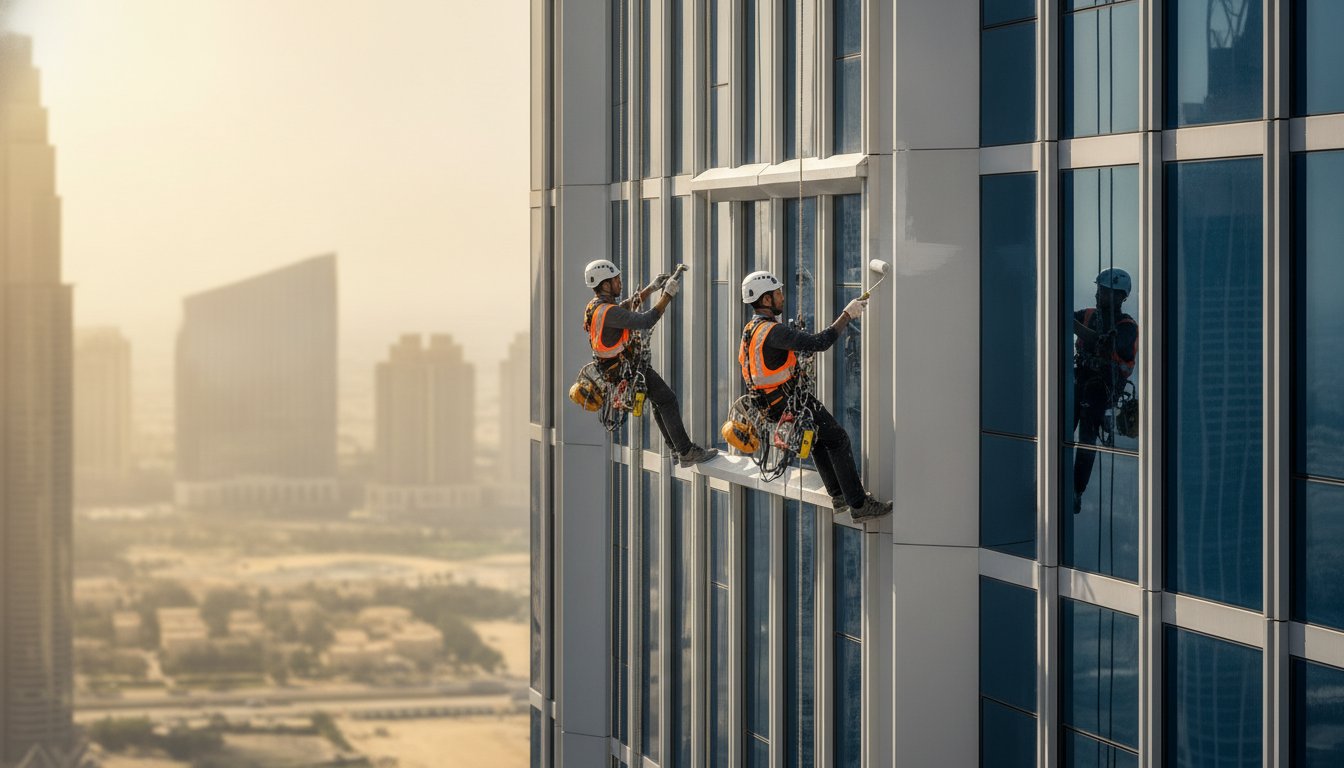
Modern high-rise projects across the Dubai skyline have largely transitioned away from traditional scaffolding to adopt more sophisticated height access systems. This shift is a direct response to the rigorous high rise painting safety standards UAE authorities mandate to preserve structural integrity and worker safety. While rope access offers superior agility for complex architectural facades, permanent Building Maintenance Units (BMUs) provide a stable solution for repetitive maintenance cycles. Mobile Elevating Work Platforms (MEWPs) offer a versatile alternative for structures with accessible ground-level footprints. We conduct a thorough technical evaluation of every building’s geometry before recommending the specific access methodology that minimizes risk and maximizes efficiency.
Daily operational safety begins with a comprehensive pre-start inspection protocol. Every morning, on-site supervisors must verify the following items before any technician ascends:
- The structural integrity of wire ropes and the functionality of hoist mechanisms on cradles.
- Hydraulic fluid levels, battery health, and tire pressure for all powered platforms.
- The security of fall-arrest anchors and the absence of corrosion on primary connectors.
- The operational status of emergency stop buttons and secondary descent mechanisms.
Suspended Access Equipment (Cradles/BMUs)
Cradles and BMUs require strict adherence to Standard Operating Procedures (SOPs) to prevent platform instability. A common compliance failure involves exceeding the load capacity by storing excessive paint materials on the platform; this practice can compromise the secondary safety brake. Redundant safety lines, completely independent of the primary hoist, are non-negotiable. These lines must be securely attached to a secondary roof-level anchor point to allow for safe emergency descent if the primary power or hoist system fails. Regular third-party recertification of these permanent units ensures they remain aligned with Dubai’s strict safety codes and operational requirements.
Powered Access Solutions (MEWPs)
Selecting the appropriate powered machinery is contingent upon the specific building geometry and urban constraints. Articulating booms provide the necessary reach to access recessed balconies and complex overhangs, whereas telescopic booms are preferred for sheer vertical extensions on flat facades. Beyond machine operation, managing the surrounding environment is critical for public safety. Contractors must establish clear physical exclusion zones to protect pedestrians and traffic from potential “drop zones” below the work area. Identifying overhead hazards, such as signage or structural projections, is a mandatory component of our daily risk assessment. This disciplined approach ensures heavy machinery integrates safely into the dense urban fabric of Dubai.
Mitigating Environmental Risks in the UAE Climate
Environmental variables in the Middle East aren’t just logistical hurdles; they’re critical safety parameters that dictate project viability. Adhering to high rise painting safety standards UAE regulators enforce requires a deep understanding of how extreme heat and wind turbulence affect human physiology and mechanical integrity. In 2026, the Ministry of Human Resources and Emiratisation (MOHRE) has intensified its focus on heat stress. This makes Wet Bulb Globe Temperature (WBGT) monitoring a mandatory practice alongside the traditional midday work ban. We integrate these environmental checks into our daily risk assessments so that technical precision is never compromised by climate-driven hazards.
The UAE’s unique geography also introduces atmospheric challenges like sandstorms and high saline humidity. Sand ingress can compromise the internal mechanisms of pulleys and descenders. High humidity accelerates the oxidation of metal anchor points. Our protocols mandate that all height access equipment is cleaned and inspected for grit or corrosion after every shift. This meticulous attention to detail prevents equipment failure and maintains the structural reputation of the assets we service.
Wind and Turbulence Management
Wind speed is the primary factor for suspending high-rise operations. While ground-level conditions may seem calm, wind speeds at 200 meters can be significantly higher. We utilize digital anemometers mounted directly on the facade to get real-time data. In skyscraper clusters like Dubai Marina, the Venturi Effect can funnel and accelerate wind between towers, creating unpredictable lateral forces. Operations must cease if gusts exceed 25 km/h for rope access or 35 km/h for cradles. All tools and paint containers must be tethered to the technician or the platform using rated lanyards to prevent high-velocity falling objects. This prevents accidental drops that could endanger pedestrians in dense urban zones.
Summer Operational Safety
Between June 15 and September 15, the mandatory midday break from 12:30 PM to 3:00 PM is strictly observed. To maintain project timelines without risking heat stroke, we often shift operational hours to early morning or late afternoon windows. PPE selection is a technical balance. Technicians require full-body protection from UV rays, yet the fabric must be highly breathable to allow for thermoregulation. UV degradation is a silent risk. Prolonged exposure to intense sunlight can weaken the synthetic fibers of ropes and safety harnesses. We implement a rigorous retire-early policy for any textile-based safety gear showing signs of UV-related discoloration or brittleness. To ensure your project remains compliant with the latest climate-specific safety mandates, partner with our exterior building painting services team for expert project management.
Strategic Compliance: Protecting Assets and Reducing Liability
Safety protocols on a vertical project serve a purpose beyond immediate worker protection; they are a fundamental driver of asset longevity. Adherence to high rise painting safety standards UAE regulators enforce ensures that technical tasks, such as surface preparation and coating application, occur in a controlled and stable environment. When technicians operate from secure, vibration-free platforms or properly rigged lines, the resulting finish is more uniform and durable. This methodical approach prevents the structural damage often caused by improper rigging or the use of uncertified access equipment that can mar sensitive facade materials.
Integrating anti-corrosive paint uae systems into your maintenance cycle provides a dual layer of protection. While the coating shields the substrate from the UAE’s high-salinity air, the rigorous safety framework protects the building’s reputation and financial value. Before any project commences, we recommend a comprehensive facade safety audit. This assessment identifies existing structural vulnerabilities and ensures the chosen access strategy aligns with the building’s specific load-bearing capacities and geometry.
The NovoTech Approach to High-Rise Excellence
We leverage over 30 years of operational history in the Emirates to navigate the regional bureaucracy and shifting legal landscape. Our team doesn’t just meet the baseline; we actively define exterior building painting dubai standards through a commitment to integrated excellence. As an authorized Terraco applicator, we combine high-performance material science with technical precision. We take total project ownership, managing every regulatory permit and safety requirement so that the compliance burden never rests on the client’s shoulders.
Risk Management for Property Managers
For property managers, reducing liability is a strategic priority. It’s essential to verify that your contractor maintains robust Professional Indemnity and Workmen’s Compensation insurance specifically rated for high-altitude work. These safeguards, paired with our zero-accident execution model, provide the peace of mind necessary for large-scale renovations. By choosing a partner that offers end-to-end responsibility, you ensure that every phase of the project, from the initial risk assessment to the final inspection, is documented and compliant. Consult with NovoTech for a compliant high-rise painting strategy that secures your building’s structural and legal future.
Future-Proofing Your Vertical Assets
The 2026 regulatory environment in the UAE demands a transition from reactive maintenance to a model of proactive, integrated excellence. Mastering the high rise painting safety standards UAE authorities mandate is no longer just about avoiding penalties; it’s about the long-term preservation of your building’s structural and financial integrity. By aligning your project with certified IRATA and IPAF personnel, you ensure that technical precision remains constant even when facing the region’s extreme environmental variables. Precision is the baseline for success. Professional oversight and the application of high-performance systems don’t just protect workers; they safeguard your reputation as a responsible property owner.
Our operational history provides the technical depth required to manage these complex compliance burdens on your behalf. With 30+ years of UAE expertise and IRATA and IPAF compliant teams, we operate as a strategic extension of your own management group. As an authorized Terraco applicator, we deliver protective finishes that meet the highest international benchmarks. Secure Your High-Rise Asset with NovoTech’s Certified Safety Experts to ensure your next project is defined by zero-accident execution and total regulatory confidence. We’re ready to secure your building’s future.
Frequently Asked Questions
What are the legal requirements for high-rise painting in Dubai?
Dubai Law No. (3) of 2026 establishes the primary legal framework for building safety and maintenance. Contractors must obtain a formal facade access permit from the Dubai Municipality before starting any work. This process requires the submission of a detailed Risk Assessment and Method Statement (RAMS) and proof of valid contractor classification. Compliance ensures project legality and protects building owners from penalties that can reach AED 1,000,000 for initial safety violations.
Is IRATA certification mandatory for all high-rise painters in the UAE?
IRATA certification is the mandatory global benchmark for any technician performing industrial rope access on UAE high-rise buildings. Every operational team must be led by an IRATA Level 3 supervisor to manage safety protocols and rescue plans. While painters using cradles or powered lifts require different credentials like IPAF, those on ropes must maintain valid IRATA cards. This ensures all high rise painting safety standards UAE regulators expect are met with technical precision.
At what wind speed must high-rise painting work be stopped?
High-rise painting operations must be suspended when wind speeds exceed specific safety thresholds to prevent platform instability. For rope access technicians, work typically ceases when gusts reach 25 km/h. Cradle systems and Building Maintenance Units can often operate up to 35 km/h, depending on the manufacturer’s technical specifications. We use facade-mounted digital anemometers to monitor real-time turbulence, especially in high-density areas like Dubai Marina where the Venturi Effect creates unpredictable lateral forces.
How often should high-rise access equipment be inspected in the UAE?
Access equipment requires a dual-layered inspection cycle to ensure mechanical reliability. Technicians must perform a documented pre-operation check every morning before ascending to verify hoist integrity and safety line anchors. Additionally, all personal protective equipment and permanent cradle systems must undergo a thorough third-party certification every six months. This rigorous schedule is a core component of the high rise painting safety standards UAE authorities enforce to prevent equipment failure at height.
What is the role of Dubai Municipality in building painting projects?
Dubai Municipality acts as the primary regulatory and auditing body for all exterior building maintenance projects in the emirate. They issue the necessary facade access permits and conduct on-site audits to verify that contractors are following approved safety plans. Through their digital building management system, they track compliance across the building’s lifecycle. Their role ensures that every exterior renovation meets the high safety and quality benchmarks required for Dubai’s modern urban landscape.
Can traditional scaffolding be used for skyscrapers in the UAE?
Traditional scaffolding is generally prohibited for skyscrapers in the UAE due to the extreme heights and wind loads involved. Modern high-rise structures require more agile and secure solutions like rope access, suspended cradles, or powered boom lifts. These systems provide superior stability and safety for technicians working hundreds of meters above the ground. We prioritize these advanced access methods to maintain structural integrity and ensure a zero-accident project environment across all vertical assets.
What insurance coverage is required for exterior high-rise painting?
Contractors must maintain robust insurance coverage that specifically includes high-altitude operations. This includes Professional Indemnity and Workmen’s Compensation insurance to cover potential site accidents or technical liabilities. Property managers should also verify that the contractor carries adequate Public Liability insurance to protect against third-party damage. These financial safeguards are essential for large-scale renovations, providing an extra layer of security beyond the technical safety protocols implemented by the on-site team.
How does the UAE Midday Break law affect high-rise painting schedules?
The UAE Midday Break law mandates a daily work suspension from 12:30 PM to 3:00 PM between June 15 and September 15. This law significantly alters painting schedules, often pushing shifts to early morning or late afternoon to avoid peak thermal exposure. Additionally, the Ministry of Human Resources and Emiratisation requires Wet Bulb Globe Temperature monitoring to ensure worker safety during high-humidity periods. We adjust our project timelines to remain fully compliant with these seasonal labor regulations.